Tag Archives: clouds

We and the trees change over time.

I’ve returned from my short road trip, to the land of my childhood. I stayed with my sister two nights, and then switched to my brother’s place for two nights, which is the very house we all lived in for years, years that went by in a flash. I went away to college when I was eighteen and never lived at home again. Even though my brother has changed a lot of things, the “envelope” of the house our father built remains the same, and the giant oak tree still towers over the back yard.

It also has been pruned recently, its canopy made much more compact, and it looks great. I wandered around the property taking in everything, but I forgot to go back with my phone later to take pictures. I was too busy focusing on the people, my people, so I have found some older images of the countryside and people that I visited, to illustrate my musings.

Wall art that has seen better days, and that we “let go.”

The day before I started out on this journey, I was glad to feel the leavinghomesickness depart and be replaced with happy anticipation at the meetings I would soon have. Just being with these dear ones and also talking about the experiences we’ve shared over the decades has filled me to the brim with thoughts and feelings I don’t think I will be able to sort out. 

Nostalgia is a “sentimental longing for the past,” so it’s not that I’m feeling, but just plain wonderment at all the days and years of my life so far. I would not go back in time, and I know those times were not ideal, but looking back I am amazed at how wholesome they were. I was blessed to live through them with several people who remain, and still care about me, which is all a great gift.
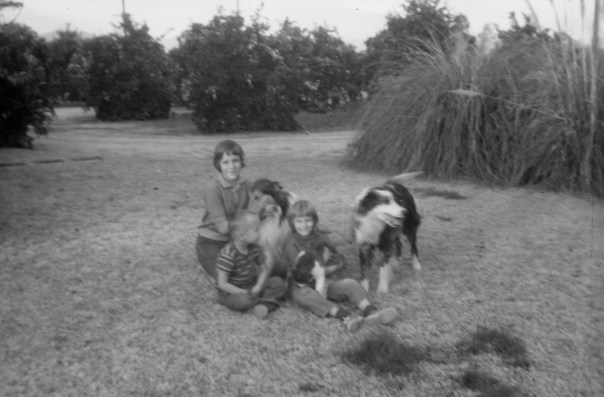
The picture and the memory are blurry, but solid.

Over the course of four days, I had long visits and conversations with twenty people, counting the six little children who are my nieces and nephews; four of those children I hadn’t met before. I saw both of my sisters and my brother, and their spouses, and children’s families. Various of us told stories that others of us had never heard, from the distant past or from relatively recently.

I had lunches with three friends, one of whom I’ve known since first grade, and two since about eighth grade; between bites we fell into telling anecdotes about each other’s mothers, may God bless their memory!

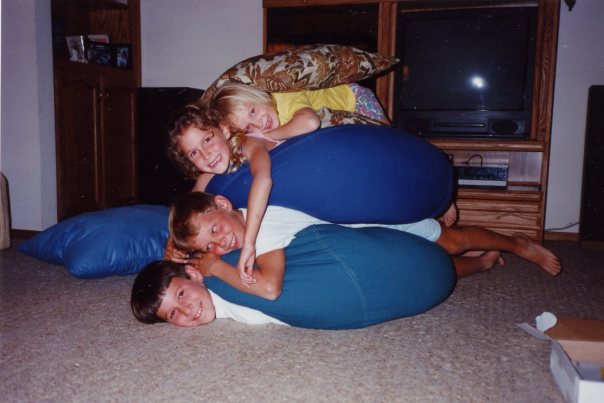
The linoleum floor of our childhood has since been replaced.
cousins
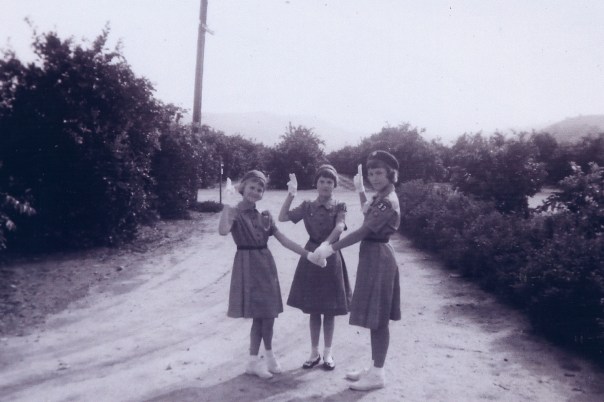
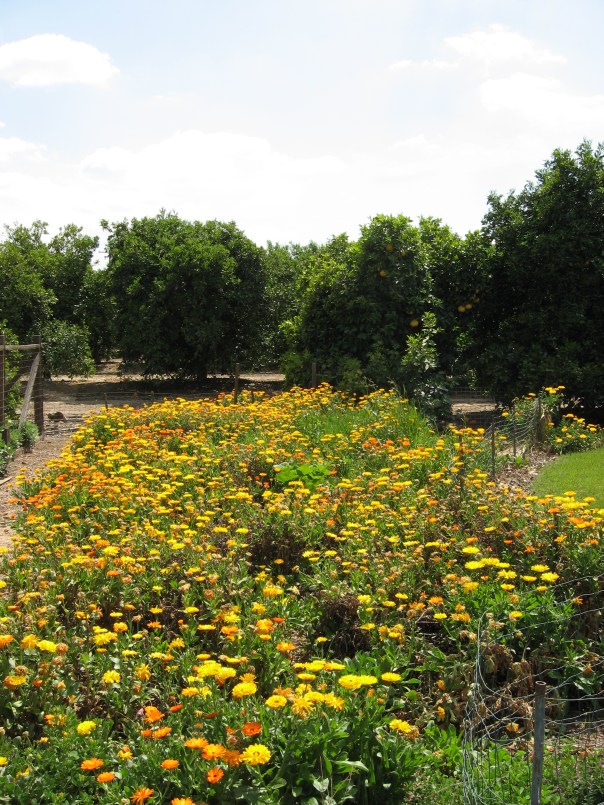
We were small Brownies, and the orange trees and rosebushes were small, too.

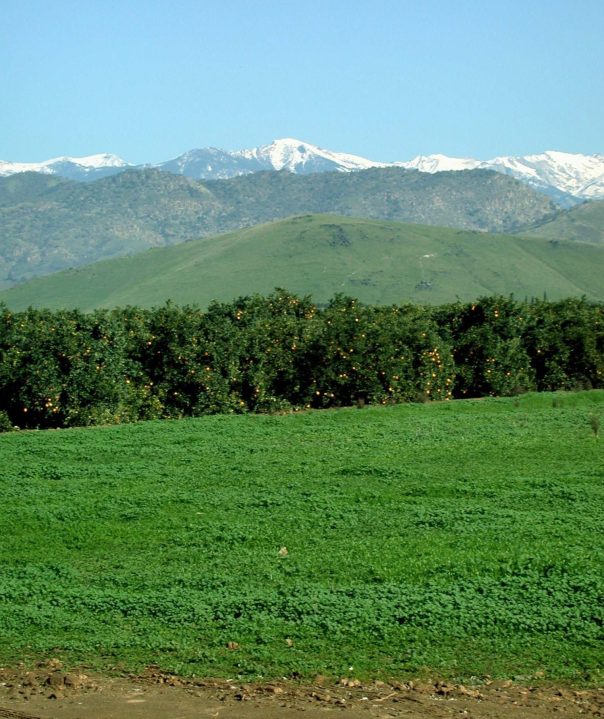
As I drove back and forth through the orange groves between town and country, I restrained myself from stopping as often as I’d have liked to, to take pictures of the hills and the orange trees. It had just rained, and the mountain peaks were dusted with snow, but the hills are still showing golden and not green. The picture below was taken by my sister Nancy some years ago, later in the season.
When rain clouds are gathering and precipitating and rearranging themselves all over again, it is like watching a huge theater screen from my private box (my car), as I’m driving down the interstate.
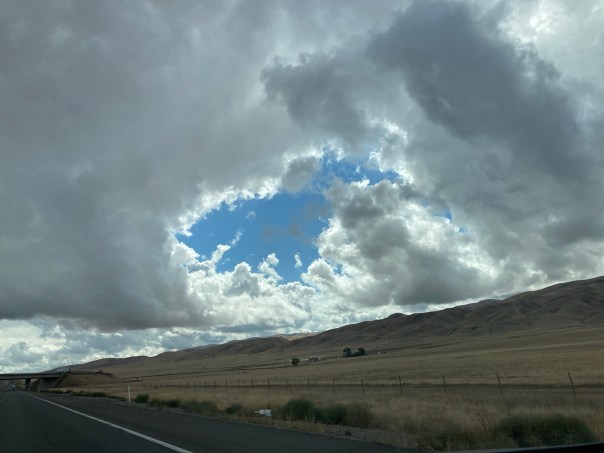
This is exactly what was happening on Tuesday, and I did take pictures of that show.

I was thrilled to see cotton on the plants in the wide fields, and I pulled over to look more closely. But I couldn’t get a good view, because mud:
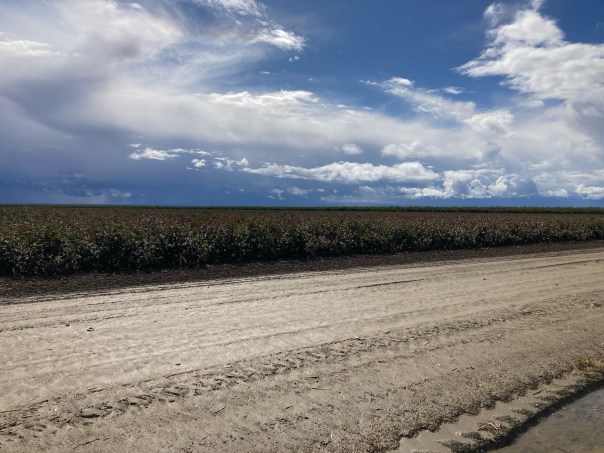
So I went along and along, and saw a rainbow pancake of light on the northern horizon, a very slim break in the clouds way beyond a field of melons.

By the time I got to Nancy’s, the storm was abating,
and the dust had been washed off of all the trees.
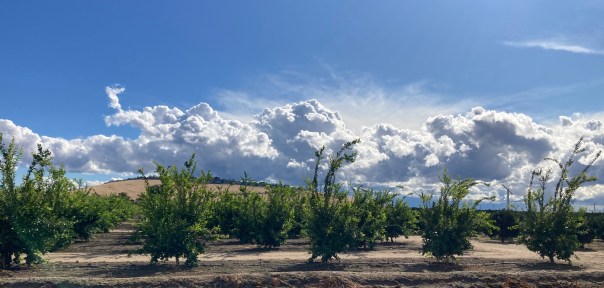
So there, I’ve put the beginning at the end of my tale. But don’t you think it’s hard, not to get the times mixed up when one makes a trip to the past? In many ways it is still present –definitely all these people I saw still are present — and may even be future. I feel the need of a pertinent quote… and the one that pops into my mind is:

The past is not what it was.
-G.K. Chesterton
 

Like bread, or the sea.

After I left my car at the mechanic’s shop for its routine service, I set off walking down the road to the bus stop. After only a few steps I stopped to admire plants along my way; I did that a few times. The California Buckeye startled me as it always does, looking like the dead of winter in early fall. The large conker peeking out redeemed the scene.

It was fun, walking for ten minutes through a sort of industrial park, where all the people arriving for work gave their energy to the atmosphere, and lots of pickup trucks lined the road, bare of sidewalks most of the way. The air was crisp but not harsh.

On a bench at the bus stop, I looked briefly across the frontage road at the seedy mobile home park whose sign was missing some letters and read “Taylo.” A mockingbird’s song came to me from somewhere, surprisingly not drowned out by the heavy traffic noise. And then my gaze rose, hungry, to the sky.

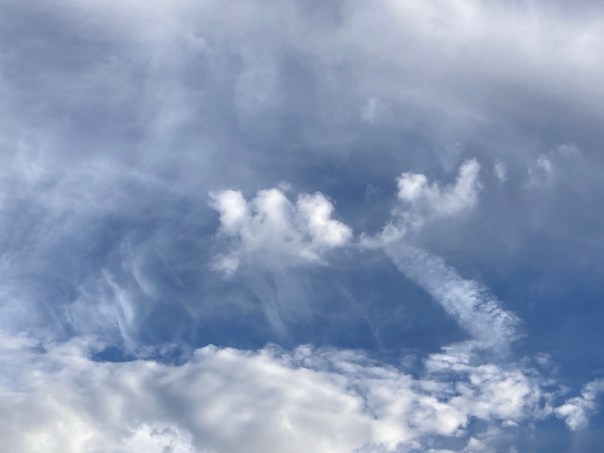
I recognized the remains of a jet stream (or chem trail?) as one element of that picture above, but there was so much else going on up there! I began to think about what Emerson said, that “The sky is the daily bread for the eyes.” I mused on how sometimes we are given all sorts of fancy bread, but at other times the sky is plain blue, or white, or gray….

After a short ride on the bus, I got off and started walking the rest of the way home, along a boulevard where I had plenty more of those big spaces to wonder at. I was struck by the realization that I was the only human on earth to whom each particular picture was given, because I was the only one at that GPS location, at that moment in the constantly changing arrangement of images.

If one lives in the big city, with skyscrapers hogging the sky, usually a little bit at least will peek through; I like to get my bearings occasionally by looking at whatever patches are available for viewing. Being in prison, though… now that would be hard. I guess they do often let at least some of the prisoners outside sometimes, but they might not feel safe and relaxed enough to feast on their daily bread in that setting.

Twice now I’ve started reading The Marvelous Clouds, and shared some quotes here. I reread some of Albert’s comments that I included in one post about the book ; he passed on some excerpts from an article about it, which is about media. One thing the author said was that “Clouds illustrate media ontology. [They] exist by disappearing.” 

I gave that book away a while back. It’s very thought-provoking, to be sure, but I think if I had continued reading it I would have just been page by page arguing with the author over various things. I don’t like that he uses clouds for anything. I’d rather receive the gift of clouds as bread for my eyes. This arrangement of clouds below looked like it was pretending to be mountains in the distance:

The author of that book, John Durham Peters, also said that clouds are the original white noise. If you want to follow that thought, read the article linked in that more recent post of mine. But I think it’s more profitable for the soul to go out and look at the sky, whether there are clouds in it or not. When there are no clouds, or they have merged into a less enthralling picture, watching them might be like staring out at the ocean. It’s always moving, but it can be boring at the same time. Sometimes we need that plain bread. Feasting all the time is not good.

While my thoughts were on the clouds, my legs carried me into neighborhoods closer to mine, but I took a less familiar route and saw this beautiful plant that I found out is called a Common Lionspaw. I got distracted from the sky and started thinking about where I could fit one of those in my garden.

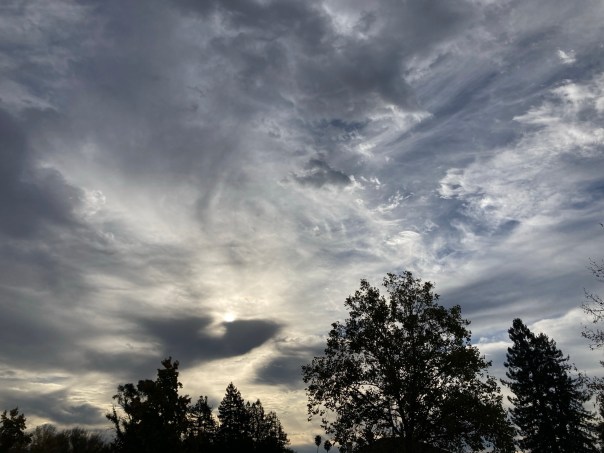
My cloud show seemed to go to intermission for a few minutes, with the actors going off stage — but quickly it started up again, as the sun began to break through.

Then, I was home again. It was time to start the rest of my day, and figure out what to eat… but my eyes had already had a big breakfast.

Blue lake and golden squirrels.

I stood on the cabin deck watching the critters on the slope below, where they scrambled about, doing their work. After a while I pulled up a chair to the railing and watched some more. Squirrels and chipmunks had found the recent offering I’d made, seeds scattered in the little neighborhood as though from their heaven.
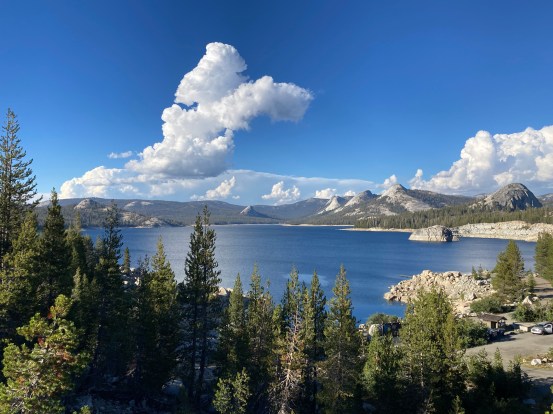
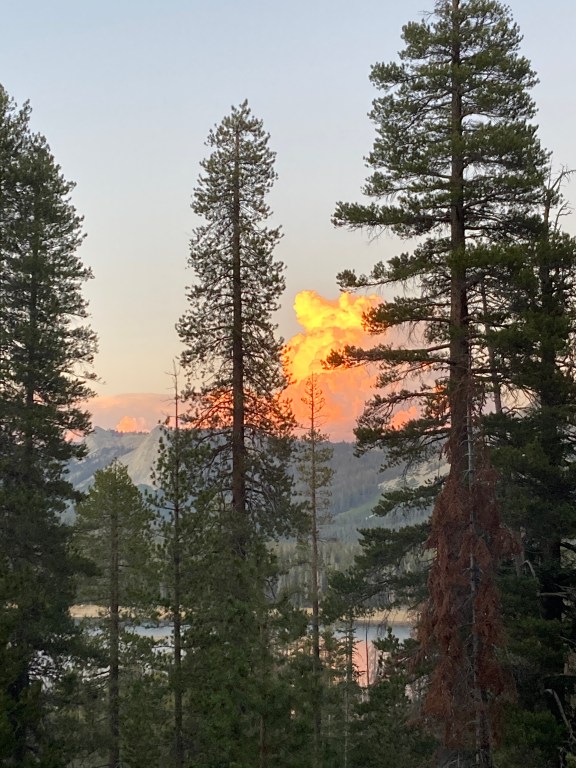
For several days I’m enjoying the mountain air at the family cabin in the High Sierra, over 8,000 feet in elevation. It’s cold this week, and the animals are no doubt storing food in their winter homes.

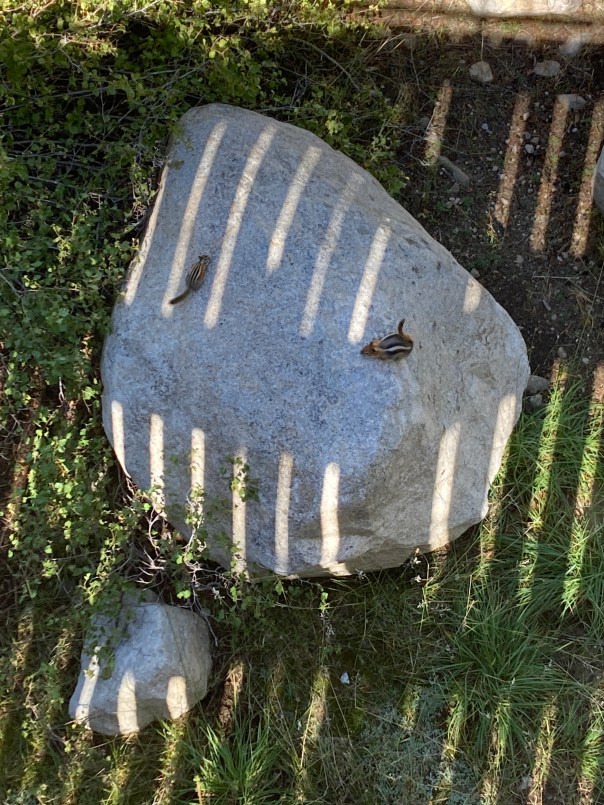
Right away I noticed that two species of small animals were present there, and I remembered the name of one, because of the many times my children and I had studied about them in the nature guides; any time our yearly camping trips took us to these Sierra Nevada Mountains, we would encounter them. The Golden-mantled Squirrel is the larger of the two, and the smaller is the chipmunk, likely the Lodgepole or Sierra Chipmunk.

Even after they discovered the seeds, the chipmunks spent time in the middle of the gooseberry bushes, hidden from view but making the branches rustle and sway. They must have been eating the dried remains of the berries. And the chipmunks especially like to play chase over and around the boulders, occasionally stopping for a second to tempt me to take their picture. I did get one blurry shot including both species.

Other than watching their fun, I’ve been taking in the cloud show that is ever fascinating, and I succumbed to the requisite first-day-at-the-lake nap. I’ve already thought of more things I want to share here, from my thoughts and observations, so probably you will hear from me again soon.

Away from shadows and wilting.

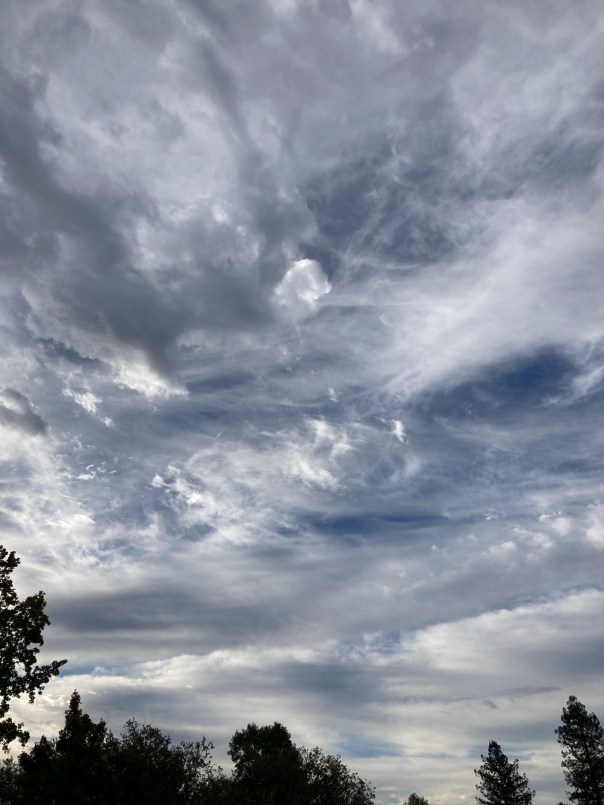
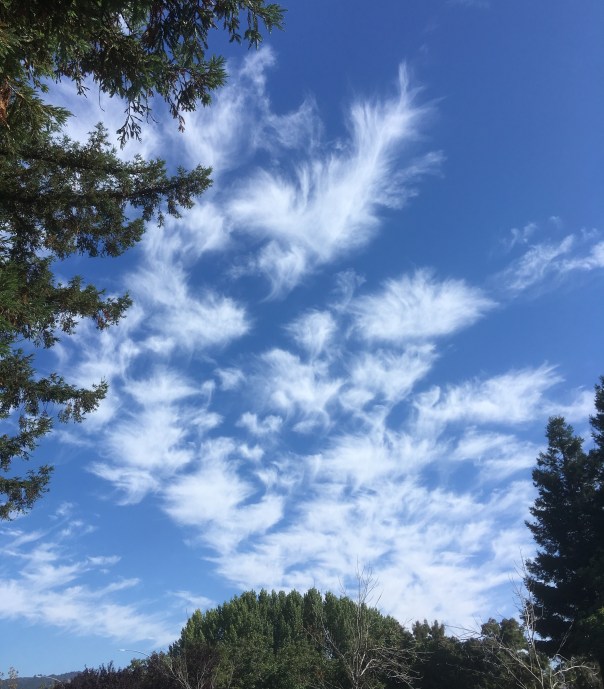
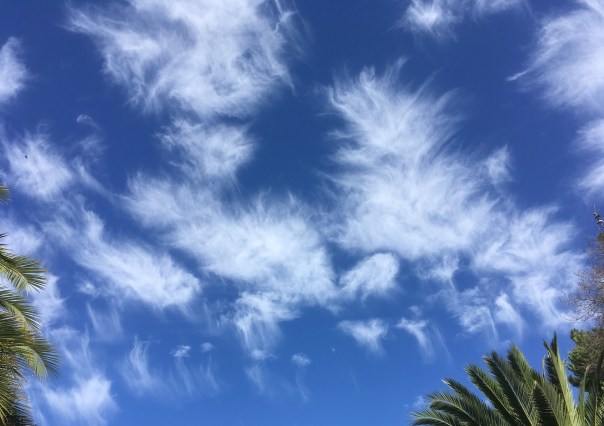
For a half hour I walked my loop bending backward to take pictures of these crazy clouds. They filled the whole sky.

After a while I thought maybe they were blending together too much to be quite as interesting, and my neck was getting tired. By then I was closer to home noticing the street view, and several unwatered lawns in the neighborhood with a cheery wildflower/weed display:

DESPAIR

So much gloom and doubt in our poetry –
flowers wilting on the table,
the self regarding itself in a watery mirror.

Dead leaves cover the ground,
the wind moans in the chimney,
and the tendrils of the yew tree inch toward the coffin.

I wonder what the ancient Chinese poets
would make of all this,
these shadows and empty cupboards?

Today, with the sun blazing in the trees,
my thoughts turn to the great
tenth-century celebrators of experience,

Wa-Hoo, whose delight in the smallest things
could hardly be restrained,
and to his joyous counterpart in the western provinces,
Ye-Hah.

-Billy Collins