Tag Archives: Dana Gioia

California Hills in August

I’m almost too late to post a poem with this title in a timely manner, not that the hills won’t look pretty much the same for another month or more. This year the grass is especially brown and parched, and we have lots of fires making the sky brown, too.

Over three years ago I posted this poem by Dana Gioia, which was the first time I wrote about him. Just now by putting his name in the search box at the bottom of this blog I discovered that it’s come up repeatedly.

I understand that Gioia has returned to our fair and thirsty state after serving as president of the National Endowment for the Arts for a few years. I wonder if he gets out of town far enough these days to feel the summer as he so aptly conveys it in this poem.


California Hills in August

I can imagine someone who found
these fields unbearable, who climbed
the hillside in the heat, cursing the dust,
cracking the brittle weeds underfoot,
wishing a few more trees for shade.

An Easterner especially, who would scorn
the meagerness of summer, the dry
twisted shapes of black elm,
scrub oak, and chaparral, a landscape
August has already drained of green.

One who would hurry over the clinging
thistle, foxtail, golden poppy,
knowing everything was just a weed,
unable to conceive that these trees
and sparse brown bushes were alive.

And hate the bright stillness of the noon
without wind, without motion,
the only other living thing
a hawk, hungry for prey, suspended
in the blinding, sunlit blue.

And yet how gentle it seems to someone
raised in a landscape short of rain –
the skyline of a hill broken by no more
trees than one can count, the grass,
the empty sky, the wish for water.

-Dana Gioia
Readers and Doers

Janet has a discussion going on about reading and what our reasons are for doing it. I’ve been thinking a lot about the decrease in the habit of reading among Americans, which was discussed recently on a Mars Hill Audio interview with Dana Gioia.

Gioia was Chairman of the National Endowment for the Arts when the agency did a large survey of the nation’s reading habits. We’ve known for decades that people are reading less…and less…and less. Isn’t this interesting, when a bachelor’s degree is becoming more common? Just this week I heard of a young woman who has a degree, who flat-out refuses to read anything, saying, “I don’t read,” at the same time she declares that she must need to get a job, she is so bored. This in spite of having a lively young child.

The phenomenon links right in to another observation by a college professor I also heard on Mars Hill, that the vast majority of students of “higher education” today do not connect their studies to their life outside the classroom. When they are with their friends, they would never think of discussing a novel or how the wisdom of the ancients applies today. Is reading a task they have only ever done to pass a test or please a teacher? One doesn’t want to call what these people have undergone “education.”

Still, there are those of us who read, and not out of duty! Not for escape, either. As it turns out–and this surprised Dana Gioia–people who have a rich internal life with books are more likely to be involved in their communities and do volunteer work than non-readers. Reading is not truly a solitary activity, because the reader and the writer are interacting, and as the reader’s interior world is enlarged, his engagement with his fellow humans broadens accordingly.

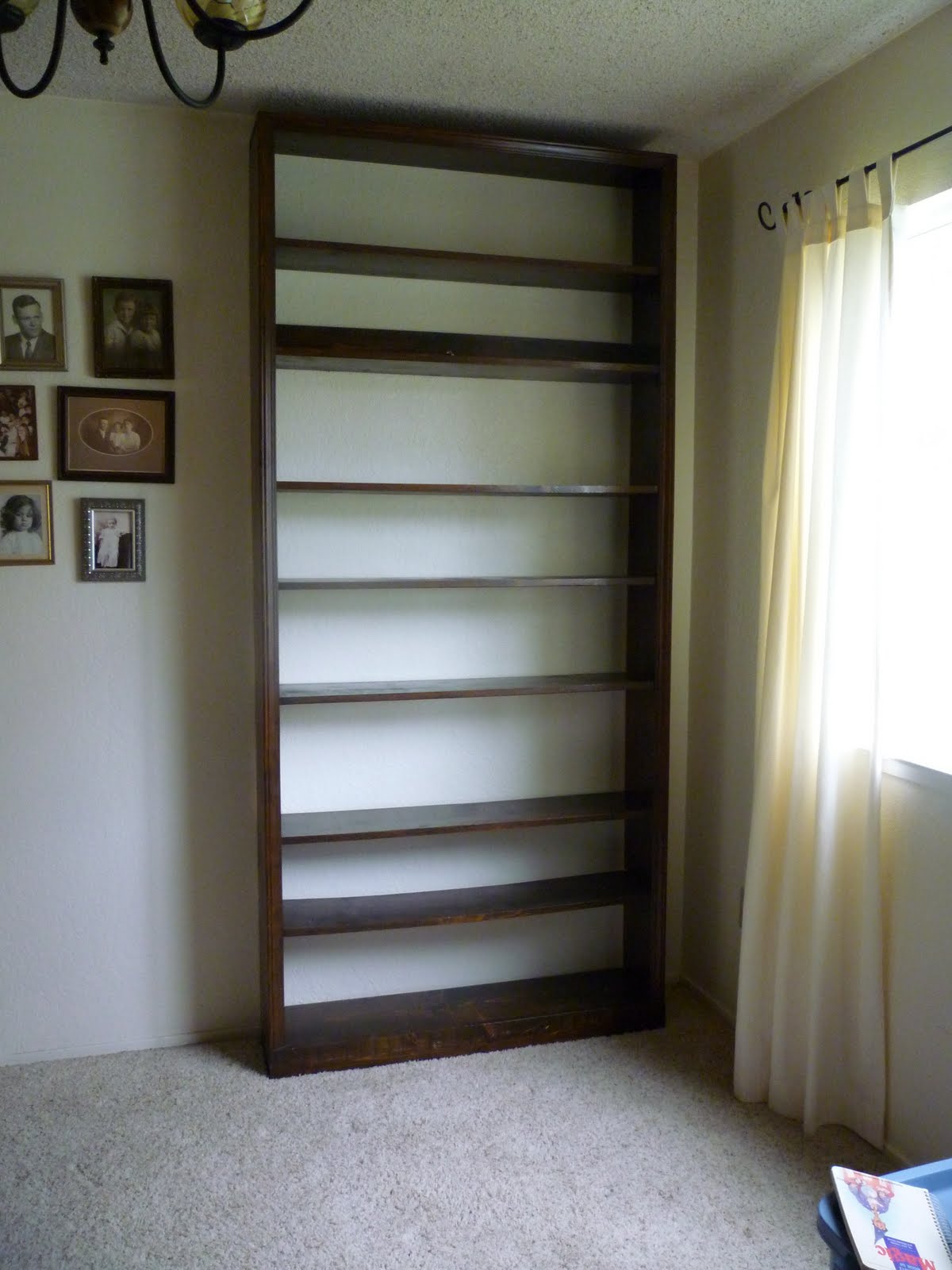
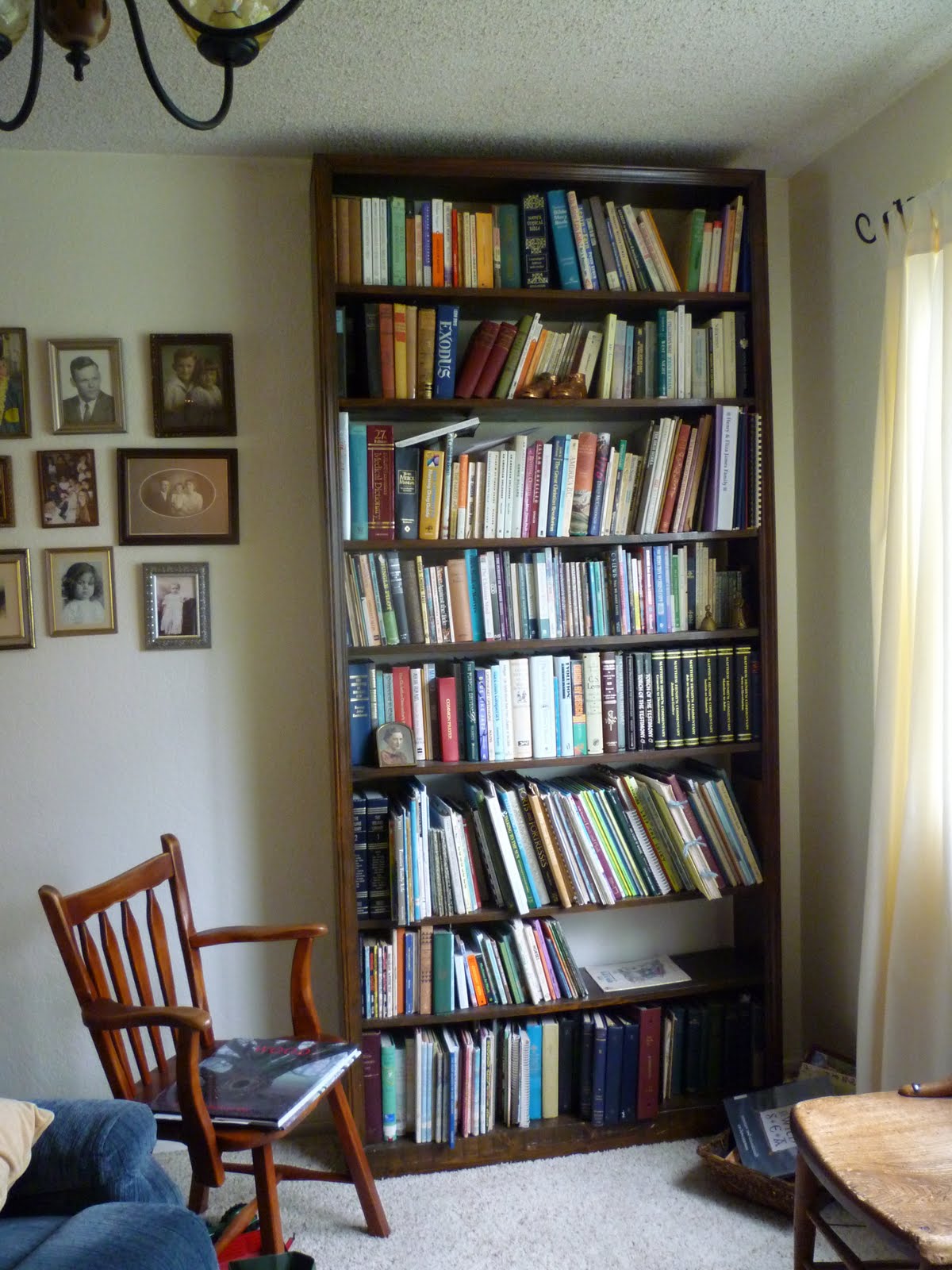
The research gives a lot to think about–and I would write down my thinking, too, if I weren’t embarking more intensely now on a very different sort of work, that of remodeling our kitchen and downstairs floors and ceilings. Just look at this bookcase that has been denuded! A pitiful sight.

It marks only the beginning of the destruction and deconstruction and disorder around here. My computer will be moved to another room, not as handy. I will be packing and packing, and scraping and painting, and cooking without a kitchen. Then I will be unpacking and setting up my home again. Though it’s certain I won’t give up reading altogether for this while, I must think of the next few months as more in the realm of doing good in “my community.”

Every Lent presents a new challenge, because even if our circumstances or station in life might be the same as last year, rare enough as that is, we as individuals have changed from last year’s season of the fast. As I heard the exhortation at Matins this morning that we would show compassion on the needy, it confirmed the idea that had been growing on me, that this house project is not this year’s distraction from Lent, but provides a perfect setting for me to learn compassion.

Having my house torn up and chaotic, wondering which task I should do next and where I stashed the item I didn’t think I would need but now I do–all this causes me anxiety. But my poor husband suffers more, I am certain, and he needs me to show compassion and patience and love.

It wouldn’t hurt me to pray the Lenten Prayer of St Ephrem throughout the days of my opportunity:

O Lord and Master of my life!
Take from me the spirit of sloth, faint-heartedness, lust of power, and idle talk.
But give rather the spirit of chastity, humility, patience, and love to Thy servant.
Yea, O Lord and King!
Grant me to see my own errors and not to judge my brother;
For Thou art blessed unto ages of ages. Amen. 

New Year’s Gifts

“I don’t like my life!” This surprising phrase repeatedly ran through my mind before Christmas. Egads, how could I be thinking something so discontented?

Was it just a variation on “O Come, O Come, Emmanuel!”? Maybe. Or, “The spirit is willing, but the flesh is weak.” And along more housewifely lines, “I can’t concentrate on anything productive because the house is so messy!” and even more specifically, realities like, “I want to write, but I can’t find my notebook.”

This new year has started off with a broken computer–an inconvenience that brings gifts: I am forced out of my routine, or rut, and get a boost toward a possibly more likeable life. The other gift is a son with a computer, newly arrived here, so that if I really need to I can use his machine. We and the computer repairman can all relax over a long weekend.

Do the following fall within the definition of resolutions? My feelings don’t appear strong enough to be called resolve, but I do have general good intentions to improve on some things. A lot of the same old things, in fact, though the outward shapes of the projects are revised.

1. Finish making a bedroom into a sewing room.

2. Take the time to sort and organize notes about reading and writing in such a way that I can make use of them; this will require some purging!

3. Be very careful about accumulating any more possessions, because they will just take more of my time for maintenance, and then before I know it, more for sorting and purging.

The new year is a gift of hope. We commemorate the Circumcision of Christ today, which reminds us of God’s covenant with us–and there is no greater Hope! We can be assured that God will be with us, full of grace for every moment and every day we are given. It’s true, we can’t get it beforehand, but we can surely anticipate it.

This poem expressing the confusing natures of time and humankind is also a gift for today.

NEW YEAR’S

Let other mornings honor the miraculous.
Eternity has festivals enough.
This is the feast of our mortality,
The most mundane and human holiday.
On other days we misinterpret time,
Pretending that we live the present moment.
But can this blur, this smudgy in-between,
This tiny fissure where the future drips
Into the past, this fly-speck we call now
Be our true habitat? The present is
The leaky palm of water that we skim
From the swift, silent river slipping by.
The new year always brings us what we want
Simply by bringing us along–to see
A calendar with every day uncrossed,
A field of snow without a single footprint.

-Dana Gioia

Putting Books on Shelves, Taking Them Off…

Earlier in the month I told how I got worked up when parts of my book order began to arrive in the mail. I admit, I do feel a bit sheepish, buying more books and telling about them, when there are plenty of good ones already on my shelves. But that’s me, a glutton.


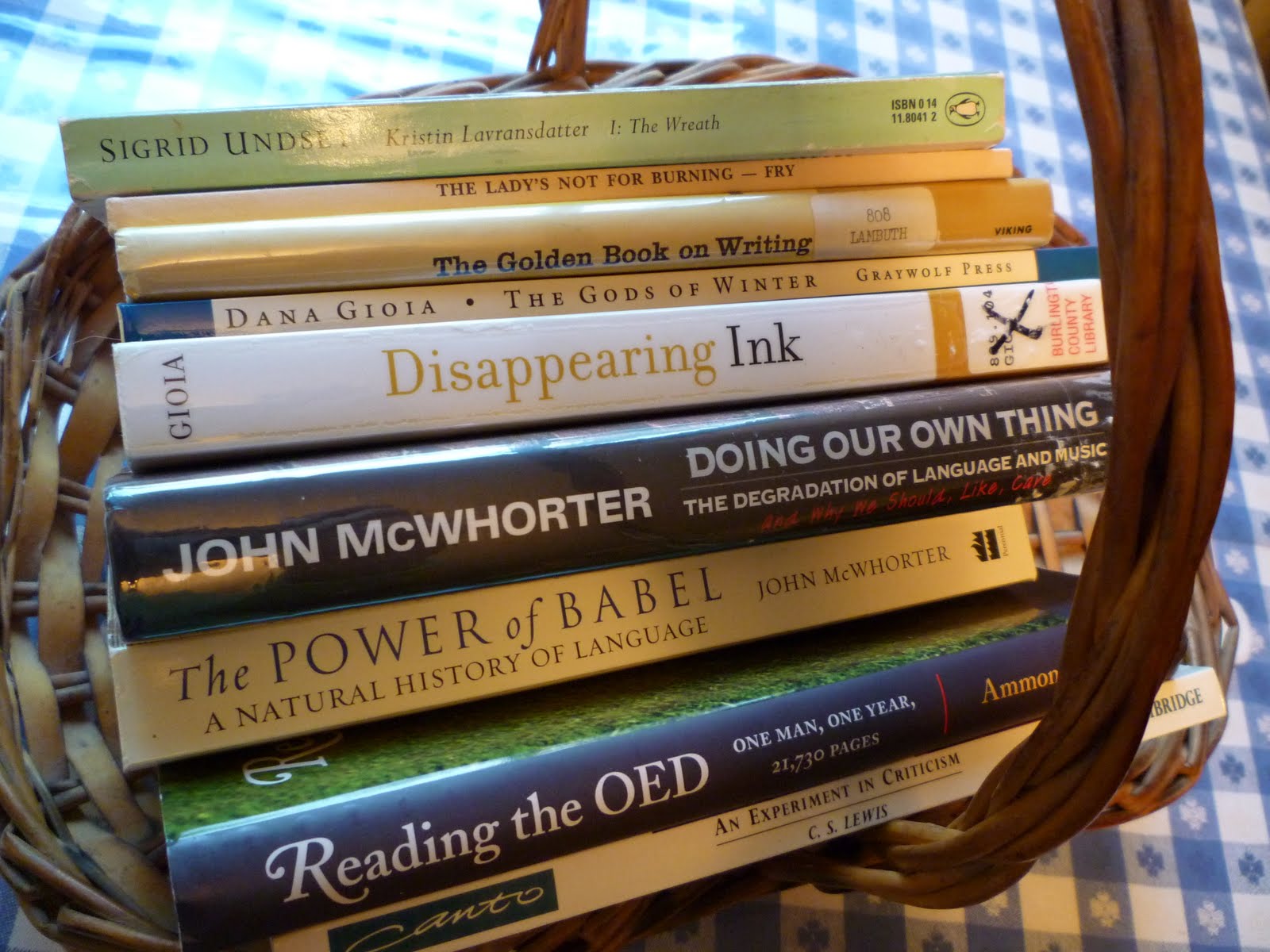
These are mostly used, almost all from different sellers, and the shipping totalled way more than the books themselves. Most of the titles have been on my wish list for months or years, and I know that some of the books, now that they are in my possession, will sit on the shelf for at least months, more likely years, before I get to them. But they have a better chance of being read now.

Not to mention, they are now available for me to remove from the bookcase briefly, to open and lovingly turn a few pages–even when there isn’t time to give my full attention to the contents. Winston Churchill gave an admonition to book-lovers to do just that. I read the saying in a London museum, and it appears I’ll have to return there if I am ever going to find it verbatim.

In some cases it is a mystery how I heard about the book or why I wanted it. The Golden Book of Writing looks valuable, and I can always use help in that department, but it will have to remain uncredited as far as who recommended it. Maybe it was my friend at Amazon.com who always says, “We have recommendations for you!”

John McWhorter has been interviewed a couple of times on Mars Hill Audio, so I’ve been familiar with him and wanting to read more from his mind. Linguistics is a subject that grabs me ever since I was privileged to take a tutorial in the subject as a freshman in college. Perusing the titles of McWhorter’s bibliography feeds my book greed.

Dana Gioia is another author whose acquaintance I first made through MHA, and I mentioned that meeting here already. I only owned one book of his poems before–now I have two, and two collections of essays. Disappearing Ink is a collection of essays subtitled Poetry at the End of Print Culture.

Kristin Lavransdatter I loved so much that I snatched up sets whenever I’d see them, in the old translation that so many people despise–I didn’t. But now I want to read it in Tiina Nunnally’s rendition.

Because I dearly love my friend, whom I will call Bird, I bought The Lady’s Not for Burning, a play by Christopher Fry. Bird is 98 years old, and this play is one of her favorite pieces of writing, I think partly because it was something she enjoyed with her late husband. Bird is terribly hard of hearing, but she can hear me when I sit nearby and we talk about how thankful we are to God for many things. She is a little worried that her eyes will fail her and she won’t be able see the print on the pages of her books; I told her I will come and read to her then.

I think she would really like Kristin Lavransdatter.