After a brief introduction to Japanese literature and culture for a few months of 2019, when I joined a Japanese Literature Challenge, I decided to leave behind the aesthetic vision of Japan, so to speak, and explore the reality and idea of Beauty in a less specific and encultured way.
My remodeling project and accompanying disorder are the reason, I believe, that I 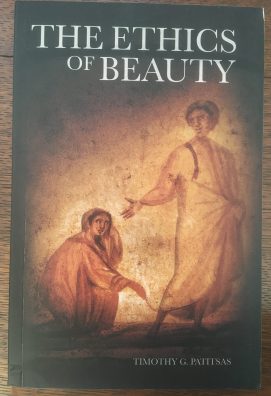 haven’t been able to concentrate on this extended philosophical reading project. It could be also that the topic is just too out-of-sync with the situation in my (indoor) living space. The chaos results from having none of the planned-for storage finished — that’s closets and cabinets in six or seven rooms — and that situation is abetted by the pandemic shutdowns of various sorts. The pandemic itself taxes the mind and emotions, and lately I’ve been reading more children’s books than anything.
But, the planned exploration looms large in the background, and its bulk has increased in a physical way, by means of big books. (I consider The Book of Tea to be about beauty, and it was by contrast such a slim and elegant item!) I’m not going to tell you about all of my Beauty books yet. Goodness, I haven’t begun anything in earnest. But the last one that came into the house was only recently published, and I may be most excited of all about it.
It’s The Ethics of Beauty by Timothy G. Patitsas, and it “weighs in” at over 700 pages. Professor Patitsas explains in the first sentence of his Preface what he is about: “…to recover a lost way of doing Ethics, one in which love for Beauty played the central and the leading role.” He shows how the definition of contemporary ethics, when seen in terms of Socrates’ three transcendentals of Beauty, Goodness, and Truth (ethics being the study of Goodness), is biased against Beauty. A little more from the Preface:

“The central text about Orthodox Christian prayer life, The Philokalia, itself means ‘the love of the beautiful.’ The Ethics of Beauty is best conceived as a prose companion to that spiritual collection — certainly not on the same level as that classic text, but hopefully recognizably in the same family. Where The Philokalia is an aid to the pursuit of the Beautiful Way in prayer, The Ethics of Beauty is a discussion of why the Beauty-first Way is preferable, and an examination of the Way within as many areas of life as possible.”
“I would never have set out upon the journey that led me to The Ethics of Beauty had I not read Jonathan Shay’s observation in his Achilles in Vietnam that contemporary analytical psychotherapy has been largely unable to heal the suffering of the soldiers afflicted most severely with post-traumatic stress disorder. I have slowly come to see that… the initial focus of soul-healing must be on Beauty rather than on truth, on a living vision of a loving and crucified God, rather than on an autopsy of the broken self.”
Hmmm… I wouldn’t be surprised if Dee Pennock talks about this healing effect of Beauty in her book that I recently mentioned.
 But, going back to the beginning of my vague plan, about a year ago I brought a fat book about Beauty and Truth into the house. The priest who lent it to me said he’d been unable to penetrate it. I knew it would likely be as heavy for me intellectually as it was in poundage, but it seemed a work I should at least have at hand when I began my study of Beauty.
This one is The Beauty of the Infinite, by David Bentley Hart; I had never yet opened it to read a line, but it’s been sitting on my mobile bookshelf in the kitchen/family room. When the Patitsas book arrived, I took Hart’s book off the shelf behind me and set it on the table so that the two could meet. And a few days later, avoiding some work, I’m sure, I opened Hart randomly in the middle, and my eyes landed here:
 “…theology owes Nietzsche a debt: I intend nothing facetious in saying that Nietzsche has bequeathed Christian thought a most beautiful gift, a needed anamnesis of itself — of its strangeness. His critique is a great camera obscura that brings into vivid and concentrated focus the aesthetic scandal of Christianity’s origins, the great offense this new faith gave the gods of antiquity, and everything about it that pagan wisdom could neither comprehend nor abide: a God who goes about in the dust of exodus for love of a race intransigent in its particularity; who apparels himself in common human nature, in the form of a servant; who brings good news to those who suffer and victory to those who are as nothing; who dies like a slave and outcast without resistance; who penetrates to the very depths of hell in pursuit of those he loves and who persists even after death not as a hero lifted up to Olympian glories, but in the company of peasants, breaking bread with them and offering them the solace of his wounds. In recalling theology to the ungainliness of the gospel, Nietzsche retrieved the gospel from the soporific complacency of modernity….
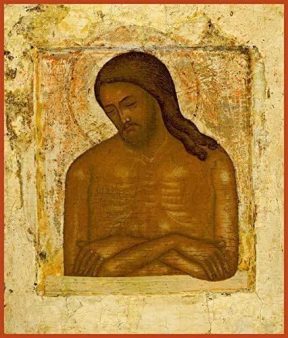
My own philosophy and theology were settled already on this source of Beauty: the Holy Trinity, the relationship of love of the Father, Son, and Holy Spirit. A few years ago Jonathan Edwards put me in mind of it in his thoughtful way, and maybe I should go back and read the extensive quotes I transcribed on the subject. But if I never get around to reading all these pages of words that are waiting for me in books, it’s okay. My heart knows the story.
 “Materialism is a conviction based not upon evidence or logic but upon what Carl Sagan (speaking of another kind of faith) called a ‘deep-seated need to believe.’ Considered purely as a rational philosophy, it has little to recommend it; but as an emotional sedative, what Czeslaw Milosz liked to call the opiate of unbelief, it offers a refuge from so many elaborate perplexities, so many arduous spiritual exertions, so many trying intellectual and moral problems, so many exhausting expressions of hope or fear, charity or remorse. In this sense, it should be classified as one of those religions of consolation whose purpose is not to engage the mind or will with the mysteries of being but merely to provide a palliative for existential grievances and private disappointments. Popular atheism is not a philosophy but a therapy.”
 Gladsome Lights