Today is Saturday, and I am attending a wedding, which is a cause for joy. According to statistics, 70% of weddings are held on Saturdays these days, but in the Orthodox Church Sunday is the preferred day. Sunday is The Lord’s Day since the Resurrection, and the day for celebration and feasting, while Saturday is the day of rest, when we remember those who have fallen asleep in death and rest in their graves. Here is another poem that ties the remembrance of death to the season, and to the One who mitigates our sorrow over it.
AUTUMN
The leaves are falling, falling as from far off, as though far gardens withered in the skies; they are falling with denying gestures.
And in the nights the heavy earth is falling from all the stars down into loneliness.
We are all falling. This hand falls. And look at others; it is in them all.
And yet there is One who holds this falling endlessly gently in his hands.
More than one reviewer of Richard Wilbur’s late collection of poems noticed that after his wife died, the poet wrote more about death, as in this example below. That would be a natural response, of course, for someone 90 years old, even if he hadn’t been recently widowed.
I know it’s recommended that people of all ages live with awareness of the shortness of our lives, as in Psalm 90: “Teach us to number our days, that we may gain a heart of wisdom.” Or as another translation goes, “Teach us to realize the brevity of life….”
If our dearest friends and family have departed, it could exacerbate any feeling of weariness we already had with this earthly existence. In the same Psalm the poet mentions the less-than-thrilling aspects of life: “The days of our years are threescore years and ten; and if by reason of strength they be fourscore years, yet is their strength labour and sorrow; for it is soon cut off, and we fly away.”
A MEASURING WORM
This yellow striped green Caterpillar, climbing up The steep window screen,
Constantly (for lack Of a full set of legs) keeps Humping up his back.
It’s as if he sent By a sort of semaphore Dark omegas meant
To warn of Last Things. Although he doesn’t know it, He will soon have wings,
And I, too, don’t know Toward what undreamt condition Inch by inch I go.
~ Richard Wilbur
Richard Wilbur was a lot smarter than an inchworm, so I like to think he had this verse from I Corinthians in mind when he wrote those last lines: “But as it is written, Eye hath not seen, nor ear heard, neither have entered into the heart of man, the things which God hath prepared for them that love him.”
Because the Preparer is Love, our Last Things, though unimaginable, will be the best.
I first shared this poem of Wilbur’s ten years ago, before he had passed over, into what we might think of as the pupa stage; today I read this about the inchworm:
“After the larva hatches, he feeds on leaves for about a month before he drops to the ground via a silken thread. In late spring or early summer, the larva burrows up to 4 inches into the ground, spins his cocoon and pupates. If he’s a fall worm, he’ll emerge in the fall, usually between November and early December. If he’s a spring worm, he’ll wait until the next late winter to emerge.”
At the time of Wilbur’s death I posted one article written about him for the occasion, but just now I found another tribute in USA Today, in which the journalist remarks on the unusual quality of happiness in this poet, and quotes Wilbur:
“I think many people associate happiness with shallowness,” Wilbur told the AP. “What people don’t want is someone who is complacent. And I know that I am not a complacent man.”
Richard Wilbur was the farthest from complacent that I can imagine. He spent his life being attentive to the world around him and pursuing love and beauty. I hope that in his present state he knows even more what C.S. Lewis meant when he said:
“Joy is the serious business of Heaven.”
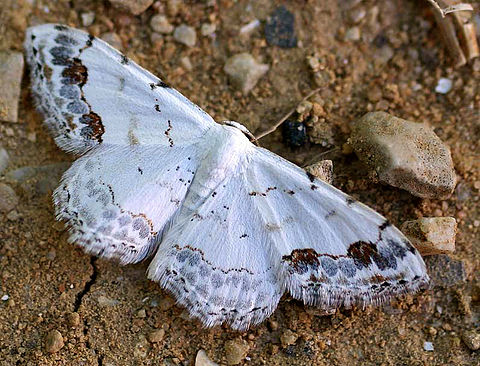
Geometer inchworm moth – Scopula Decorata or Middle Lace Borer
“First, I took a running leap,
and then, half buried in the heap
that we’d raked up, I lingered, caught
in a cocoon of leaves and thought.”
That is the first stanza of a new poem by Jean L. Kreiling, which I just read on the website of the Plough Publishing Company. The title is “After Helping my Father Rake the Leaves,” and it is rich with images of the season, “hot colors from a chilling world,” and memories of the poet’s father, who “turned his face into the wind” — a metaphor for his inspiring life and attitude.
You can read the whole loving poem on the Plough site.
At this time of year when nights grow longer, and we can’t get rid of them soon enough in the mornings, now it is, for some reason, that I want to share this poem I’ve been mulling over, about night being gone altogether. Oh, wouldn’t it be lovely to live where bell songs would visit your garden at the break of day?
FOUR POEMS IN ONE
At six o’clock this morning I saw the rising sun Resting on the ground like a boulder In the thicket back of the school, A single great ember About the height of a man.
_ _ _ _ _ _ _ _ _ _ _ _ _ _ _ _
Night has gone like a sickness, The sky is pure and whole. Our Lady of Poland spire Is rosy with first light, Starlings above it shatter their dark flock. Notes of the Angelus Leave their great iron cup And slowly, three by three Visit the Polish gardens round about, Dahlias shaggy with frost Sheds with their leaning tools Rosebushes wrapped in burlap Skiffs upside down on trestles Like dishes after supper.
_ _ _ _ _ _ _ _ _ _ _ _ _ _ _ _
These are the poems I’d show you But you’re no longer alive. The cables creaked and shook Lowering the heavy box. The rented artificial grass Still left exposed That gritty gash of earth Yellow and mixed with stones Taking your body That never in this world Will we see again, or touch.
_ _ _ _ _ _ _ _ _ _ _ _ _ _ _ _
We know little We can tell less But one thing I know One thing I can tell I will see you again in Jerusalem Which is of such beauty No matter what country you come from You will be more at home there Than ever with father or mother Than even with lover or friend And once we’re within her borders Death will hunt us in vain.



 “First, I took a running leap,
 Gladsome Lights