 What is proper footwear for a mountain cabin? My sisters and niece showed me how to dress properly, and even provided the gear.
I had a very full long weekend. Unfortunately it necessitated me driving two exhausting days for the sake of enjoying two layover days with family, at my sister Cairenn’s cabin that I was experiencing for the first time.
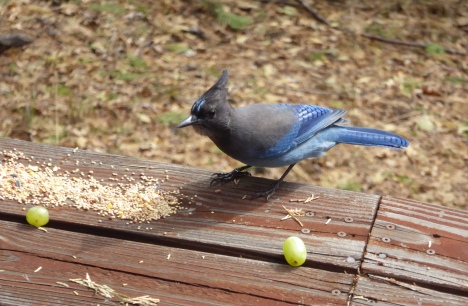
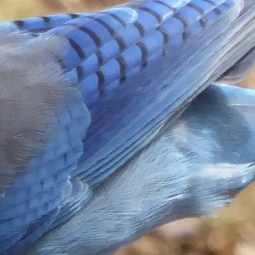
Good thing I had little I needed to do on my recovery day but look at photographs and write sentences to go with them. While I’m still in a grouchy mood I’ll get the bad parts of the excursion off my mind first. That way I can have pleasant pictures at the end and maybe go to bed feeling more elevated. But, okay, before we get to the bad parts, a beautiful jay. And a close-up of his blueness:
Drought. Here in the lower elevations of the more southern Sierra Nevada, the lack of adequate snow and rainfall for several years in a row is evidenced by the sight of many dead trees. And on my way up the hill I saw Lake Success, which is at about 4% of its capacity.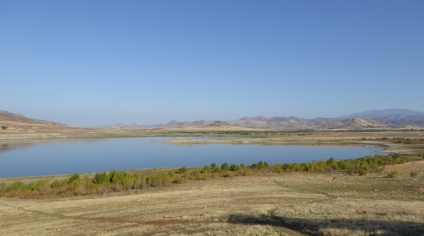
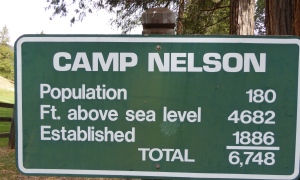
Camp Nelson is a small community at a much lower elevation than our family cabin that is also in the Sierras. This town stays open all year, and the roads get plowed every day when it snows. The last many miles going in are so curvy, I got carsick even though I was driving. Of course that made the drive seem even longer.
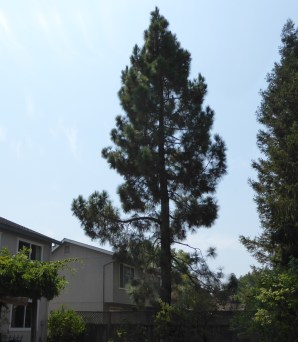
I haven’t been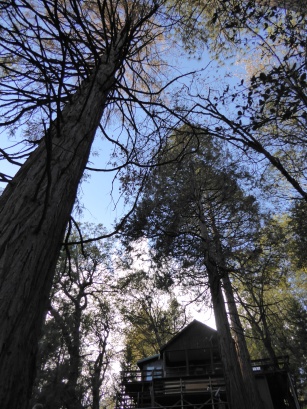 in the High(er) Sierra since July. Maybe the trees there are also yellowing and dying by now, but I suspect that these at the lower elevations and farther south are suffering more. At least one big tree on Cairenn’s lot needs to be removed safely before it comes down dangerously. It’s the one on the left in this photo with the peak of her cabin below.
In many cases it’s not the lack of water that kills the trees, but the bark beetle that does it. A USDA article explains: “Under normal conditions, trees produce enough resinous pitch to drown and ‘pitch out’ the beetles that attempt to enter. When trees are stressed they are unable to produce sufficient amounts of defensive pitch and the beetles are able to bore deep into the trunks of trees, eventually killing the tree.”
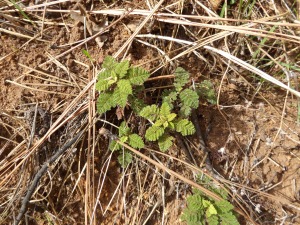 One plant that was a new discovery for me has always been disagreeable to my sister Nancy. When she first pointed it out to me on one of our several walks together around the village, I leaned up close and she cried, “Don’t touch it!”
She didn’t want me to be contaminated by its notoriously clinging odor. This wildflower in the rose family, called Bear Clover or Mountain Misery, is also not appreciated by most animals because of its smell. In the forest’s ecosystem it plays a complex role, as I read about in this article. It’s very drought-tolerant and recovers quickly from fire, too.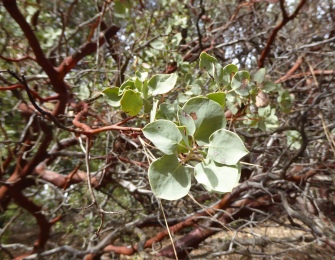
What else is super drought-tolerant? Our beloved manzanita. I took almost as many pictures of manzanita last weekend as of Steller’s jays. The ones in Camp Nelson get so tall! They all looked particularly healthy; I think they have the added protection of not being the sort of material the bark beetle prefers.
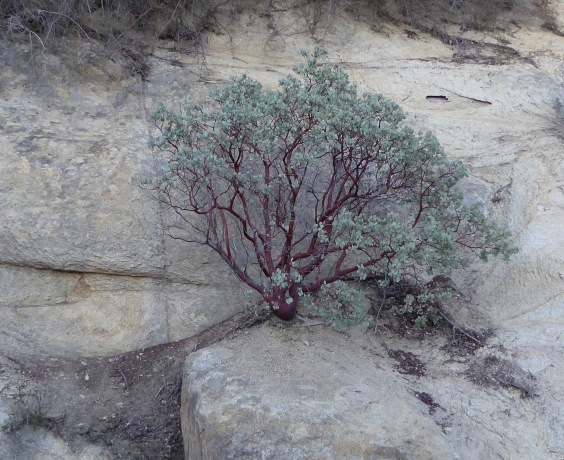
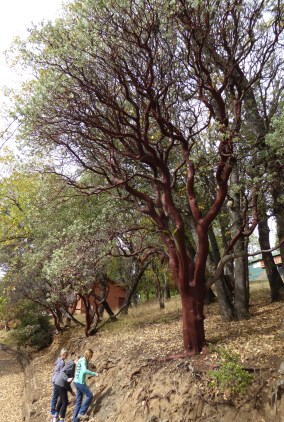
In this picture on the right we have just discovered a manzanita seedling growing in the bank, and it is about to be transplanted by group effort to Cairenn’s lot.
We looked at trees a lot during our Sisters +1 Retreat. Those huge pine trees, Ponderosas and Jeffreys, are both found in this area. I have written about them before on my blog, but as often happens, the more you know the more you realize you don’t know…
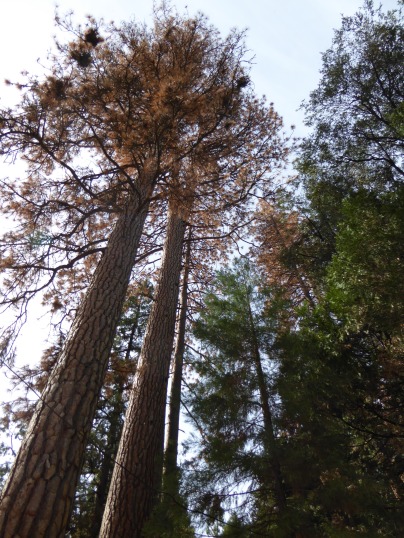

They resemble each other in so many ways. I hadn’t even heard before that the bark of one smells like vanilla; ah, but which one is it…? Both, as I read when I got home. The ones we sniffed did have that yummy scent.
I could tell by the way I was frequently lagging behind on these walks, that we didn’t have enough of a group mindset to do an intensive tree study, and anyway I’m not encouraged to spend a lot of time on the questions myself when I read that even experts have had to correct their identification errors.

On our walks we saw donkeys and mules and deer. One evening we saw seventeen deer on the “meadow” that is a sort of town green.
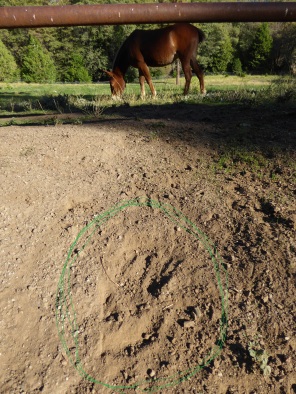
And a bear track! I circled it in green below, looking something like a thumbless human handprint.
As we relaxed at the cabin, eating, playing games, eating, reading and chatting, eating, the Steller’s jays and squirrels entertained us and kept me busy with my camera.
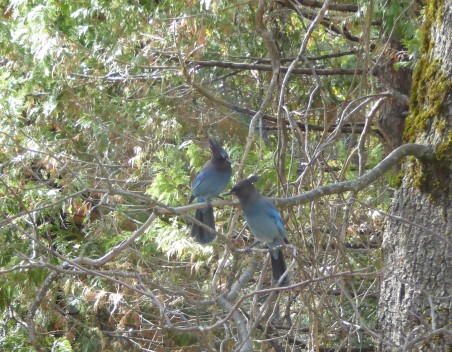
After I took about a hundred pictures of the jays I got down to business and did some sewing. I sewed a button on to my fleece jacket, which I then hung on a hook and left at the cabin – ugh! 
I worked on one of my patchwork potholders, and started to take apart a pillow that was made for Pippin by her grandmother 30 years ago. I hope to spiff it up and re-stuff it.
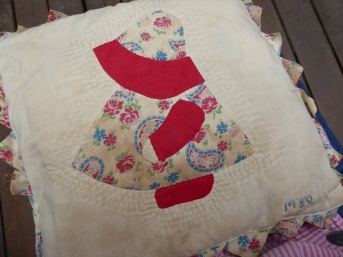

I even did some coloring with my sister and my niece Jelly. The picture I chose to color was one of the simplest in the book, and it reminds me a little of the elderberry bushes that I have admired so often up in the mountains. I didn’t see any in this area, though.


What I did see were mountain sunflowers and their seed heads.
Two days with dear people went by so fast… Next thing I knew, I was driving back 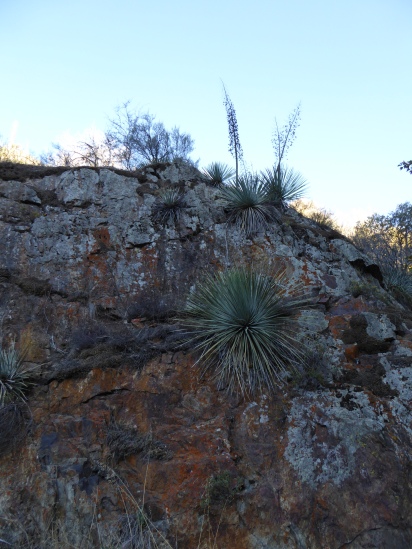 down that curvy road, early enough in the morning to get some more nice pictures. I had been taking vitamin B6 for two days, and maybe that was why I didn’t get queasy on the descent.
Just a little lower down there were fewer conifers and more desert-y plants to be seen, and wildly painted rock cliffs to highlight their drama.
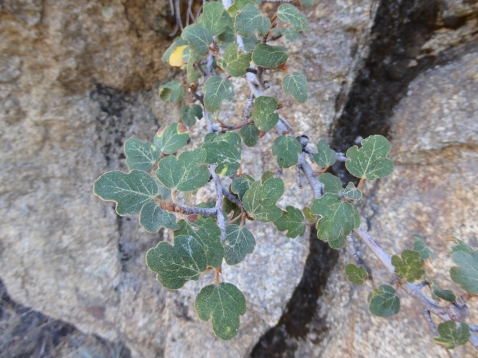
Below is another plant I didn’t take the time to research today. It looks like some kind of berry bush, growing out of a rock cleft.
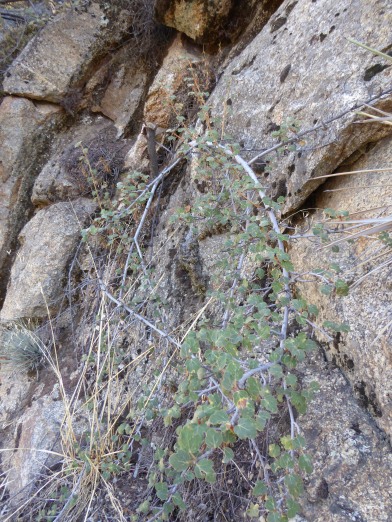
…and I have to admit that yes, its leaves do somewhat resemble those of manzanita. I guess I have a fondness for leathery gray-green Survivors.
As I wound my way down, off to the south the morning light came over the ridges and fell on forests of manzanita bushes that spread in rough bands across the slopes.
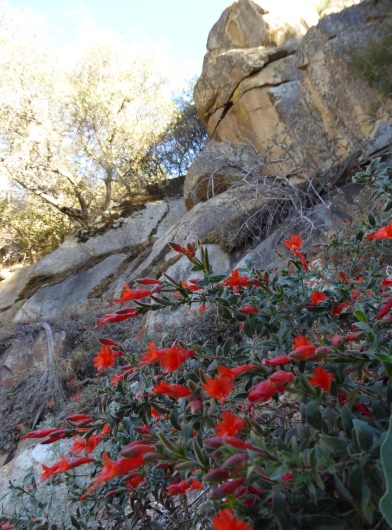
 The last mountain scene I captured was of more rock, with late penstemon blooming out of it. I was amazed, and honored.
When I arrived on the flats of the southern Central Valley, I kept taking pictures, because of the olive trees. More gray-green and hardy specimens! Tall ones dwarfing the orange groves…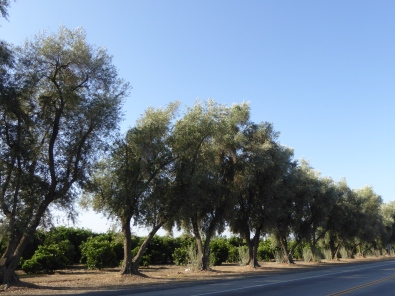
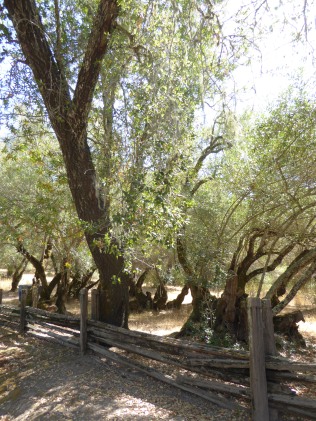
…and just a few blocks from my old high school, old gnarly and knobby ones like this:
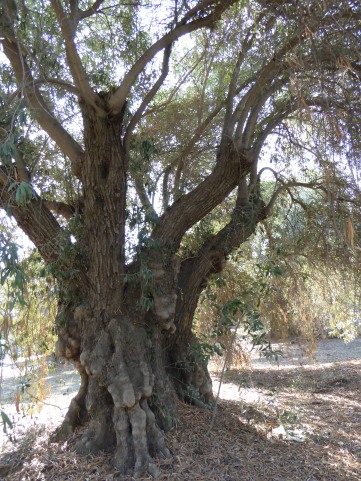
I was grateful for the chance to walk around in this grove, and the brief encounter was very satisfying. Just hanging around the trees must have given me the strength to soldier my way up the Interstate for the remaining hours that were required to get me home. I like being home.
Good night.


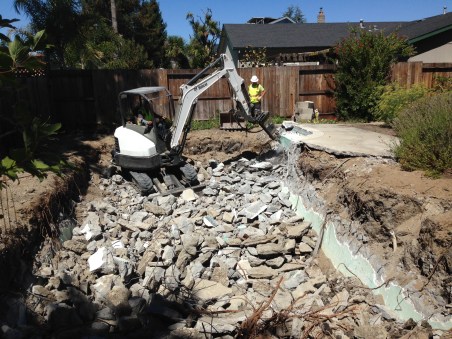
 The effect on the mind and psyche was similar, too. I knew this makeover was what I wanted, so I was willing to suffer the pain and discomfort, but the reality of being invaded and pummeled and realigned hour after hour — little foam earplugs couldn’t soften the attack. Yet I was spellbound by the show, and could not keep myself from going out again and again to watch the experts do their thing, and to document the progress.
 Pretty blank, isn’t it? You might notice that in the two top pictures, there were shrubs on the right. In the picture just above they are gone, too, scooped up in a few seconds by the power shovel. Soon paths will be laid, nice topsoil will be brought in, trees planted, and raised vegetable beds built. Many other features of this garden are on the drawing board, and I’ll be sure to tell about them as they come along. I wish it could all be done
 right now, but that’s not how life is.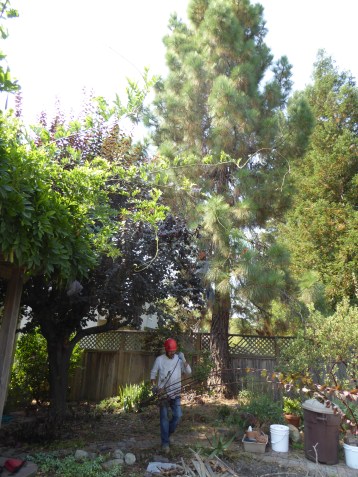



 Gladsome Lights