Tag Archives: fig

My tree is stressed and so am I.

The fig tree towering over my garden is loaded with fruit — but wait, what is wrong here? The figs are turning purple while they are still very small; they stay hard, they stay small, and they fall on the ground. You can see in the photo below how they don’t have enough water content to droop at all, and the sign of a ripening fig is that it droops more and more on its stem until it is hanging quite limp and juicy and sweet. I am distressed about the situation, but from what I’m reading the tree has been stressed. And I think I know why.

My wonderful new landscaper who turned out to be not so wonderful, adjusted my irrigation settings several weeks ago, and since then I’ve been concerned about a few plants that don’t look happy. When I checked the control box it appeared that everything was horribly mixed up, but I didn’t trust myself to understand it, so I had my neighbor down to look at the setup, and between us we got it straightened out.
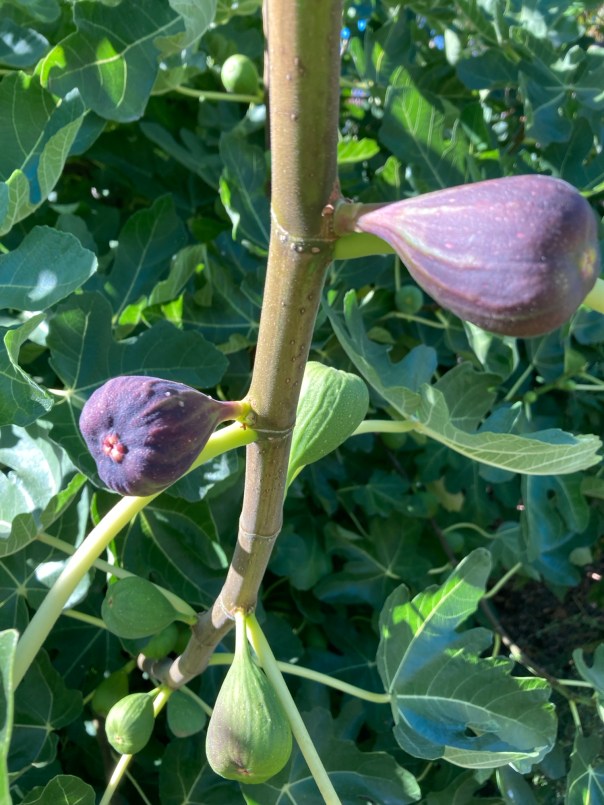
In the meantime the poor tree was very thirsty. Evidently when this happens the tree itself doesn’t show signs of stress, but it neglects the fruit ripening process. I have followed advice online to remove the smallest fruits at the ends of the branches, farthest from the tree; many of these were only 1-2 centimeters in diameter and probably would not have ripened before the frost anyway. Removing them lets the tree pour more energy into the larger fruit, and I hope at least some of them will ripen. I gave the tree a deep watering with the hose, too.

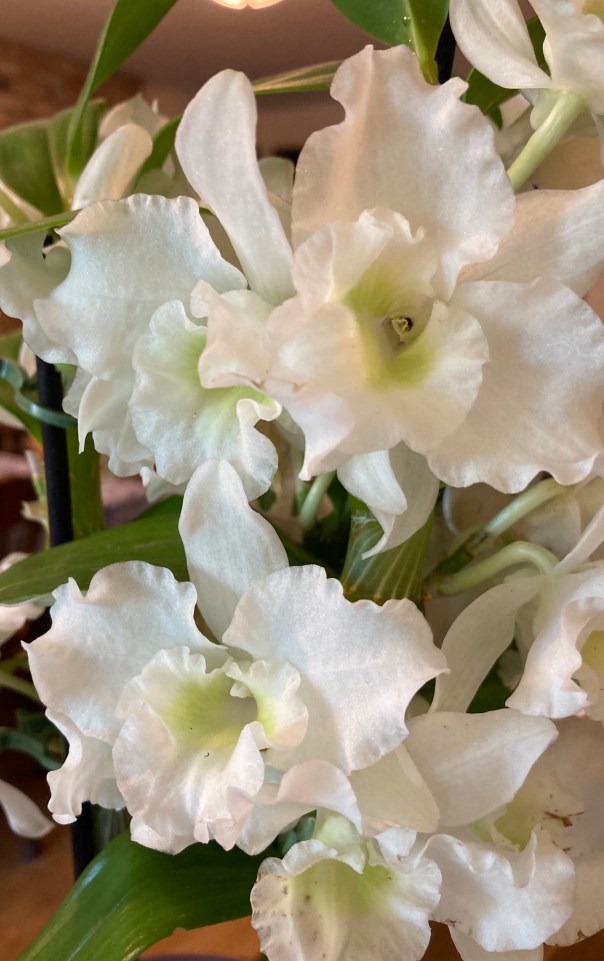
My newest orchid.

We’ve been having nice warm weather for a week or so, but at this moment it is raining. This afternoon the sun was shining and I had a young family for lunch. The children played in the garden and the playhouse, arranging salads on the little plastic plates. They’d collected snippets of parsley, mints, cherry tomatoes, rosemary, lavender, and even kale, and to top it off, asked me to cut up a lemon for them to squeeze over. They liked their salads better before the addition of lemon.

I showed them this bird’s nest that I found in the fig tree. It doesn’t look as though any baby birds hatched in it. It is very clean, and a unique building project. I see familiar materials from close by: cast-off garden twine (two types), needles from the Canary Island Pine, long Bermuda grass stems, and even dried nigella flowers. The strangest element, and not something I’ve seen outside here, is steel wool, forming the center of the bottom.

At least half the garden is in transition and upheaval right now; I will soon have all of the irises out and will amend the soil in several places before I put those back, or install the many new plants I have, or transplant old ones to an environment with more suitable amounts of sun.

milkweed

The tarragon has flowers! That was a surprise; it’s evidently a bigger plant than I can make use of anymore. It will go dormant soon…
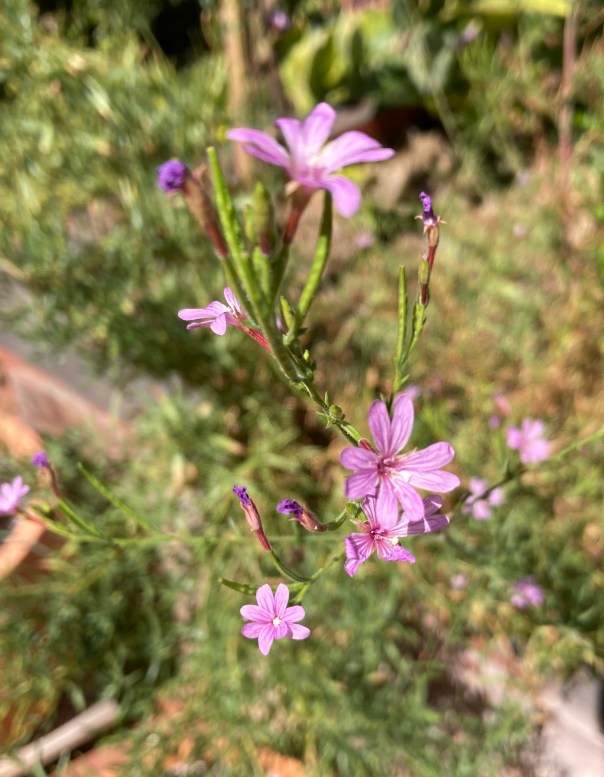
Tarragon flowers

I finally took the time to cut zinnias and bring bouquets into the house, for the sake of my lunch guests. They are like much of my backyard garden now, not getting as much sun as they used to, and they are leggy — but plenty productive. Yesterday I was able to spend quite a while, in the 90-degree heat, tidying up all over the place, so I feel better about the stuff that remains undone. And there are still twelve days left of September ❤

A May afternoon with friends.

cistus

After church on Sunday I had twelve friends over for a little party. Half of them were children under ten, and all of those had been in my house before; they fell to right away playing with my dress-up clothes, dolls, and matchbox cars. At one point the squirming baby let me remove her to the armchair in the play area where we read a couple of stories together, so that in the other room her mother might drink tea with both hands.

dwarf pomegranate and helianthemum

The weather had warmed up just enough between Saturday and Sunday to make it pleasant for eating outside, and for the children to enjoy organizing the playhouse. I had spent more time cleaning that little hut in preparation than I did the real house — but I still have not sewn new curtains for its window, in these ten years since it became mine.

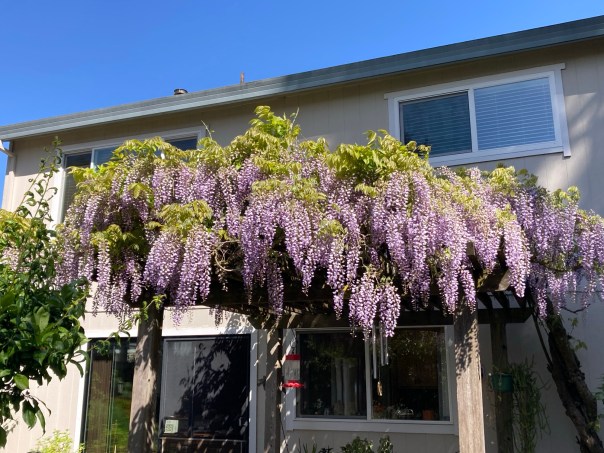
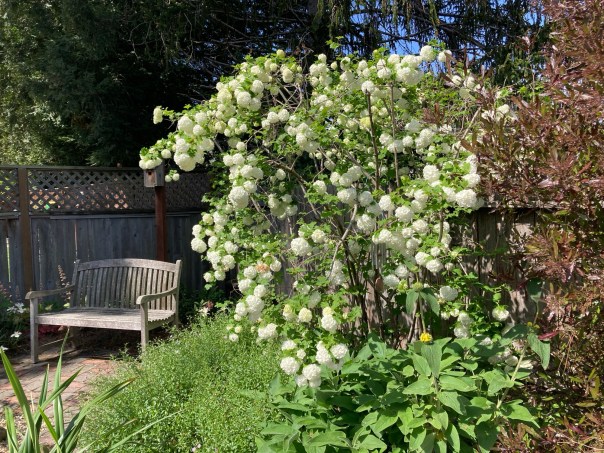
May is in many ways the perfect month for a garden party, because of the variety of blooms — and what a joy to have other people soaking up the beauty with me. This spring, since I “lifted the skirt” on the pomegranates, the orange helianthemums are bursting with more flowers than ever before; the wisteria is in its prime, and the bees are buzzing all over it. The snowballs on the viburnum are at their best. And we have the possibility of temperate and sunny afternoons. I always think it should be easy to host more such gatherings, but just finding a date that works for everyone takes a lot of effort; in this case I’d begun that process seven weeks ahead.

snowball bush

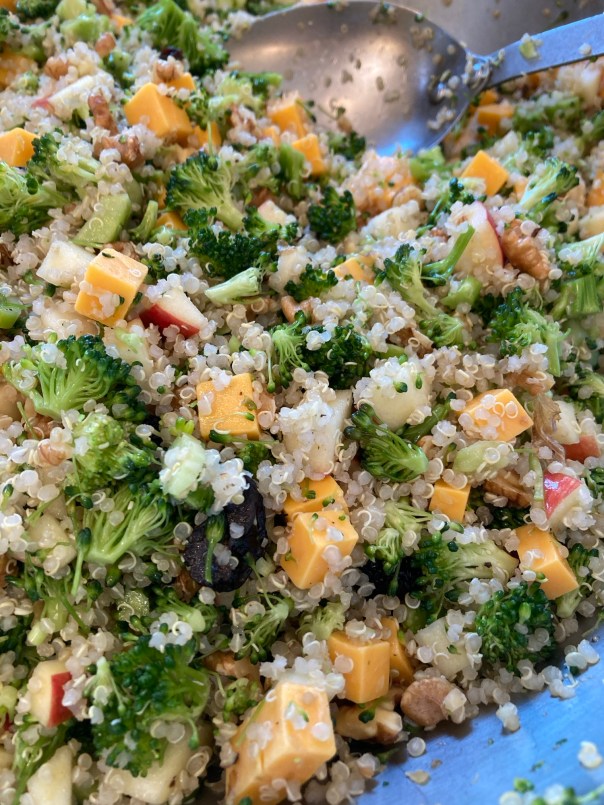
I’d started planning the menu, too — it needed to be items that wouldn’t need fussing over that day. One thing I made the evening before was this favorite quinoa salad that is tweakable to what one has on hand, which I found on the New York Times cooking site. I am unlocking the recipe for you, and you can access it through the link: Quinoa and Broccoli Spoon Salad.

A warning about the quantity of salad that came from one of the cooks who joked about it supposedly serving 4-6: “…it serves 4 to 6 distance swimmers during an Olympic training camp.” I used two cups of quinoa and ended up with plenty left over for my guests to take home plus more than I can eat staying here. I don’t like mustard so I left that out, and I used dried California cherries instead of cranberries, toasted walnuts instead of pecans. I like these NYT recipes because the cooks who try them share things they learned when making them according to the original instructions, or after they alter various ingredients or procedures.

figs in the fall

Few people like raw broccoli, but as I have learned and other cooks testified, the dressing in this dish quickly marinates the small pieces of broccoli and removes the unpleasant rawness, while retaining a little crispness.

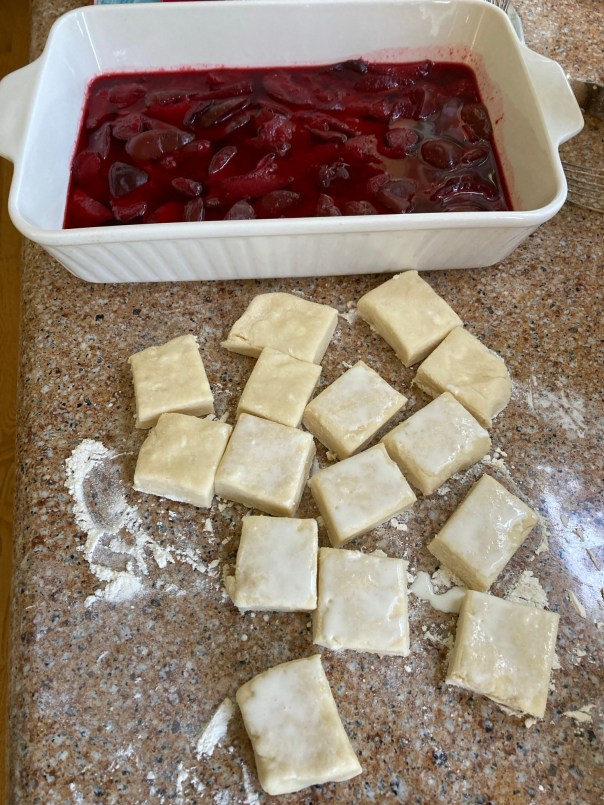
In an effort to use up foods from my freezer and pantry, I made one dessert using plums from my trees that I’d put by last summer, and another dessert using figs that I had tried freezing raw for the first time. Both worked well and were heartily eaten. Plum and Cream Scone Cobbler from Smitten Kitchen I’ve made before with peaches, but this time I had enough plums to use them.

It was delicious, but I will change some things if I make it again. The scones that make the cobbler topping are just too rich, with a whole stick of butter and a cup of cream in the dough. At least, they are too rich combined with the amount of fruit called for. Maybe I would decrease the butter by half next time, and use at least 50% more fruit. (Ha! I see that last time I made it I told myself to make those very changes next time, and forgot.) I also seem to have cut my scones too large…

My guests and I didn’t only talk about books over the course of our leisurely afternoon, but many book titles popped up in our conversation, more than I even know about. A few that I can recall just from our last hour together were: The Ethics of Beauty; St. Ephrem the Syrian: Hymns On Paradise; The Hidden Rainbow; Christ the Conqueror of Hell; The Little Liar; and Orthodoxy and the Religion of the Future.

At one point I ran upstairs to get this book to show the others, my latest deep read. They all had a good laugh with me. It’s not just goofy, but is actually a very thought-provoking book! Maybe I will tell about here it sometime: How to Talk About Books You Haven’t Read. I do a lot of that already, but I’m sure there’s room for improving my skills.

Usually when children play in the playhouse, they like to prepare salads or other halfway-pretend dishes made of all the edibles I give them permission to pick from the garden, including flowers as well as vegetables.

collard flowers

I meant to point my younger guests to my exuberantly flowering kale, parsley and who-knows-what in the planter boxes I am not cultivating right now, but I never got around to it. After everyone had gone home I checked out the back garden to see if there was the sort of happy mess I’m used to in and around the playhouse. There was no evidence that anyone had done any “cooking,” but rather a lot of setting in order, with the dish soap by the sink and a lavish bouquet completing the scene. It was symbolic of all that I had received from my guests who gave me an afternoon in spring.

The mood and the glow.

Today was Palm Sunday for us Orthodox Christians, and tonight I attended the first of the Bridegroom Matins services. Until this year, at least as long as I’ve been a member, our parish has held this service in the morning, but this year we are doing it in the evening. Here is an explanation of the tradition:

“Bridegroom Matins is a service specific to the first four evenings of Holy Week and commemorates the last days in the earthly life of the Lord. Incorporated into these services is the theme of the first three days of Holy Week; which is the last teachings of Christ to his disciples. As such, these services incorporate readings and hymns inspiring this theme. The mood of the services is to experience sorrow and to feel Christ’s voluntary submission to His passions and highlight the purpose behind the evil that is about to take place against the Lord. The atmosphere is one of mourning (for sins) and is symbolic of the shame the Christian should feel for the Fall of Adam and Eve, the depths of hell, the lost Paradise and the absence of God.”
Those mornings that seem so long ago, I would arrive in the dark, and come out from the service after the sun had risen; many times I’d walk around the church property and take pictures before driving home. This evening, I came straight home and visited my own garden, which was radiant with the setting sun after a rainy day.

One of the Gospel stories featured in today’s Matins service is the parable of the barren fig tree. Here is my own tree, that is not likely to be fully illustrative of that parable, come fall.

At least seven Psalms are read at every Orthodox Matins service, and tonight two more were read, including this one:

Psalm 19 (20)

May the Lord hear thee in the day of tribulation:
may the Name of the God of Jacob protect thee.

May he send thee help from the sanctuary:
and defend thee out of Zion.

May he be mindful of all thy sacrifices:
and may thy whole burnt offering be made fat.

May he give thee according to thine own heart;
and confirm all thy counsels.

We will rejoice in thy salvation;
and in the Name of our God we shall be exalted.

The Lord fulfill all thy petitions:
now have I known that the Lord hath saved his anointed.

He will hear him from his holy heaven:
the salvation of his right hand is in powers.

Some trust in chariots, and some in horses:
but we will call upon the Name of the Lord our God.

They are bound, and have fallen,
but we are risen, and are set upright.

O Lord, save the king:
and hear us in the day that we shall call upon thee.

What any kind of pruning can do.

It’s surprising how much glory has bloomed and gone, in my garden and by the creek. Well before the end of July we’ve cut back the purple explosion of germander and forced the bees to move to the echium and salvias, which continue to branch out and lengthen their nectar offerings. The Jerusalem sage and lavender I always think of as long-lasting…. How can they be done? Santa Barbara daisies at least come again and again after each shearing.

By the creek, the Queen Anne’s Lace and fennel will continue for months more, and other insects feed on them. But I never see honeybees there.

Early on when the gyms first closed because of the covid-19 quarantine and more people were walking those creek paths, I saw that many of the fennel plants down there had been mutilated and dishonored. I wished I had clippers with me so I could cut them off neatly to relieve the humiliation.

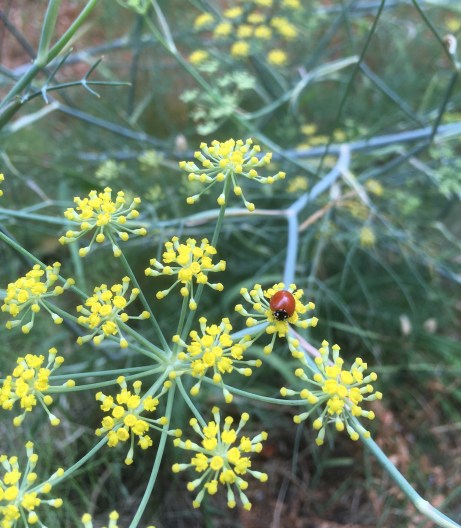
But three months later, those same plants are most beautiful! For all they cared, the breakage of their stems might have been expert pruning by loving horticulturists. Now those specimens have branched out gracefully to outshine their fellows that shoot straight up. The ladybug above is posing on one.

Last fall I planted a few begonias in pots on the patio, but so far only this older one has opened:

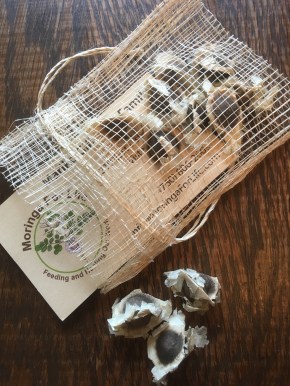
In the vegetable boxes many of the things I planted rather late and experimentally did not even sprout, but currently collards are coming along. And in the greenhouse, moringa! I bought the seeds two years ago at an event I blogged about: here. (I also had a bunch of little amaranth plants from that source growing nicely, but something ate them off at the stem.)

This spring I managed to keep three of the seeds warm and moist long enough for one of them to sprout. If the seeds had not been so unusual, I might not have invested in the project, but who knows… and whether I will ever use it, no one can predict that, either!

I plan to grow my little tree in a pot, and then a bigger pot if I manage to keep it alive long enough for it to outgrow containers. The leaves can be used like spinach, or for tea. It’s supposed to be one of those “superfoods,” which I’ve noticed become fads and then after a while you don’t hear about them anymore. I’m more interested in this species because it’s not a sweet fruit to add to the carb load of a diet.

My fruit trees are looking good. The plums and fig got their solstice pruning to keep the size down. For the fig, that mostly meant taking a foot or two off the top. I’m keeping them at a size where I can pick the fruit without a ladder, and take care of the trees on my own. The fig tends to grow horizontally, which makes it easy for me; it’s a dwarf species also, called Blackjack. But it doesn’t seem particularly dwarfish in its fifth season of bearing! It’s loaded with fruit. Yum.

I have four Elephant Heart plums on my two trees, which this morning I thought I better take pictures of, because in previous years they have not only started out few but mostly disappeared. My lemon tree I have in the last year or so been more diligent than ever to feed regularly, and it has responded by producing a score at least of little lemons that are getting big fast. They will be ripe next winter.

Must leave you now and go see what else needs pruning!