Tag Archives: Fr. Alexander Schmemann

We thirst for time’s transformation.

I continue my alphabetical posts, from which I took a Holy Week hiatus after “S for squash.” That brings me to “T” for — what else? — time.

In my recent musings on the meaning of kairos vs. chronos, I found this passage from Fr. Alexander Schmemann’s journals:

This morning during Matins I had a jolt of happiness, of fullness of life, and at the same time the thought: I will have to die! But in such a fleeting breath of happiness, time usually schmemann close 16‘gathers itself.’ In an instant, not only are all such breaths of happiness remembered but they are present and alive — that Holy Saturday in Paris when I was a young man — and many such ‘breaks.’ It seems to me that eternity might not be the stopping of time, but precisely its resurrection and gathering. The fragmentation of time, its division, is the fall of eternity. Maybe the words of Christ are about time when He said, ‘…not to destroy anything but I will raise it all on the last day.’ The thirst for solitude, thirst for the transformation of time into what it should be — the receptacle, the chalice of eternity.

The Kairos in my week.

While it is still this week in chronos, I must tell about the several ways kairos has made its impression on my heart and mind.

Last Sunday when I was zooming with my friends up the Nevada highway to church, we passed a car whose license plate read “Kairos.” We knew that Greek word from its use at the beginning of Orthodox Divine Liturgy, when the Deacon proclaims, “It is time (kairos) for the Lord to act,” so it seemed to us a fundamentally theological word, and with the aid of my phone we researched and discussed the concept as we rolled along, and wondered if the vehicle belonged to someone we would be worshiping with in a few minutes.

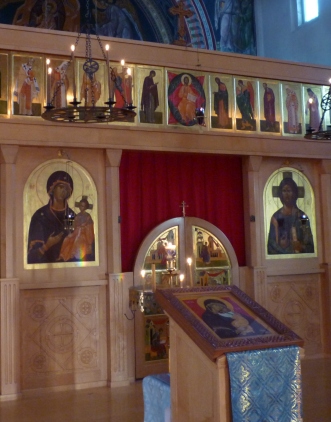
gl iconostas crp P1110337

It was the Sunday of the Last Judgment, and in the homily our attention was directed to the icons on either side of the doors to the altar. On one side is the icon of The Incarnation, and on the other, of The Pantocrator, or Judge. Everything in between happens right here, Fr. Stephen said, in the Church, from the altar and in the Holy Mysteries, bringing heaven to earth and joining all who partake or have died in Christ. We had just an hour earlier read on Wikipedia that kairos refers to “a moment of indeterminate time in which everything happens.”

The meaning and reality of Time is a deep well into which I love to dip, with my mind, but it is a heady beverage and makes me dizzy. I didn’t do any further reading this week, as I plodded on through chronos — chronological time — and tried not to get behinder in it and in my housework and tax preparation and garden planning….

I plodded, because after my joyous interlude of a kind of kairos, about which I wrote in my last post, I returned to my house that still seems empty without my husband, to my responsibilities that continue to overwhelm me, to a future whose unknowns appear daunting, now that I have to meet them without my life’s companion. And in less than two weeks we will come to the one-year mark, of his death. Is there another kind of time that reflects what I feel, that it was only last month? Or that it is a perverse, somehow false, fact? I guess that would be called grief.Minarets Wild. 81

Yesterday I spent most of the day updating my screensaver, which right now is scrolling through a folder of photos named “Mr. Glad.” I had decided it didn’t have enough files in it, so I combed through all the other folders to find more images of him, and I was very nurtured by reviewing his life, and my life with him, in this visual way. We had over the last years scanned hundreds of pre-digital photos into the computer, so there he was as a little boy laughing on his father’s lap, bursting with the energy and zeal of youth at our wedding, cradling our newborn babies or reading to our little children; singing with his strong and beautiful voice in church, backpacking with his kids, giving me a kiss on the cheek while I was standing over the stove.

My housemate Kit had never met my husband, and she was glad to look through many of the pictures with me and hear some stories. It made me happy to collect my pictures, and even happier to have her to share them with. I went contentedly to bed and sleep last night.

Bill and Gretchen at lake, on dome

I hadn’t planned to attend Liturgy this morning, for the Commemoration of the Holy Monastic Saints. But I woke at 4:30, and after an hour passed and I couldn’t go back to sleep, I turned on the light and got up, and it seemed at the time that God had awakened me so that it would be easy and sensible to go to church. And there is nothing that makes me feel so needy for the Holy Mysteries as missing sleep!

(Which reminds me of how we moderns are so far removed from the sacredness of even chronos that we have to try to control it with our silly clock changes.)clock antique look

I went back to my rest and dreams after all, not before a good session of musing on how this month is likely to be harder than I expected. I woke at last in time to get to church, where I was surprised that in addition to the Holy Ascetics, we were remembering a beloved priest from San Francisco, who reposed ten years ago this day.

In his homily and other remarks, our rector brought up the reality of kairos, speaking of how in the church, in the Liturgy, we are joined together with everyone who has ever died in Christ. He said, “It is common to hear, ‘I have Christ in my heart,’ but we also can have a little of each other in our hearts, because we are brought into the Kingdom, in that moment of kairos.” It was what I needed to be reminded of this morning: not my loss, but the enduring nearness of my dear husband.

Now I want also to read more about this truth, this kairos that I experience. I imagine that Fr. Alexander Schmemann’s book The Eucharist will speak a good deal to the subject, and just this afternoon I ran across a pertinent article, on The Chalice of Eternity. It will be a good place for me to start. Here is a quote from what appears to be a thorough treatment of time in all its facets and forms:

In Christ, as the Lord of Time, is realized the ingathering of all moments in one moment of what we might call an ‘eternal temporality’ and which Schmemann calls temps immobile, that is, the co-inherence or co-presence of each part of time to each other in the present in Jesus Christ. Christ is Himself the Lord of Chronos or time proper because He is the Kyrios Kairou, Lord of the appointed time of our salvation. In Him, our broken mode of temporality, chronos, is renewed and sanctified, ascending with Him to the Father and becoming a spiritual mode of time through its marriage with creaturely eternity (aeon). But when He returns to us in His Body and Blood in the liturgy, which is both our ascent to God and His descent to us, we see that our new mode of time, eternal temporality, is something radically new to creation, sensible and spiritual at once, as it has partaken of the very mode of God Himself as everlasting Trinity (aidiotes), God before the ages.    -Dr. Brandon Gallaher

Tomorrow is the Sunday of Forgiveness, and The Casting out of Adam and Eve from Paradise. And then (for us Orthodox) Lent begins! May the everlasting Trinity use this blessed season to reveal to us Himself and all of His Truth, including the reality and fullness of kairos. Amen.

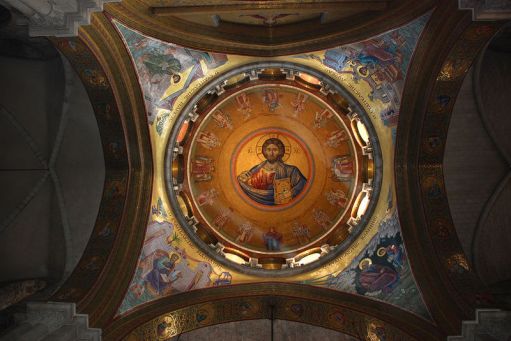
pantocrator dome in church


Lazarus and Flowers

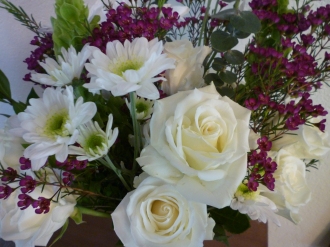
In the West it is the end of Good Friday as I write, but this year for us Orthodox it issymp white roses the beginning of Lazarus Saturday, when we remember an event that starts out very poignantly, with Jesus’s friends lamenting the death of their brother, and Jesus Himself weeping.
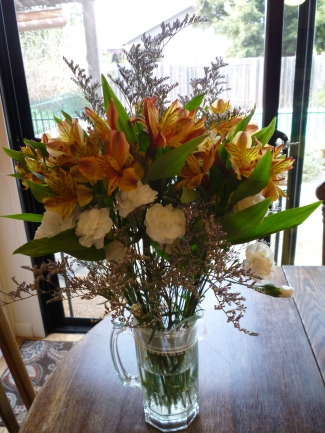

This story of a death and of friends and family sorrowing is timely in my own life right now, and of course I have done some weeping lately – but mostly I wanted to write about the flowers that have come to me, and I may be stretching a bit to connect all these thoughts together.

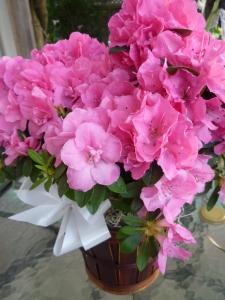
Flowers have been coming into our house nearly every day for more than two weeks. They are beautiful bouquets and arrangements and plants, and when the first one arrived, before my husband died and on our wedding anniversary, the circumstances made it obvious that God had sent it by the hand of an angel, to convey His love and to assure me that Hebouquet CMc 2 will be my Husband, as it says in Isaiah 54: “For your Maker is your husband; the LORD of hosts is his name; and your Redeemer the Holy One of Israel….” I cried a good deal over that bouquet, and as the florist delivery man and I became better acquainted day by day, I received every new gift with joy.

We know flowers not just as symbols, but primarily as real and exquisite works of art, lovely in themselves. I think the florist noticed the repeated name on each order and tried to make every creation a little different; we have been enjoying dozens of varieties and species of blooms, ferns, branches of shrubs, succulents in ever-changing combinations, all gorgeous.

Other friends brought their own original and unique arrangements, or sometimes just a contribution to a nosegay. Each was given a place in the house where it could minister to the crowd of family who were coming and going for a fortnight and often sleeping here (One night 15 of us slept under this roof.), but I think I was the symp mix w lupinemost nourished of anyone by all the sweet flower-love. These real and aromatic things helped to keep me aware of God’s presence as much as did the kind messages in cards, and the care packages of fruit and candy.
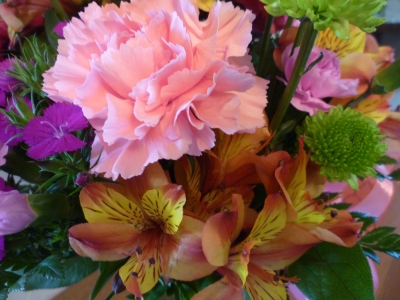
They also gave me a job to do. While my children took over the more difficult practical matters of phone calls, shopping, cooking and organizing a funeral, I was able to wander about tending my flowers, trimming the stems, changing the water, removing spent ones and recombining the longer-lasting blooms (Carnations win the prize for aging well.). It was and is an easy sort of gardening, and very soothing.

People have given our family flowers and other kindnesses because they love us; that makes them feel our sorrow with us. We don’t really need any more explanation than that, but there is another aspect to our sorrowing. I find what Fr. Alexander Schmemannsymp azalea says about Jesus’s tears to be helpful:

He weeps because He contemplates the miserable state of the world, created by God, and the miserable state of man, the king of creation… “It stinketh,” say the Jews trying to prevent Jesus from approaching the corpse, and this “it stinketh” can be applied to the whole of creation. God is Life and He called the man into this Divine reality of life and “he stinketh.” At the grave of Lazarus Jesus encounters Death — the power of sin and destruction, of hatred and despair. He meets the enemy of God. And we who follow Him are now introduced into the very heart of this hour of Jesus, the hour, which He so often mentioned. The forthcoming darkness of the Cross, its necessity, its universal meaning, all this is given in the shortest verse of the Gospel — “and Jesus wept.”
….

symp tulips The power of Resurrection is not a Divine “power in itself,” but the power of love, or rather, love as power. God is Love, and it is love that creates life; it is love that weeps at the grave and it is, therefore, love that restores life… This is the meaning of these Divine tears. They are tears of love and, therefore, in them is the power of life.
Perhaps Mary and Martha didn’t have as many flowers as I do when Lazarus died. They likely did have flower essences in the ointment they would have used to prepare their brother’s body for burial.

And they had the Lord, not just weeping with them for the wrongness of death, but in His love giving the ultimate gift, His own Self. Without the knowledge of that Love and the assurance of a coming Resurrection, what flowers can give wouldn’t be very satisfying. But while my husband walked this earth he and I shared Christ’s life-creating Love, and we still do. Flowers are one more reminder of that reality to my still-weeping heart.

symp w carnation

Mary also was given a gift.

This week we Orthodox celebrate one of the Twelve Great Feasts of the Church, The Birth of Christ’s mother Mary, whom we Orthodox call the Theotokos. This name, which means God-bearer, honors Jesus Christ in that it contains the statement of our belief that He is “…very God of very God, begotten, not made, being of one substance with the Father.”

In this article about the feast Fr. Alexander Schmemann tells us that Mary’s birth was not unlike that of any other human, with all its gifts and potential. Putting it that way, though, belies the immensity of what happens when someone is born, if you believe Fr. Alexander who says that “…with each birth the world is itself in some sense created anew and given as a gift to this new human being to be his life, his path, his creation.” This is hard for me to wrap my head around; probably because it’s something that the heart has to learn.

Mary was given this gift – and she gave the world a great gift. Certainly she played a big role in our salvation history, and we love her for it, and love to celebrate her birthday.

These excerpts are from a slightly longer article here: On The Nativity of The Theotokos

Nat_Theot

THE BIRTH OF THE THEOTOKOS:

Son of God, Son of Man… God descending and becoming man so that man could become divine, could become partaker of the divine nature (2 Peter 1:4), or as the teachers of the Church expressed it, “deified.” Precisely here, in this extraordinary revelation of man’s authentic nature and calling, is the source of that gratitude and tenderness which cherishes Mary as our link to Christ and, in Him, to God.

And nowhere is this reflected more clearly than in the Nativity of the Mother of God. Nothing about this event is mentioned anywhere in the Holy Scriptures. But why should there be? Is there anything remarkable, anything especially unique about the normal birth of a child, a birth like any other?

The Church began to commemorate the event with a special feast…because, on the contrary, the very fact that it is routine discloses something fresh and radiant about everything we call routine and ordinary, it gives new depth to the unremarkable details of human life…. with each birth the world is itself in some sense created anew and given as a gift to this new human being to be his life, his path, his creation.

This feast therefore is first a general celebration of Man’s birth, and we no longer remember the anguish, as the Gospel says, “for joy that a human being is born into the world” (Jn. 16:21). Secondly, we now know whose particular birth, whose coming we celebrate: Mary’s. We know the uniqueness, the beauty, the grace of precisely this  child, her destiny, her meaning for us and for the whole world. And thirdly, we celebrate all who prepared the way for Mary, who contributed to her inheritance of grace and beauty….

And therefore the Feast of her Nativity is also a celebration of human history, a celebration of faith in man, a celebration of man. Sadly, the inheritance of evil is far more visible and better known. There is so much evil around us that this faith in man, in his freedom, in the possibility of handing down a radiant inheritance of goodness has almost evaporated and been replaced by cynicism and suspicion.

This hostile cynicism and discouraging suspicion are precisely what seduce us to distance ourselves from the Church when it celebrates with such joy and faith this birth of a little girl in whom are concentrated all the goodness, spiritual beauty, harmony and perfection that are elements of genuine human nature. Thus, in celebrating Mary’s birth we find ourselves already on the road to Bethlehem, moving toward the joyful mystery of Mary as the Mother to God.

—Fr. Alexander Schmemann