Tag Archives: Fr. Stephen Freeman

My gleanings include rubbish and pies.

I guess I’ve had enough time and thinking power this week to read and ponder, but my activities didn’t result in anything of my own to posit or report, so I’ll just pass on some recent gleanings.

Women Priests?  I love it when a reviewer is bold enough to say “This book is rubbish.” Honesty and confidence! Although, if that’s all she can say, she won’t get a hearing; I want to hear reasons for her belief. I just read this blog post titled “Merlin Stone’s book is rubbish”, and though I had never heard the author’s name before I immediately wanted to read that article.

It’s a brief review of  When God Was a Woman, which the blogger first had to read in seminary years ago. She writes, “There is neither historical nor anthropological support for her thesis that the Hebrews suppressed goddess worship. She tries to prove that the Canaanites had a matriarchial and matrilineal structure. She is wrong on both counts.” Go to the blog Just Genesis to read the supporting details. The writer always has lots of fascinating historical and archeological knowledge to pass on.

Pies, pies, pies... Three women collaborated on a book, which as soon as I read about it I had to have sent as a birthday gift for my granddaughter. It may be a bit early for her, but I like to encourage little girls to start taking a creative role in the kitchen and to look to real grownups for inspiration.

The book is Pieography, written by Jo Packham, Food Styling by Anne Marie Klaske, Photography by Traci Thorson. All of these women have blogs; Jo and Traci feature photos of some pies, but I think you have to get the book if you want the recipes and stories.

I haven’t seen the book yet, but I’ve enjoyed Anne Marie’s blog in particular. The clean and elegant style is nice to surf around in and see snippets of the Klaske Family’s farm life. On Thursdays you can get inspired to bake pies!

Death of the Old Man:  Father Stephen Freeman shared a link to his daughter’s blog, on St. John of the Cross and the loss of identity, or the Dark Night of the Soul, or the “death of the old man.” Actually the subtitle of the post is “The Loss and Discovery of our Identity in God” (italics mine), so it ends on a very positive note, to be sure.

She writes, “If we had always thought of the death of our old man as purely symbolic, it may come as something of a shock to think of real pain being involved. But when our turn inevitably comes to go through pain or tragedy, then we may take comfort in knowing that many have travelled down this path before us.”

Icons and Images:  A book on the history of the use and theology of images in Jewish culture and in the church is the subject of this blog post on Orthodox-Reformed Bridge. Early Christian Attitudes Toward Images is written by Stephen Bigham, and a series of four blog posts is planned to review the book. This structure follows the organization of the book:

The book is divided into four chapters. Chapter 1 deals with the “hostility theory” which holds that the early Christians were hostile toward images. Chapter 2 deals with early Jewish attitudes toward images. Chapter 3 deals with the early Christian attitudes towards images, that is, the pre-Constantinian period. Chapter 4 deals with Eusebius of Caesarea who witnessed the beginning of Constantinian era.

The author is an Orthodox priest, and the blogger Robert Arakaki was Reformed in his theology before converting to Orthodoxy. I’m looking forward to reading all the reviews of what looks to be a thorough treatment of the subject.

Beethoven in Space:  Lastly, here’s a music video featuring Hubble images and beautiful music. A blessed weekend to you all!


St. George

From Everywhere Present by Fr. Stephen Freeman:

“The body of Christ is one Body. There is only One Church — not divided between those who have fallen asleep in Christ and those who remain behind. Whether we are here or in the hand of God, the struggle is the struggle of the whole Church. My success or failure in my spiritual life is not my private business, but the concern of a great cloud of witnesses. Neither are they watching only as disinterested bystanders. They urge us on and support us with their prayers. Were they to watch us without participating at the same time in our struggles, the watching would be like torture. As it is, their watching is prayer and participation of the deepest sort.

“It is for this reason (among many) that many services in the Eastern Church contain the phrase, ‘Lord Jesus Christ, through the prayers of our holy fathers, have mercy on us and save us.’ It is a humility of sorts, a demurring to the prayers of greater Christians — but it is also calling on a reality that abides. We are not alone. The great cloud of witnesses stands with me and in me in prayer.

“Every prayer we ourselves offer is a participation in the life of the world. We have a participation in the great cloud of witnesses, but we also have a participation in everyone who is. The prayer of a righteous few has an amazing salvific impact on the life of the world. If they’d had but a few more righteous men, Sodom and Gomorrah would still be standing. To this day we do not know how many or how few, in their righteous prayers, preserve us before God”.

Today, April 23, we remember Holy Greatmartyr, Victorybearer and Wonderworker George, and ask him to also remember us to God.

I’m jumping in with joy.

blessing-creek1

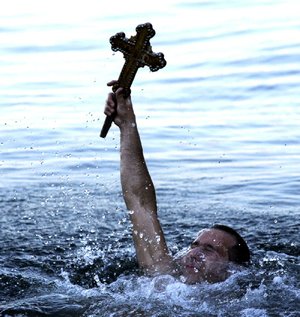
It’s the Feast of Theophany! How can I not post something on this day when there is blessing abounding to the degree that people want to jump into icy waters over it? I am caught between the impulse to spread the riches around, and the awareness of the extreme limitations of my mind when the meaning of Christ’s baptism is set before me. There is a lot to take in and try to absorb at Theophany, regarding the Baptism of Our Lord.

Orthodox Christians celebrate Theophany in various ways around the world. Some release doves as a symbol of the Holy Spirit while others toss crosses into water in remembrance of Christ’s baptism. Young boys or men often dive into the water to retrieve the cross. I know what I’ll do — I’ll post a link to Father Stephen Freeman’s recent blog on the subject. An excerpt:

St. John himself does not seem to understand the purpose of Christ’s Baptism. He is told that “whomever you see the Holy Spirit rest upon and remain” is the Messiah – but he is given little information beyond that. Witnessing Christ’s Baptism and the Spirit resting upon Him, he hears the voice, “This is my beloved Son in whom I am well pleased” (Matthew, Mark and Luke all bear witness to the voice).  The Church later celebrates this manifestation of the Trinity (Christ in the water, the Spirit descending, the Voice of the Father – hence the title “Theophany”).

But with the text alone, on its literal level, we are left with a mystery, without context or meaning. The Tradition of the Church, however, sees the Baptism of Christ in the context of Pascha (Easter) as it sees everything in the context of Christ’s Pascha. Christ’s Baptism is a foreshadowing (and on more than a literary level) of His crucifixion and descent into Hades (just as our own Baptism is seen by St. Paul as a Baptism into Christ’s “death and resurrection”).

When he goes on to explain that in the workings of God in the world, the literal is not all there is, he quotes Fr. Andrew Louth:

Allegory is a way of entering the ‘margin of silence’ that surrounds the articulate message of the Scriptures, it is a way of glimpsing the living depths of tradition from the perspective of the letter of the Scriptures.

There is so much to think about, even if you aren’t part of the Orthodox Tradition in which we will be participating on the praxis level by blessing urns of water, creeks and lakes and oceans of water. In parishes everywhere priests will be blessing houses as my rector described in our newsletter, so as to bring “the joy of the feast of the manifestation of the Holy Trinity to each and every dwelling. Think of the house blessing as a renewal of God’s grace in your home.”

How could we not be welcoming of that? I won’t be jumping into any frozen streams, I hope ever, but I will certainly have the joy of the feast.

O Christ our God,
 Who hast revealed Thyself,
And enlightened the world,
Glory to Thee.

Can consumers be saved?

In trying to understand ourselves, people have worked out different ways to analyze aspects of the human person. Are we spirit-soul-body or mind-emotions? Is it body-and-intellect, or heart vs. head? It’s too bad we have to be always chopped up into warring interests. God intended for us to be unified creatures, as the Holy Trinity is a Unity, but only by God’s grace can we begin to know some of that intended wholeness.

What is the heart? Surely it’s not just the emotions, as many moderns seem to think. The Orthodox Church understands the heart very differently and more deeply than this. The Greek word nous, the fathers tell us, is not easily translated into English. But some current writers have been able to get through my dullness and give a little more clarity.

One of these is Fr. Stephen Freeman, and his recent blog post “Shopping for God” contains a lot of nourishment that will take me some time to soak up thoroughly. My title is a question posed at the end of his article written on Black Friday Eve.

I haven’t finished my Christmas shopping, but even when I come to the end of that I know there will be other anxiety-producing prompts to and from my false self, so I appreciate Fr. Stephen’s reminder of my inheritance in Christ, and His Kingdom within.

Here are some excerpts:

Shoppers desire beauty, acceptance, self-confidence, power, intelligence, pleasure, excitement, a host of intangible needs. They are not natural needs, but the passions of the spiritually disordered. Our unnatural existence is centered in the false self — the sense of identity generated within our memory, thoughts and emotions. It is burdened with uncertainty. Comparing, judging, measuring, revising are constant activities of the mind in its role of the false self.
 ………

Christ at the well

The human life was created to be centered in the heart, the spiritual seat of our existence. The heart is not subject to the passions, not driven by desire and necessity. It is not the same thing as the mind. It does not compare or judge, measure or spin tales of its own existence. It simply is. It is in the heart that we know God (truly know). Its aesthetic is true beauty, found within the most ordinary of objects as well as in the greatest efforts of man. The heart is content.