Tag Archives: Fr. Stephen Freeman

Can consumers be saved?

In trying to understand ourselves, people have worked out different ways to analyze aspects of the human person. Are we spirit-soul-body or mind-emotions? Is it body-and-intellect, or heart vs. head? It’s too bad we have to be always chopped up into warring interests. God intended for us to be unified creatures, as the Holy Trinity is a Unity, but only by God’s grace can we begin to know some of that intended wholeness.

What is the heart? Surely it’s not just the emotions, as many moderns seem to think. The Orthodox Church understands the heart very differently and more deeply than this. The Greek word nous, the fathers tell us, is not easily translated into English. But some current writers have been able to get through my dullness and give a little more clarity.

One of these is Fr. Stephen Freeman, and his recent blog post “Shopping for God” contains a lot of nourishment that will take me some time to soak up thoroughly. My title is a question posed at the end of his article written on Black Friday Eve.

I haven’t finished my Christmas shopping, but even when I come to the end of that I know there will be other anxiety-producing prompts to and from my false self, so I appreciate Fr. Stephen’s reminder of my inheritance in Christ, and His Kingdom within.

Here are some excerpts:

Shoppers desire beauty, acceptance, self-confidence, power, intelligence, pleasure, excitement, a host of intangible needs. They are not natural needs, but the passions of the spiritually disordered. Our unnatural existence is centered in the false self — the sense of identity generated within our memory, thoughts and emotions. It is burdened with uncertainty. Comparing, judging, measuring, revising are constant activities of the mind in its role of the false self.
 ………

Christ at the well

The human life was created to be centered in the heart, the spiritual seat of our existence. The heart is not subject to the passions, not driven by desire and necessity. It is not the same thing as the mind. It does not compare or judge, measure or spin tales of its own existence. It simply is. It is in the heart that we know God (truly know). Its aesthetic is true beauty, found within the most ordinary of objects as well as in the greatest efforts of man. The heart is content.


Jesus, unbind us!

For Orthodox Christians, today is Lazarus Saturday. We don’t celebrate Easter until next week, but the raising of Lazarus gives us a glimpse of Christ’s own rising from the dead a week later, and of our own coming resurrection.

This year I am a sponsor/godmother to a catechumen who will be baptized a week from today; last night I attended the last of her classes with her, and listened in on the explanation of all the services to come this week, and their meaning in our lives.

I was reminded of my own baptism five years ago, and also filled with joy in remembering and anticipating the many stops along this last stretch of the journey to Pascha. The liturgical landscape is marked by beloved hymns and prayers I have sung year after year, and which will bring me into the shining presence of Christ again, by His grace.

It’s easy to be emotional today, even thinking about an experience that is not primarily emotional, because I am housebound for a relatively minor disability, and have to miss a few services this coming week. So I’m feeling sorry for myself, but trying to be thankful at the same time, and accept all the blessings God is giving me.

When God is constantly pouring down love and blessing, it’s easy to get overwhelmed or confused. One day, the blessings look to any passerby to be good fortune, and another day, it takes a discerning eye to see Him, and be at peace. Even in the church services there are so many “things” going on that I can never attend to them all at once. One time I notice a particular hymn and how it blends perfectly into the whole message of the day; another time I spend most of the service in a battle just to return again and again from my distracting thoughts.

In my large parish we have numerous opportunities to participate in the services held, especially during Lent and Holy Week. I’m sure there is no one who can attend all of them, even the priests. Because circumstances change, including the circumstances of our own hearts and health, every Lent is at least a little different in how God deals with us. The upcoming week is part of that reality of having to live day-by-day and moment-by-moment, in thankfulness.

So often I come up against my own weakness and laziness. Father Stephen touches on this in his recent blog post about Lazarus, relating his meditations while sitting in the tomb of Lazarus a few years ago:

For me, he is also a sign of the universal entombment. Even before we die, we have frequently begun to inhabit our tombs. We live our life with the doors closed (and we stink). Our hearts can be places of corruption and not the habitation of the good God. Or, at best, we ask Him to visit us as He visited Lazarus. That visit brought tears to the eyes of Christ. The state of our corruption makes Him weep. It is such a contradiction to the will of God. We were not created for the tomb.

I also note that in the story of Lazarus – even in his being raised from the dead – he rises in weakness. He remains bound by his graveclothes. Someone must “unbind” him. We ourselves, having been plunged into the waters of Baptism and robed with the righteousness of Christ, too often exchange those glorious robes for graveclothes. Christ has made us alive, be we remain bound like dead men.

I sat in the tomb of Lazarus because it seemed so familiar.

Whether you celebrate tomorrow or next week, may your celebration of the Resurrection be a glorious feast.

Sweep away all false things…

St. John the Forerunner

“The sweet work of repentance that is set before us as followers of Christ, is nothing other than the return to reality.”

“How we feel about many things has this same make-believe quality. We find certain styles of clothing and certain products (cars, houses, etc.) attractive and desirable, but often with little more than subjective reasons for our desires. The power of this make-believe is so great that it is well-known that many people “go shopping” to battle depression. It is a strange therapy.”

Read the rest of the article by Father Stephen Freeman here — about the real cause of so much of our grief and misery in everyday life, “a ceaseless struggle with things that have no true existence.”

When I look around his blog I always find plenty to provoke my thoughts in a good direction. I’m assuming his book Everywhere Present that just came out will put a lot of this food for the soul together in one nourishing bowl.

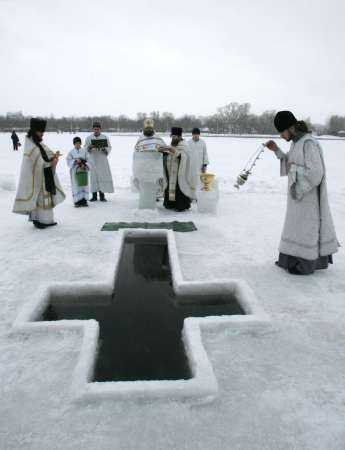
Blessing the Waters

from Google images

Church fathers tell us that the love of God warms the soul. Hell and sin are cold. So this photo, so striking in its whiteness and cultural drama, also is highly symbolic of Christ’s incarnation and salvation of the world.

I begin to grasp what Fr. Stephen writes, (link from yesterday) how the tradition of the Church “sees the Baptism of Christ in the context of Pascha (Easter) as it sees everything in the context of Christ’s Pascha. Christ’s Baptism is a foreshadowing (and on more than a literary level) of His crucifixion and descent into Hades, just as our own Baptism is seen by St. Paul as a Baptism into Christ’s ‘death and resurrection.’ ”

These Christians are blessing the waters on Theophany as Christ blessed and baptized a cold and needy Creation when He went down into the Jordan.