Lo! I am come to autumn,
When all the leaves are gold;
Grey hairs and golden leaves cry out
The year and I are old.
In youth I sought the prince of men,
Captain in cosmic wars,
Our Titan, even the weeds would show
Defiant, to the stars.
But now a great thing in the street
Seems any human nod,
Where shift in strange democracy
The million masks of God.
In youth I sought the golden flower
Hidden in wood or wold,
But I am come to autumn,
When all the leaves are gold.
-G.K. Chesterton
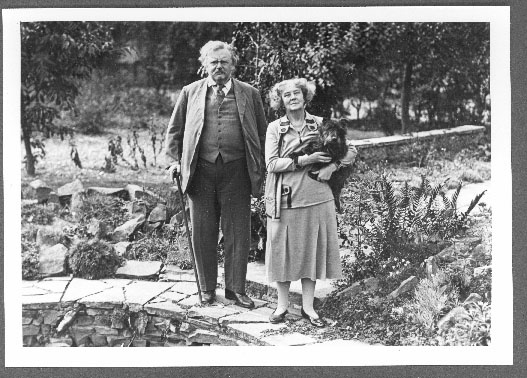
Gilbert Keith Chesterton died on June 14, 1936. This poem about the autumn of his life perhaps spanned several seasons in his consciousness before he died in springtime. I haven’t found out when it was written.
Pippin and I visited Chesterton’s humble grave when we were in England in 2005.
Yesterday when I set out on my walk it was already noon, but I was chilly from working at my computer in the cold corner of the house. I thought about how if I looped my path counterclockwise the southern sun would be at my back as I walked north on a long straight stretch out in the open. And it turned out just as I’d hoped. At least five minutes of heaven’s heat lamp bringing me up to a comfortable temperature.
But this pale and clear morning I left the house before sunrise and before the thermometer had climbed past 40°. Soon the cold was stinging my earlobes and hands, and my nose and eyes were watery. I saw the sun rise over the foothills to the east – what a privilege to witness that daily gift. A quote from G.K. Chesterton came to mind, about the sun rising daily because God decides again that He would like to raise it, but I can’t find that one. [Note: DeAnn found the quote for me and you can read it in the Comments below!] This from my files also stirs the mind and soul:
“The one created thing which we cannot look at is the one thing in the light of which we look at everything. Like the sun at noonday, mysticism explains everything else by the blaze of its own victorious invisibility. Detached intellectualism is (in the exact sense of a popular phrase) all moonshine; for it is light without heat, and it is secondary light, reflected from a dead world. But the Greeks were right when they made Apollo the god both of imagination and of sanity; for he was both the patron of poetry and the patron of healing.
“Of necessary dogmas and a special creed I shall speak later. But that transcendentalism by which all men live has primarily much the position of the sun in the sky. We are conscious of it as of a kind of splendid confusion; it is something both shining and shapeless, at once a blaze and a blur. But the circle of the moon is as clear and unmistakable, as recurrent and inevitable, as the circle of Euclid on a blackboard. For the moon is utterly reasonable; and the moon is the mother of lunatics and has given to them all her name.”
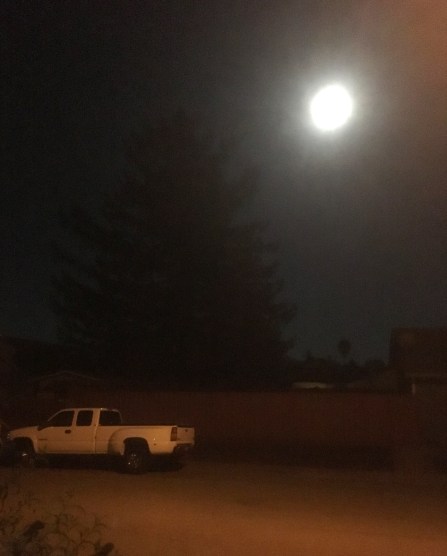
As I was beginning to type here, a friend wrote me that I really should look at tonight’s big harvest moon — so I went out front, and there it was in my favorite setting above the tree across the street, and well worth the interruption! Yes, light without heat, but beautiful, and a joyous link between me and all my loved ones who are looking up tonight at the same reflecting ball.
The Queen Anne’s Lace above the creek did not keep blooming as long as I expected. But some of the blooms are quite spectacular in their dramatic and seed-full drying-out. This was the main thing I wanted to show you tonight!
Poetry is sane because it floats easily in an infinite sea; reason seeks to cross the infinite sea, and so make it finite. The result is mental exhaustion. To accept everything is an exercise, to understand everything a strain.(This and all quotes in green below are from G.K. Chesterton.)
I had another title for this blog post, something about pollinators, but when I saw the preponderance of green in the images, it made me think of Tuesday’s poem, which could be talking about my own garden that is wild with leaves and flowers popping out at a mad rate. All the glory does make it hard for me to hold a thought, and there are many I should not let go of — starting with all the outdoor tasks that won’t wait: feeding and weeding and trimming and tying….
But going back to the poem, I’ve been thinking about how it describes the way the most common natural occurrences — after all, “the world comes back” in spring year after year — can confuse and even shock us if we really pay attention. In my yard it seems that between the time I walk from the front garden to the back and return again, a new weed has sprouted or an iris has emerged.
Why have I arrived on the path by the salvia? I don’t even take time to ponder, but I immediately start pulling weeds. Then I return to the fountain and see a honeybee on a flower, and must go into the house for my camera and “waste” a few minutes attempting to record one of the thousands of thrilling things happening here, right outside my door.
There is a road from the eye to heart that does not go through the intellect.
This road leads to the heart from other sensory “gates” as well. My garden seems primarily visual, but also the rich scents of osmanthus and daphne and lavender have their own direct routes to my heart, as do the bird songs. I don’t have to think about them or know their meaning. In the poem about the “Deciduous Spring,” sounds of words are used to mimic the visual symphony or cacophony that all this burgeoning creates.
The poet only asks to get his head into the heavens.
It is the logician who seeks to get the heavens into his head. And it is his head that splits.
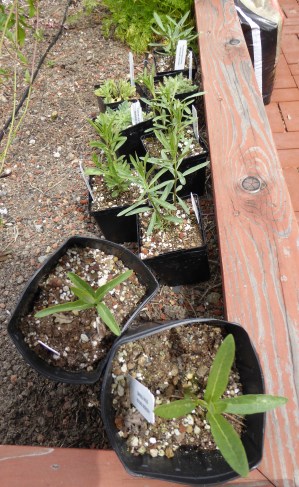
This week I will be adding more plants to the mix, and several of them will be of the sort that the hummingbirds and bees and other insects like. Last fall I planted five types of seeds that did not sprout: poppies, milkweed, prairie echinacea… So — I found a native plant nursery where I was able to buy two species of milkweed plants, orange Moroccan poppies, and penstemon. Visions of Monarch butterflies fill my head.
In the picture below of the waiting plants, the milkweed is mostly in the foreground, two types that are native to the western U.S.: Asclepias fascicularis and Asclepias speciosa
The perplexity of life arises from there being too many interesting things in it
for us to be interested properly in any of them.
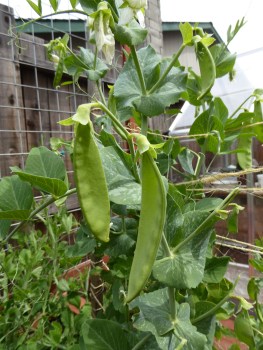
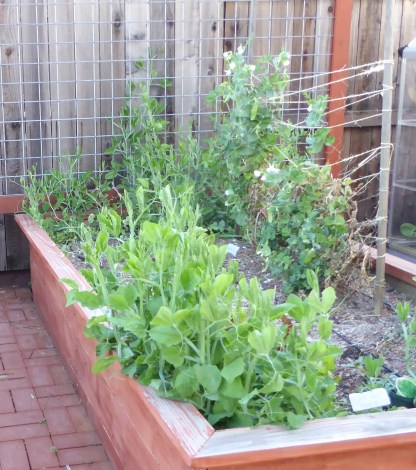
Three varieties of peas, mostly flowers soon to bloom.
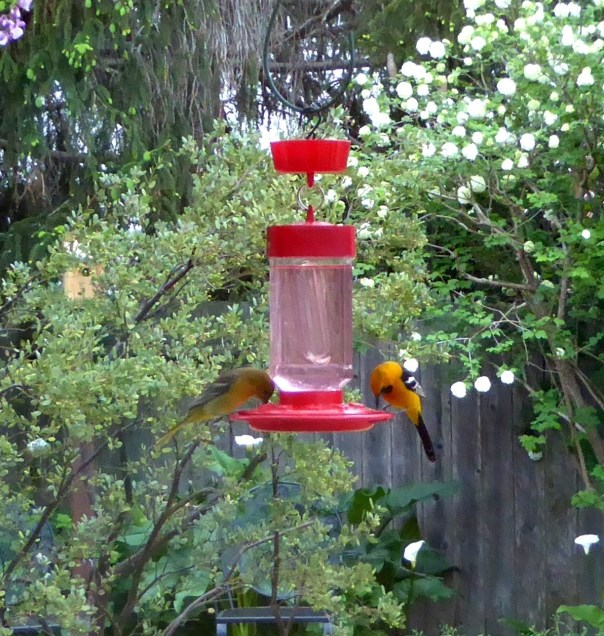
To mention a pair of not-green things: The orioles are back! Not in the group that I am trying to attract with certain flowering plants, their preference is sugar water.
They are very shy, so I’m not going to try to take new pictures of them. This one is from my great photographic effort last spring.
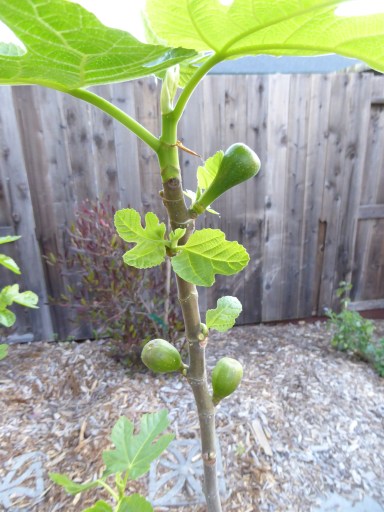
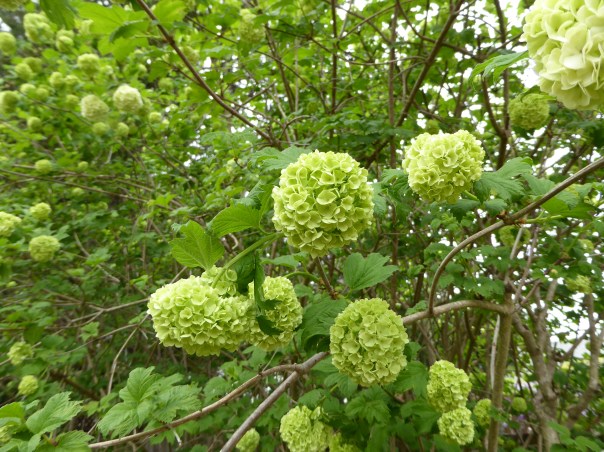
The snowballs on the viburnum are little green things so far. Green fruits are on the fig tree. I ran into a Painted Lady butterfly over there, and bumblebees, but their interest was the lithodora blossoms.
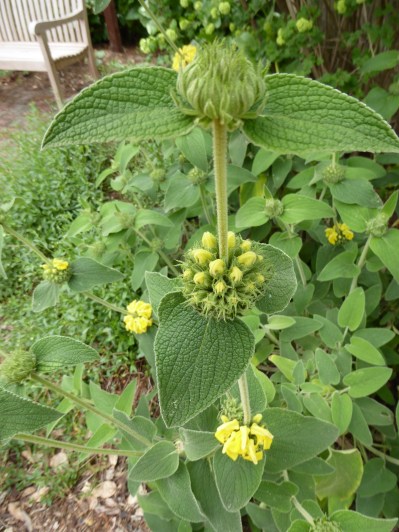
Jerusalem sage
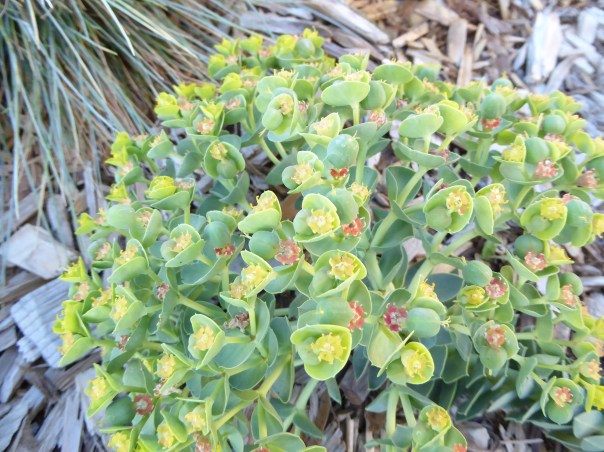
Even the tiny flowers of the Euphorbia myrsinites are swallowed up in their green leaves.
Nearly every day I fall in love again and try to capture another poppy with my camera.
This time my toes got in the picture. At least they are not green.
The whole order of things is as outrageous as any miracle
which could presume to violate it.
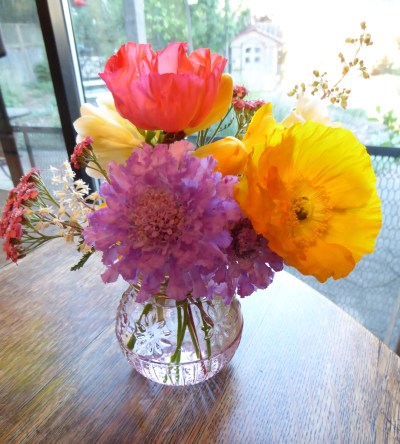
And below, I used a clever jar-vase that Mrs. Bread gave me for my birthday, and made a colorful bouquet that will give your eyes respite from green. It is like a little canning jar with a ring that screws on the top, but into the ring is set a florist’s frog, making it perfect for arranging odd little blooms with their often short stems that one finds in a garden like mine.
That’s my show-and-tell for today! How does your garden grow?
My early walk was so variously interesting and nourishing, I thought it alone would have taken all morning. First thing, down by the creek I got the briefest glimpse of a strange bird, not a jay but with blue around its head somewhere, and I heard its call, but it always flew through the trees just out of sight.
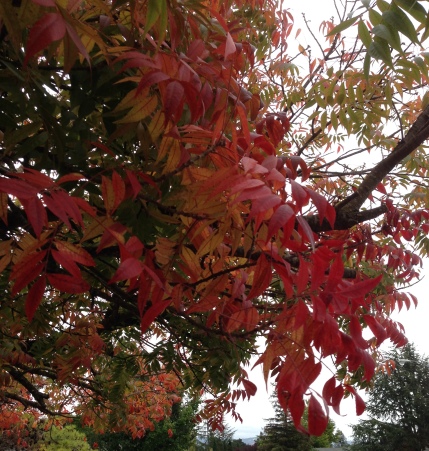
The skies were cloudy, my house was chilled, but the air outdoors was gentler than is typical for these parts, and all the deciduous trees made their own light against the dark background. It was natural to be looking up, and to notice the music of bird conversations. I was made aware today of how wild birds live their own separate existence, so mysterious and otherworldly. When one is caught in a camera lens or is slowed down by an injury, making it possible for me to draw a little closer and examine the feathers or the colors, or to look in the bright eyes, the only reasonable response is reverence.
And yet, the creatures are everywhere. It is estimated that there are 10,000 bird species and 200 – 400 billion individual birds in the world. Most of the free ones seem always to be just beyond reach, airy and on the move. Egrets at least will stand still long enough to be stared at. This morning a human mom, her baby in a stroller, was looking over the bridge, and when I asked her if she’d seen any waterfowl, told me about two egrets down by the next bridge. I went there, but they were gone.
What I did see was a turkey vulture! Normally I think they are repulsive, but that may be because they are circling a dead something on the ground, or eating carrion on the highway. When I saw this one sitting on the bank of the creek, all parts but his head looked almost pretty. He was so slow and still, I think he might have been sick or injured. When I came closer he flew clumsily on to a nearby branch.
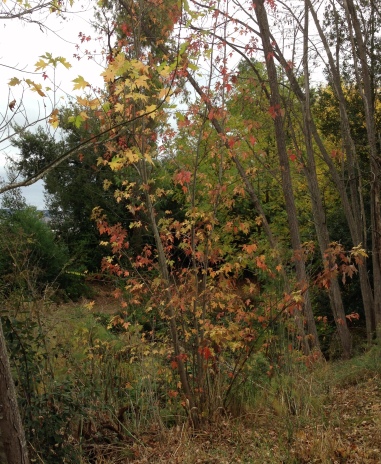
A breeze was coming up — rain was on its way. Some of the leaves were hard to capture with my camera as they fluttered and waved around, and I thought it amusing that I was so determined to take more Autumn Color pictures. It seemed that just a couple of days ago I was thinking that I was tired of them. It is true, this saying of G.K. Chesterton: “There is no such thing on earth as an uninteresting subject; the only thing that can exist is an uninterested person.” Today, I was keen on leaves.
“Autumn is a second spring when every leaf is a flower.”
― Albert Camus
My plan was, when I came home, to finish cleaning up the yard before the rain came and made that kind of work more tedious. For some reason two of my lavender bushes are still blooming, but as even they are at the end of the season, I began to prune them back, and then I realized I could bring the cuttings into the house for a dry bouquet. And why not add some yarrow blooms; they are untiring in their production of yellow flowers.
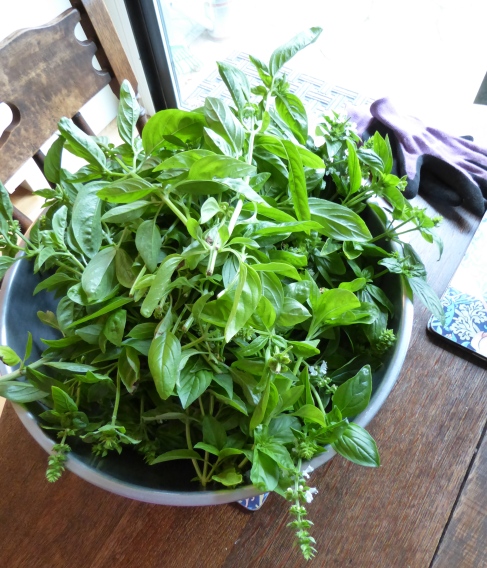
The basil that was spindly and reluctant all summer has beefed up and made something of itself in the last weeks, so I cut all of it and thought I would make a batch of pesto.
And why not bake a cake? Housemate Kit was due to return home today after several months in Guatemala on a missions trip, and wouldn’t she like a cake when she came in from driving through the rain for hours? I’ll tell you more about the cake in another post, but let me just say that it had chocolate in it, and what with all the sampling of 60% cacao chips, and licking of batter and tasting of crumbs, I was getting plenty of caffeine to excite my brain for hours to come – like now.
When I was thick in the business of messing up the whole kitchen with flour, flowers, and cake crumbs, I got the news that some cousins I had expected tomorrow were also driving down through the storm and arriving this evening instead, and would take me out to dinner.
So the rain came drizzling as I was baking; then sprinkling while I washed the dishes; and by dinnertime it was pouring very encouragingly. After Chinese dinner we came home and Kit had arrived – we all ate cake together, and put the basil in the fridge for tomorrow.




 Even the tiny flowers of the Euphorbia myrsinites are swallowed up in their green leaves.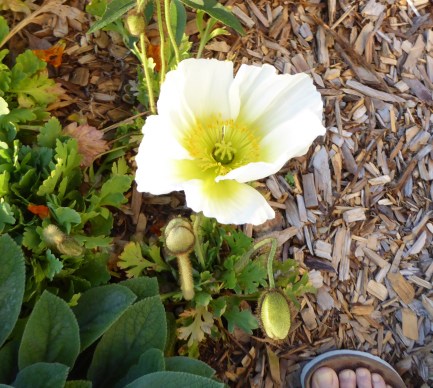
 My early walk was so variously interesting and nourishing, I thought it alone would have taken all morning. First thing, down by the creek I got the briefest glimpse of a strange bird, not a jay but with blue around its head somewhere, and I heard its call, but it always flew through the trees just out of sight.
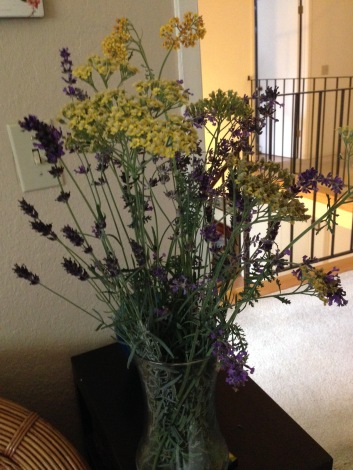 , to finish cleaning up the yard before the rain came and made that kind of work more tedious. For some reason two of my lavender bushes are still blooming, but as even they are at the end of the season, I began to prune them back, and then I realized I could bring the cuttings into the house for a dry bouquet. And why not add some yarrow blooms; they are untiring in their production of yellow flowers.