“There is a wild garment that still carries nobly the name of a wild Highland clan: a clan come from those hills where rain is not so much an incident as an atmosphere. Surely every man of imagination must feel a tempestuous flame of Celtic romance spring up within him whenever he puts on a mackintosh. I could never reconcile myself to carrying all umbrella; it is a pompous Eastern business, carried over the heads of despots in the dry, hot lands. Shut up, an umbrella is an unmanageable walking stick; open, it is an inadequate tent. For my part, I have no taste for pretending to be a walking pavilion; I think nothing of my hat, and precious little of my head. If I am to be protected against wet, it must be by some closer and more careless protection, something that I can forget altogether. It might be a Highland plaid. It might be that yet more Highland thing, a mackintosh.
Rainy day in the Highlands 2005
And there is really something in the mackintosh of the military qualities of the Highlander. The proper cheap mackintosh has a blue and white sheen as of steel or iron; it gleams like armour. I like to think of it as the uniform of that ancient clan in some of its old and misty raids. I like to think of all the Macintoshes, in their mackintoshes, descending on some doomed Lowland village, their wet waterproofs flashing in the sun or moon. For indeed this is one of the real beauties of rainy weather, that while the amount of original and direct light is commonly lessened, the number of things that reflect light is unquestionably increased. There is less sunshine; but there are more shiny things; such beautifully shiny things as pools and puddles and mackintoshes. It is like moving in a world of mirrors.”
— G.K. Chesterton, “The Romantic in the Rain.”
In spite of our lack of macintoshes, I believe that Pippin and I did feel the romance of our visit to the Highlands and other damp British places, and Pippin gets credit for the photos.
G.K. Chesterton wrote a whole article on the topic of rain. He addresses it partly to the strict teetotalers of his era, around 1910. It rejoices my heart that I have rainy weather in which to enjoy this piece, from which I have gleaned generous excerpts for the benefit of my (possibly also romantic) readers. More installments to come soon.
As for the fascination of rain for the water drinker, it is a fact the neglect of which I simply cannot comprehend. The enthusiastic water drinker must regard a rainstorm as a sort of universal banquet and debauch of his own favourite beverage.
Think of the imaginative intoxication of the wine drinker if the crimson clouds sent down claret or the golden clouds hock. Paint upon primitive darkness some such scenes of apocalypse, towering and gorgeous skyscapes in which champagne falls like fire from heaven or the dark skies grow purple and tawny with the terrible colours of port. All this must the wild abstainer feel, as he rolls in the long soaking grass, kicks his ecstatic heels to heaven, and listens to the roaring rain. It is he, the water drinker, who ought to be the true bacchanal of the forests; for all the forests are drinking water. Moreover, the forests are apparently enjoying it: the trees rave and reel to and fro like drunken giants; they clash boughs as revellers clash cups; they roar undying thirst and howl the health of the world.
All around me as I write is a noise of Nature drinking: and Nature makes a noise when she is drinking, being by no means refined. If I count it Christian mercy to give a cup of cold water to a sufferer, shall I complain of these multitudinous cups of cold water handed round to all living things; a cup of water for every shrub; a cup of water for every weed? I would be ashamed to grumble at it. As Sir Philip Sidney said, their need is greater than mine—especially for water.
–From “The Romantic in the Rain”
I took the pictures from the window of our car one summer afternoon a few years ago, as my husband and I drove through pouring rain in the High Sierra. I took a video also as we rode along with our friends, somewhat hushed by the splashing of so much water and the blub-blub of the windshield wipers. I wish I had the ability to post the video with those sounds, and the sound of his voice, but the picture here at the bottom is a kind of screen shot from it.
I am becoming friendlier with the moon. Our growing relationship is the result of my being prodded by things I read on three different blogs in the last year. Hanging Out the Wash by Adair Lara (recommended by Kim) was the final push that brought it all together, with one simple line in a book full of simple, obvious but needed suggestions as to how to “find more in less” and to “come home to ourselves.” The tip: “Start reading the weather page.” People debate about whether the phases of the moon affect weather patterns, but that is not really why that advice motivated me. It’s just that the moon and its changes are part of my everyday physical environment just as the weather is.
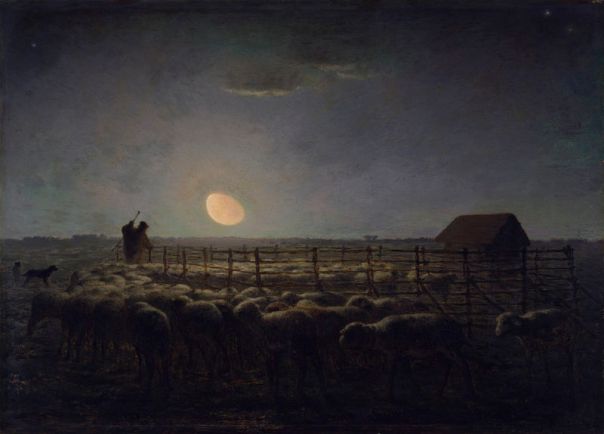
Jody told us about the astronomy site Sky & Telescope on which you can learn what is going on in the sky week by week. I found the lovely painting at the bottom of this page on that expansive website. At left is an example of one of this week’s graphics.
Jody has all around her on the prairie some wide-open spaces without the intrusion of street or city lights, and I can tell from reading her blog that she has made good use of her opportunities.
I don’t think that my urban dwelling is an excuse for ignoring the sky, though. I can at least see the moon, when weather permits, and after I found out when the next full moon would occur it changed my whole week; I have been looking forward to this night (Feb. 3rd in the Western Hemisphere) when the full moon will occur. It so often happens that Mr. Glad and I will say to one another, “Doesn’t the moon look lovely! Do you think it is full tonight?” And we study and try to know if its shape is perfectly round or not, and we never can decide. But this week is different! As I drove home from Vespers on Saturday there was my friend the Man in the Moon smiling down on me, looking just a little lopsided as was to be expected three days ahead of his fullness.
Sun, Moon and Earth by Robin Heath I read about on a blog and ordered by mail. It is just a beautiful little book that tells us how “Every organism on Earth responds to four major cycles: the solar and the lunar day, the synodic month, and the year. We all dance to these primary rhythms. This book reveals the poetic cosmology….”
But it is a little book with correspondingly small diagrams of the movements of our huge sky. I discovered long ago that when I am forced to write in a small space it pinches my creative mind, and I am now thinking that my poor brain was similarly unable to process the meanings of these pictures — perhaps if the images and diagrams had been about 10x larger … It’s a nice size to take on a camping trip, however!
I will digress here from talking mainly about the moon, to a philosophical consideration of celestial bodies from G.K. Chesterton, who in his book Orthodoxy compares the sun and the moon.
“The one created thing which we cannot look at is the one thing in the light of which we look at everything. Like the sun at noonday, mysticism explains everything else by the blaze of its own victorious invisibility. Detached intellectualism is … all moonshine; for it is light without heat … that transcendentalism by which all men live has primarily much the position of the sun in the sky. We are conscious of it as of a kind of splendid confusion … a blaze and a blur. But the circle of the moon is as clear and unmistakable, as recurrent and inevitable, as the circle of Euclid on a blackboard. For the moon is utterly reasonable; and the moon is the mother of lunatics and has given to them all her name.”
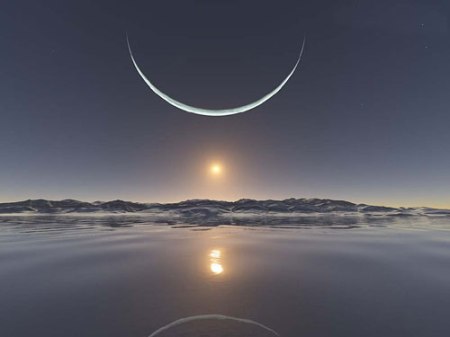
If we want to consider the lack of heat of the moon, here is an image as cold as it might ever appear, above a sunset at the North Pole. It’s one of many downloadable astronomy pictures on this site.
As to Chesterton’s assertions: I could not stop myself from posting that paragraph because of my fondness for thinking about symbols and metaphors, and he is using the physical realities of the sky to show the richness of our life and faith. As a symbol, the moon may be set against the sun, but as physical things they are both welcome parts of our everyday lives. Right now I am considering — and loving — the moon merely as itself, and a better quote for that is:
I see the moon, And the moon sees me. God bless the moon, And God bless me.
There is nothing cold and intellectual about that. It’s a sort of poetic cosmology I can appreciate, in which every bit of the Creation speaks of our common Creator and Father, and is part of our earthly home — even the moon that is above the earth, looking down on us, as it seems.
This picture from the Book House volume Nursery Friends from France that impressed me as a child also evokes the familiarity and even homeyness of the moon for the song, “Au Clair de la Lune.”
Two more places I found to help me learn more about my friend:
Moon Giant tells us the exact time of day when the moon is full for each time zone. On this page I had to learn what Coordinated Universal Time (UTC) is; Wikipedia let me know that it is “one of several closely related successors to Greenwich Mean Time (GMT).”
And the almanac shows the calendar for every day of the month, which I like best of all. The sliver of crescent moon, such as Jody caught in her photo, always enchants me, and on this calendar I can see when it will be in that form.
This possibly older version of the rhyme above expands on the meaning of the moon for us humans:
I see the moon and the moon sees me Down through the leaves of the old oak tree. Please let the light that shines on me Shine on the one I love.
This is the moon we have in common with everyone who’s ever lived on the earth, the way we drink the same water that’s been ever recycled. One time when I commented on having seen the moon my husband teased me, “It’s the same moon that’s always been there.” I began to think about how I share the moon with my great-great-grandparents, with John Muir as he saw it from the mountain peaks, with Galileo and with our Lord as He walked the earth.
Youth is the period in which a man can be hopeless. The end of every episode is the end of the world. But the power of hoping through everything, the knowledge that the soul survives its adventures, that great inspiration comes to the middle-aged.
Gilbert Keith Chesterton, in Charles Dickens (1906)


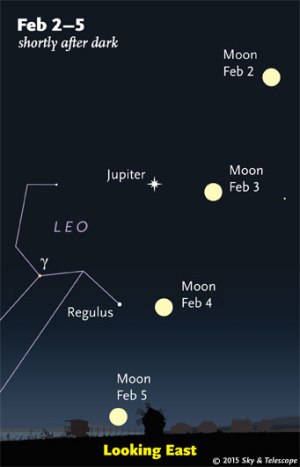 rn what is going on in the sky week by week. I found the lovely painting at the bottom of this page on that expansive website. At left is an example of one of this week’s graphics.

 Gladsome Lights