Tag Archives: heaven

He drops by a silken thread.

More than one reviewer of Richard Wilbur’s late collection of poems noticed that after his wife died, the poet wrote more about death, as in this example below. That would be a natural response, of course, for someone 90 years old, even if he hadn’t been recently widowed.

I know it’s recommended that people of all ages live with awareness of the shortness of our lives, as in Psalm 90: “Teach us to number our days, that we may gain a heart of wisdom.” Or as another translation goes, “Teach us to realize the brevity of life….”

If our dearest friends and family have departed, it could exacerbate any feeling of weariness we already had with this earthly existence. In the same Psalm the poet mentions the less-than-thrilling aspects of life: “The days of our years are threescore years and ten; and if by reason of strength they be fourscore years, yet is their strength labour and sorrow; for it is soon cut off, and we fly away.”

A MEASURING WORM

This yellow striped green
Caterpillar, climbing up
The steep window screen,

Constantly (for lack
Of a full set of legs) keeps
Humping up his back.

It’s as if he sent
By a sort of semaphore
Dark omegas meant

To warn of Last Things.
Although he doesn’t know it,
He will soon have wings,

And I, too, don’t know
Toward what undreamt condition
Inch by inch I go.

~ Richard Wilbur

Richard Wilbur was a lot smarter than an inchworm, so I like to think he had this verse from I Corinthians in mind when he wrote those last lines: “But as it is written, Eye hath not seen, nor ear heard, neither have entered into the heart of man, the things which God hath prepared for them that love him.”

Because the Preparer is Love, our Last Things, though unimaginable, will be the best.


I first shared this poem of Wilbur’s ten years ago, before he had passed over, into what we might think of as the pupa stage; today I read this about the inchworm:

“After the larva hatches, he feeds on leaves for about a month before he drops to the ground via a silken thread. In late spring or early summer, the larva burrows up to 4 inches into the ground, spins his cocoon and pupates. If he’s a fall worm, he’ll emerge in the fall, usually between November and early December. If he’s a spring worm, he’ll wait until the next late winter to emerge.”

At the time of Wilbur’s death I posted one article written about him for the occasion, but just now I found another tribute in USA Today, in which the journalist remarks on the unusual quality of happiness in this poet, and quotes Wilbur:

“I think many people associate happiness with shallowness,” Wilbur told the AP. “What people don’t want is someone who is complacent. And I know that I am not a complacent man.”

Richard Wilbur was the farthest from complacent that I can imagine. He spent his life being attentive to the world around him and pursuing love and beauty. I hope that in his present state he knows even more what C.S. Lewis meant when he said:

“Joy is the serious business of Heaven.”
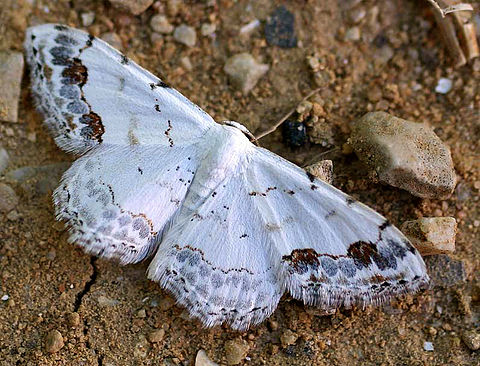
Geometer inchworm moth – Scopula Decorata or Middle Lace Borer

Echoes of harmonies and blisse.

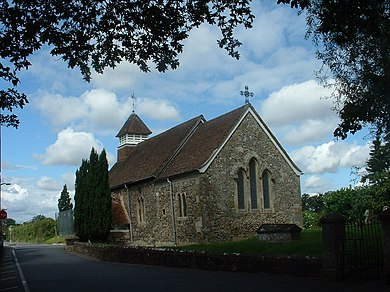
St Andrew’s Church in Bemerton, Wiltshire

This is the church where George Herbert served as rector for a only a few years before his death at the age of 39. He was born in Wales in 1593, into a wealthy and powerful family. The poet John Donne was his godfather, which was surely an important role, as his father Richard died when George was three years old. After his university education he held posts at Cambridge, was briefly a member of parliament, and held the clerical post of prebend.

But it wasn’t until 1629 that he decided to enter the priesthood and was appointed to the parish where “he lived, preached and wrote poetry; he also helped to rebuild the Bemerton church and rectory out of his own funds.”

He knew he was dying (of consumption); it was in that last year of life that he sent all of his poems to his friend Nicholas Ferrar, asking him to publish them if he thought they were good for anything. He said that they held “a picture of the many spiritual conflicts that have passed between God and my soul, before I could subject mine to the will of Jesus, my Master.” Commenting on George Herbert’s religious poetry later in the 17th century, Richard Baxter said that the poet “speaks to God like one that really believeth in God, and whose business in the world is most with God. Heart-work and heaven-work make up his books.”

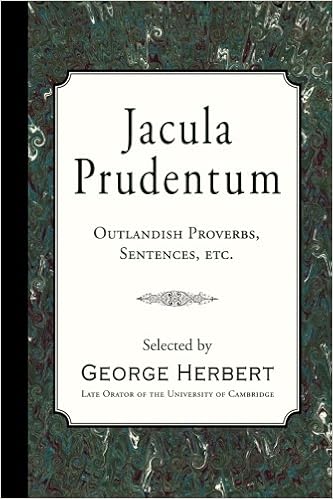
His prose works include a volume of nearly 1200 “outlandish proverbs” that he collected, and which is currently available on Amazon. That’s one that looks interesting to me, too.

Charles Cotton described George Herbert as a “soul composed of harmonies,” and it seems that he was also a skilled lutenist and composed hymns. More than ninety of Herbert’s poems have been set for singing over the centuries by composers like Benjamin Britten, Henry Purcell, and Ralph Vaughan Williams. When I read that the Wesley brothers adapted a few dozen for the Methodist hymnal, I checked out our family’s inheritance of hymnals from Methodist and Presbyterian churches but only found one attribution to Herbert.

But I do have a collection of his poems. I’ve shared other works of this poet; now here is one that I only recently noticed, whose echo-dialogue and themes I like very much. I found online a thorough exploration of the poem by Inge Leimberg, who tells us that “In Herbert the three themes of death, being restored from death, and spiritual vision are closely bound up with music and poetry (which to Herbert are one and the same).” I haven’t finished reading her essay, but I did catch one example of the layers of meaning he was famous for; “holy leaves” likely refer not just to leaves, but also to pages of the Bible.

One friend was of the opinion that Herbert would be singing his melodies with the angels in heaven, and I wouldn’t be surprised if the angels do join in with this harmonious and persevering soul.

HEAVEN

O who will show me those delights on high?
Echo.         I.
Thou Echo, thou art mortall, all men know.
Echo.         No.
Wert thou not born among the trees and leaves?
Echo.         Leaves.
And are there any leaves, that still abide?
Echo.         Bide.
What leaves are they? impart the matter wholly.
Echo.         Holy.
Are holy leaves the Echo then of blisse?
Echo.         Yes.
Then tell me, what is that supreme delight?
Echo.         Light.
Light to the minde : what shall the will enjoy?
Echo.         Joy.
But are there cares and businesse with the pleasure?
Echo.         Leisure.
Light, joy, and leisure ; but shall they persever?
Echo.         Ever.

-George Herbert 1593–1633

Where is home, and where is Heaven?

Sooo slow I am in fully returning to Being Home. Though I suppose I never will be living in my house in quite the same way as before, having sojourned so distantly, and changed in God only knows what ways. I grew older, for sure. But maybe I grew younger, too?

clean air, vineyards and mustard bloom

I was so surprised, when I walked in the front door on my return from that other world, to see that I have wood floors. At that moment I didn’t feel the lack of windows and light, but only felt the warmth and welcome that my house had held in trust for me all those weeks, even though I had learned to live happily with hard and cool marble floors, and the strange light coming through a multitude of windows, reflected off the Arabian Sea and filtered through smog.

It’s taken me nearly three weeks just to fill and start up the fountain again. The finches were having to make do with winterized nyger seed, that is, frozen and thawed, rained on and packed down into a brick at the bottom of the feeder. But I fixed those things today and looked around some more at the garden. Rosemary is blooming and the fountain is now tinkling.

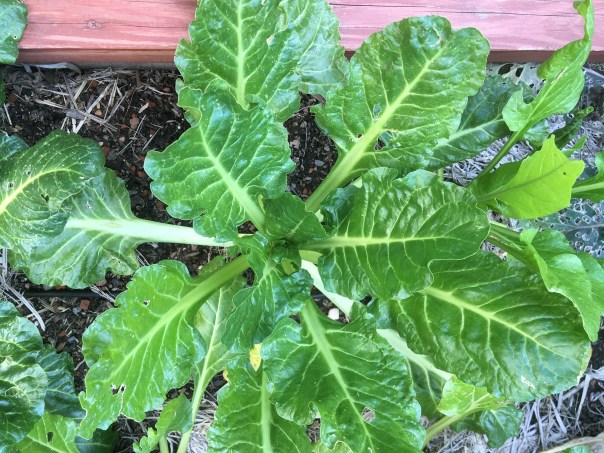
I just learned that Swiss chard is also called silverbeet!
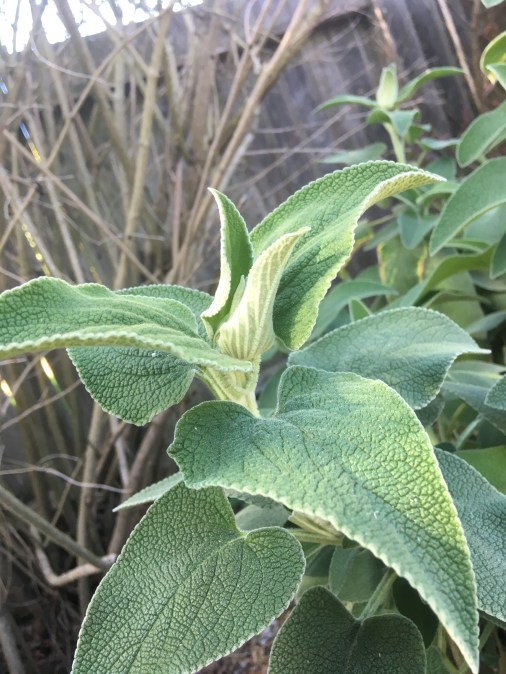
Jerusalem Sage
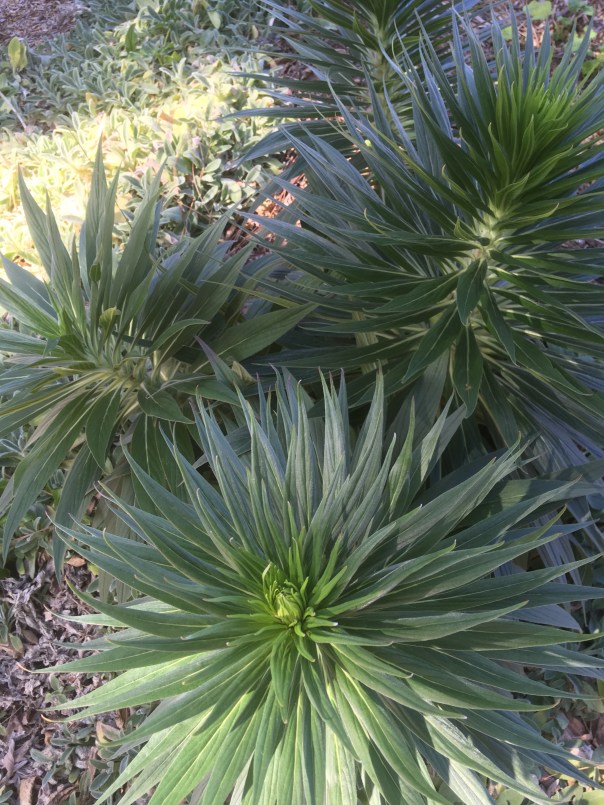
Pride of Madeira with no blooms yet…

Do you remember Miss Grenadine? She was a gift from Mr. Glad. She kept watch over my bedroom while I was gone, and still does during the day:

I had lunch with my goddaughter last week. She and her husband lost their house in the fires that ravaged our area last October. A day or two after that dreadful event, she texted me, “Wherever our family is together, that is home.”

I understand some of that. Ever since my husband passed from this earthly life three years ago this month, I have felt most at home when I am with my children, wherever a few of us are gathered. I don’t think I would feel this way if we didn’t all agree on this: though we’ve been supremely blessed in this life, it’s not satisfying in itself, no matter what beautiful place you live in and with what dear humans.

At this moment I’m thinking about things homey and cozy (or cool, as we preferred, in Mumbai), but of course concurrent in all of our lives is pain and suffering. Wherever I go, I bring myself with my sin-sickness, and I carry in my heart the burdens of those whose suffering seems to me hardly bearable. But in every place, Christ is. He is the one who makes the atmosphere sweet with the scent of flowers or the affection of our children. He is always giving us Himself.

At the end of things, The Blessed will say, “We have never lived anywhere except in Heaven.” And the lost will say, “We were always in Hell.” And both will speak truly.
― C.S. Lewis