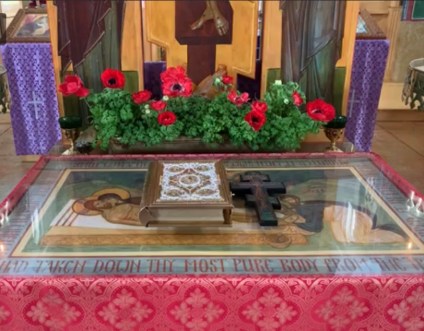
On Holy (“Good”) Friday we Orthodox keep vigil next to the “shroud” icon of Christ all night through, until noon on Saturday, remembering our Lord in the tomb. From the time of His death until His Resurrection on Sunday, we don’t go about our “usual business.” In my parish, parishioners take turns reading or chanting Psalms at a small lectern, with the aid of a candle during the hours of darkness.
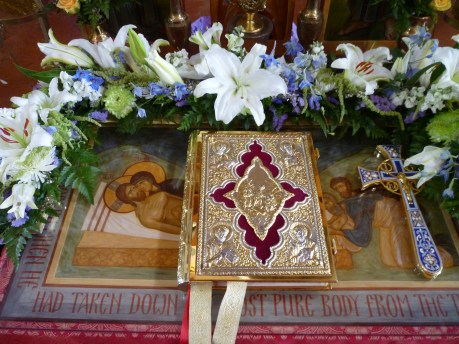
This vigil is something we also try to do, if at all possible, for any mere human from whom the spirit has departed, as each one bears the image of Christ. And as He blessed Creation and the material world by becoming part of it in His Incarnation, so each body of flesh is holy and precious.
(I don’t know if I wrote here previously about how we were able to honor my husband this way two years ago, between the time of his death and his burial, as his coffin remained in our house until the day of his funeral, and many people came to pray the Psalms nearby over the course of three days.)
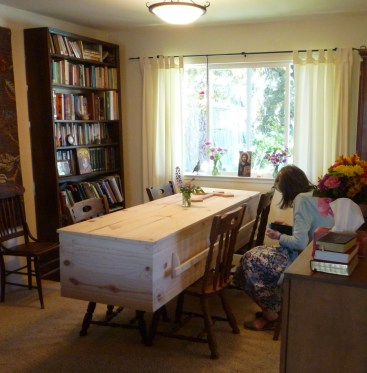
Even if you are not a Christian, or a worshiper of any kind, the body is that aspect of your person with which you have exerted your will to live and love — to stand up, to feed yourself, and even better, to embrace those you love and to express thanks and kindness. All these actions and behaviors build a heritage and a history attached to your physical self, a unique life given by God. It’s not a “shell” or a thing to be discarded as unimportant. You are honorable, every part of you, because of Who made you, and because of His love.
Christians have the added motive to honor the body, that we want to follow the example of our Savior in every way that we can. As His body was lovingly prepared for burial, so we want to do when it is in our power.
I was gratified to read the following explanation of some of these things that was included in a funeral program last summer, when we were saying goodbye to one of our parishioners and laying his body to rest:
“…we believe the body to be an honorable and even a holy thing. For us the body is not something which is dishonorable or defiled, or to be hidden away or hurriedly disposed of. It is less than the soul, and we know that, deprived of the soul, it will dissolve into its elements, but we believe also that on the last day, whether the deceased were a Christian or not, it will be raised up again. We believe that it was part of that person who has died and is therefore to be treated with reverence….
“The body of an Orthodox Christian is a holy thing. It is that body which was washed in Holy Baptism, anointed with holy Chrism, which partook of the Body and Blood of Christ in the Eucharist, which was anointed with holy oil, which received the tonsure at Baptism, at Ordination or at monastic profession, which was crowned in marriage, which made the sign of the Cross, which looked at and kissed the holy icons, which reverenced and touched the sacred relics, which stood in prayer, which made prostrations, which listened to the chants and readings, which read the Scriptures and prayers, which smelled the incense and fragrances, which went on pilgrimage, wept, suffered illnesses and pains, suffered in child-birth, which struggled against the passions, which gave alms, which fasted, restrained itself, tried to keep itself pure, indeed which participated in the true worship of the True God.”
Know ye not that your body is the temple of the Holy Spirit? (I Cor: 6:19)
More on this subject is in the article online from which these paragraphs were taken.


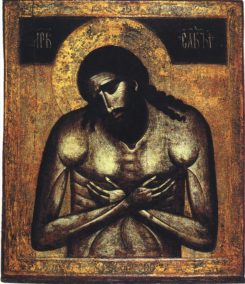 adds, ‘even death on a Cross.’ The point of the ‘even’ is not that the Cross is painful above all pain, but that the Cross is shameful above all shame.”
 Gladsome Lights