Tag Archives: Holy Saturday

Death is over, Pascha continues.

Every experience of Pascha in the Orthodox Church is going to be unique, and I suppose a person might remember past celebrations and compare one to another, but there is no question that this year was the best. Last year was the best, too. Because right now, whatever year it is, is the Pascha that has come to us now, and Pascha is a gift from Christ, from His Church, to us, His Church. We receive the Kingdom of God into our souls, just as the mercies of God are new every morning — especially Pascha morning.

“Death is over,” our rector preached this afternoon at Vespers, and the choir was even more robust than last week, with fourteen mostly big men (and several women) singing the triumphant resurrectional hymns, and many of the rest of us singing along with our favorites.

But let me backtrack to earlier in Holy Week. I spent all day Wednesday working on my red egg project. I’ll write more about that later, because to my surprise, the “experiments” continued all the way to Friday, involving about 365 eggs in all. I was still learning things this afternoon, so I will write a thorough report for the benefit of future red egg-dyers.

Our Holy Friday services, of which there are three, begin with Matins of Holy Friday on Thursday evening; it is to me one of the most beloved of all the week’s services. It is long, because 12 Gospel passages telling of Christ’s last days are read, solemnly in the middle of the church, while we hold candles and let our hearts be taken into that moment in God’s time. This year I made it to the other two services, too, on Holy Friday proper. Then I crashed.

The morning of Holy Saturday I took my turn and read the last two hours of the Psalms, by the icon “corpse” of Christ. Probably I should have been content to sign up for just one hour; I guess I was greedy! My voice was getting hoarse by the last half hour…
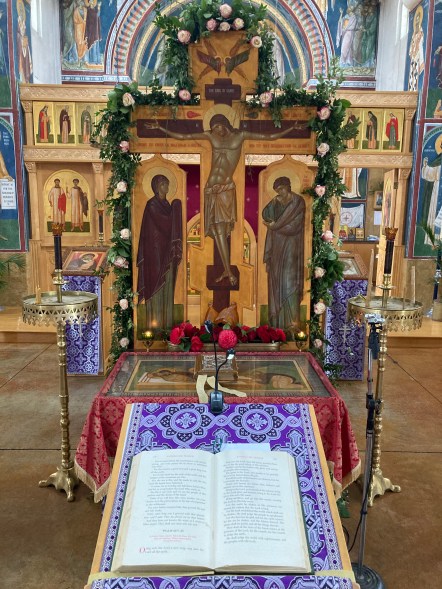
Then it was time for the baptisms; it was an especially meaningful day for me,
because I am the sponsor for the young woman who became “newly illumined.”

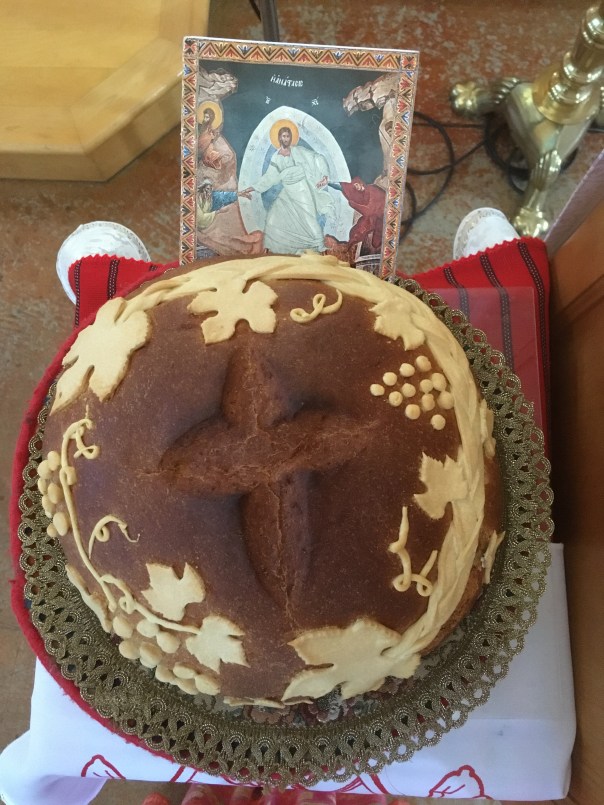
After that long service, taking most of Saturday afternoon, and the Eucharist, we had wine and freshly baked sourdough bread, to break our fast and to keep us going a little longer.

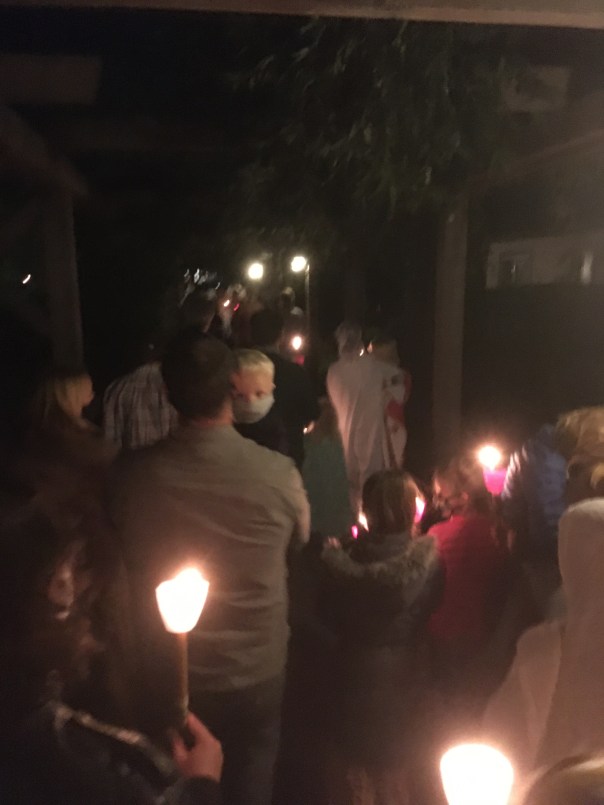
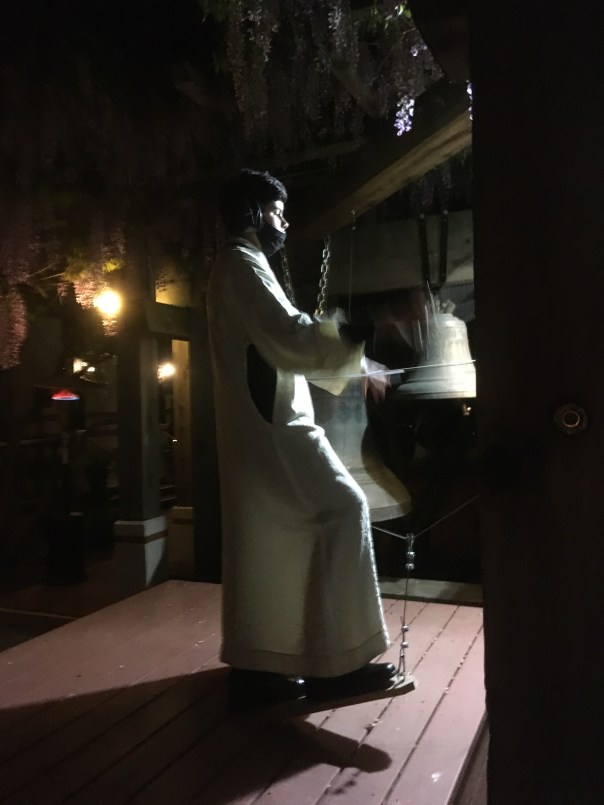
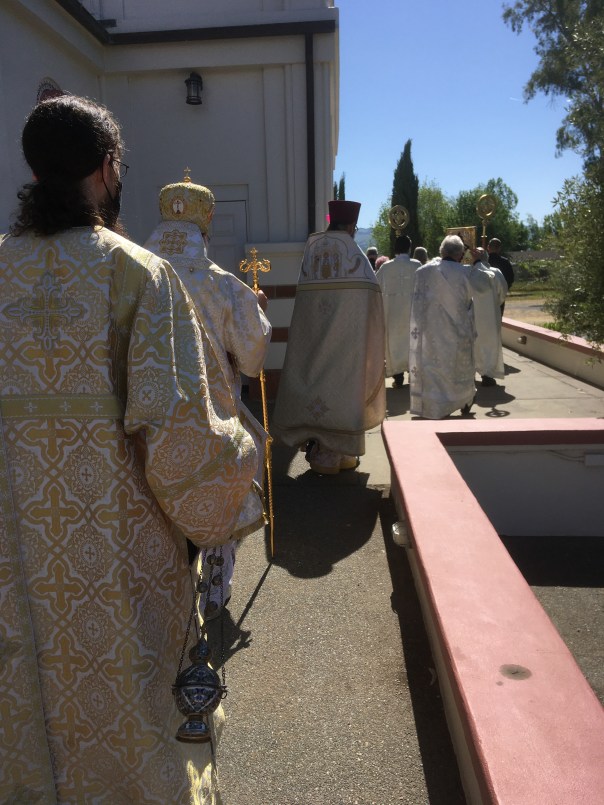
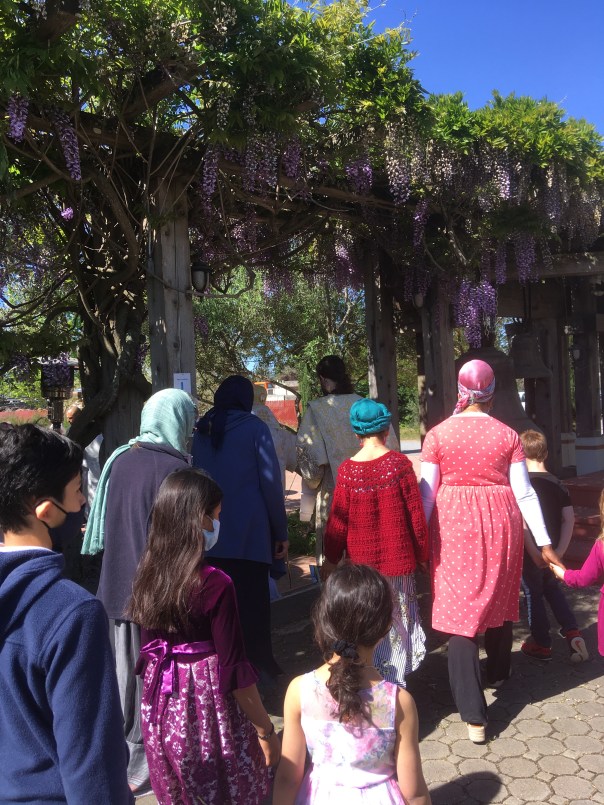
I went home and managed to take a nap before our midnight service. Orthodox Christians can’t wait until nine or ten o’clock, as we would on a typical Sunday morning, to meet and worship. Not at all. We want to be already gathered in the church by 10:00 or 11:00 o’clock, so that we can have time to process around the whole church property, and then be back at the doors to sing “Christ is risen!” as soon as the clock has changed to Sunday.

From 2010.

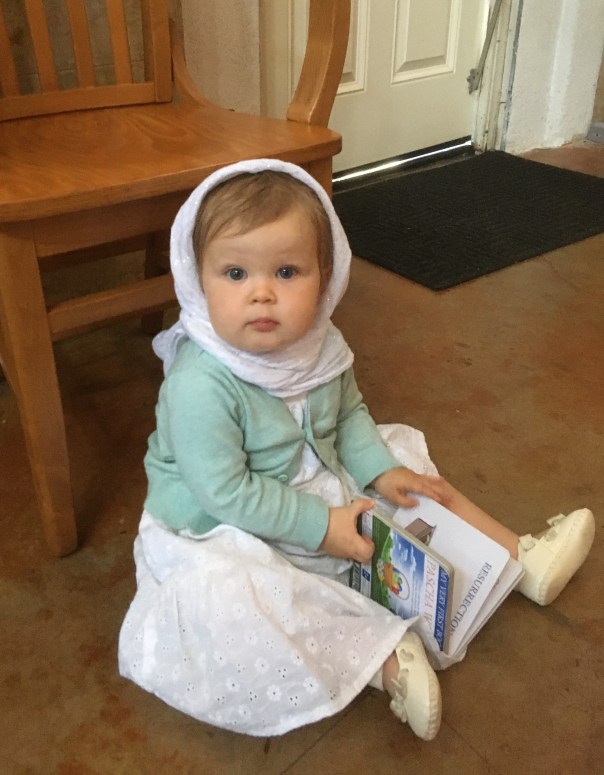
There came that glorious breaking forth of jubilation, with the chandeliers laden with flowers and set to swinging; ladies and children in their long white skirts, or frilly Easter dresses; deacons repeatedly walking up and down censing the whole temple; and the Paschal Homily of St. John Chrysostom, and the first chapter of John’s Gospel, starting with:

1 In the beginning was the Word, and the Word was with God, and the Word was God.
2 The same was in the beginning with God.
3 All things were made by him; and without him was not any thing made that was made.
4 In him was life; and the life was the light of men.
5 And the light shineth in darkness; and the darkness comprehended it not.

So much joy, in the risen Christ, our life and our light. What can I say? We feasted on Pascha, and then we gathered in the church hall and broke our Lenten fast together with earthly food: chocolate cake, mascarpone cheese, our red eggs, salami, chicken wings, and wine. Those were just a few items I saw at our table. I got home just after 4:00, and remarkably was able to be asleep before 5:00.

Today was the Paschal Vespers, which was richer and more elated than I ever remember. But maybe I myself was just not as tired as some years! Then the Pascha picnic, and a chance to spread ourselves on our blankets over the grass or at the picnic tables, and catch up for hours in a very relaxed way, watching the babies crawl around, and the tug-o-war competitions.

I’m going to reset my body clock tonight, I hope, and attend Bright Monday’s Divine Liturgy in the morning. For this Bright Week we will have frequent reminders of how Christ’s death ended death, and that his resurrectional life sustains us every hour of every day; Pascha continues. Christ is risen! Indeed He is risen!

Struggling and singing and floating to Pascha.

CHRIST IS RISEN!

It is the theme of the week, “Bright Week” for us Orthodox Christians who struggled and floated through Holy Week while practically living at church. In the ten days starting with Lazarus Saturday and rolling us along through Bright Monday, we had 19 unique services at my parish, including several that were 2-3 hours long. No one participates in all of them, but some people come very close.

Because of frequent changes in the last year as to who can and may sing and chant at which of our services, it fell out that during this Lent and especially Holy Week I had more chanting duties than ever, and all of that reading of Psalms and other prayers contributed to my joy — and fatigue! What time I wasn’t in church in the last twelve days, I gravitated to my bed, or accomplished minimal garden duties.

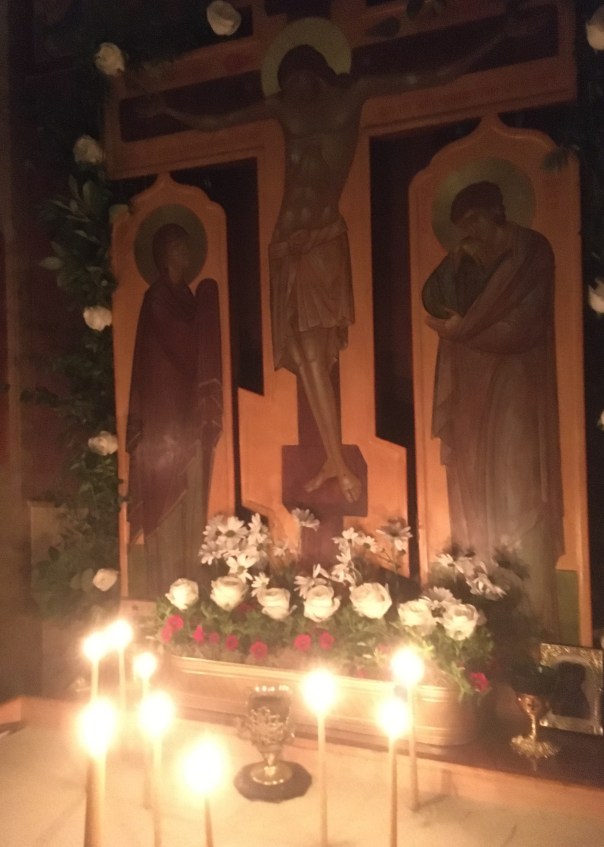
The service of Matins of Holy Friday, on Thursday evening, is a highlight of the week. Twelve separate Gospel passages are read, seemingly everything written about Christ’s passion. We stand holding candles, and most people sit down after each of the twelve readings for the prayers and hymns that set apart the Gospel passages. The first reading is more than four chapters long: John 13:31 – 18:1. Every year is a little different for me — I’m sure it’s like that for everyone — but whether you are distracted a lot or hardly at all, there is a blessing in just being there in body, and in hearing so many words of Good News, Christ’s willing self-sacrifice for us.

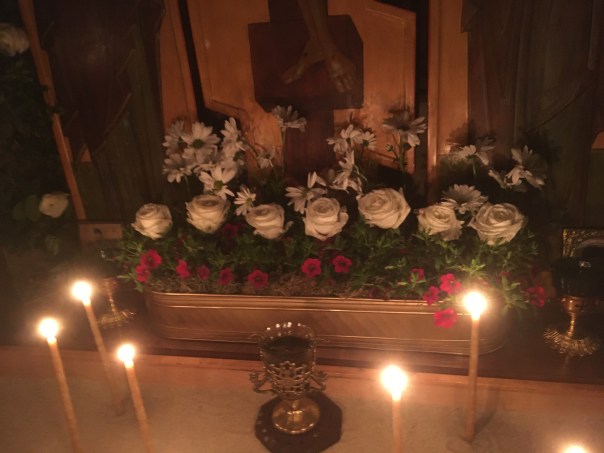
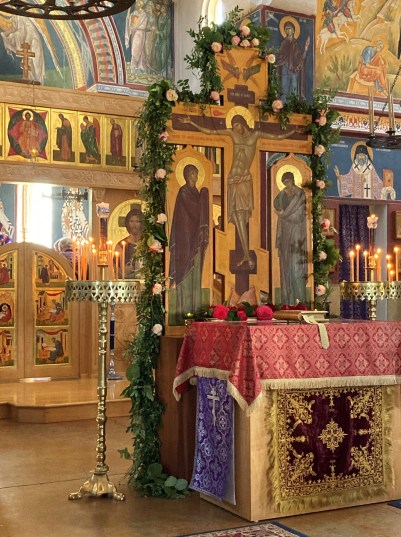
By Friday afternoon we have had three Holy Friday services by which to enter in to the Crucifixion. On Friday evening the services of Holy Saturday begin; Saturday afternoon is the radiant commemoration of Christ’s descent into Hades to free the faithful of the Old Covenant, and His victory over death. The choir leads us in singing “Arise O God; Judge the earth, for Thou shalt have an inheritance among all the nations,” while all over the church people switch out the purple cloths for white.  The Old Testament story of Jonah three days in the belly of the whale is read at this service, because Jonah is seen in the Church as a type of Christ Who was three days in the tomb. It’s just one of fifteen Old Testament readings that are interspersed with two long and exultant hymns.

Afterward we go home to rest and eat a little, before returning a few hours later for the culmination of Great Lent and Holy Week, the celebration of the Holy and Glorious Resurrection of the Lord and Savior Jesus Christ. Parishioners have been taking turns reading the Acts of the Apostles continuously since the end of the afternoon service, and do so right up until the beginning of the Pascha services just before midnight. Then all the lights in the church are turned off, and at midnight:

The Light of Christ’s Resurrection “breaks through” when the priest takes the vigil light from the altar and gives it to the faithful, while singing: “Come receive the light, that is never overtaken by night, and glorify Christ, Who is risen from the dead.”

From there the people process out of the church building, where the Gospel account of the empty tomb is read; verses from Psalm 68 are sung — “Let God arise, let his enemies be scattered; let those who hate him flee from before his face!”; and the famous Paschal hymn is joyously chanted by all: “Christ is risen from the dead, by death trampling down upon death, and to those in the tombs He has granted life.” In this way the Church announces to the entire world the glorious news of the Resurrection. The Festal Midnight Liturgy of Easter is celebrated and the faithful partake of the Eucharist in the “Light of the Resurrection.”

The spiritual striving of the Lenten season and the blessed travel through Holy Week has been accomplished, and thus the Joy of the Resurrection is inexplicably palpable for all who have participated in this grace-filled journey.

We missed so much of this experience last year! It doesn’t break neatly into parts, a couple of which can be torn out of the whole and doled out over the Internet on a screen. But our deprivations made us all the more jubilant and grateful this year for our traditional over-the-top way of celebrating. The Death of Death is surely a reality we want to know in our hearts and lives. Somehow all of these Lenten and Holy Week labors empty us and humble us in mysterious ways to make us able to receive the grace of divine Life that is poured out at Pascha.

I stayed to break the fast with a few others afterward, with cheeses and meat, wine and chocolate, and didn’t get home until 4:00 a.m. Then we were back for Paschal Vespers at 1:00 — such a bright service! We couldn’t have our usual big barbecue this year but a few families stayed to picnic and visit all afternoon, and their children had an egg hunt.

Our bishop was with us on Bright Monday for Divine Liturgy, plus friends and deacons from a “sister parish” nearby. It was interesting how I began that hour of worship with so much verve, but about fifteen minutes in felt the weight of the residual exhaustion pulling me into a chair, where I tried to keep my mind awake, please God, for just a few more minutes!

At the end of Bright Monday’s service several of our men singers treated us, in English, to this Georgian Paschal hymn that has become one of my favorites. It must be getting more popular among the Orthodox worldwide, if the number of YouTube videos compared to last year is any indication. I found so many good versions, from cathedral to country folk to quarantine virtual choir, I am going to share several with you, in English and in Georgian.

Georgian Hymn in English – Virtual Choir

Kriste Aghdga – family in country

Kriste Aghdga – in English and Georgian

Kriste Aghdga – in a cathedral in Georgia

IN TRUTH HE IS RISEN!

Not one atheist has plunged.

Below are encouraging words from Metropolitan Anthony Bloom, prefaced by a few of my own Holy Saturday thoughts from six years ago, when I was freshly bereaved of my husband. I will leave that mercifully dated personal context as is, though it is for the more enduring words of Metropolitan Anthony that I am re-posting:

– – – – – – – – – – – – – – – – – – – – – – – – – – – – –

I find myself in a phase of grief where from time to time during the day I feel acutely lost without my husband, the absence of him like a soreness in my spirit, an ache in the middle of my chest telling me that something is very wrong with me. Yes, something is wrong!! It’s death that is wrong – it’s wrong for us to be separated, for me to lose the heart of my heart. I have known this truth in my mind and for the world generally – now I understand it in my bones.

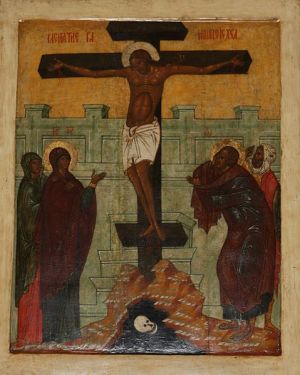
Crucifixion wikimediaBut as I’ve said here more than once already, I have the peaceful assurance that we are not absolutely separated, and a huge thankfulness as well that neither of us has been cut off from the Source of our life and existence. Sometimes we humans use the figure of speech that we will “die of grief,” because it feels that wrenching. But I know even as I am feeling it and railing against it, that I will live through it. This is all because Christ suffered for us, and he overcame death. My pain is like a pinprick compared to what Christ endured on our behalf. As for my husband, “Blessed are the dead who die in the Lord.”
These words from Metropolitan Anthony Bloom that I first read in God and Man two years ago are even more meaningful to me on this Holy Saturday:

When in the Apostles’ Creed we repeat “And he descended into Hell,” we very often think “That’s one of those expressions,” and we think of Dante and of the place where all those poor people are being tortured with such inventiveness by God.

But the Hell of the Old Testament has nothing to do with the spectacular hell of Christian literature. The Hell of the Old Testament is something infinitely more horrid; it is the place where God is not. It is the place of final dereliction; it’s the place where you continue to exist and there is no life left.

Harrowing-Dionisius

And when we say that he descended into Hell, we mean that having accepted the loss of God, to be one of us in the only major tragedy of that kind, he accepted also the consequences and goes to the place where God is not, to the place of final dereliction; and there, as ancient hymns put it, the Gates of Hell open to receive Him who was unconquered on earth and who now is conquered, a prisoner, and they receive this man who has accepted death in an immortal humanity, and Godlessness without sin, and they are confronted with the divine presence because he is both man and God, and Hell is destroyed — there is no place left where God is not.

The old prophetic song is fulfilled, “Where shall I flee from thy face — in Heaven is thy throne, in Hell (understand in Hebrew — the place where you are not), you are also.” This is the measure of Christ’s solidarity with us, of his readiness to identify himself, not only with our misery but with our godlessness. If you think of that, you will realise that there is not one atheist on earth who has ever plunged into the depths of godlessness that the Son of God, become the Son of Man, has done. He is the only one who knows what it means to be without God and to die of it.

— Metropolitan Anthony Bloom

To be without God and to die of it.

I find myself in a phase of grief where from time to time during the day I feel acutely lost without my husband, the absence of him like a soreness in my spirit, an ache in the middle of my chest telling me that something is very wrong with me. Yes, something is wrong!! It’s death that is wrong – it’s wrong for us to be separated, for me to lose the heart of my heart. I have known this truth in my mind and for the world generally – now I understand it in my bones.

Crucifixion wikimediaBut as I’ve said here more than once already, I have the peaceful assurance that we are not absolutely separated, and a huge thankfulness as well that neither of us has been cut off from the Source of our life and existence. Sometimes we humans use the figure of speech that we will “die of grief,” because it feels that wrenching. But I know even as I am feeling it and railing against it, that I will live through it. This is all because Christ suffered for us, and he overcame death. My pain is like a pinprick compared to what Christ endured on our behalf. As  for my husband, “Blessed are the dead who die in the Lord.”

These words from Metropolitan Anthony Bloom that I first read in God and Man two years ago are even more meaningful to me on this Holy Saturday:

When in the Apostles’ Creed we repeat “And he descended into Hell,” we very often think “That’s one of those expressions,” and we think of Dante and of the place where all those poor people are being tortured with such inventiveness by God.

But the Hell of the Old Testament has nothing to do with the spectacular hell of Christian literature. The Hell of the Old Testament is something infinitely more horrid; it is the place where God is not. It is the place of final dereliction; it’s the place where you continue to exist and there is no life left.

Harrowing-Dionisius

And when we say that he descended into Hell, we mean that having accepted the loss of God, to be one of us in the only major tragedy of that kind, he accepted also the consequences and goes to the place where God is not, to the place of final dereliction; and there, as ancient hymns put it, the Gates of Hell open to receive Him who was unconquered on earth and who now is conquered, a prisoner, and they receive this man who has accepted death in an immortal humanity, and Godlessness without sin, and they are confronted with the divine presence because he is both man and God, and Hell is destroyed — there is no place left where God is not.

The old prophetic song is fulfilled, “Where shall I flee from thy face — in Heaven is thy throne, in Hell (understand in Hebrew — the place where you are not), you are also.” This is the measure of Christ’s solidarity with us, of his readiness to identify himself, not only with our misery but with our godlessness. If you think of that, you will realise that there is not one atheist on earth who has ever plunged into the depths of godlessness that the Son of God, become the Son of Man, has done. He is the only one who knows what it means to be without God and to die of it.

— Metropolitan Anthony Bloom