
“When the glorious disciples were enlightened
at the washing of their feet before the supper,
the impious Judas was darkened by the disease of avarice,
and to the lawless judges he betrayed You,
the Righteous Judge.”
-Hymn for Holy Thursday
“When the glorious disciples were enlightened
at the washing of their feet before the supper,
the impious Judas was darkened by the disease of avarice,
and to the lawless judges he betrayed You,
the Righteous Judge.”
-Hymn for Holy Thursday
One of the readings for Holy Thursday, from Matthew 26 :
“You know that after two days is the Passover, and the Son of Man will be delivered up to be crucified.”
Then the chief priests, the scribes, and the elders of the people assembled at the palace of the high priest, who was called Caiaphas, and plotted to take Jesus by trickery and kill Him. But they said, “Not during the feast, lest there be an uproar among the people.”
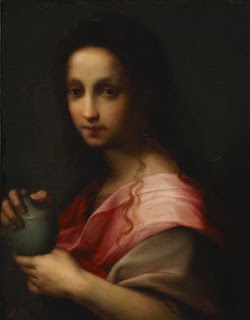 And when Jesus was in Bethany at the house of Simon the leper, a woman came to Him having an alabaster flask of very costly fragrant oil, and she poured it on His head as He sat at the table. But when His disciples saw it, they were indignant, saying, “Why this waste? For this fragrant oil might have been sold for much and given to the poor.”
But when Jesus was aware of it, He said to them, “Why do you trouble the woman? For she has done a good work for Me. For you have the poor with you always, but Me you do not have always. For in pouring this fragrant oil on My body, she did it for My burial. Assuredly, I say to you, wherever this gospel is preached in the whole world, what this woman has done will also be told as a memorial to her.”
“…what transformed the cross and eternally transforms the cross into victory if not the love of Christ, the same divine love that, as the very essence and glory of the kingdom of God, Christ manifested and granted at the last supper? And where, if not at the last supper, do we find the consummation of the full, complete self-sacrifice of this love, which in ‘this world’ made the cross — betrayal, crucifixion, suffering and death — unavoidable?

“The gospels and the church services, particularly the wonderfully profound services of passion week, witness precisely to this link between the last supper and the cross, to their connection as the manifestation and victory of the kingdom of God. In these services, the last supper is always referred to that night that surrounds it on all sides and in which particularly shines the light of the festival of love that Christ accomplished with his disciples in the ‘large upper room, furnished,’ as if prepared in advance from all ages.
“This was the night of sin, night as the very essence of ‘this world.’ And here it thickens to the limit, it prepares to devour the last light shining in it. Already the ‘princes of the people are assembled together against the Lord and his Christ.’ Already the thirty silver pieces — 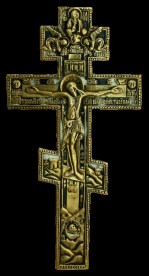 the price of betrayal — are paid. Already the crowd, incited by their leaders, armed with swords and spears, are heading out on the road leading to the garden of Gethsemane.
“But — and this is infinitely important for the Church’s understanding of the cross — the last supper itself took place under the shadow of this darkness. Christ knew ‘the hand of him who betrays me is with me on the table’ (Luke 22:21). And it was precisely from the last supper, from its light, that Judas, after taking the morsel (John 13:27) went out into that dreadful night, and soon after him, Christ.
“And if in the services of Holy Thursday, the day of the express commemoration of the last supper, joy is all the time interlaced with sadness, if the Church again and again recalls not only the light but also the darkness overshadowing it, it is because, in the double exits of Judas and Christ from that light into that darkness, she sees and knows the beginning of the cross as the mystery of sin and the mystery of victory over it.”
-Father Alexander Schmemann, The Eucharist


 Gladsome Lights