Tag Archives: imagination

A place for the genuine.

POETRY

I too, dislike it: there are things that are important beyond
      all this fiddle.
   Reading it, however, with a perfect contempt for it, one
      discovers that there is in
   it after all, a place for the genuine.
      Hands that can grasp, eyes
      that can dilate, hair that can rise
         if it must, these things are important not because a

high-sounding interpretation can be put upon them but because
      they are
   useful; when they become so derivative as to become
      unintelligible, the
   same thing may be said for all of us—that we
      do not admire what
      we cannot understand. The bat,
         holding on upside down or in quest of something to

eat, elephants pushing, a wild horse taking a roll, a tireless
      wolf under
   a tree, the immovable critic twinkling his skin like a horse
      that feels a flea, the base-
   ball fan, the statistician—case after case
      could be cited did
      one wish it; nor is it valid
         to discriminate against “business documents and

school-books”; all these phenomena are important. One must
      make a distinction
   however: when dragged into prominence by half poets,
      the result is not poetry,
   nor till the autocrats among us can be
     “literalists of
      the imagination”—above
         insolence and triviality and can present

for inspection, imaginary gardens with real toads in them,
      shall we have
   it. In the meantime, if you demand on the one hand, in defiance of their opinion—
   the raw material of poetry in
      all its rawness, and
      that which is on the other hand,
         genuine, then you are interested in poetry.
For a Sleepless Child

FOR A SLEEPLESS CHILD

If your room is ever too dark,
small one, look out through your window
up at the moon, that little bulb
left on for you in the sky’s black wall.
It will still be there come morning,
burning in a bright room of blue.

And if your room, restless one,
is much too still, listen to the clatter
of the freight, rattling past trestles
on the cool night breeze. Then follow
the moon to the side of the tracks,
where the train is a long, slow dream

you can jump on. An open car
is waiting for you — one step up —
you’re on! Now watch the dark towns, the lights
deep in the porches, and lie down
in the soft straw, and sleep till morning,
when the train chugs into station,

noisy with birds and wires overhead.

~ Peter Schmitt

Late-Moon-Train-by (2)


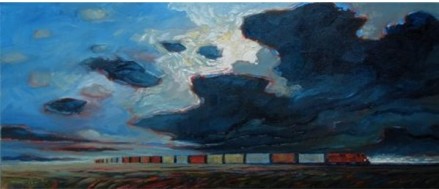
Painting: Late Moon Train by Steve Coffey

The poetry of a wise man might crack your shell.

Many people seem to think that politics will save us, that if we could just get the right people, or “our people” in office, they would begin to set things right, however we envision that. Anthony Esolen in the article Listening Up, in the Nov-Dec 2019 issue of Touchstone magazine, discusses some reasons for this idea, and its often corresponding impulse to judge our human forefathers for their sins, judgment not “by eternal verities, but by the cheap modern substitute, the ‘political.'”

He believes we lack historical imagination, and he sets out to consider the different ways one might make better use of stories and history in general, giving examples first from antiquity:

“So to attempt to transpose Xenophon or Cyrus to the current day, and to grill him with ‘political’ questions, is not to think politically at all, but to replace reality with a caricature. You will learn nothing from Xenophon that way. You may instead be out to teach him a lesson, him, that is, being the cartoon Xenophon you have made. At no time do you allow yourself to be still and to learn, so that the poetry of a wise man might penetrate your shell, crack it open, and show you the stars.

“Once you enter the world of history, you encounter the maddening complexity of human affairs, not to mention that labyrinth called the human heart. With hindsight we can say, with some confidence, that the young Octavius was far better suited for governing the Roman world than was the elder and more experienced Antony. We cannot be so sure of ourselves, though, when it comes to the noble-minded Brutus, and the ambitious and capable Julius Caesar, whom he assassinated.”

Esolen goes on to mention American leaders of note, and of complex history and character, such as William Tecumseh Sherman, and Stonewall Jackson, “a genuinely kindly owner of slaves.” And then he comes to his “three broad categories of modern man, each of them characterized by the stories they listen to and tell”: The Man of Faith, The Man of Wistful Unbelief, and the Man of Superstition.

I found his categories to be very helpful in understanding differences between people in the first two groups especially, and their stories that nourish our hearts. Oh, if only the third group would quiet down and listen to some true stories! But they don’t like the stories of the other two groups, and have their own ever-changing and doubtful heroes.

“History is too dark and tangled a forest for them, sacred Scripture too high a mountain to climb. Therefore they fall into worship of the biggest or most prominent things near them: sex, themselves, the State.”

“They are not brave enough to enter the dark caverns of the human heart…. they cannot forgive what men and women really are. They have no sense of sin, which afflicts everyone, including themselves, but they grasp at being among the elect, by having the most up-to-date pseudo-political opinions.”

You can read the whole article here: “Listening Up.”

People who make history know nothing about history.
You can see that in the sort of history they make.
-G.K. Chesterton


Moles fly, and sparrows sweep the sky.

IMG_3260Preface:  I drafted this post yesterday, not expecting to publish it this soon, but today, the occasion of a statewide election day, I was pained to see public pleas and even poems put forth drawing attention to the needs of “art” and “artists” for money and support. I am all for supporting artists whom I admire, but I am also realizing that in the minds of some professional artists, art has become just another “spiritual practice” to support and be supported by that new religion of modernity, politics. So I decided to share this poem, and my short response, on behalf of all you creative people out there, who may or may not know that you are. Art will never not be, and that is a gift.

PRAISE in SUMMER

Obscurely yet most surely called to praise,
As sometimes summer calls us all, I said
The hills are heavens full of branching ways
Where star-nosed moles fly overhead the dead;
I said the trees are mines in air, I said
See how the sparrow burrows in the sky!
And then I wondered why this mad instead
Perverts our praise to uncreation, why

Such savor’s in this wrenching things awry.
Does sense so stale that it must needs derange
The world to know it? To a praiseful eye
Should it not be enough of fresh and strange
That trees grow green, and moles can course in clay,
And sparrows sweep the ceiling of our day?

-Richard Wilbur

This poem was part of Wilbur’s first collection published when he was 26, just returned from World War II. I read it in Poem A Day Volume 3, where it is accompanied by comments from Wilbur himself:

“Aristototle once said, ‘The making of metaphor is the peculiar gift of the poet, the mark of poetic genius.’ This early poem of mine — a Spenserian sonnet, by the way — begins as an impatient attack on metaphor, but by the close has capitulated and become helplessly metaphorical. That’s as it should be, because the likening of all things, the implication that all things are connatural, is of poetry’s essence.”

I like that in the poem, he refers to “uncreation,” i.e., the One who has made “all things visible and invisible,” and from which Source they also come by their likeness one to another. God is the supreme metaphorical Poet from whom we all receive this gift of making metaphors, and most of us think and speak in metaphors all day long. When in the poem we read, “summer calls,” is that not likening summer to a being that can beckon with a hand or voice? To think of our senses as “stale” links them in our mind to flat beer or dry bread. It’s part of the gift of imagination which has the same Source, and another way that we are made in the image of God. Glory to the Father, and to the Son, and to the Holy Spirit!