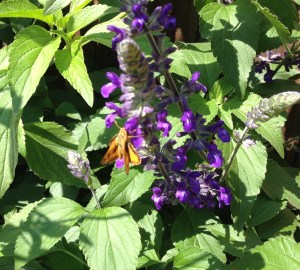
This morning, another visitor, whom my Facebook friends identified for me.
It’s a Gulf Fritillary:
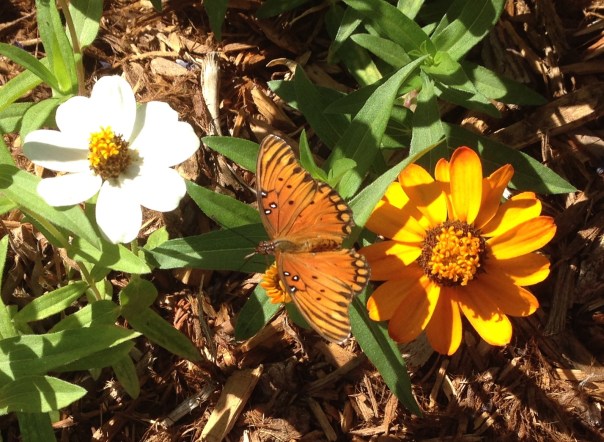
This morning, another visitor, whom my Facebook friends identified for me.
It’s a Gulf Fritillary:
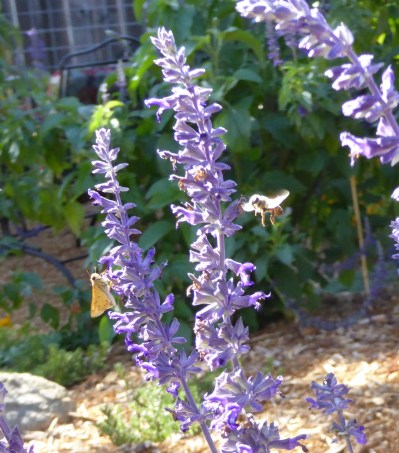
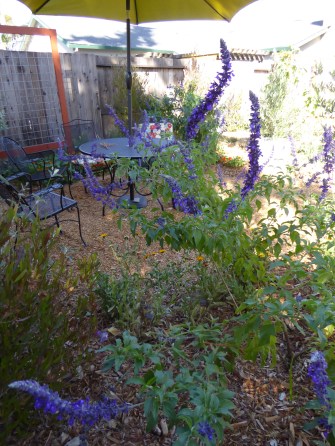
I am sitting in the garden, in the corner where the unbelievable salvias and the olive trees have grown up to make a sort of alcove. The three salvias are each six to nine feet in diameter and four feet high; they amazed me by taking a big leap in July and August of their first year. The umbrella is shielding me from the sun, and I am enjoying the insects that make the air alive with their darting and swooping from one flower to another above and all around me.
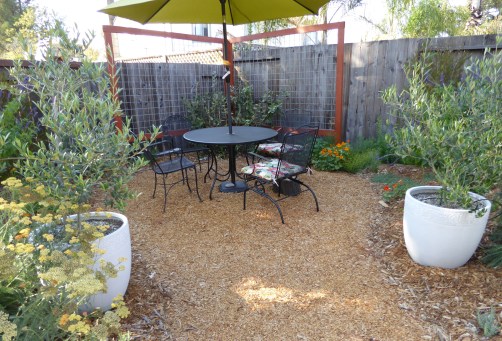
The only reason I thought to move out here with my bowl of plums is that my house is so cold. I brought the laptop so I could continue reading Fr. Stephen’s article while I ate, but the fruit drew all of my attention to my mouth, and to the juicy plumminess too intense to consume mindlessly while reading. Now I remember why I planted two Elephant Heart Plum trees last fall — which, by the way, didn’t produce any fruit from their pretty green and white blossoms this season. Pearl brought me some of her plums yesterday; a year ago the mature trees at her new house had been the inspiration for my decision to grow some of my own.

If I could just sit out here in the soft air, I would most certainly eat less; shivering in the house makes me distracted and uneasy without knowing why, and I unconsciously start stoking the furnace of my body with whatever fuel I can find in the cupboards.
And being in the garden makes me want to share the experience in words, so I looked to see if I have a good summer poem from a previous year. I’m sure it must be here somewhere, if I only had the patience. While looking I found a verse that is new to me, from Walter de la Mare, about one of the winged creatures flitting about.
After pasting it in (and thereby shaping this article into another Pollinator post) I thought perhaps I shouldn’t be so hasty, and I began to look online for a different poem, maybe about a dragonfly or a butterfly ? which, after all are more to my liking. I also hunted around for a clue to the meaning of “specks of sale” in the poem. Does anyone know? I wonder if sale is a word for salt? [Duh. It was a typo, as commenter shoreacres pointed out below. But from now on I think I will always think of it as a synonym 🙂 ]
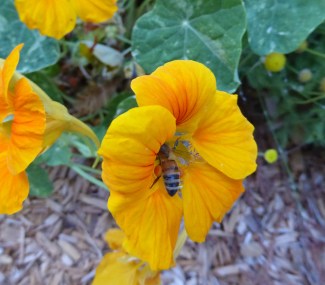
But before any more pages had time to load – I must be too far from the house for the wifi – a common housefly dropped in on me, on my arm, on my keyboard, my shoulder, and he would not be shooed away for anything. I think he sensed what was going on, and wanted me to tell his story, and not another’s. Maybe as soon as I hit “Publish” he will go back to playing.
THE FLY
How large unto the tiny fly
Must little things appear!-
A rosebud like a feather bed,
Its prickle like a spear;
A dewdrop like a looking-glass,
A hair like golden wire;
The smallest grain of mustard-seed
As fierce as coals of fire;
A loaf of bread, a lofty hill;
A wasp, a cruel leopard;
And specks of salt as bright to see
As lambkins to a shepherd.
-Walter de la Mare
I love to have a day like today, when I stayed home and worked, mostly in the garden. I planted seeds in the greenhouse on Wednesday, and today I wanted to sow others directly into the planting boxes. But I hadn’t realized how little space is currently unused by other plants. So I decided to take out a few leeks to make room for carrots. 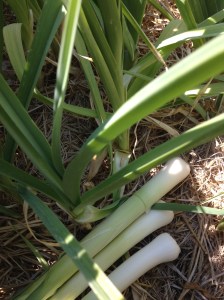
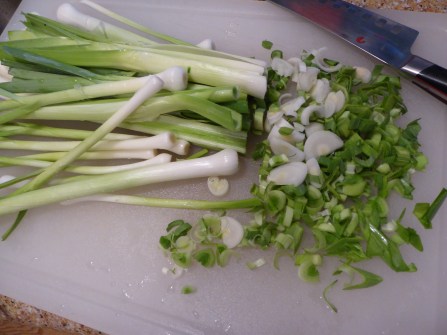
I haven’t been sure about those leeks, if they are growing properly, or are a complete loss. Maybe they didn’t get enough water and are spongy as well as spindly? So I pulled up a few of the largest, and discovered that they are perfectly fine. This was comforting; my fennel had indeed been almost a complete loss, because I let it go too long. And one doesn’t want to have that experience often, of using a chunk of precious space for several months with not much to show for it.
(So I made some Leek Confit this evening.)
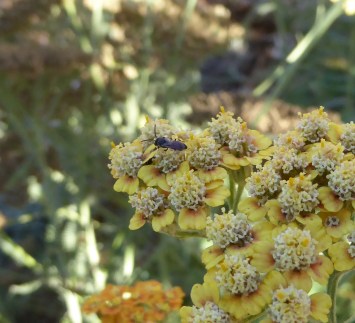
At one point in my back-and-forth around the garden, I stopped raking pine needles or preparing seed beds and just watched all of the insects that are incredibly busy feeding off the flowers. It’s become the pollinator garden that I planned for, and there are many kinds of bees, wasps, flies, moths and butterflies to be seen working.
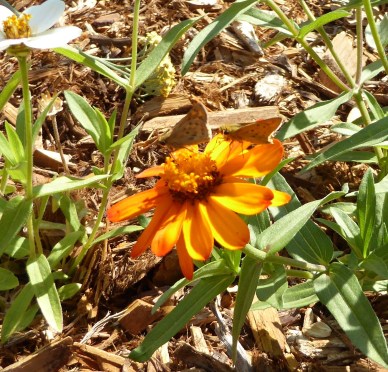
These two seemed to be taking a break from their job, to play tag on a zinnia.
After I took several pictures of them they escaped from my spying and continued their game on the underside of the flower.
I also noticed a hummingbird at the Bachelor’s Buttons, when he made the branches shake, but he didn’t hang around very long after that. 
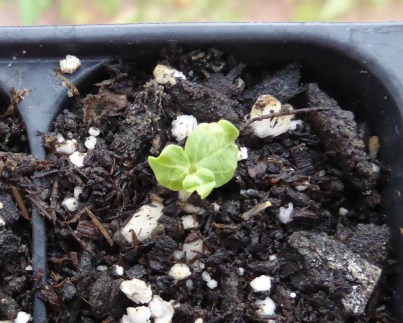
The arugula seeds came up in only three days, in the warm and humid greenhouse, and in four days the hollyhocks began to emerge! This is a newborn hollyhock for you.

While I was doing my work in the back, the landscapers were doing theirs out front.

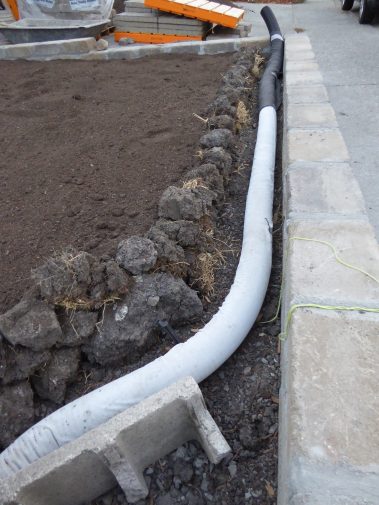
I was quite pleased to see how they made use of the clods of adobe clay to make a sort of wall by the drain that slopes down the grade and will carry off any extra water from heavy rains.
A lovely and restful day. Only my feet hurt. So I wrote this blog post instead of taking an evening walk.
Good night!

 We have helped our neighbor over the years by pruning her overgrown Asian pear tree, and by picking up the fruit that drops throughout the summer months. Recently she did some of this work herself, and put fifty or so pears into a plastic bag and left it under the tree for a week or two. After a while Mr. Glad couldn’t stand it, and he tried to put the whole lot into the trash, but he found it also contained scads of bees, one of which stung him.
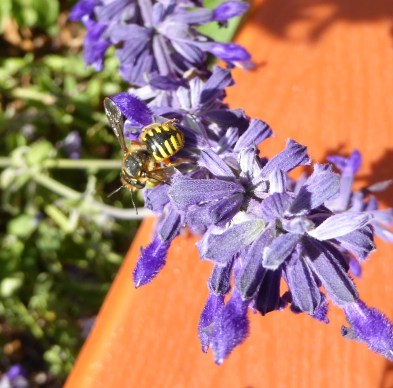
[Correction years later: Those probably were not bees, but syrphid flies; I can’t see any of the images clearly enough to know, this much removed from the event. I didn’t know about syrphids at the time, and even after learning how flies differ from bees, I get them mixed up. But this article has some good information still, so I will leave it up. And maybe it is not a yellow jacket, either, but it is a wasp.]
I saw one of those fruits on the sidewalk with 60% of the inside gone, in the process of being excavated by six honeybees. I was so surprised — I didn’t know they would eat fruit. Another day I took pictures of some of the pears lying on the grass, full of bees, and wasps too.
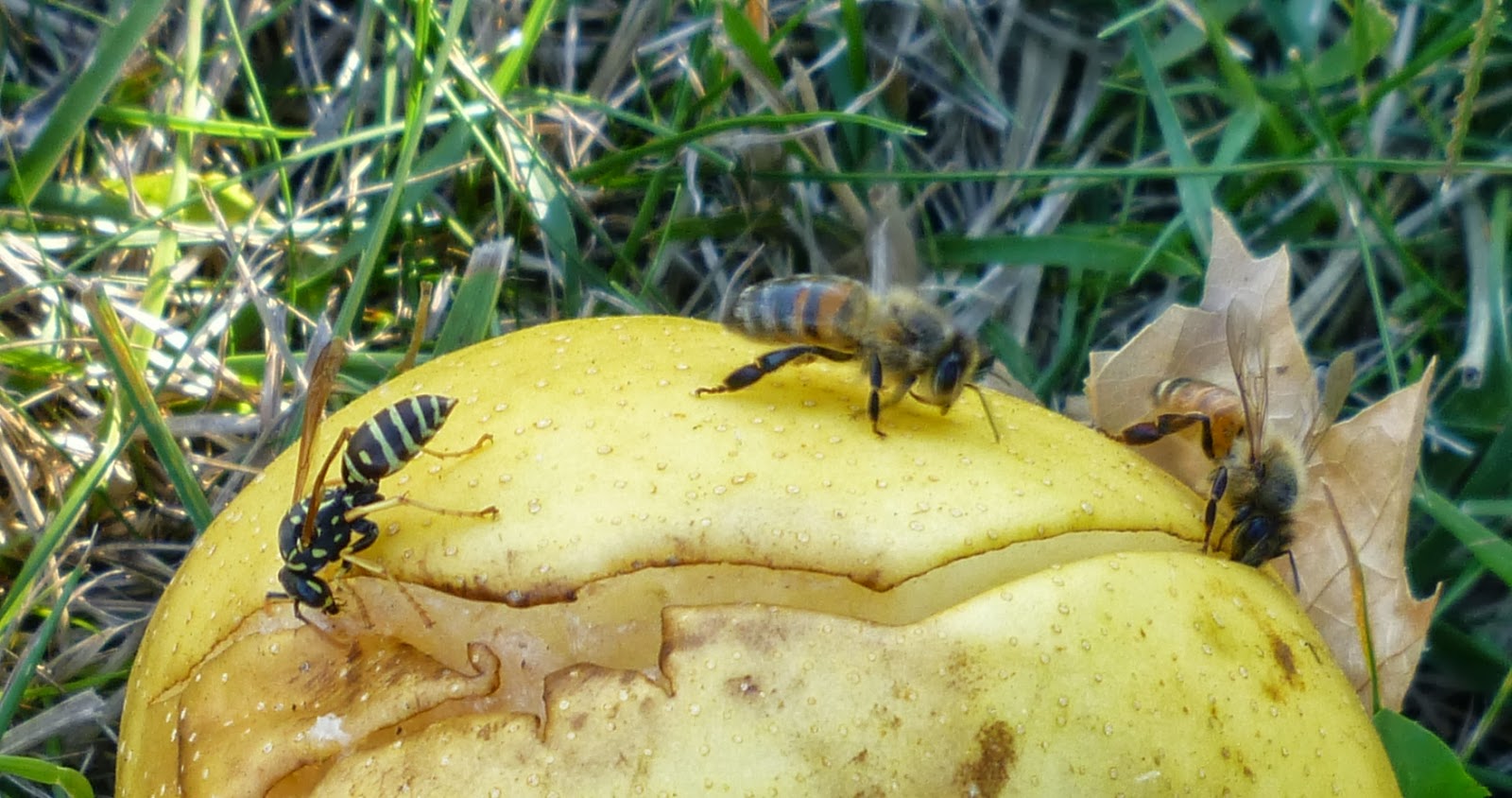 |
| yellow-jacket wasp on left |
The few wasps were spending as much time acting aggressively toward the bees as they were drinking pear juice, trying to be king of the mountain. I thought of what I’d read from The Bee Lady, who recently instructed us about the difference in species. She also let us in on the fact that yellow jackets are carnivores, and they will eat bees. I think that is horrid – as if bees didn’t have enough problems already.
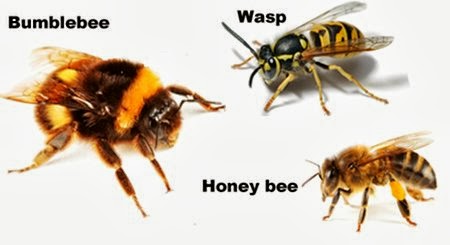 Wasps aren’t bees. Pest removal companies perpetuate the confusion by saying they do “bee removal” when they are talking about both insects. Why can’t they say “Bee and Wasp Removal”? This one has a good chart showing many wasps and bees, even though the company name is not entomologically precise.
To be fair, even wasps do serve a purpose on the earth, as this page points out. I read that one kind of wasp eats black widows, for which I’m sure I must thank the Lord.
 |
| wasp and bee getting along in Australia by C. Frank Starmer via Creative Commons |
I liked this page, too, that delineates some differences between bumblebees and honeybees. Ants, wasps and bees are related species, but they are different species. I am with The Bee Lady on this one — bees should not have to bear the reproach of their cousins.
Ever since I reviewed all those pictures of the blessing of bees and honey, while telling about the Feast of Transfiguration, my love for bees has grown as has my wonderment at honey and the miracle of it all. I’m even eating more honey, such a beautiful food. Wasps haven’t a clue how to make it.

 Gladsome Lights