Yōko Sano was an award-winning Japanese children’s author and illustrator. I found out about her because until her death in 2010 she was the wife of Shuntarō Tanikawa, “one of the most widely read and highly regarded of living Japanese poets, both in Japan and abroad, and a frequent subject of speculations regarding the Nobel Prize in Literature.” (Wikipedia)
I read poems by Tanikawa that I liked, while reading a bit in the Anthology of Modern Japanese Poetry, translated and compiled by Edith Marcombe Shiffert and Yuki Sawa. Here’s one:
PICNIC to the EARTH
Here let’s jump rope together, here.
Here let’s eat rice balls together.
Here I will love you.
Your eyes reflect the blue of the sky,
Your back will be dyed with the green of the herbs.
Here we will learn the names of the stars together.
Staying here let’s imagine all the things that are far off.
Here let’s gather seashells.
From the sea of the daybreak’s sky
let’s bring back the tiny starfish.
At breakfast we will throw them out
and let the night go away.
Here I will keep on saying “I have returned!”
as long as you repeat “Welcome back!”
Here I will keep on returning to again and again.
Here let’s drink hot tea.
Here sitting together for a while
let’s have the refreshing wind touching us.
I like to think he was writing this to his wife Yōko. She illustrated a volume of his poetry, but she is especially famous in the West for her own book The Cat That Lived a Million Times, which was the inspiration for one of my favorite movies, “Groundhog Day.”
The cat in the story, which I’ve only read about, because my library  doesn’t have that book, is reincarnated again and again but never learns to love until he has a cat “wife” and family. This is a little different from Bill Murray’s character in the movie, because when the insufferably conceited Phil Connors is punished, he is forced to live the same day over and over again. He tries to escape by death but that is evidently impossible; eventually he gets over himself and is released from the torturous day.
I did borrow I Am a Cat by Natsume Sōseki from my local library. Its beginning chapter was the first short story that Sōseki ever wrote, and he intended for it to stand alone. But the editor of the magazine in which it was published — more than a hundred years ago now — persuaded him to continue it as a series, and that is how the novel was born. I did read that first chapter, but I don’t know if I will go on, much as I enjoyed the character of the nameless cat. My stacks of books from the broad genre of Japanese literature are tall, and life is short!
In the same poetry anthology mentioned above I read Makoto Ōoka, a contemporary of Tanikawa, and this evocative poem:
TO LIVE
I wonder if people know
that there are several layers in the water?
Fish deep in it and duckweed drifting on its surface
bathe in different lights.
That makes them various colored.
That gives them shadows.
I gather up pearls on a pavement.
I live inside a phantom forest;
upon notes of music scattered over the strings of my being.
I live in hollows of drops that trickle upon snow;
in damp ground of morning where the liverwort opens.
I live upon a map of the past and future.
I have forgotten the color my eyes were yesterday.
But what things my eyes saw yesterday
my fingers realize
because what my eyes saw was by hands
patted like touching the bark of a beech tree.
O I live upon sensations blown about by wind.
Cats do not seem to be a common subject for Japanese poetry. In two anthologies I didn’t find one on that subject, though at least two poems mentioned babies teething. To conclude my ramblings on my browsing I give you this 11th-century verse from One Hundred Poems from the Japanese translated by Kenneth Rexroth:
Involuntary,
I may live on
In the passing world,
Never forgetting
This midnight moon.
-The Emperor Sanjō
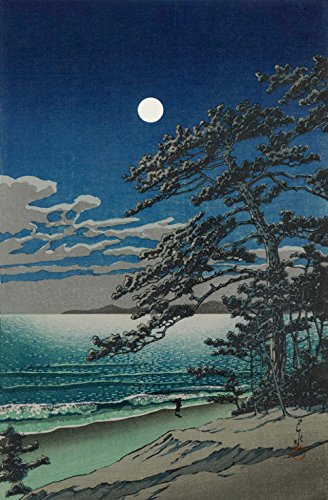
“Spring Moon at Ninomiya Beach” by Kawase Hasui


 Gladsome Lights