Because when I recently rediscovered this post from three years ago, I was nourished by it again, I am re-posting it for my new readers and for all of us. It concerns the most enduring things, never outdated. One of those always-new things, which I’ve only this year begun to read and think about in the context of the Annunciation, is hospitality of the sort that the Virgin demonstrated toward the very Son of God. She is an example for us all.
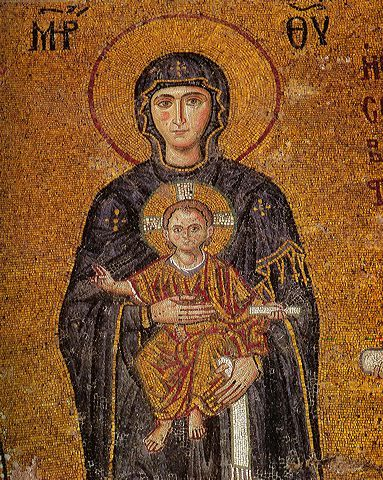
Today is the beginning of our salvation;
the revelation of the eternal Mystery!
The Son of God becomes the Son of the Virgin
as Gabriel announces the coming of Grace.
Together with him let us cry to the Theotokos:
“Rejoice, O Full of Grace, the Lord is with you!”
I had wanted to continue my ruminations on The Lily of the Field and the Bird of the Air by further considering The Moment that Søren Kierkegaard refers to when, after waiting in silence, “…the silent lily understands that now is the moment, and makes use of it.”
I don’t know what that moment consists of for you, for me, for us as a world community, or in our cities or church communities or families. No doubt there are overlapping times and seasons containing infinite instants, and only by quiet listening can we make any sense of them. But this passage in particular I wanted to pass on, in which the writer discusses what is missed when we fail to make the proper, standing-before-God kind of preparation:
“Even though it is pregnant with rich significance, the moment does not send forth any herald in advance to announce its arrival; it comes too swiftly for that; indeed, there is not a moment’s time beforehand…. But of course everything depends upon “the moment.” And this is surely the misfortune in the lives of many, of far the greater part of humanity: that they never perceived ‘the moment,’ that in their lives the eternal and the temporal were exclusively separated.”
 So many thoughts swirl in my own noisy mind and heart that I could not imagine how I might find a way to share even these few gleanings with you. Then, in God’s providence and the church calendar, appeared someone who is the supreme example for us of being ready for the moment, that time in history and that time in her life, in a particular moment of a day, when the Angel Gabriel appeared to her. Today we remember that event, when Mary listened, and responded, “Behold, I am the handmaid of the Lord; let it be to me according to your word.”
The Word became flesh and came to live with us, taking on all our human experience, its weakness and suffering and death. He defeated death, and opened the gates of Paradise. The Incarnation, the beginning of our salvation, is The Moment of history; our own “Yes” to God, echoing Mary’s willingness, can be the essence of our every prayer as well, as we wait on Him.
Kierkegaard exhorts us, in words that seem especially fitting for this time of uncertainty and change: “Would that in the silence you might forget yourself, forget what you yourself are called, your own name, the famous name, the lowly name, the insignificant name, in order in silence to pray to God, ‘Hallowed be your name!’ Would that in silence you might forget yourself, your plans, the great, all-encompassing plans, or the limited plans concerning your life and its future, in order in silence to pray to God, ‘Your kingdom come!’ Would that you might in silence forget your will, your willfulness, in order in silence to pray to God, ‘Your will be done.’“
We know that God’s will for us is good, now as ever. Our inability to see or understand that is due to our weakness or sin, or His hiding of His works. May He give us grace to wait and to pray, and eventually we will see the full salvation of the LORD.
Oh, the depth of the riches and wisdom and knowledge of God!
How unsearchable are his judgments and how inscrutable his ways!
For who has known the mind of the Lord,
or who has been his counselor?
Or who has given a gift to him that he might be repaid?
For from him and through him and to him are all things.
To him be glory forever. Amen.
Romans 11


 Repentance is not self-flagellation;
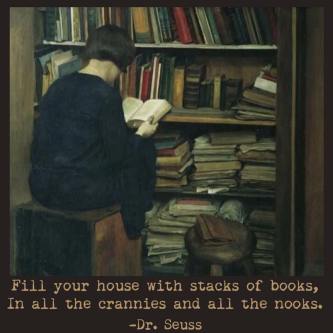 milieu in which Technopoly flourishes is one in which the tie between information and human purpose has been severed, i.e., information appears indiscriminately, directed at no one in particular, in enormous volume and at high speeds, and disconnected from theory, meaning, or purpose.” -Neil Postman in Technopoly
 “Faith is not a matter of ‘belief,’ an act of intellectual willing. Faith is a perception of things that do not necessarily appear obvious. In the language of Scripture – ‘faith is the evidence of things not seen.’ But the perception of faith is similar to the perception of objects beneath the surface of a lake. If the surface is disturbed, the objects disappear. The objects do not go away – but we can no longer perceive them.
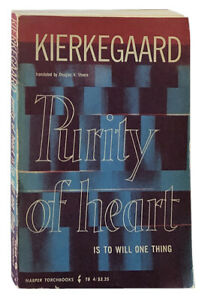 I would like to read more of Søren Kierkegaard’s writings. My intent is on display in the form of four titles by him that I have had sitting on the mobile bookshelf here in my kitchen/family room, for a year at least. I guess if I could decide which to read that would be a good start. A biography of him I am not likely to get to, but who knows…? In the meantime, I am reading this homage by Dana Gioia in the form of a poem. Seems like after this I owe it to Kierkegaard to read at least one more of his own works, though not in hopes of explaining any “riddles.” Only God can do that, and we know that He will — all of them, all of us.
 Gladsome Lights