The Poem-a-Day selection for yesterday was about maps, by Carl Sandburg. I read it when I came home from church this afternoon, after hearing a homily about a map. In Liturgy we learned that the map to the Kingdom is in our heart — but many other things are in the heart, as is obvious from our own lives and from the daily news. One consequence that can result from contemplating the news of the world is an increase of fear and anxiety in our hearts.
The experience related in Sandburg’s poem seems to echo what St. Macarius describes, following the Prophet Jeremiah, who said, “The heart is deceitful above all things, and desperately wicked: who can know it?“
St. Macarius: “Within the heart is an unfathomable depth. There are reception rooms and bedchambers in it, doors and porches, and many offices and passages. In it is the workshop of righteousness and of wickedness. In it is death, in it is life….The heart is but a small vessel; and yet dragons and lions are there, and there likewise are poisonous creatures….rough, uneven paths are there, and gaping chasms.”
EXPERIENCE
This morning I looked at the map of the day
And said to myself, “This is the way! This is the way I will go;
Thus shall I range on the roads of achievement,
The way is so clear—it shall all be a joy on the lines marked out.”
And then as I went came a place that was strange,—
’Twas a place not down on the map!
And I stumbled and fell and lay in the weeds,
And looked on the day with rue.
I am learning a little—never to be sure—
To be positive only with what is past,
And to peer sometimes at the things to come
As a wanderer treading the night
When the mazy stars neither point nor beckon,
And of all the roads, no road is sure.
I see those men with maps and talk
Who tell how to go and where and why;
I hear with my ears the words of their mouths,
As they finger with ease the marks on the maps;
And only as one looks robust, lonely, and querulous,
As if he had gone to a country far
And made for himself a map,
Do I cry to him, “I would see your map!
I would heed that map you have!”
-Carl Sandburg
Our pastor was preaching on Matthew 6, where Christ teaches us:
The light of the body is the eye. If therefore thine eye be single, thy whole body shall be full of light. But if thine eye be evil, thy whole body shall be full of darkness. If therefore the light that is in thee be darkness, how great is that darkness!
No man can serve two masters; for either he will hate the one and love the other, or else he will hold to the one and despise the other. Ye cannot serve God and mammon.
Therefore I say unto you, take no thought for your life, what ye shall eat, or what ye shall drink; nor yet for your body, what ye shall put on. Is not the life more than meat, and the body than raiment?
Behold the fowls of the air, for they sow not, neither do they reap, nor gather into barns; yet your heavenly Father feedeth them. Are ye not much better than they? Which of you by taking thought can add one cubit unto his stature?
It’s interesting to look at several translations of the words describing the healthy or unhealthy eye: cloudy or clear, evil or single, diseased or unclouded. Of course, Christ is our Light, He said so Himself, and if we keep our eye on Him, He will light the path, He will be the map in our heart, so that we find the best things that St. Macarius tells about:
“The heart is Christ’s palace…There Christ the King comes to take His rest, with the angels and the spirits of the saints, and He dwells there, walking within it and placing His kingdom there….the heavenly cities and the treasures of grace: all things are there.”
When Christ places His kingdom there, we understand that our heavenly Father is obligated to take care of us — He loves us and is, after all, our Father. Much more than any earthly father He loves us and wants to provide for our needs.
Today I also read a poem by Wendell Berry, on this blog, and he expresses and heeds the exhortation in today’s Gospel:
THE PEACE of WILD THINGS
When despair for the world grows in me
and I wake in the night at the least sound
in fear of what my life and my children’s lives may be,
I go and lie down where the wood drake
rests in his beauty on the water, and the great heron feeds.
I come into the peace of wild things
who do not tax their lives with forethought
of grief. I come into the presence of still water.
And I feel above me the day-blind stars
waiting with their light. For a time
I rest in the grace of the world, and am free.
-Wendell Berry
What a contrast Berry’s focus is to Sandburg’s narrator who wanders where “no road is sure,” and who longs for a good map. “We have been given the map!” I want to tell him. Keep your eyes on Christ, and walk on past the dragons and gaping chasms. Cling to Him, keep bringing your focus back to Him as a light that is far brighter than your “mazy stars,” and you will find your way to Christ’s palace, and take your rest, too, with the saints and angels, amid the treasures of grace.
 n the greenhouse!) are very happy with the weather. I’ve been busy battening down the hatches, which includes battling with mice and rats who found my garage a cozy place to set up housekeeping for the winter. I’m thankful for them at this point, because they have forced me to clean the garage from top to bottom. Dear little things – and I’m trying not to be sarcastic – I know they are doing what is normal and right for them.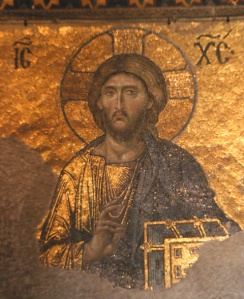
 a long time I’d been hoping to keep St. Brigid’s Day with some kitchen activity; I even programmed the idea into my online calendar and every year toward the end of January the e-mail reminder arrived, “If it’s not a fasting day, make Irish food.” As the day came and went year after year, always on the eve of a major feast of the Orthodox Church, there was never time or energy to enact my plan. Until this year.
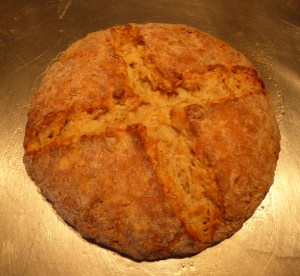
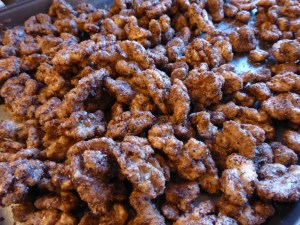 Confession: I actually did alter the bread recipe a bit, partly because I had an egg yolk left over from making these

 Gladsome Lights