The thinnest yellow light of November is more warming and exhilarating than any wine they tell of. The mite which November contributes becomes equal in value to the bounty of July.
-Henry David Thoreau
The thinnest yellow light of November is more warming and exhilarating than any wine they tell of. The mite which November contributes becomes equal in value to the bounty of July.
-Henry David Thoreau
FINAL SOLILOQUY OF THE INTERIOR PARAMOUR
Light the first light of evening, as in a room
In which we rest and, for small reason, think
The world imagined is the ultimate good.
This is, therefore, the intensest rendezvous.
It is in that thought that we collect ourselves,
Out of all the indifferences, into one thing:
Within a single thing, a single shawl
Wrapped tightly round us, since we are poor, a warmth,
A light, a power, the miraculous influence.
Here, now, we forget each other and ourselves.
We feel the obscurity of an order, a whole,
A knowledge, that which arranged the rendezvous.
Within its vital boundary, in the mind.
We say God and the imagination are one…
How high that highest candle lights the dark.
Out of this same light, out of the central mind,
We make a dwelling in the evening air,
In which being there together is enough.
-Wallace Stevens

I discovered this poem on the blog Kingdom Poets, where the poet-blogger D.S. Martin wonders if Stevens ought even to be “mentioned in a blog about Christian poetry.” Martin also quotes a few speculative lines from a biographer of Stevens, as to the lifelong skeptic’s motives for receiving Christian baptism on his deathbed. I’d like to read more of what he wrote later in life, but the images and evocations of this poem are familiar enough to me to make me think that Wallace Stevens had truly tasted of the Kingdom of God, that Holy Spirit-quickened heart where Christ dwells, of which He spoke when He said, “The Kingdom of God is within you.”
St. Porphyrios said provocatively, “Whoever wants to become a Christian must first become a poet.” Father Stephen Freeman has quoted the saint when he writes about “what can drive us both to poetry as well as theology”:
“The reduction of the world and its ‘history’ are the tools of those who lack the imagination and patience to find the truth. The Fathers tell us to ‘pay attention.’ This is true with regard to the heart, but it is also true with regard to the world around us. Attention does not solve the mystery, but it at least acknowledges its presence and gives rise to enough wonder to make understanding possible at some point.”
“Evil is never creative. It is destructive and occasionally diverse in its activities. But creativity requires energy and commitment. Evil’s own entropy always reduces it to banality and boredom. It prefers prose: poetry is too much work.”
Fr. Stephen also quotes a poem from e.e. cummings, including the lines, “i do not know what it is about you… only something in me understands…”
The type of somethings that e.e. cummings refers to can’t be known intellectually, but they are the testimony of our own experience that “mystery is not only an aspect of the divine, but part of the nature of all reality. Everything is far more than it appears.”
I am eternally grateful to writers like Wallace Stevens who commit their strength of mind and length of days to sharing their glimpses of the mysterious reality behind the obvious,
…since we are poor, a warmth,
A light, a power, the miraculous influence.

O LIGHT INVISIBLE
O Light Invisible, we praise Thee!
Too bright for mortal vision.
O Greater Light, we praise Thee for the less;
We thank Thee for the light that we have kindled,
The light of altar and of sanctuary;
Small lights of those who meditate at midnight
And lights directed through the coloured panes of windows
And light reflected from the polished stone,
The gilded carven wood, the coloured fresco.
Our gaze is submarine, our eyes look upward
And see the light that fractures through unquiet water.
We see the light but see not whence it comes.
O Light Invisible, we glorify Thee!
In our rhythm of earthly life we tire of light. We are glad when the day ends, when the play ends; and ecstasy is too much pain.
We are children quickly tired: children who are up in the night and fall asleep as the rocket is fired; and the day is long for work or play.
We tire of distraction or concentration, we sleep and are glad to sleep,
Controlled by the rhythm of blood and the day and the night and the seasons.
And we must extinguish the candle, put out the light and relight it;
Forever must quench, forever relight the flame.
Therefore we thank Thee for our little light, that is dappled with shadow.
We thank Thee who hast moved us to building, to finding, to forming at the ends of our fingers and beams of our eyes.
And when we have built an altar to the Invisible Light, we may set thereon the little lights for which our bodily vision is made.
And we thank Thee that darkness reminds us of light.
O Light Invisible, we give Thee thanks for Thy great glory!
-T.S. Eliot, from The Rock

(You may hear the poet himself reading here.)
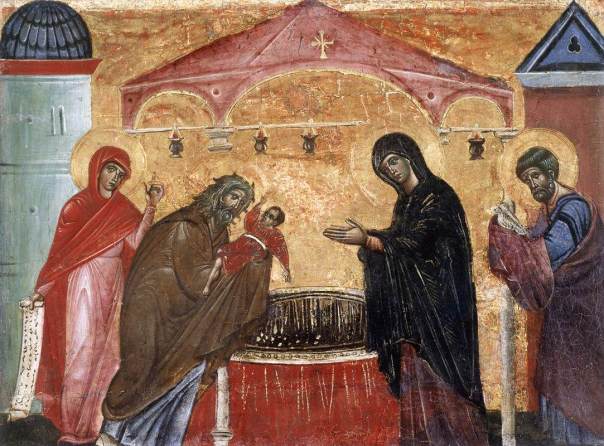
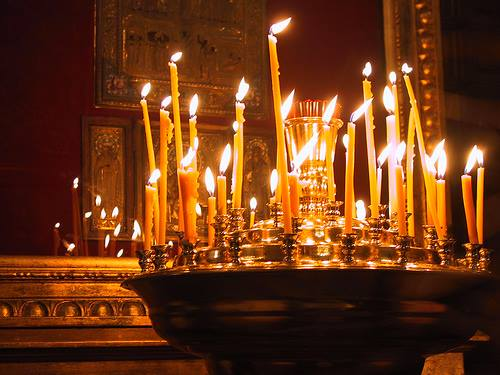 “Our lighted candles are a sign of the divine splendor of the one who comes to expel the dark shadows of evil and to make the whole universe radiant with the brilliance of his eternal light. Our candles also show how bright our souls should be when we go to meet Christ. The Mother of God, the most pure Virgin, carried the true light in her arms and brought him to those who lay in darkness. We too should carry a light for all to see and reflect the radiance of the true light as we hasten to meet him. The light has come and has shone upon a world enveloped in shadows; the Dayspring from on high has visited us and given light to those who lived in darkness. This, then, is our feast, and we join in procession with lighted candles to reveal the light that has shone upon us and the glory that is yet to come to us through him. So let us hasten all together to meet our God.
“The true light has come, the light that enlightens every man who is born into this world. Let all of us, my brethren, be enlightened and made radiant by this light. Let all of us share in its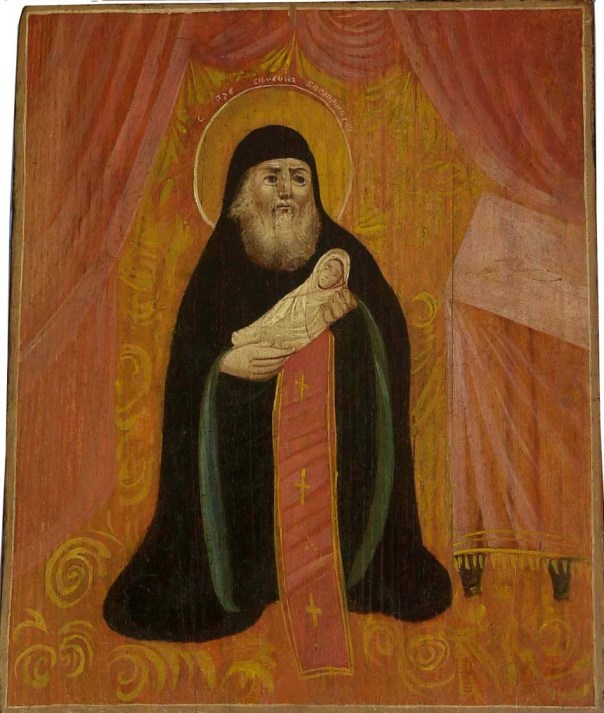 splendor, and be so filled with it that no one remains in the darkness. Let us be shining ourselves as we go together to meet and to receive with the aged Simeon the light whose brilliance is eternal. Rejoicing with Simeon, let us sing a hymn of thanksgiving to God, the Father of the light, who sent the true light to dispel the darkness and to give us all a share in his splendor.
“Through Simeon’s eyes we too have seen the salvation of God which he prepared for all the nations and revealed as the glory of the new Israel, which is ourselves. As Simeon was released from the bonds of this life when he had seen Christ, so we too were at once freed from our old state of sinfulness.
“By faith we too embraced Christ, the salvation of God the Father, as he came to us from Bethlehem. Gentiles before, we have now become the people of God. Our eyes have seen God incarnate, and because we have seen him present among us and have mentally received him into our arms, we are called the new Israel. Never shall we forget this presence; every year we keep a feast in his honor.”
St Sophronius of Jerusalem, c. 560 – 638