Tag Archives: maps

Book Bits of India

A couple of friends asked me last fall if I were reading about India in preparation for traveling here, and I had to admit that I wasn’t. I’ve always been like this, before school field trips or grownup camping trips, unable to focus in an academic way on a future and therefore theoretical event with its vast possibilities. It seems to me to be putting the answers ahead of the questions that I haven’t yet been stimulated to ask; the likelihood is high that I would have wasted my time reading material that would turn out to be irrelevant to my personal experience.

I did try a little. First I started in on Midnight’s Children by Salmon Rushdie, but I couldn’t get interested. And through Great Courses I listened to a professor of Indian history lecture tediously for some hours, until I couldn’t bear him any longer. Just before my trip, I began to listen to Michael Wood’s The Story of India, and he was very engaging and promising.

But once I arrived and had several days’ worth of experiences under my belt, I started reading lots of articles online, and delving into the many books on the subject of India that are in this house. I’m sure I won’t finish reading any of them, but they have all contributed to my understanding and made my stay here richer. I’ll share somewhat random quotes from a few of them in my list below.

Reimagining India: Unlocking the Potential of Asia’s Next Superpower edited by McKinsey & Company     This collection of essays by dozens of writers, mostly Indian, ranges from hard-core economic and trade issues to a discussion of how India became the world leader in the game of cricket. I will probably refer to some of the articles in future posts.
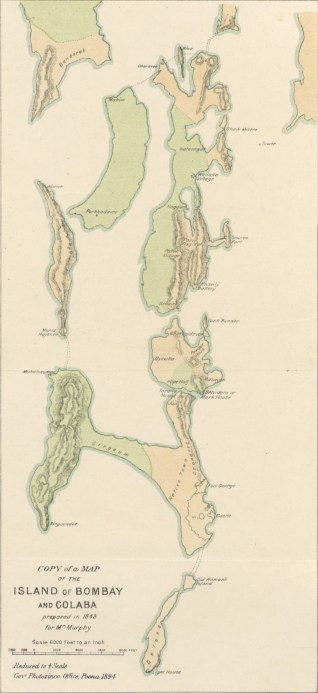
Eyewitness Travel: India     “Consisting of seven swampy islands when the Portuguese acquired it in 1534, Bombay (from the Portuguese Bom Bahia or ‘Good Bay’) came to the British Crown in 1661 as part of the dowry of Catherine of Braganza when she married Charles II. Finding little use for the islands, the British leased them to the East India Company, which quickly realized their potential as an excellent natural harbour in the Arabian Sea. The rise of Bombay began in the late 1600’s, when the company relocated its headquarters here. By the 18th century, Bombay had become the major city and shipbuilding yard on the western coast, and by the 19th century, land reclamations had joined the islands into the narrow promontory that it is today.”

Culture Shock! India by Gitanjali Kolanad c. 1994    “You may meet with the invitation to ‘drop by anytime.’ In E.M. Forster’s A Passage to India, Mrs. Moore meets with a situation where she tries to pin down a specific time with a Mrs. Bhattacharya, who is gracious but vague. In the end Mrs. Moore settles with her on the coming Thursday, only to find that the Bhattacharyas are leaving for Calcutta the following morning.

“Mrs. Moore is bewildered by the exchange, but one Indian friend to whom I told the story understood the situation perfectly. She said, ‘The guest is blessing you, doing you a great honor by visiting you. How can you be so rude as to try to restrict them to a certain time?'”
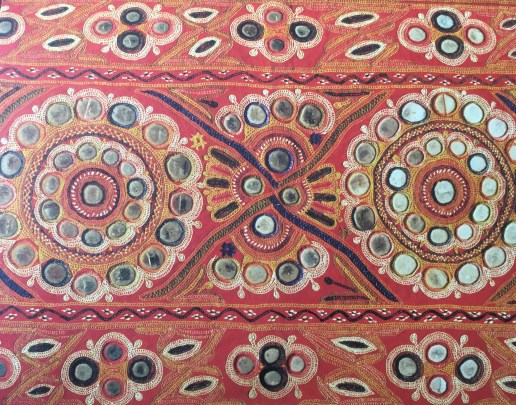
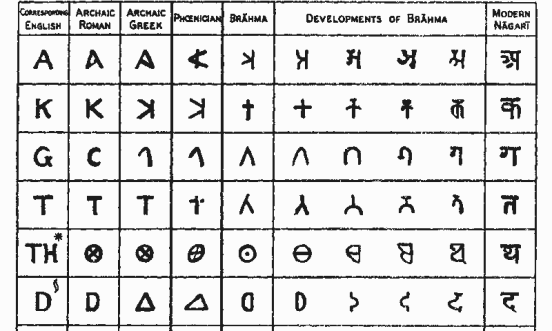
The Story of India by Michael Wood (frontispiece above)     Quoting Sir William Jones: “‘The Sanskrit language, whatever be its antiquity, is of a wonderful structure; more perfect than the Greek, more copious than the Latin, and more exquisitely refined than either, yet bearing on both of them a stronger affinity, both in the roots of verbs, and in the forms of grammar, than could possibly have been produced by accident; so strong indeed, that no philosopher could examine them all three without believing them to have sprung from some common source, which, perhaps, no longer exists.'”

“The question is very complex, but there is one thing on which all competent linguists agree: Jones was right — the languages are connected; and the time depth of the ‘family tree’ of the Indo-European languages precludes the idea of India as the place of origin. The Sanskrit language must have originated outside India. But how far back? And from where? Was it brought by invaders or travelers, by elites or mass migration?

“This is now one of the hottest arguments in modern India, where the battle over history that began under the British in the nineteenth century is now at the heart of politics and education because it bears on central questions of identity.”
India: The Cultural Companion by Richard Waterston     This book focuses on the history and tradition of India’s many indigenous religions.

“[It is] common to read in Hindu texts of attempts to ‘cheat’ or ‘vanquish’ time. A verse from the Mahabharata advises that ‘time “cooks” all beings’ and ‘destroys all creatures;’ when everything else sleeps ‘time is awake, time is hard to overcome.'”…. “The present age (Kali Yuga) is the last in the cycle and marks the point at which spiritual intelligence and morality have reached their lowest ebb.”

“The most striking aspect of Jain karma is that it is perceived as a material entity, like a subtle dust that clogs the soul, binding it to the body. Many lifetimes are required to rid the soul of karmic dust and so liberate it.”

Indian Nationalism: A History by Jim Masselos     I enjoyed this book for its thorough overview of the people and events by which the first stirrings of the will to independence multiplied in various places around the subcontinent and overcame the many differences of culture and religion to become a unified force strong enough to oust the British.

Indian Breads by G. Padma Vijay     This was a Christmas present from Kate and Tom. How did they know I would love the Indian flatbreads of which there are enough varieties to fill a book? Just last night we ate garlic or lassoon paratha, one of many paratha recipes that are joined by instructions for naan, chapattis, rotis and many breads you’ve probably never heard of even if you love to eat Indian food. The smoke alarm always goes off here when Kareena makes her wonderful chapattis, so when I go home I may have to limit my experiments to days of open windows.

Flowers of India by Helmut Wolf      A board book on this subject is just about my speed. I found it in a fancy shop that sells children’s clothes, and I will put it in my suitcase as one concrete item among all the intangible smidgens of knowledge I have collected from books.

Food for the mind, feasts for the eyes.

If I have trouble putting together a Real blog post, it’s not because I haven’t been soaking up the sights and thinking about so many things. Now that I am actually here, I have been reading about and discussing with Kate and Tom Indian history, language, politics, slums, and religion.

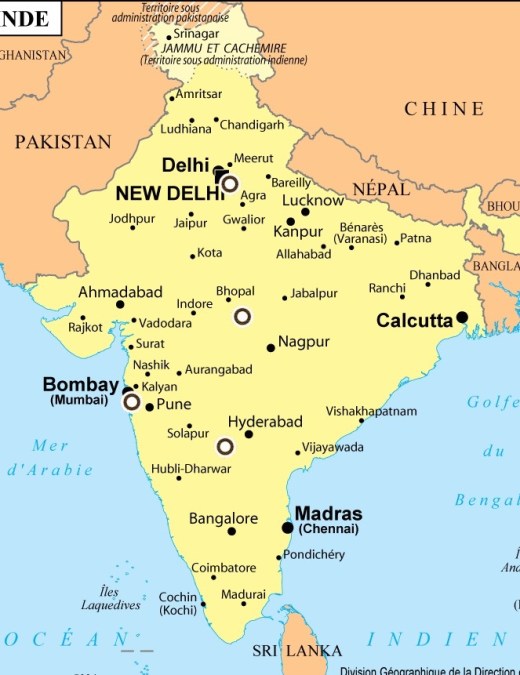
The night before Baby Raj was born, Tom projected maps of India on the big screen and gave a little talk on various of these topics — it was the best sort of lesson for me, the map presentation helping me to tie bits of knowledge together in my mind. Perhaps there’s a chance I will retain more than a smidgen.

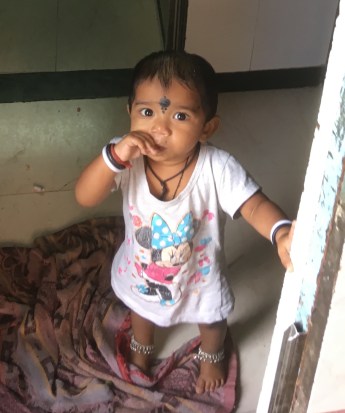
My “studies” are interspersed with or carried on in the midst of Baby Immersion. Just being in a home where a newborn baby lives and breathes and will stare back at you with no feeling of awkwardness — it’s too sweet.

This baby will have Indian nannies as long as he lives here, so some of the first words impressed on his pliable mind will be from Indian languages. But which ones? Hindi is not the primary language spoken in these parts, and India has designated 30 languages as “official” languages of the nation. According to Census of India of 2001, India has 122 major languages and 1599 other languages.

20% of Indians speak Dravidian languages, which are not even related to Indo-Aryan languages such as Hindi. These and other non-Hindi speakers have fought against proposals to impose the Hindi language in southern India. The Indian constitution does not give any language the status of national language, but the authorized version of laws is required to be in English, and the business of the Supreme Court is conducted in English.

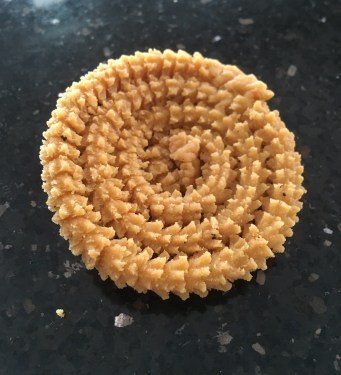
I’ve learned very few Indian words, mostly names of food. But I didn’t learn the name of the Diwali festival treat above before eating the last one in the house. Almost everyone I encounter seems to speak at least a little English, but sometimes I can’t understand one word in a whole sentence by the most fluent speakers, because of their accent.

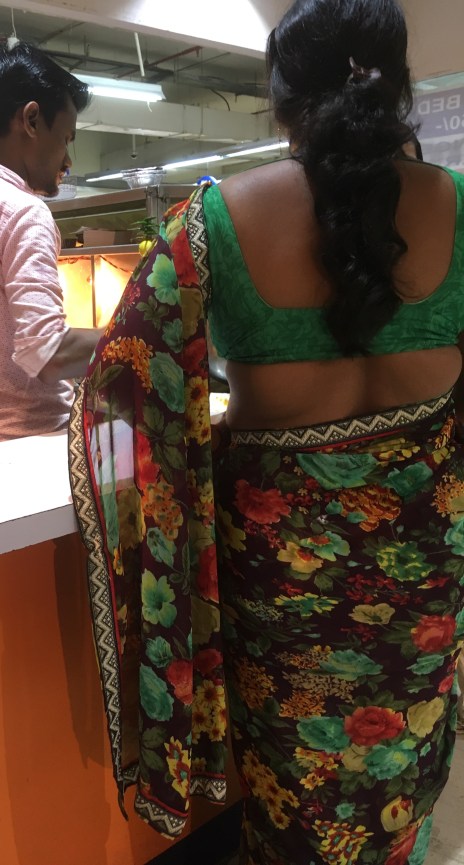
Everywhere we go I feast on colors, and feel myself to be somewhat ghostly in appearance in contrast to the Indian women in their rich attire. I’m sure I will come home with a few new and bright, concrete items to go with the images on my computer and the imprints on my mind. New dishes are constantly being set out on this banquet table.

Shopping with pani puri.

Tom took me along on his shopping trip yesterday, to a few stores and shops including a multi-story big box that had features of a Super Wal-Mart, Costco, and a department store. The escalators were ramps that accommodated shopping carts, and we visited all the floors and departments, but never found a C-battery or anyone who knew what that was. Tom wasn’t very sure himself, but some new baby equipment wants them. Oh well.

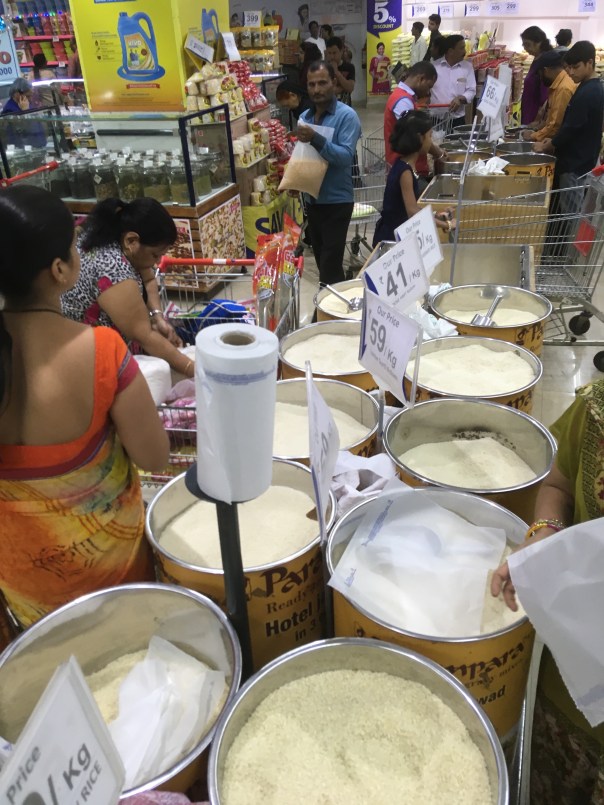
I was fascinated by the many varieties of basmati rice, both packaged and in large bins where women in pretty clothes were scooping up their favorite type. I love basmati rice and used to buy it in 25# bags myself; I came home with a jar of the Brown Basmati.

The packaged rice is one of many products and ads that feature a photo of a famous movie star, often a Khan, or the “Big B,” Amitabh Bachchan. I don’t have a hope of keeping all these celebrities straight, but a couple of them have leading roles in an unusually good Bollywood movie we are currently watching here (over the course of three nights, because it’s close to four hours long): “Lagaan.” Oh, and on the route between the different shops, whose car did our driver point out but that of the very Aamir Khan himself. Mumbai is the center of Bollywood, did you know?

Women were also filling bags with large-crystal sugar from a great bulk bin.
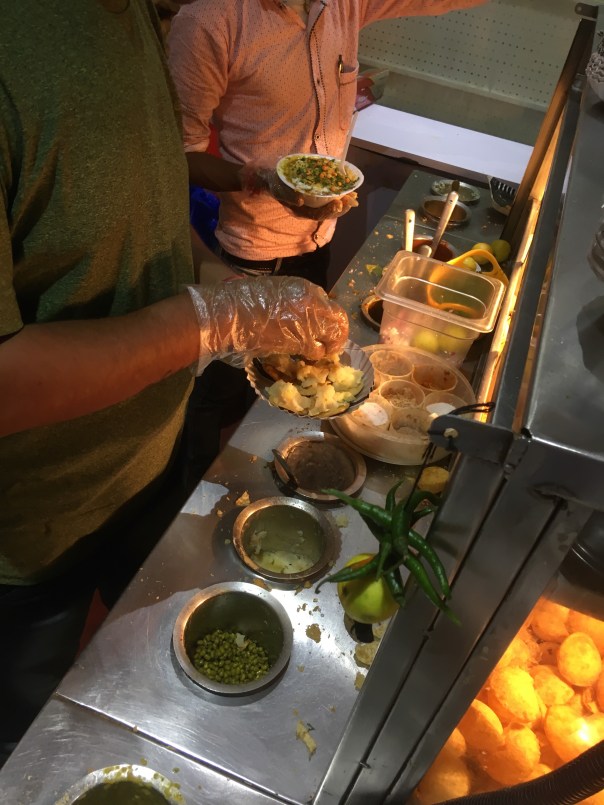
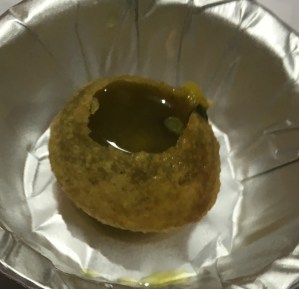


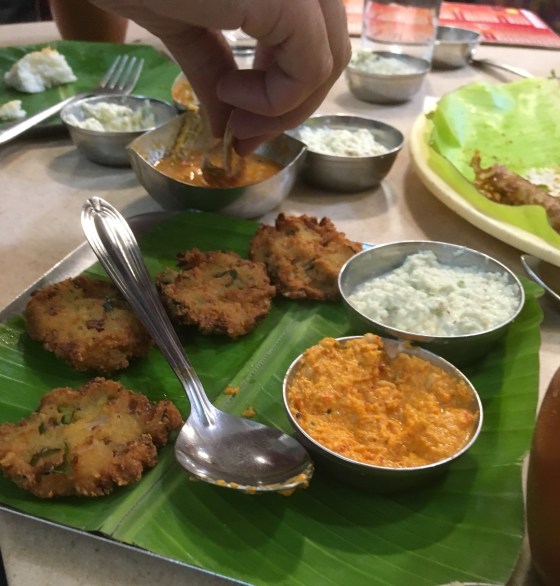
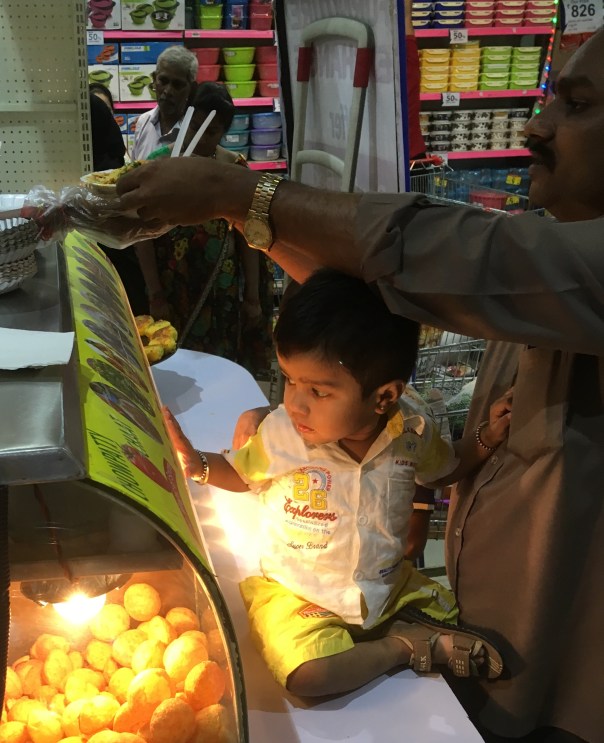
We ate several pani puri snacks and another type of snack at a stand in the food department of the store. For us to take our fill of those savory treats cost less than 100 rupees which Tom said was about $1.10.


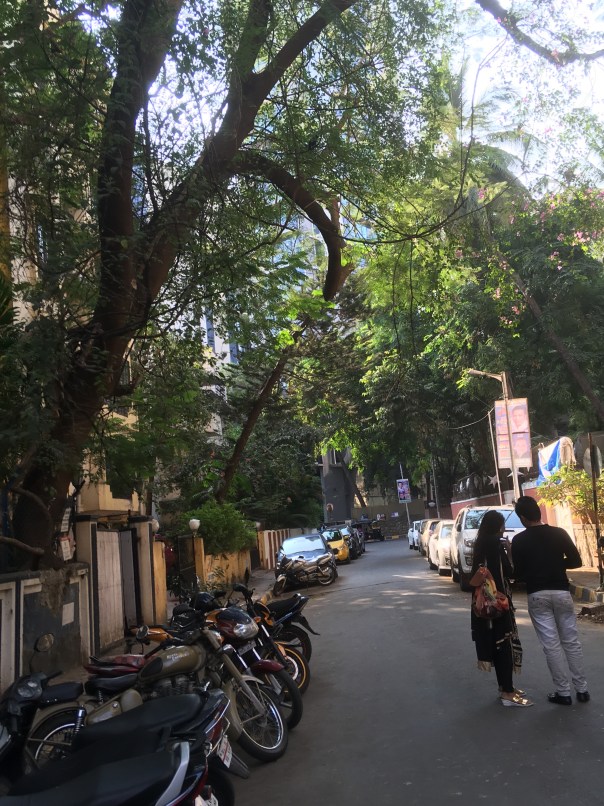
From this store we drove to that quiet neighborhood Tom introduced me to on my first day here, where is found their favorite market.

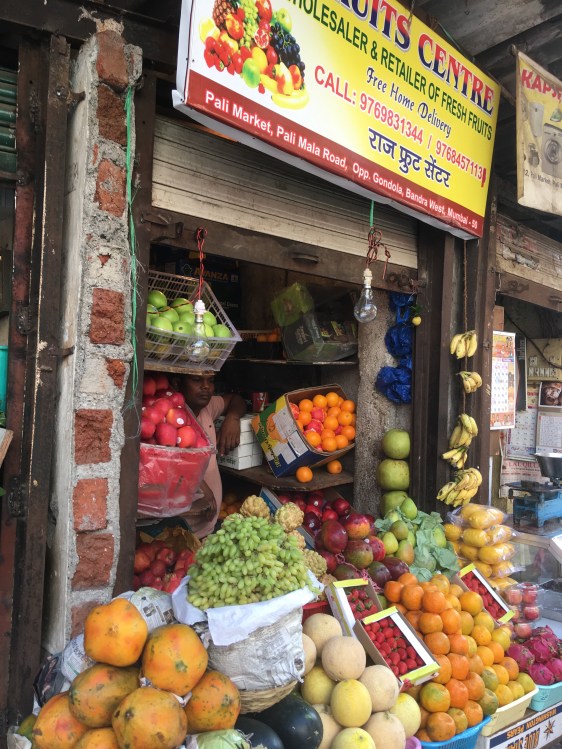
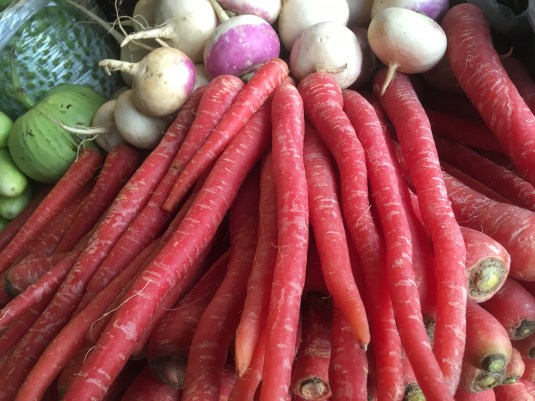
The shopkeepers know at least the names of vegetables and how to count in English so I was able to complete the purchase of some carrots, zucchini, peppers and broccoli while Tom went to the next stand where we found leeks and potatoes from which he is going to make soup.

Are those red carrots really carrots? I’ll cook them today and find out.
We brought all our loot home and then Tom cooked up a big delicious dinner featuring mutton chops, pesto green beans, tomato salad and more. It was the first meal of not particularly Indian food that I’ve had in ten days.

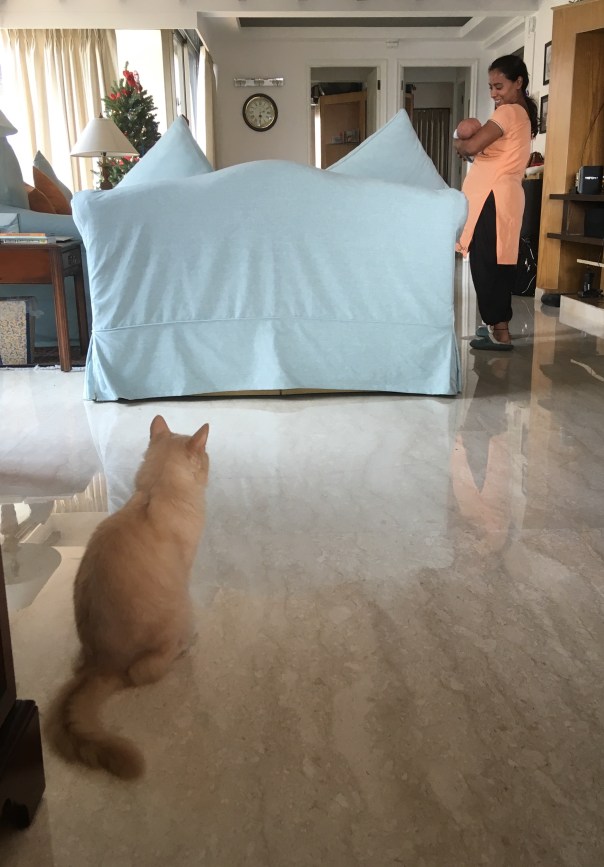
Baby “Raj” had stayed home with his mama. They are eating well and building strength and we are all enjoying the early Getting to Know You period. Well, not quite all: Huckleberry Cat has led a very sheltered life until this point and he doesn’t feel entirely positive about the strange creature who suddenly showed up.

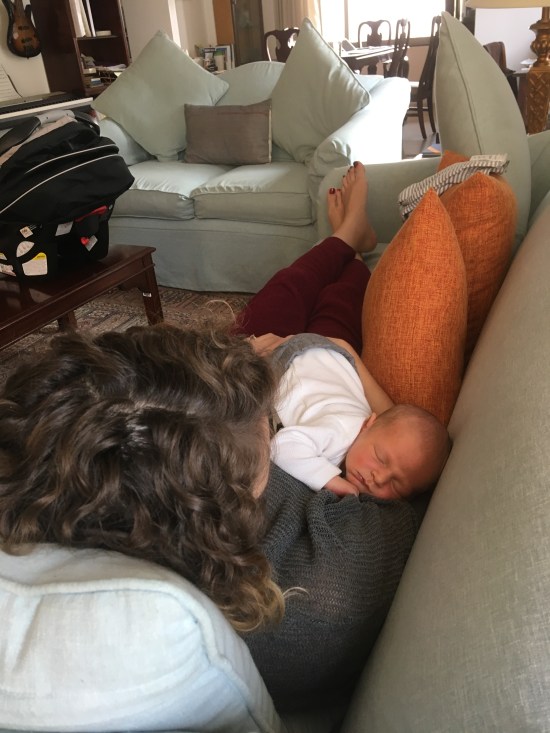
As I write, it is a lazy Sunday afternoon. I’ve been holding a sleeping baby for an hour while chatting with Kate and Tom about so many things India, seeds that could germinate into future blog posts. Now I’m back here typing with two fingers to finish this one. My mind will immediately and irresistibly start gathering threads of images and impressions to weave into the next scrap of cloth I hope to share with you, of this colorful tapestry that is Bombay.

The clear eye on the map.

The Poem-a-Day selection for yesterday was about maps, by Carl Sandburg. I read it when I came home from church this afternoon, after hearing a homily about a map. In Liturgy we learned that the map to the Kingdom is in our heart — but many other things are in the heart, as is obvious from our own lives and from the daily news. One consequence that can result from contemplating the news of the world is an increase of fear and anxiety in our hearts.

The experience related in Sandburg’s poem seems to echo what St. Macarius describes, following the Prophet Jeremiah,  who said, “The heart is deceitful above all things, and desperately wicked: who can know it?

St. Macarius: “Within the heart is an unfathomable depth. There are reception rooms and bedchambers in it, doors and porches, and many offices and passages. In it is the workshop of righteousness and of wickedness. In it is death, in it is life….The heart is but a small vessel; and yet dragons and lions are there, and there likewise are poisonous creatures….rough, uneven paths are there, and gaping chasms.”

EXPERIENCE

This morning I looked at the map of the day
And said to myself, “This is the way! This is the way I will go;
Thus shall I range on the roads of achievement,
The way is so clear—it shall all be a joy on the lines marked out.”
And then as I went came a place that was strange,—
’Twas a place not down on the map!
And I stumbled and fell and lay in the weeds,
And looked on the day with rue.

I am learning a little—never to be sure—
To be positive only with what is past,
And to peer sometimes at the things to come
As a wanderer treading the night
When the mazy stars neither point nor beckon,
And of all the roads, no road is sure.

I see those men with maps and talk
Who tell how to go and where and why;
I hear with my ears the words of their mouths,
As they finger with ease the marks on the maps;
And only as one looks robust, lonely, and querulous,
As if he had gone to a country far
And made for himself a map,
Do I cry to him, “I would see your map!
I would heed that map you have!”

-Carl Sandburg

Our pastor was preaching on Matthew 6, where Christ teaches us:

The light of the body is the eye. If therefore thine eye be single, thy whole body shall be full of light. But if thine eye be evil, thy whole body shall be full of darkness. If therefore the light that is in thee be darkness, how great is that darkness!

No man can serve two masters; for either he will hate the one and love the other, or else he will hold to the one and despise the other. Ye cannot serve God and mammon.

Therefore I say unto you, take no thought for your life, what ye shall eat, or what ye shall drink; nor yet for your body, what ye shall put on. Is not the life more than meat, and the body than raiment?

Behold the fowls of the air, for they sow not, neither do they reap, nor gather into barns; yet your heavenly Father feedeth them. Are ye not much better than they? Which of you by taking thought can add one cubit unto his stature?

It’s interesting to look at several translations of the words describing the healthy or unhealthy eye: cloudy or clear, evil or single, diseased or unclouded. Of course, Christ is our Light, He said so Himself, and if we keep our eye on Him, He will light the path, He will be the map in our heart, so that we find the best things that St. Macarius tells about:

“The heart is Christ’s palace…There Christ the King comes to take His rest, with the angels and the spirits of the saints, and He dwells there, walking within it and placing His kingdom there….the heavenly cities and the treasures of grace: all things are there.”

When Christ places His kingdom there, we understand that our heavenly Father is obligated to take care of us — He loves us and is, after all, our Father. Much more than any earthly father He loves us and wants to provide for our needs.

Today I also read a poem by Wendell Berry, on this blog, and he expresses and heeds the exhortation in today’s Gospel:

THE PEACE of WILD THINGS

When despair for the world grows in me
and I wake in the night at the least sound
in fear of what my life and my children’s lives may be,
I go and lie down where the wood drake
rests in his beauty on the water, and the great heron feeds.
I come into the peace of wild things
who do not tax their lives with forethought
of grief. I come into the presence of still water.
And I feel above me the day-blind stars
waiting with their light. For a time
I rest in the grace of the world, and am free.

-Wendell Berry

What a contrast Berry’s focus is to Sandburg’s narrator who wanders where “no road is sure,” and who longs for a good map. “We have been given the map!” I want to tell him. Keep your eyes on Christ, and walk on past the dragons and gaping chasms. Cling to Him, keep bringing your focus back to Him as a light that is far brighter than your “mazy stars,” and you will find your way to Christ’s palace, and take your rest, too, with the saints and angels, amid the treasures of grace.