Tag Archives: memory

The moon to the rescue.

The last lines of this poem rescue it for me, out of a feeling of chaos and loss. The moon is a real thing, unlike the many insubstantial facts that we might forget. In this case it’s also an experience in the moment, of heartfelt beauty, good for centering the soul.

FORGETFULNESS

The name of the author is the first to go
followed obediently by the title, the plot,
the heartbreaking conclusion, the entire novel
which suddenly becomes one you have never read, never even heard of,

as if, one by one, the memories you used to harbor
decided to retire to the southern hemisphere of the brain,
to a little fishing village where there are no phones.

Long ago you kissed the names of the nine muses goodbye
and watched the quadratic equation pack its bag,
and even now as you memorize the order of the planets,

something else is slipping away, a state flower perhaps,
the address of an uncle, the capital of Paraguay.

Whatever it is you are struggling to remember,
it is not poised on the tip of your tongue
or even lurking in some obscure corner of your spleen.

It has floated away down a dark mythological river
whose name begins with an L as far as you can recall

well on your own way to oblivion where you will join those
who have even forgotten how to swim and how to ride a bicycle.

No wonder you rise in the middle of the night
to look up the date of a famous battle in a book on war.
No wonder the moon in the window seems to have drifted
out of a love poem that you used to know by heart.

-Billy Collins
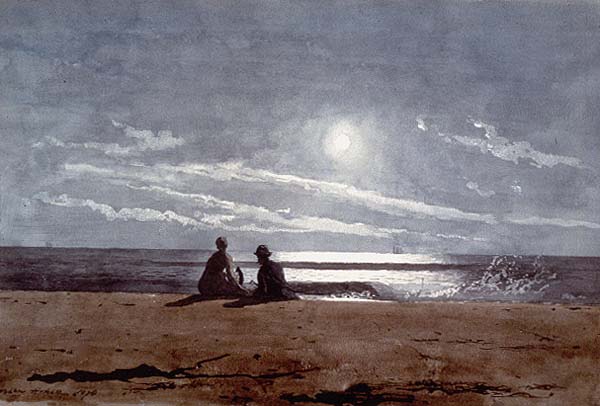
Winslow Homer, Moonlight


The house stands vacant.

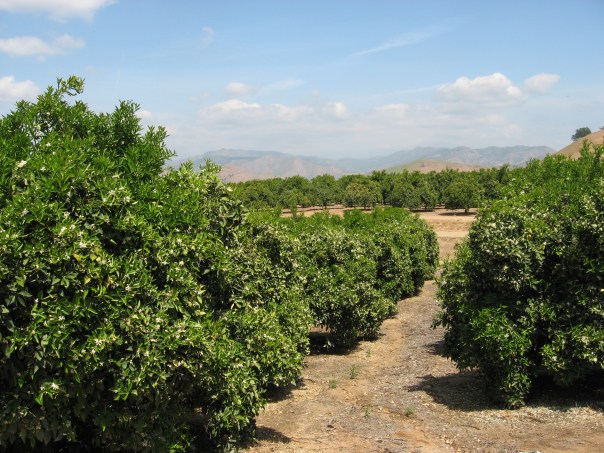
Back in the day when I lived with my family in farm country, in the midst of miles and miles of citrus orchards, my siblings and I would ramble through the groves, ours and our neighbors’, and along the private dirt roads dividing the properties from each another. All the kids did this, and no one ever suggested we were trespassing.

Once we came upon a small and shabby house with its doors and windows open, and obviously abandoned. We dared to go in, and walked through the rooms, which still contained furniture such as a kitchen table with dried up food on plates, other unwashed dishes in the sink, and personal belongings lying about. We didn’t stay long, it was too creepy, but my imagination was stirred from then until now, wondering what story lay behind the disorder. What would prompt the residents to leave without finishing dinner, and never come back? Why had no one bothered to come and clean up the mess, and make the place livable again?

That house didn’t show signs of having been beautiful at any time, but under different circumstances, it might have been. It remains for me a disturbing memory, for all the sad stories it might have been hinting at, but also because of the physical ugliness that stood as a witness to chaos. In all likelihood it has been leveled to the ground long since, and orange trees planted in its spot. I wonder if anyone else remembers it.

The poem below tells of a much richer and more nuanced experience and story. The poet Frederick Goddard Tuckerman was stricken when his wife died after the birth of their third child, and felt that as the father of the child he was somewhat guilty. Most of his poems after her death express these feelings of loss, loss of home and of the woman as the center of family life. One commentator suggests that the description of the mother, twice using the word “sat,” indicates her being frozen in time as a memory.

SONNET XVI (“Under the mountain”)

Under the mountain, as when first I knew
Its low black roof, and chimney creeper-twined,
The red house stands; and yet my footsteps find
Vague in the walks, waste balm and feverfew.
But they are gone; no soft-eyed sisters trip
Across the porch or lintels; where, behind,
The mother sat, — sat knitting with pursed lip.
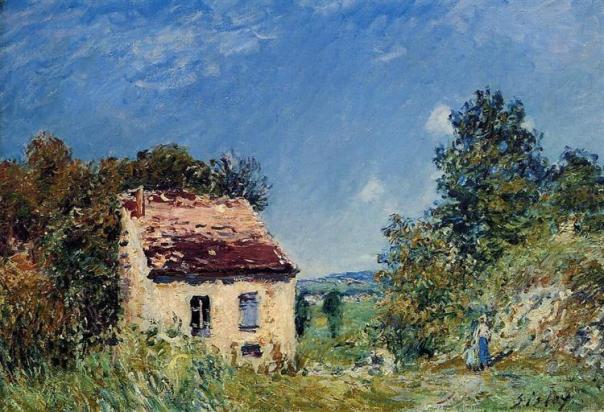
The house stands vacant in its green recess,
Absent of beauty as a broken heart;
The wild rain enters; and the sunset wind
Sighs in the chambers of their loveliness,
Or shakes the pane; and in the silent noons,
The glass falls from the window, part by part,
And ringeth in the grassy stones.

-Frederick Goddard Tuckerman

Alfred Sisley, Abandoned House


Thanks to Sally Thomas for sharing this poem on her Substack page last month.

What is it I almost remember?

What Dorothy Parker describes in her poem below reminds me of what C.S. Lewis called sehnsucht, the heart’s longing, seemingly for its home – in God. These episodes often happen at moments when we experience something very good or beautiful, and realize deep in ourselves that it doesn’t quite satisfy, but only reveals our homesickness.

In The Weight of Glory Lewis describes this aching in our heart:

 “In speaking of this desire for our own far off country, which we find in ourselves even now, I feel a certain shyness. I am almost committing an indecency. I am trying to rip open the inconsolable secret in each one of you—the secret which hurts so much that you take your revenge on it by calling it names like Nostalgia and Romanticism and Adolescence….

“We cannot tell it because it is a desire for something that has never actually appeared in our experience. We cannot hide it because our experience is constantly suggesting it, and we betray ourselves like lovers at the mention of a name. Our commonest expedient is to call it beauty and behave as if that had settled the matter. Wordsworth’s expedient was to identify it with certain moments in his own past. But all this is a cheat. If Wordsworth had gone back to those moments in the past, he would not have found the thing itself, but only the reminder of it; what he remembered would turn out to be itself a remembering. 

“…These things—the beauty, the memory of our own past—are good images of what we really desire; but if they are mistaken for the thing itself they turn into dumb idols, breaking the hearts of their worshipers. For they are not the thing itself; they are only the scent of a flower we have not found, the echo of a tune we have not heard, news from a country we have never visited.”

Peder Monsted

TEMPS PERDU

I never may turn the loop of a road
Where sudden, ahead, the sea is lying,
But my heart drags down with an ancient load–
My heart, that a second before was flying.

I never behold the quivering rain–
And sweeter the rain than a lover to me–
But my heart is wild in my breast with pain;
My heart, that was tapping contentedly.

There’s never a rose spreads new at my door
Nor a strange bird crosses the moon at night
But I know I have known its beauty before,
And a terrible sorrow along with the sight.

The look of a laurel tree birthed for May
Or a sycamore bared for a new November
Is as old and as sad as my furtherest day–
What is it, what is it, I almost remember?

-Dorothy Parker

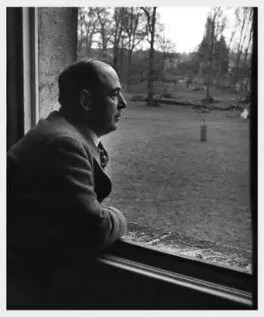
the poet