Tag Archives: memory

The little old lady laughs.

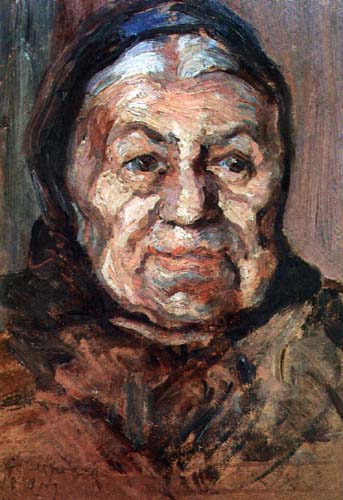
Portrait of an Old Woman, Nadezda Petrovic, 1909

TABLE TALK

The little old lady laughs like a little girl, going
On with the tale of this and that happy day.
Says the little old lady, “Oh, what times were they
When I fell in love without Grandmother’s knowing!”
The little old lady is a little rogue, showing
A malicious twinkle in the depths of her eyes.
How distinct the silver of her hair one descries
Against the caramel-tinted skin glowing.

The little old lady forgets how dull or shady
Life may be; and the wrinkles laugh over her face.
Sweet tremors through her blessed old body race:
And my dear looks at me and I look at my dear,
And we laugh, and we laugh . . . all the while we hear
The white history of the loves of the little old lady.

-Manuel Magallanes Moure (1878-1924) Chile
Translated by Muna Lee

Sweetness and gravities.

Li-Young Lee has written at least two poems about peaches; I am guessing they are in many ways connected in his memory to his childhood. Here is the most recent one I came across, which is about much more than the sweet fruit itself:

THE WEIGHT OF SWEETNESS 

No easy thing to bear, the weight of sweetness.

Song, wisdom, sadness, joy: sweetness
equals three of any of these gravities.

See a peach bend
the branch and strain the stem until
it snaps.
Hold the peach, try the weight, sweetness
and death so round and snug
in your palm.
And, so, there is
the weight of memory:

Windblown, a rain-soaked
bough shakes, showering
the man and the boy.
They shiver in delight,
and the father lifts from his son’s cheek
one green leaf
fallen like a kiss.

The good boy hugs a bag of peaches
his father has entrusted
to him.
Now he follows
his father, who carries a bagful in each arm.
See the look on the boy’s face
as his father moves
faster and farther ahead, while his own steps
flag, and his arms grow weak, as he labors
under the weight
of peaches.

-Li-Young Lee

And here is the poet reading another poem more focused on the subject, which I shared some years ago without the audio. This one really makes me want to drive an hour or two into California’s Central Valley to find some peaches that fit his description:

The shape of what you lived.

REMEMBERING

And you wait. You wait for the one thing
that will change your life,
make it more than it is—
something wonderful, exceptional,
stones awakening, depths opening to you.

In the dusky bookstalls
old books glimmer gold and brown.
You think of lands you journeyed through,
of paintings and a dress once worn
by a woman you never found again.

And suddenly you know: that was enough.
You rise and there appears before you
in all its longings and hesitations
the shape of what you lived.

-Rainer Maria Rilke

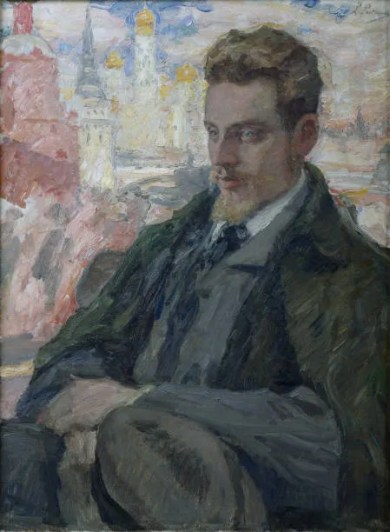
Rilke, by Leonid Pasternak 1928

Never look straight up at the sun.

I traveled north several hours to my daughter’s for Thanksgiving last week, and home again three days later. Through rural areas mostly, my favorite views were of the forests and orchards, oaks and maples and almonds, many of the trees with their leaves glowing yellow and red as the light caught them just right, against a dark green conifer background. The sun was, as this poem says, the artist.

THE SUN

All colors come from the sun. And it does not have
Any particular color, for it contains them all.
And the whole Earth is like a poem
While the sun above represents the artist.

Whoever wants to paint the variegated world
Let him never look straight up at the sun
Or he will lose the memory of things he has seen.
Only burning tears will stay in his eyes.

Let him kneel down, lower his face to the grass,
And look at the light reflected by the ground.
There he will find everything we have lost:
The stars and the roses, the dusks and the dawns.

Warsaw, 1943

―Czesław Miłosz

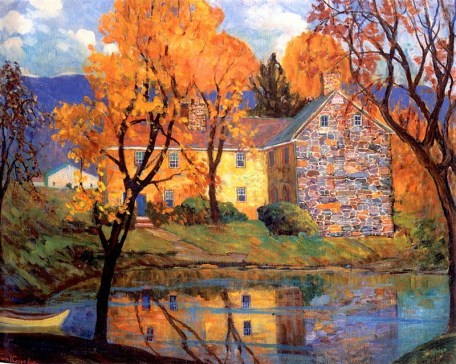
Fern Coppedge, Autumn