I think today might be Midsummer, by my way of reckoning. It’s warm and sunny, and in the last few days, not only did I pick my first zucchini, but the first plum fell, perfectly ripe and delcious, a week or two ahead of its fellows. Back when it was officially Midsummer, my own garden was not feeling it, but now everything is lovely and relaxed, like sitting on a porch at the end of a long day — even when I am still working in the middle of the afternoon.
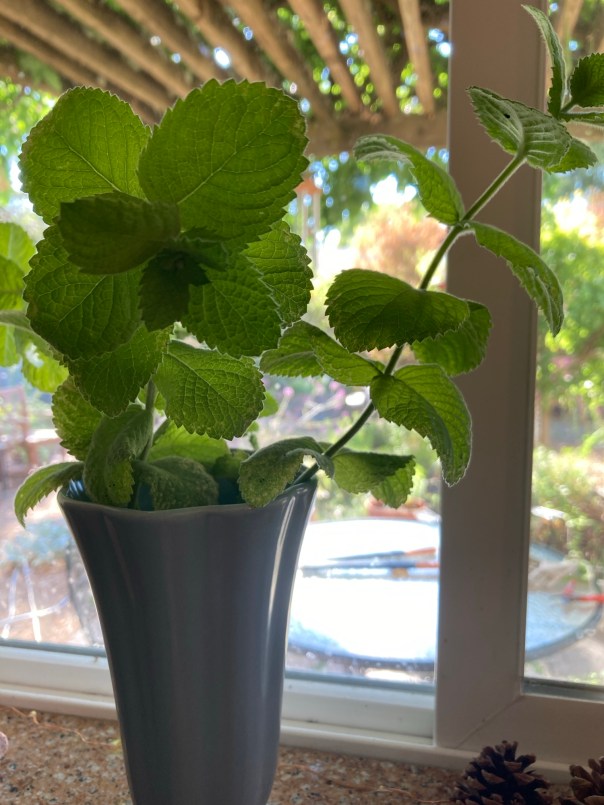
The lavender is pretty much spent, and needs trimming back. The acanthus likewise. Yesterday I yanked at the enthusiastic, yards-long wisteria runners that were crawling up the sides of the house, trying to get in at the window screens, and managed to pull most of them down and cut them off. Today I noticed that the apple mint has sent out new leaves low on its stems, so I trimmed the tops of those few. I don’t need to make tea or anything right now, so I put the bunch in a vase by the kitchen sink, where for a few days I can better enjoy their soft greenness.
This year in my parish the birthday of St. John the Baptist, June 24th, falls on Holy Spirit Day, and our youth are also heading off to church camp, so I wasn’t paying close enough attention. Ideally I’d have shared about it last night, on St. John’s Eve, because this year that is the day that has captured my imagination.
Father Malcolm Guite has written more than one sonnet for the celebration of St. John’s Day, the birth of St. John the Baptist. Here is one of them, prefaced by his notes on the feast:
“Now, with the summer solstice, we have come to midsummer and the traditional Church festival for this beautiful, long-lit solstice season is the Feast of St. John the Baptist, which falls on June 24th, which was midsummer day in the old Roman Calendar. Luke tells us that John the Baptist was born about 6 months before Jesus, so this feast falls half way through the year, 6 months before Christmas!
“The tradition of keeping St. John’s Eve with the lighting of Bonfires and Beacons is very ancient, almost certainly pre-Christian, but in my view it is very fitting that it has become part of a Christian festivity. Christ keeps and fulfills all that was best in the old pagan forshadowings of his coming and this Midsummer festival of light is no exception. John was sent as a witness to the light that was coming into the world, and John wanted to point to that light, not stand in its way, hence his beautiful saying ‘He must increase and I must diminish’, a good watchword for all of those who are, as the prayer book calls us, the ‘ministers and stewards of his mysteries’.”
Midsummer Eve Bonfire – Nikolai Astrup
ST. JOHN’S EVE
Midsummer night, and bonfires on the hill Burn for the man who makes way for the Light: ‘He must increase and I diminish still, Until his sun illuminates my night.’ So John the Baptist pioneers our path, Unfolds the essence of the life of prayer, Unlatches the last doorway into faith, And makes one inner space an everywhere. Least of the new and greatest of the old, Orpheus on the threshold with his lyre, He sets himself aside, and cries “Behold The One who stands amongst you comes with fire!” So keep his fires burning through this night, Beacons and gateways for the child of light.
I just now figured out from this Wikipedia entry the source of the word bonfire:
“In England, the earliest reference to this custom occurs in the 13th century AD, in the Liber Memorandum of the parish church at Barnwell in the Nene Valley, which stated that parish youth would gather on the day to light fires, sing songs and play games. A Christian monk of Lilleshall Abbey, in the same century, wrote:
“‘In the worship of St John, men waken at even, and maken three manner of fires: one is clean bones and no wood, and is called a bonfire; another is of clean wood and no bones, and is called a wakefire, for men sitteth and wake by it; the third is made of bones and wood, and is called St John’s Fire.'”
The summer solstice always marks in my mind the beginning of summer, so I’m out of sync with the ancients who called it Midsummer…. even though the other end of the year does seem like Midwinter. Where I am, the heat is just now escalating, and definitely not at its peak, and for that reason I think my personal date for Midsummer would be sometime in July or August. When I get that certain feeling, I’ll let you know what date I choose.
Jules Breton – Midsummer Night Dance in Courrires
Only recently did I learn about St. John’s Eve celebrations at all. [Update: see the video link from Lisa in the comments below, for much more history of the day.] Some online Christian friends in England and Ireland gathered around bonfires last night — while I in California was still at church celebrating Pentecost. I doubt I will ever be able to join such festivities over there… maybe I should try to rouse interest in planning a West Coast Midsummer Fest for 2025. Does that sound fun to you? And do you feel that where you are, it is truly Midsummer — or Midwinter?
The Sun — Giuseppe Pellizza da Volpedo
(If you enjoy the sonnets from Malcolm Guite, remember that most of them have been published in his several collections. The one here can be found in Sounding the Seasons, his cycle of seventy sonnets for the Church Year.)
It’s surprising how much glory has bloomed and gone, in my garden and by the creek. Well before the end of July we’ve cut back the purple explosion of germander and forced the bees to move to the echium and salvias, which continue to branch out and lengthen their nectar offerings. The Jerusalem sage and lavender I always think of as long-lasting…. How can they be done? Santa Barbara daisies at least come again and again after each shearing.
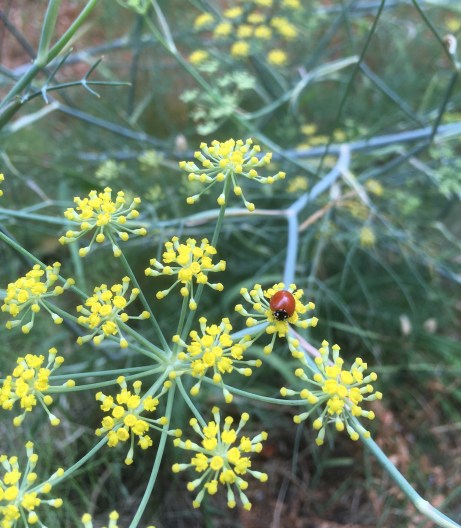
By the creek, the Queen Anne’s Lace and fennel will continue for months more, and other insects feed on them. But I never see honeybees there.
Early on when the gyms first closed because of the covid-19 quarantine and more people were walking those creek paths, I saw that many of the fennel plants down there had been mutilated and dishonored. I wished I had clippers with me so I could cut them off neatly to relieve the humiliation.
But three months later, those same plants are most beautiful! For all they cared, the breakage of their stems might have been expert pruning by loving horticulturists. Now those specimens have branched out gracefully to outshine their fellows that shoot straight up. The ladybug above is posing on one.
Last fall I planted a few begonias in pots on the patio, but so far only this older one has opened:
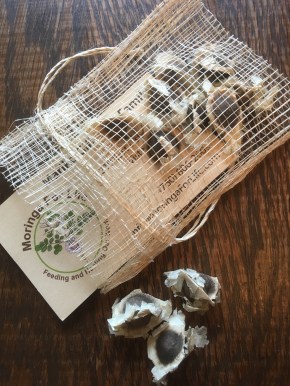
In the vegetable boxes many of the things I planted rather late and experimentally did not even sprout, but currently collards are coming along. And in the greenhouse, moringa! I bought the seeds two years ago at an event I blogged about: here. (I also had a bunch of little amaranth plants from that source growing nicely, but something ate them off at the stem.)
This spring I managed to keep three of the seeds warm and moist long enough for one of them to sprout. If the seeds had not been so unusual, I might not have invested in the project, but who knows… and whether I will ever use it, no one can predict that, either!
I plan to grow my little tree in a pot, and then a bigger pot if I manage to keep it alive long enough for it to outgrow containers. The leaves can be used like spinach, or for tea. It’s supposed to be one of those “superfoods,” which I’ve noticed become fads and then after a while you don’t hear about them anymore. I’m more interested in this species because it’s not a sweet fruit to add to the carb load of a diet.
My fruit trees are looking good. The plums and fig got their solstice pruning to keep the size down. For the fig, that mostly meant taking a foot or two off the top. I’m keeping them at a size where I can pick the fruit without a ladder, and take care of the trees on my own. The fig tends to grow horizontally, which makes it easy for me; it’s a dwarf species also, called Blackjack. But it doesn’t seem particularly dwarfish in its fifth season of bearing! It’s loaded with fruit. Yum.
I have four Elephant Heart plums on my two trees, which this morning I thought I better take pictures of, because in previous years they have not only started out few but mostly disappeared. My lemon tree I have in the last year or so been more diligent than ever to feed regularly, and it has responded by producing a score at least of little lemons that are getting big fast. They will be ripe next winter.
Must leave you now and go see what else needs pruning!
 I think today might be Midsummer, by my way of reckoning. It’s warm and sunny, and in the last few days, not only did I pick my first zucchini, but the first plum fell, perfectly ripe and delcious, a week or two ahead of its fellows. Back when it was officially Midsummer, my own garden was not feeling it, but now everything is lovely and relaxed, like sitting on a porch at the end of a long day — even when I am still working in the middle of the afternoon.
 This year in my parish the birthday of St. John the Baptist, June 24th, falls on Holy Spirit Day, and our youth are also heading off to church camp, so I wasn’t paying close enough attention. Ideally I’d have shared about it last night, on St. John’s Eve, because this year that is the day that has captured my imagination.





 Gladsome Lights