Tag Archives: Monarch butterflies

What the deer and I notice.

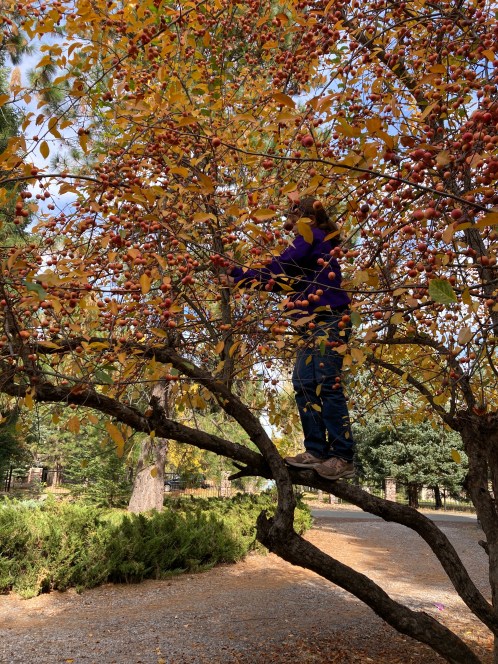
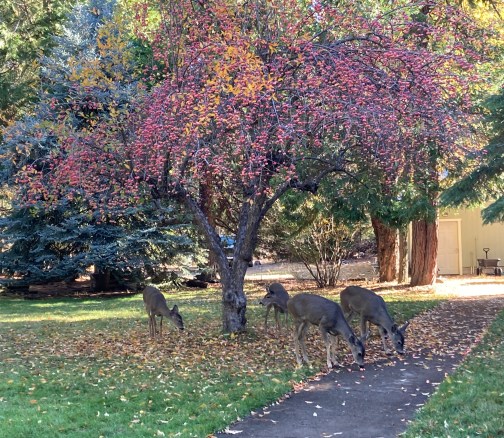
When Ivy shook the crabapple tree, dozens of fruits thumped down on the grass, alerting the deer across the street. Right away one mama hurried over with her two fawns to  accept the offering.

I’m at daughter Pippin’s for a few days, having many literary, outdoorsy and even poetic adventures. Five hours farther north in California than I live, and at higher elevations, I’m enjoying the more dramatically aromatic and visual signs of fall.
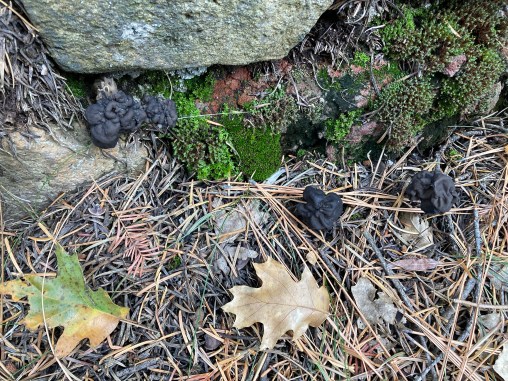
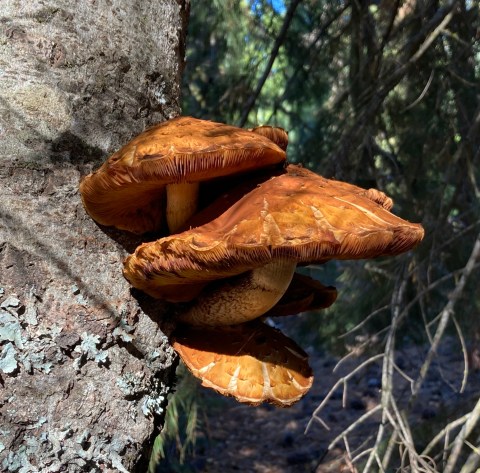
In their back yard, dozens of mushrooms have sprouted: these are Western Black Elfin Saddle, and Spectacular Rustgill — plus one I didn’t identify.

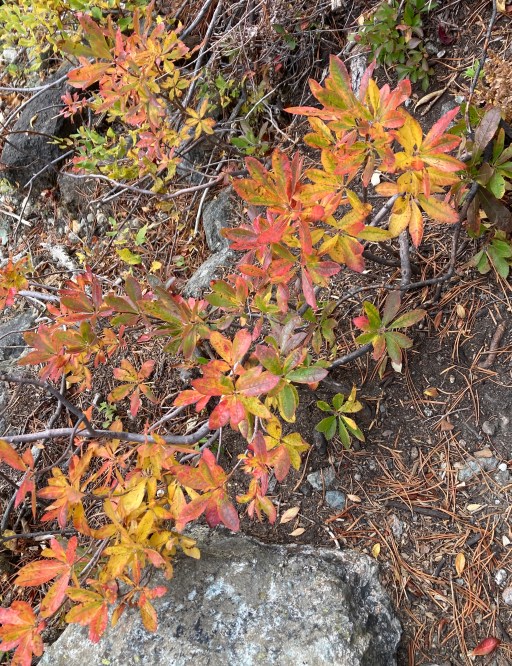
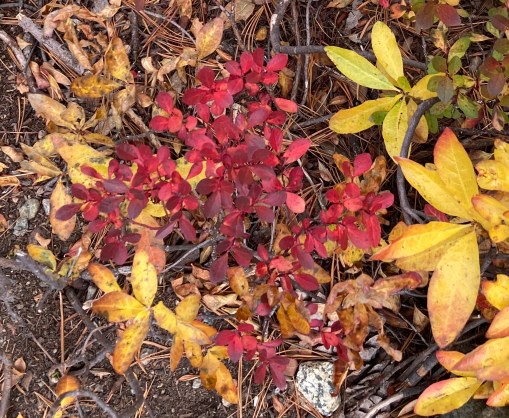
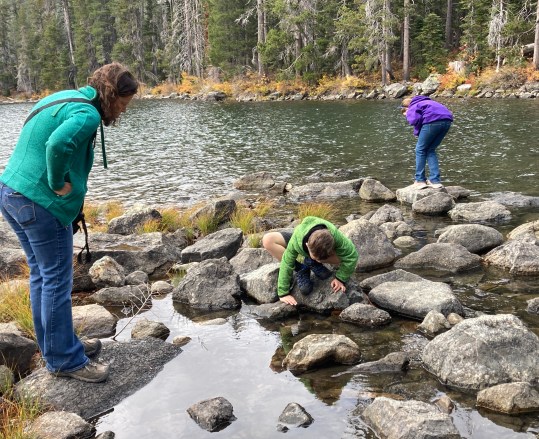
Higher up where we played at the edges of a lake, various plants drew our attention to them because of their beautiful colors, and even Pippin learned a new species: Dwarf Bilberry. In our sightings it was often set off by azaleas turning color in a wide range of tones.
At the lake we discovered schools of baby trout, minnow sized, in a sunlit pool making for a natural fish nursery.
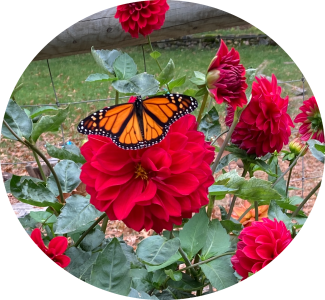
The most surprising thing close to home was a Monarch butterfly in Pippin’s garden, seemingly having wandered way off course; they are never seen in this part of the country, and this is the wrong time of year, as well. It was fluttering among the extravagant dahlia flowers, and we encouraged it to light on a white one, or any color more complementary. But it preferred the red one.

Just below is a picture of this year’s most startling bloom, maybe 9-10 inches across, “Belle of Barmera.” I never get bored looking at these beauties, which are planted inside a high-fenced garden to keep them from the deer. This was one of the years that the deer poked their heads through and ate some anyway.


It’s been quite a rich visit as far as natural wonders go.
I hope to tell about other sorts of fun I’ve had, very soon.
Feasting all over.

We are celebrating one of our parish feast days, and I was blessed to be at Vigil tonight. The hymns and readings for the feast are the same every year, but the arrangements and singers and various aspects change, so that every service is both comforting in its familiar traditions and beautifully unique.

At a festal vigil the Five Loaves are blessed and broken for us to eat, to sustain us during what can be a long service; and we receive anointing with holy oil as another way to participate bodily. The Vigil service includes parts of the Vespers and Matins services and is the first part of the feast, which concludes in the morning.

The caterpillars on my milkweed plants are partaking of a different sort of food.  They have been traveling among all the different species of Asclepias, including the new plants just set out. Though there are fewer of them now, it’s good to see their survival instincts operating.

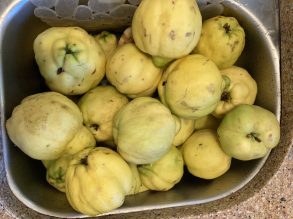
The day that I set off for Pippin’s place last week, I received a quantity of quinces by way of a friend of a friend, which anonymous friend drove several miles from another town to drop them off at church, so that I could pick them up on my way north. They sat in the back of my car for those several days, and this week I processed them. They turned out to be very wormy, but they were so big and numerous that after quite a lot of trimming and slicing, I ended up with a few quarts. I poached them with lemon, sugar and a cinnamon stick. I froze most of them but have been enjoying one quart right away.


In the past I have mostly baked them, and that was much easier. I love quince and am sad that so few people have trees anymore. I have put out queries some years to search out whether anyone knows of unwanted quinces I could take; this batch came to me completely out of the blue, unasked for.

Divine Liturgy for the feast will be in the morning, the celebration of the Eucharist. That will make it feel like Sunday, but it’s Saturday…. and besides feasting, I’ll be gardening — and resting, because I’ve been running around a lot!

I leave you with one of the readings from this evening’s service, which refers to a hearty feast of wisdom:

PROVERBS 9:1-11

Wisdom has built her house,
she has hewn out her seven pillars,
she has slaughtered her meat, she has mixed her wine,
she has also furnished her table.
She has sent out her maidens,
she cries out from the highest places of the city,
“Whoever is simple, let him turn in here!”
As for him who lacks understanding, she says to him,
“Come, eat of my bread and drink of the wine I have mixed.
Forsake foolishness and live,
and go in the way of understanding.
He who corrects a scoffer gets shame for himself,
and he who rebukes a wicked man only harms himself.
Do not correct a scoffer, lest he hate you;
give instruction to a wise man,
and he will be still wiser;
teach a just man, and he will increase in learning.
The fear of the Lord is the beginning of wisdom,
and the knowledge of the Holy One is understanding.
For by me your days will be multiplied,
and years of life will be added to you.”

I give Nature a hand.

Yesterday I wrote about the dwindling supply of milkweed leaves for my hungry caterpillars, and Linda responded in a comment that they have been known to eat butternut squash in a pinch. I was so grateful for her help, and was ready to go shopping for it and to put cubes of vegetable on sticks for them before I would head out of town.

But when I went out to check on the cats they seemed to have stopped eating, and one of them seemed to be working himself into the hanging J position. They hadn’t eaten all the leaves available. I got quite a surprise to see three more, slightly smaller caterpillars on the pathetic Narrow-Leaf Milkweed plant nearby! Should I also try to rescue them?

Later when I checked again, still none of the six were eating — was that because it was cool and cloudy? — but they had moved and were all stretched out vertically. In case they were going to return to chomping through the leaves, I decided to bring a stem of milkweed over from under the fig tree. There was one with a strange horizontal, shallow root, which pulled up easily. I stuck it in the ground so that its leaves touched the other (healthy) plant; I anchored it with rocks and gave it a good watering. I finished packing the car and drove off.

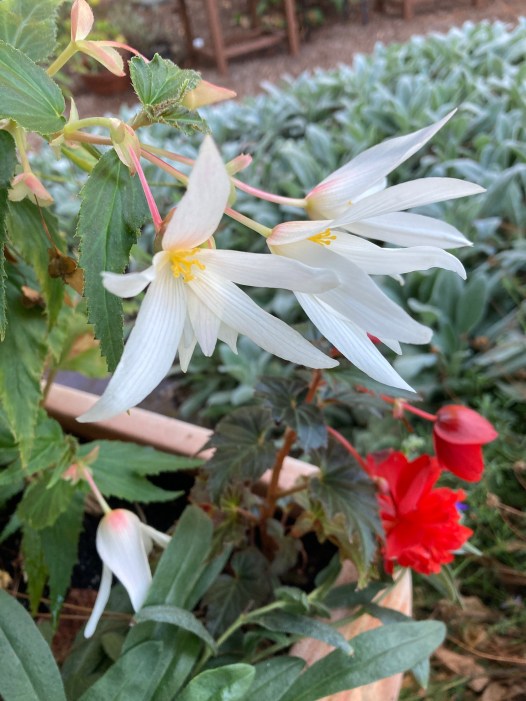
When I get home again next week you can be sure I will let you know the current state of affairs of what is now a group of six Monarch caterpillars. For now, I want to show you something pretty I noticed on the patio — the white begonia is tall and healthy, much bigger than last year. It’s a pristine, comforting bit of newness when the earth is making its yearly descent into death and decay.

The caterpillars may starve to death.

When I was planting the new milkweed species that I’d bought, I saw Monarch caterpillars on the established Showy Milkweed plant!

They are still there, three days later. But there is much less of the plant left for them to eat. I notice that this morning two have moved over to the smaller stem. (I wish I could have seen them doing that.) This milkweed is a young start that I moved across the yard from under the fig tree, where the original plant had reproduced dozens more over the years.

I transplanted it last year, close to the Narrow-Leaf Milkweed, out in the open where the Monarchs might find it. The Showy leaves are large and meaty, and they are what I fed my caterpillars four years ago, even though the eggs had been laid on the Narrow-Leaf. Meanwhile, the fig tree has grown so large, in spite of being a dwarf variety, that it is shading the Showy Milkweed out of existence over there.

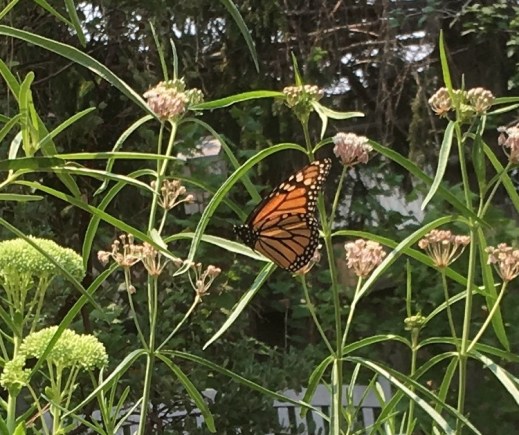
Monarch among the Narrow-Leaf Milkweed plants, 2018.
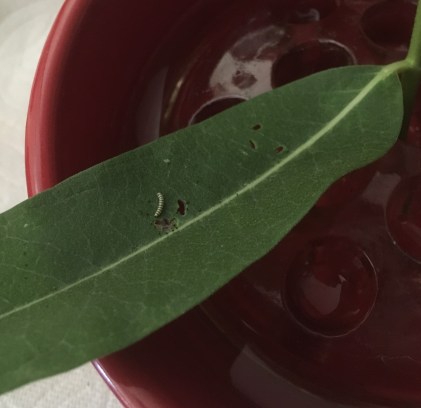
Monarch caterpillar on Showy Milkweed leaf, 2018.
2018

The Narrow-Leaf Milkweed is one of the two species native to my region, which is why I planted it originally. It has the most dramatic blooms, like ladies in crowns and pink dresses dancing in formation:

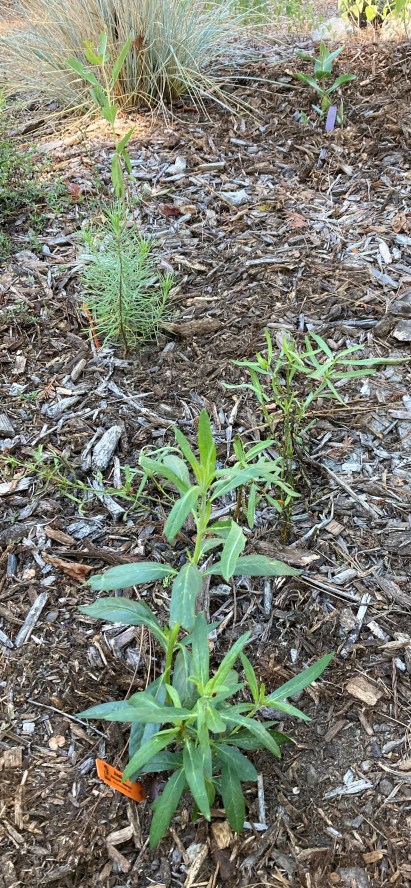
… but as I have said before, there is not enough leaf matter there to make the newborn caterpillars grow big and strong and become butterflies. It was my hope that if I put the Showy type out there, the Mama Monarch would choose it. And she did! But — it is hardly bigger than the new starts I set out. From the bottom of the picture at left:
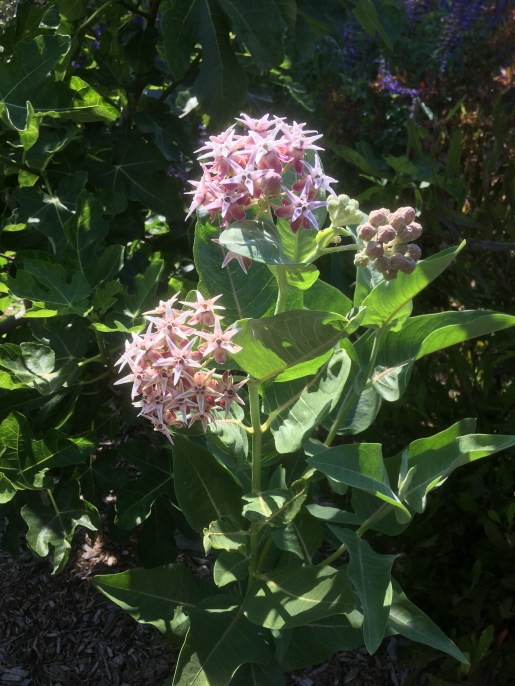
1- Asclepias physocarpa – Family Jewels.
2- aphid-infested Narrow-Leaf Milkweed
3-  Asclepias linaria – Pineneedle Milkweed
4- Showy Milkweed (top L)
5- Asclepias glaucescens – Nodding Milkweed (top R)

I know from the past, when I raised and released three butterflies, that they eat a lot. Back then I picked numerous large leaves off the Showy plant — which was huge — to feed them.

These three have already eaten half of the plant, and they have a lot more growing to do:

When I return from my trip north, I’m afraid that they will have eaten every last leaf, and then starved to death. Should I take them with me, and feed them? But feed them what? I only have two spindly Showy plants growing under the fig tree currently. What if I were to lay them on the ground under the one being eaten right now, making a path to the new starts? Do I really want them to possibly defoliate those, too, when they have barely begun? After that truly thrilling Monarch Project I undertook I decided once was enough. Bearing responsibility for caterpillars was too much work. And physically exhausting for other reasons! So… I think I will have to let nature take its course.

It might be that the smallish Showy Milkweed just wants a tiny bit more water to help Nature along, and then that course might result in this kind of Show next summer:

2021

If so, there will be plenty of food for all caterpillar comers.

“For seasonable weather and the abundance of the fruits of the earth
and for peaceful times
let us pray to the Lord.”
-Litany of Peace