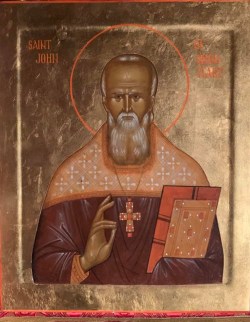
 Earlier this month we were reminded of the popularity of St. Nicholas in the Orthodox Church around the world. If you took a vote for the favorite saint, he would win. Another, more modern saint, who lived in the 19th century, is also remembered in December: St. John of Kronstadt. I see that he had some of the same qualities as St. Nicholas. This article tells how generous he was to the poor. Here is a small excerpt:
He would shop for food, go to the pharmacy for prescriptions, to the doctor for help, many times giving the poor his last few coins. The inhabitants of Kronstadt would see him returning home barefoot and without his cassock. Often parishioners would bring shoes to his wife, saying to her, “Your husband has given away his shoes to someone, and will come home barefoot.”
He seems to have had the gift of exhortation; he truly loved people, whether the upper classes or the criminals who were exiled to Kronstadt at the time, and would spend hours at a time in the shacks of the latter, “talking, encouraging, comforting, crying, and rejoicing together with them.”
His popularity has not waned, judging from the fact that between 1990 and 2016, “more than 60 new churches or altars in Russia alone were dedicated to him,” his flat in Kronstadt became a registered museum, his biography was published in a highly respected series, and monuments to St. John have been placed in cities not only in Russia and gifted to Orthodox communities around the world, including in Washington, D.C., in 2019.
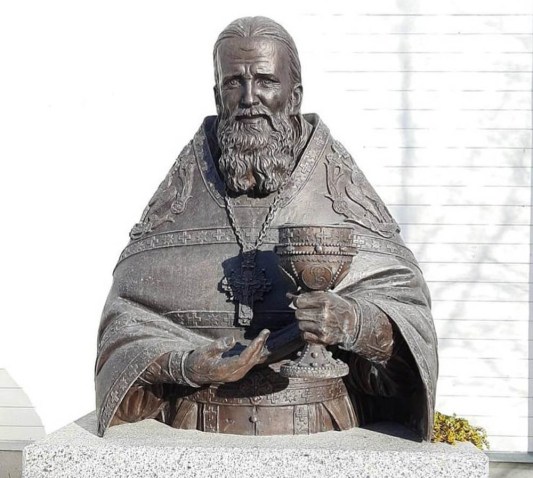
This monument to him was installed last year in his home village of Sura, Arkhangelsk Province, in northwestern Russia, which in 2010 had a population of 727:
Because of his zealous love and spirit of encouragment, one can find many helpful quotes from the saint, and I have posted a few in the past. Here I pass on an exhortation from St. John that is a good reminder to us in the current era, of ultimate reality:
“There is nothing impossible unto those who believe; lively and unshaken faith can accomplish great miracles in the twinkling of an eye. Besides, even without our sincere and firm faith, miracles are accomplished, such as the miracles of the sacraments; for God’s Mystery is always accomplished, even though we were incredulous or unbelieving at the time of its celebration. ‘Shall their unbelief make the faith of God without effect?’ (Rom. 3:3). Our wickedness shall not overpower the unspeakable goodness and mercy of God; our dullness shall not overpower God’s wisdom, nor our infirmity God’s omnipotence.”
-St. John of Kronstadt

 Gladsome Lights