Tag Archives: neighborhood

A branch of eucalyptus.

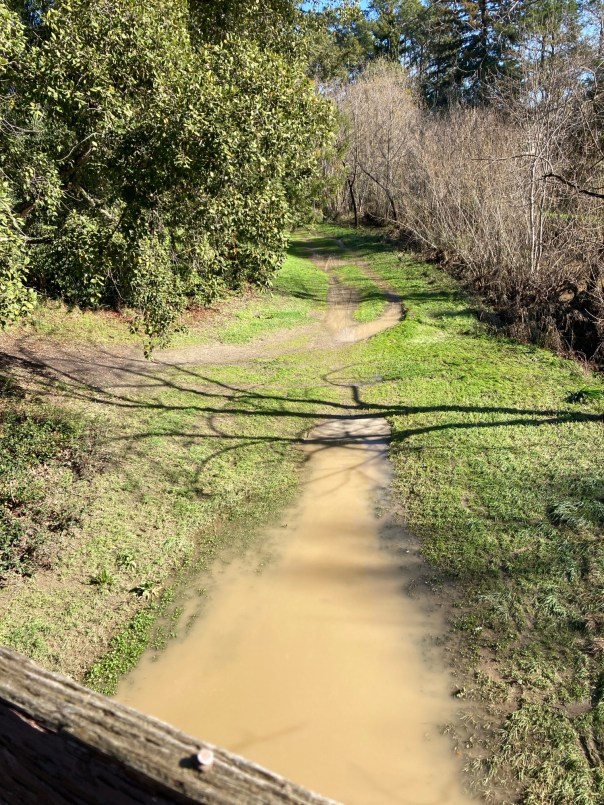
Today we had a sunny surprise of a break between storms, so that I could take a walk under blue skies. The rain has flooded the creek paths in my neighborhood where people like to run with their dogs, a few feet lower down than the paved path I was on; this is not uncommon in the winter season, and the creeks are maintained every couple of years to make sure that the heavier flows rushing down from the hills don’t encroach on the main paths.

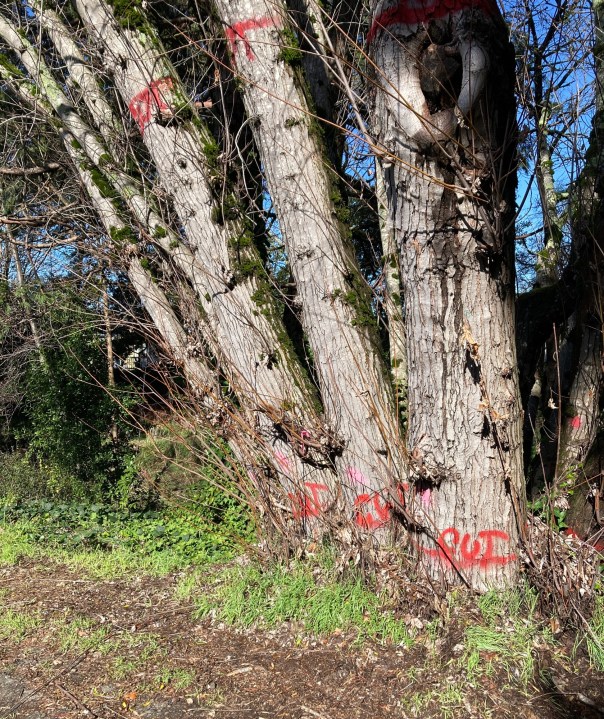
I was admiring the giant eucalyptus trees along the way when I noticed a small branch from one blown down at the edge of the path. It was of a type with extra-slender leaves, and so freshly washed, I decided to bring it home where I could keep enjoying it for a while. Here are the trees from which it fell, that I craned my neck to see:

For years I’ve been planning to write a long and thorough article about the history of eucalyptus trees in California and the controversy around them, but I never get that much leisure time. I have mentioned them several times, though, over the years.

I heard that the city is planning to repave this path that has some serious bumps where tree roots have pushed it up, and that that is why they are planning to cut some big ones. I hope it’s not too many! They have been my friends for thirty-five years ❤

African Blue Basil

This morning I switched my walking route to the less-frequented, unpaved path by the creek, and I was alone down there. But for a minute I could hear above me on the paved path, behind the trees, a woman talking on her mobile phone. She had it set on speaker, and I could hear both sides of the conversation. The woman near me said, “How is your diet? Are you eating the right things?” and I caught the Woman-on-Speaker saying, “I just can’t eat salad,” after which Woman No. 1 said, “I know people think Special K tastes like cardboard, but I eat a bowl of it every night before bed. It helps me sleep good!” And then they were out of range….

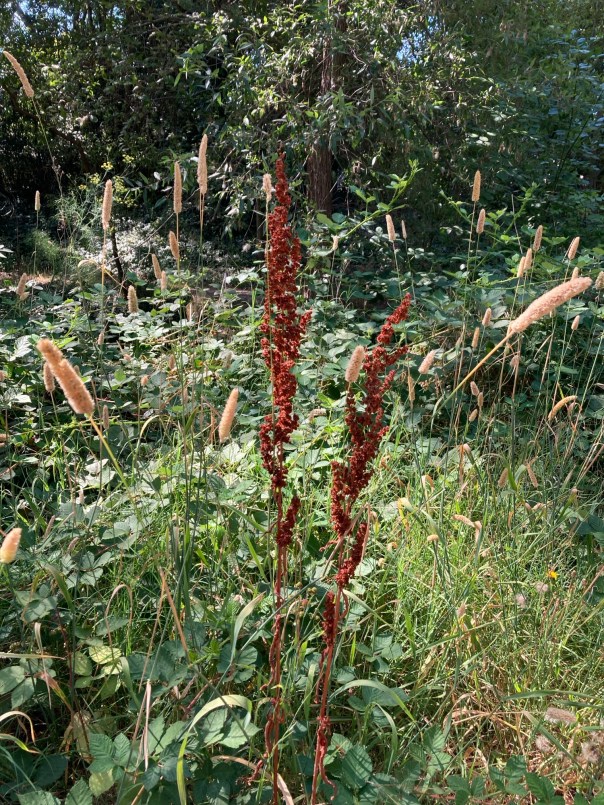
Bristly Oxtongue

That conversation is slightly connected, by being about things we do or do not eat, to the title I almost gave to this post, something about “Bristly Oxtongue” — but it was a little too rough. Now that I think about it, I do see why the plant was given that name, though when I have cooked beef (ox) tongue, I never thought of the bumps as bristly. And the botanical one I saw on the path was in its glory, such as that is, with prolific flowers on a 4-ft high plant. I have identified it in the past, but lately don’t tend to pay attention to the various thistly and bristly plants out there.

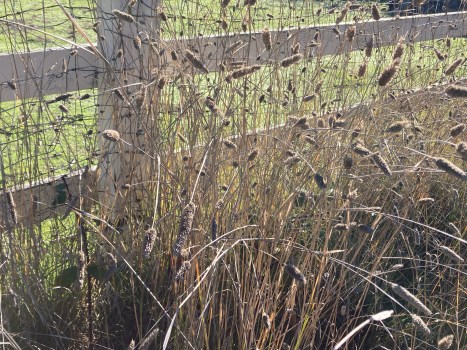
Another plant that is not my favorite, and which I wish I could keep far away from my garden, is Bermuda Grass. When I was growing up, the birds brought its seeds to the lawn my father had planted around our new house, and from then on it was a Bermuda Grass lawn, which has a lot to say for it in the dry and hot Central Valley of California. It needed watering less than weekly. It was a scratchy and coarse kind of grass to play on, and in the winter it goes dormant and brown, but it’s very hardy in every way. This plant has been encroaching from my neighbor’s back yard to mine for as long as I’ve lived here, and I am forever fighting its advance.

Today I realized that one reason this stretch of path is surprisingly green, is that it has a healthy crop of Bermuda Grass growing on the sides.

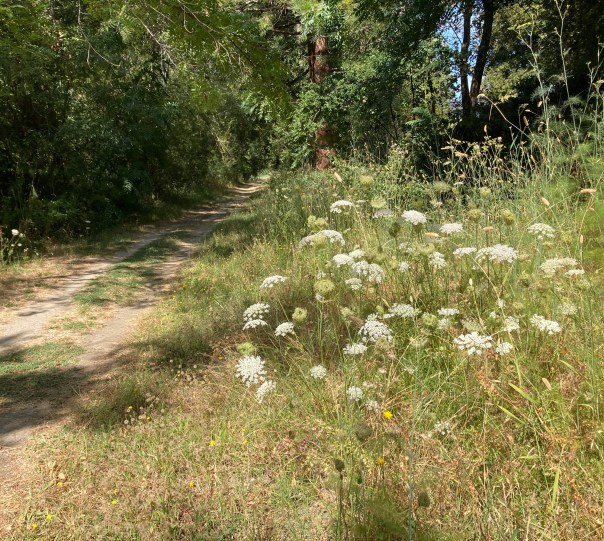
I saw quite a few other plants along the way. Curly dock reminds me of the rural bus stop of my childhood, where that plant was always growing.

Back in the home garden, my cultivated species are filling my cup of contentment. I have strawflowers for the first time, which the skippers love. If I didn’t have the ability to put a big digital photo here, I wouldn’t be able to see the long but miniature tongue the skipper is dipping down into that flower. Drink up, little skipper! Be my guest!

African Blue Basil

The plant you have been waiting for is the African Blue Basil — at least, that’s what the tag on the little pot said, that I brought home from the nursery. I just read about it online, and it says that the leaves are purple when they first sprout, and mine aren’t… It also is supposedly a perennial, which would be nice. It’s magnificent, and I saw two species of honeybees among the dozen or more were working it. It’s the latest dish that the pollinators are tasting on the smorgasbord in the Glad Garden.

Blessed Monday

Monday is usually for me a recuperative day when I try to stay home and catch up with myself after a lot of Sunday “output.” It didn’t happen the same way today, because I wanted to get to the post office early and mail lots of Christmas packages. It was a cold but not freezing, clear and sunny day, and once I was relieved of my burdens, I knew I would take a walk.

It’s very strange, how for more than a year I have been stubbornly averse to the long-familiar walks in my neighborhood. Is it “familiarity breeds contempt”? But as I always say, every day is different out there, and if you can’t see that, then certainly week by week you would notice, that the plants and the weather are obviously different, so that it is not the same place you are walking. I still didn’t care.

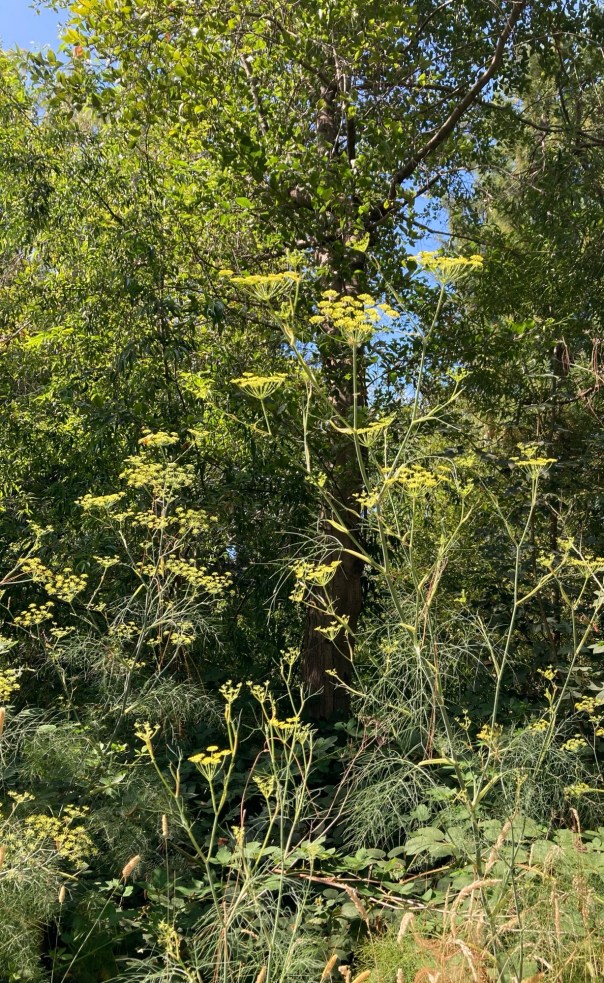
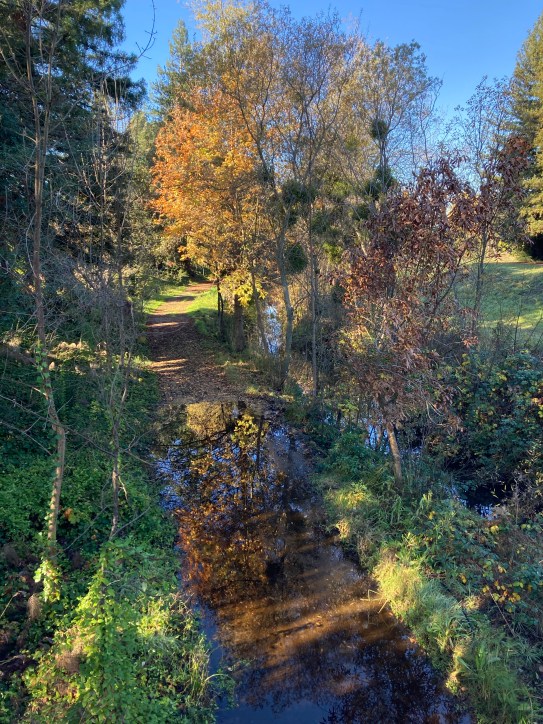
Autumn, after the rains, always tries to pull me out for an explore. But until today, I resisted. I had too much on my mind, on the calendar, and didn’t feel the freedom. It was a providential synchronicity that today, when I am transitioning into the remainder of Advent, the weather was perfect for it. As soon as I neared the creek the heady scents filled my head — of wet earth and leaves, infused with the sweetness of fennel seeds fermenting in the dampness.
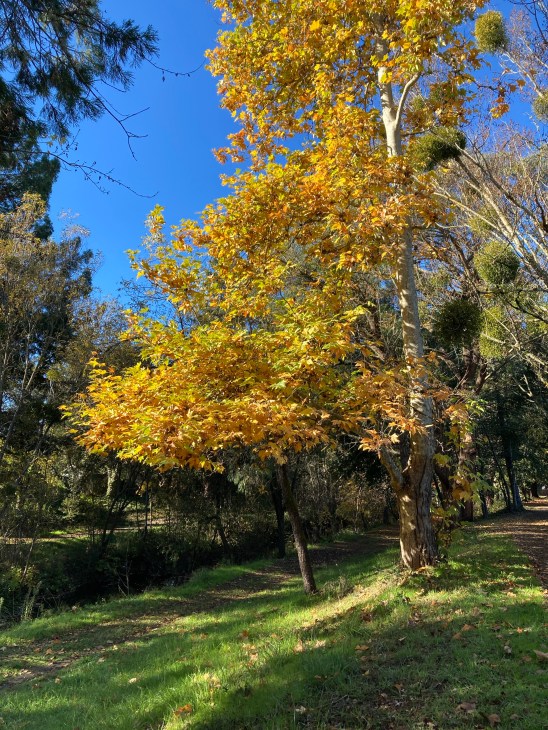
We’ve had enough rain that the sheep in the pasture had plenty of bright green grass to graze on, and I think it made the fall colors extra bright. And my mood was bright. Now on to cookie baking!

Red poppies keep the coolness relative.

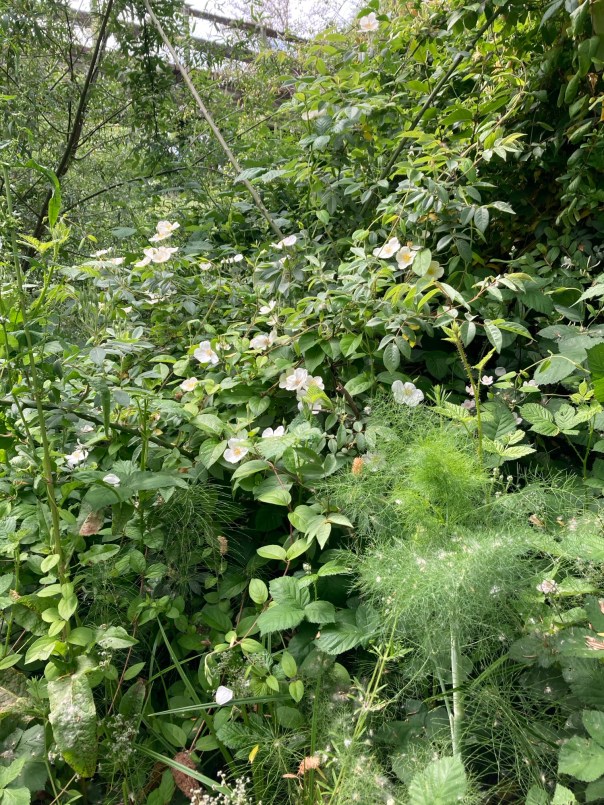
It has been years since I visited what I call The Rose House, though it probably takes less than fifteen minutes for me to walk there. What I found when I saw it last week was that the whole rose garden in front has been cleaned up, and all the bushes pruned. On the corner opposite, a man was standing in his vast flower garden; I didn’t see him at first, as I paused to admire a giant cistus in bloom, until he said, “It’s a beauty, isn’t it?” After a brief chat I said I had come that way to check out the roses across the street; he told me that the owner lives there himself, and has for a long time. So the reason for the previous unkemptness remains a mystery.

When I set out on my walk I debated taking my phone with me, because I have joined a Digital Detox group for the month of May; those in the group are taking up the challenge to detach as much as possible from our devices, according to the needs of our unique circumstances. Because my phone is my only camera at the ready, I decided to take it with me, though I have been trying to take fewer pictures as well. Since my destination was a particular beauty-soaked spot, I wanted to be equipped.

On this walk I was restrained with my camera. It seems that after having accumulated six or seven years’ worth of photos by means of my phone, the thrill of accumulating them is wearing off. Since 2020, when various forces began trying to separate me from other embodied humans, I’ve been extra aware of how easy it is to substitute indirect for direct experiences; for example, looking at pictures of roses instead of walking down the street to smell a real rose.

Our women’s book group is reading Heidi currently, and I’ve been reveling in the images of the child running all over the mountain and hugging the goats. It’s easy for me to have comparable experiences, now that spring is here and I can feel myself melting into the landscape under the sun’s rays. It is a holistic experience of beauty, in which all of my senses relay to me the many impressions that add up to a Beauty that is greater than all the parts of the moment; and I am certainly in a heavenly realm, compared to what you would see if I sent you a two-dimensional photo of me bending over the flower beds.

In The Master and His Emissary, another book I am dipping into, Iain McGilchrist discusses the different modes of being in the world that the right and left hemispheres of the brain offer. As it relates to beauty, this basic aspect of the left hemisphere is critical:

“The left-hemisphere view is designed to aid you in grabbing stuff. Its purpose is utility and its evolutionary adaptation lies in the service of grasping and amassing ‘things.’” 

McGilchrist says that on the other hand, our relationship with the beautiful “is more like longing, or love, a betweenness, a reverberative process between the beautiful and our selves, which has no ulterior purpose, no aim in view, and is non-acquisitive.” This is something the right brain intuitively and holistically understands.

We don’t go through our days aware of the interactions between the hemispheres of our brain, but a big point of the author’s thesis is that “as a society, we are becoming more like individuals with right hemisphere deficits.”

Just a few hours before I took my Rose Walk, I had been reading the book, and this passage jumped out at me:

“As Alain Corbin has argued, we have become more cerebral, and retreated more and more from the senses – especially from smell, touch and taste – as if repelled by the body; and sight, the coolest of the senses, and the one most capable of detachment, has come to dominate all.”

Because it is so easy for us to capture and share visual images by means of our digital technologies, we are flooded with them. As I made my way over to the Rose House I kept thinking about how rich was my experience outdoors, full of bird song, the  sound of children’s voices at the creek, the particular feel of the early evening air in May, and the scents — the rose scents most of all. And in my pictures, the only thing I would be able to pass on to you would be a record of what my relatively “detached” sense conveyed to me.

“The coolest of the senses.” That statement about our visual sense startled me, and made me want to push back against the image-focused culture that I have embraced, and against my habit of orienting my explorations toward what my camera can do something with. Since the roses themselves are often so heavy with scent, it was not hard to appreciate them in a multi-sensory way.

But then — on my way back home I passed by a house with an extravagant poppy display. Oh my, but it was hard to think that my sensing of them was cool. They were swaying in the breeze, and laying themselves down as an offering on the sidewalk. Their colors were warm…. no, hot!


Nearby, dozens of carpenter bees were making a racket in their wild excitement over the largest patch of cerinthe I’ve ever seen, and bright orange California poppies mixed in with the giant red and pink and purple ones. Truly, I experienced the longing that C.S. Lewis describes:

“We do not want merely to see beauty… We want something else which can hardly be put into words – to be united with the beauty we see, to pass into it, to receive it into ourselves, to bathe in it, to become part of it.”

After living in this neighborhood for more than 30 years, and responding to an incredible amount of beauty that presents itself to me day after day, season by season, concentrated in this tiny part of the world, I think by now I must have received at least a smidgen of it into myself.

At the corner of my cracked driveway, there my own dear flowers greeted me: the Mexican Evening Primroses, and the California poppies that have only recently added themselves to that display. So I snapped one more picture to detach from the whole landscape and atmosphere to put here flat on the screen. I’m glad you all have enough right brain function to appreciate them such as they are; along with them, I send you my love.