Tag Archives: plant identification

In the weeds and happy about it.

On my way up the mountain earlier in the week I came across several plants whose common names include the word weed: Two tarweeds and two vinegarweeds. They all got my attention by the way they added color to the drying-out landscape of late summer.

When I was still only approaching the foothills, I saw bluish plants dotting the yellow-brown expanse stretching out away from the road, and it didn’t look like anything I had ever noticed before.

It may be that in the past they were not as tall and visible from the road, and that this year’s extra rainfall helped Trichostema lanceolatum to thrive. It was hard to get a picture of it without my socks attracting various stickers waiting in ambush, but this closeup on Wikipedia shows what a graceful flower form is hidden in the overall unimpressive bush:

“The plant is an important pollen source for native bees and other insects. When a pollinating insect alights on the lower lobes of the corolla, and inserts its mouth parts into the nectar-containing lower section of the same tube, the narrow corolla portion above is straightened and snaps rapidly downward brushing pollen onto the insect’s back.

“The volatile oils make it unpalatable to grazing and foraging animals.

“The indigenous peoples of California used this as a traditional medicinal plant, as a cold and fever remedy, a pain reliever, and a flea insect repellent.”

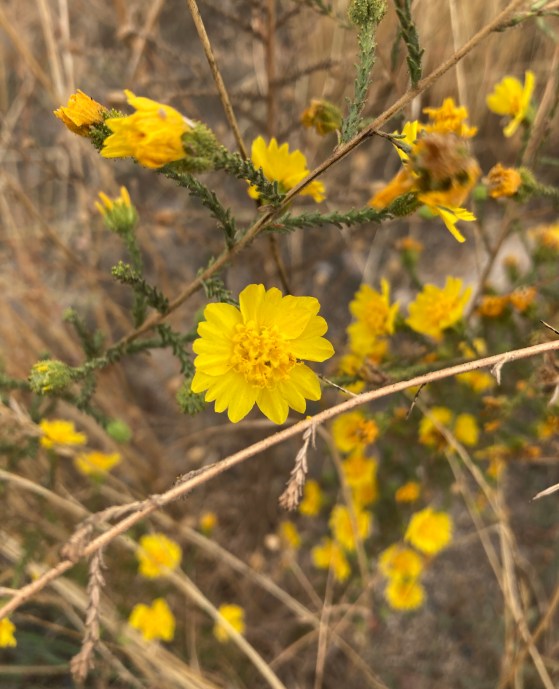
The two species of tarweeds caught my eye a little further on. I think it was mostly Fitch’s Tarweed, Centromadia fitchii, that had turned the slopes and flatlands gold in large swaths on either side of the highway.

But the more photogenic plant I managed to get close to was Heermann’s Tarweed (according to my Seek app), Holocarpha heermannii. Both of these plants are in the Aster Family, but different genera. A lot of tarweeds are in the Madia Family, but it seems that Heermann’s is irregular.
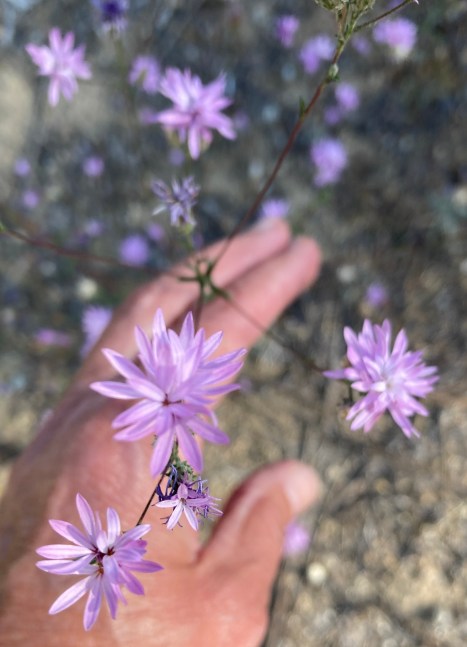
The second plant called vinegarweed grows along the roads in the High-er Sierra. When I first met it in 2009, it didn’t occur to me to taste it; maybe if I had, the idea of vinegar would have been uppermost? But my mind immediately wanted to call it Purple Haze, or Lavender Mist.
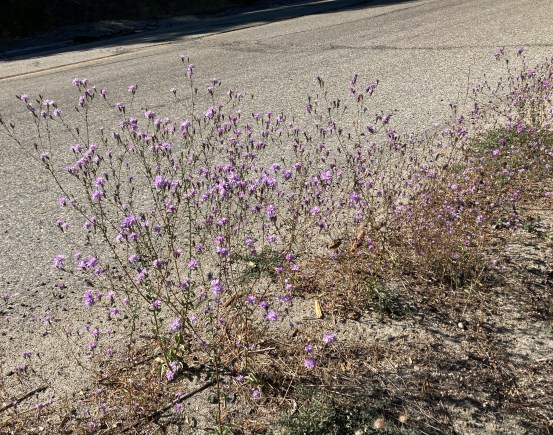
It typically gets my attention as I come  around a curve in the road, floating as a long pastel smudge on the shoulder. That first sighting was long before I had any kind of nature identification app, and when I eventually found someone who could tell me what it was (Sierra Vinegarweed or Lessingia leptoclada), that amateur botanist told me that if it had been up to her, she’d have named it Lavender Groundsmoke. The hope of encountering these flowers again would alone be enough to bring me up to the mountains every summer.
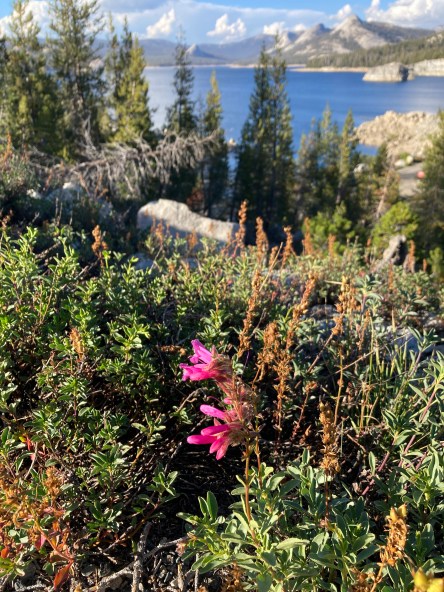
The last plant I will share has no connections to vinegar or tar; it is the favorite Mountain Pride, or Newberry’s Penstemon. In an average year, its flowers would have faded to brown by now, and in fact most of them have. But the snow hung on so late here this summer, till the end of July, that the earliest wildflowers had to wait at least a couple of weeks longer to emerge. I was happy to find one bloom of Mountain Pride still fresh and bright. These plants that sit overlooking the lake are a landmark for me, announcing at the end of my journey to the cabin, You have arrived!
I study and drink grasses.

Today my friend Cindy and I drove out to the beach, a birthday outing for her. It was about 60 degrees, which was truly fine when the sun came out; there wasn’t much wind. While Cindy lay under a driftwood teepee, I took a brisk walk down the beach a ways, trying to exercise my feet in the squishy sand right where the wave has just receded.

Washed up by the surf I saw several by-the-wind Sailors, Velella velella. It’s hard not to notice their brilliant blue. I had heard a couple of months ago that people were seeing thousands of them on California beaches this year, which is unusual. This one was about two inches long.

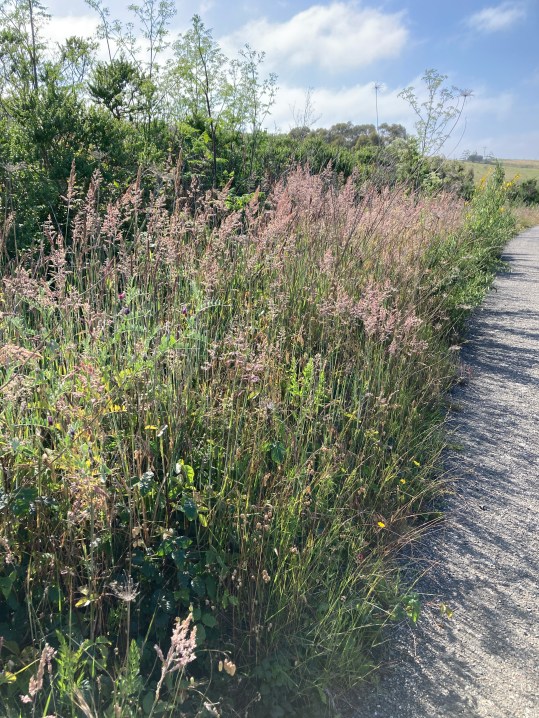
The only stop we made for wildflower appreciation was on the way home, and it wasn’t for flowers at all, but for grass. Stands of pink grass waved in the breeze a the edge of the road; I discovered it is common velvetgrass, holcus lanatus. I think this is the first time my Seek app has been able to tell me anything about grasses; maybe it has truly been adding to its knowledge base. After all, one often does get the message that “Seek doesn’t know what this is. We are still learning!”
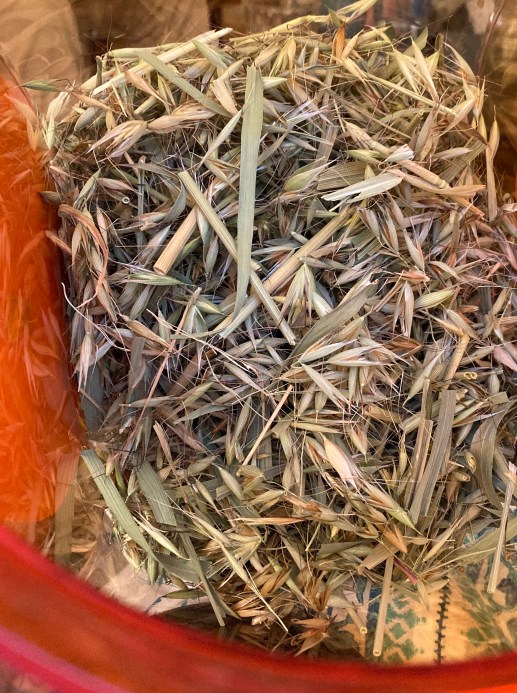
Recently I was offered a cup of tea at a friend’s house, and it was the most delicious drink, toasty and sweet, like nothing I’d ever tasted before. When my host came back into the room I asked her, and she said it was an infusion of wild oats — she had gathered them from nearby fields, and dried them. She showed me her stash, which she keeps in a big pretzel jar:

Just now I read more about this plant, a native perennial called California Wild Oat Grass, Danthonia californica. I was surprised to learn that it is recommended for growing domestically: “In home yard use, this grass gives a lowland meadow look or grows well in a rock garden.”

I don’t think my garden has the meadow look that would provide context for this native grass, but it is nice to think that other people might take advantage of its good features, and maybe drink its flowers, as I did. For now, my own interest lies almost entirely in trying to learn about more of the many grasses that live in northern California. I’ll be sure to let you know if I do.

California Wild Oat Grass – Internet photo

How I could muddle those two….

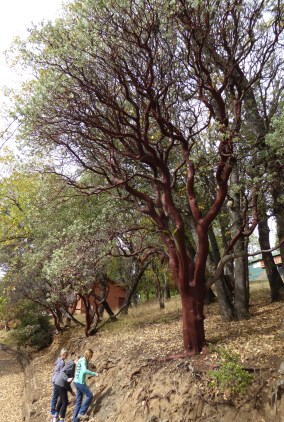
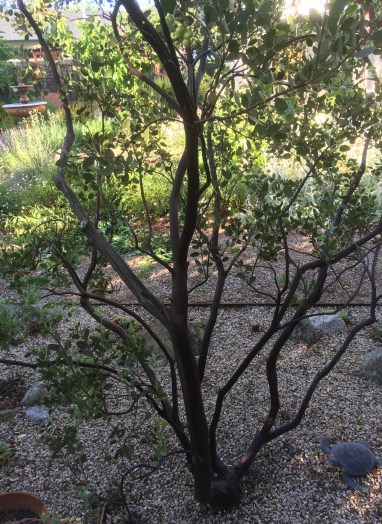
My particular manzanita tree is not bushy, and only briefly ever was, in its youth. It’s always difficult to get a picture of the whole plant; because of its airy form, whatever is growing behind it shows through and you can’t see how beautiful the tree itself is. As I did yesterday, I typically just show parts of it here on my blog. Here is one view from the past:

And here are several other specimens I saw growing in the southern Sierra Nevada:

GL P1020456GL P1020381

As Wikipedia tells us: Manzanita grows in “the chaparral biome of western North America, where they occur from Southern British Columbia and Washington to Oregon, California, Utah, Arizona, New Mexico, and Texas in the United States, and throughout Mexico. Manzanitas can live in places with poor soil and little water.”

Back in the 80’s when I lived in another town, my horticulturist neighbor took the lawn out of her front yard and planted sixteen manzanita bushes there next to the driveway. I was mightily impressed. The last time I drove by, they were still looking beautiful, at least to my eye, which is accustomed to those twisty, even artsy lines. I know that some of you will remember when I went to a lot of trouble to get a branch of manzanita installed in a corner of my living room.
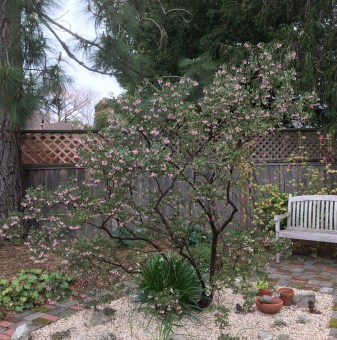
This may be the best picture so far.

Yesterday when I briefly referred to my own beloved tree, and then posted two pictures from my neighborhood walk of a dramatically different sort of tree I don’t much care for (Atlas Cedar), I didn’t realize how I was making it easy for my readers to get the wrong idea, and when it relates to my favorite, (whom I named “Margarita”) I could not let it go. My late husband and I planted this tree twenty years ago, and you can see a picture of us working on a path just before installing it in my post Changing Views, which tells its history, and shows many images over the years, including of its unusual peeling bark.

Because of the preference of the 105 species and subspecies of Arctostaphylos for dry summers, I have only gravel and succulents under my tree, and hope that she continues to like it here. I tried again to take pictures this morning, and I will finish off with one. (Those are needles of the Canary Island Pine which continually descend to decorate the manzanita like Christmas ornaments.) I’m thankful to have had an excuse to review Margarita’s history for a while this morning, and to tell you once again about my long time friend.

The forest adorns itself and me.

black locust

In the middle of Saturday’s graduation party, Pippin and I wandered through a gate into the vegetable garden and soon found ourselves sitting in two chairs that seemed to have been set there just for us introverts, who were perhaps unconsciously following the advice given to introverts as to strategies for party-going.

After the weekend was over and we were both in our separate towns and homes again, in “recovery mode,” it was amusing how we found ourselves still together, after a fashion.

I was sifting through my pictures and notes on my phone and looking through my Weeds of the West, the book Pippin had mentioned when I asked her about a weed growing in her own vegetable garden. I was only a few pages away from finding it when on my computer a message popped up from her with a photograph of that very page.

Great Hound’s Tongue

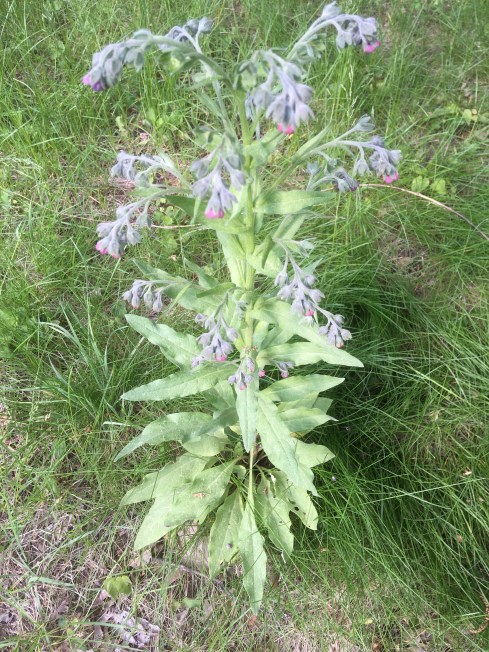
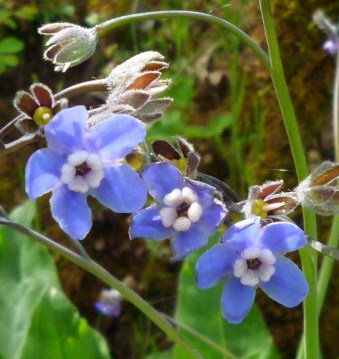
It is Common Hound’s Tongue, Cynoglossum officinale, or “gypsyflower,” which she said she always pulls out before it makes its terrible stickery burrs — and this very minute, when I looked for photos of them online, I realized that these are the burrs which one September I noticed looked like Mrs. Tiggy Winkle! It’s also the same genus as beautiful wildflowers like the Great Hound’s Tongue I saw in Oregon eight years ago.

There is also another photo of hound’s tongue in my files that I think might be Pippin’s work, because it comes from her neck of the woods and I don’t remember taking it:

If that weed in Pippin’s garden looks strangely familiar to those of you who have been reading my last several blog posts…. That’s because hound’s tongue is in the Boraginaceae Family! Yep, it’s closely related to borage. Well, well.

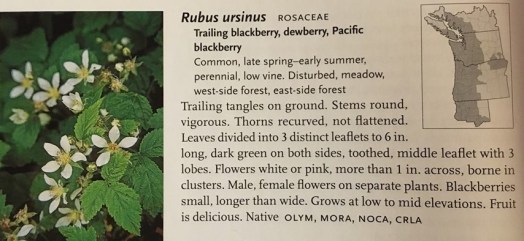
The first full day I spent at Pippin’s, we took a picnic to the lake before working in the garden. There we also found some plants to look into further. There was a white flowering bush my daughter told me was a ceanothus called Mountain Whitethorn, though its flowers can be blue or pink.  We saw a recumbent berry that Pippin identified yesterday as a Dewberry, a name that echoes in my mind from the distant past.

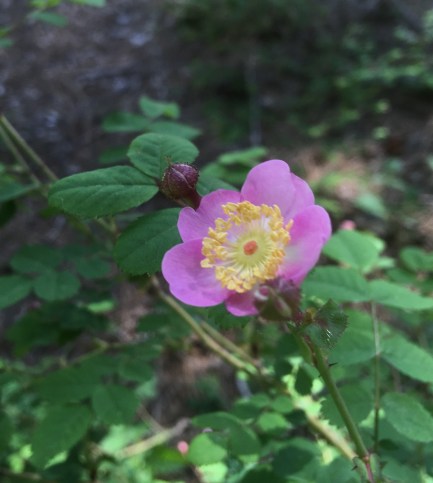
And we all stopped to look at a lovely wild rose,
until Scout in his bare feet ran into some red ants, and from then on we didn’t linger.

wild ginger
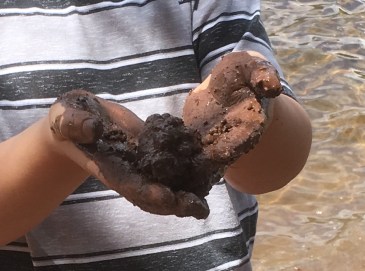
merely mud

Back when we’d arrived for our picnic, before we had even got fully out of the parking lot above the lake path, we were hit by the scent of black locust trees in bloom — so delicious. And because a couple of my readers have told me that the flower petals are edible, we all tried them. They were a little dry and bland compared to pineapple guava petals, in case anyone is interested. 🙂
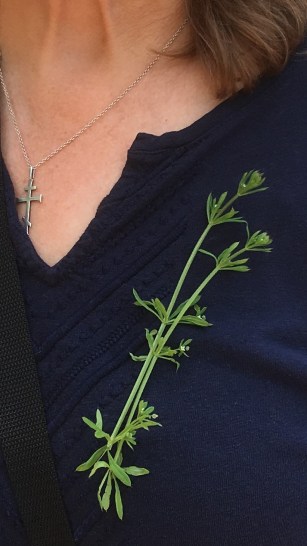
Right under the boughs of those trees Scout spied what he called “Botany Brooch,” and which I knew as the annoying sticky weed or catchweed, Galium aparine. But if you need a very temporary natural-looking piece of adornment, it lives up to its other nickname of “velcro plant,” and requires no difficult clasp to attach it, even after it  has wilted, which happens fast.

From this time forward, I will be less grumpy about this plant with a dozen nicknames, and who knows, you might even see me wearing a bit of it at my garden (work) parties.

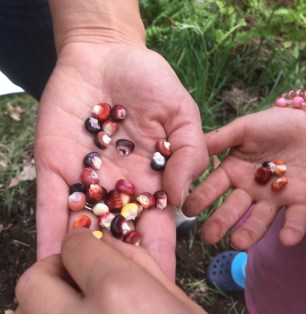
When we returned to the garden that afternoon it was to plant Indian corn that Mr. and Mrs. Bread had given from their bounty. Pippin has never tried to raise corn before but she knows people who do, up there where the growing season is not long. It needed to be planted inside the garden fence so the deer won’t eat it; we decided to dig some “hills” here and there where there weren’t too many rocks to extract.

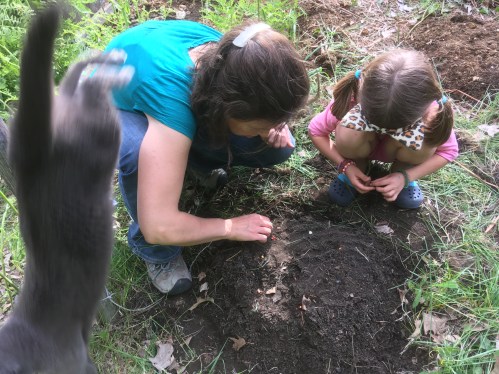
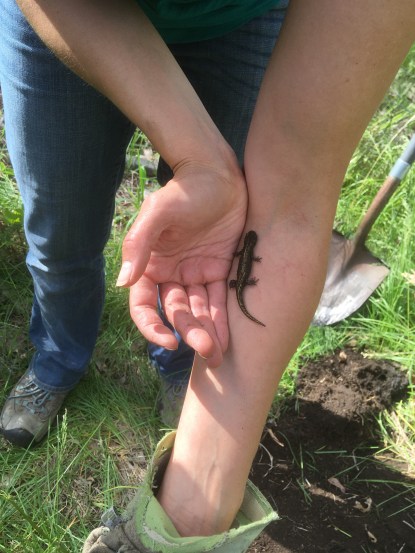
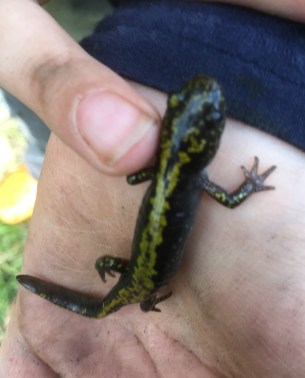
In the course of the afternoon the Professor brought us bags of compost and contributed to the dinner that was simultaneously in process. The children played all over the place, and helped to push the seeds into the earth, and discovered worms to feed to a toad that Pippin had found hiding behind a box. A salamander was unearthed and rinsed off and admired, and eventually let go in a wet area of the yard. I tried to take pictures of the striped bumblebees that are so pretty, compared to the fat black ones that I get down here.

blueberry flowers

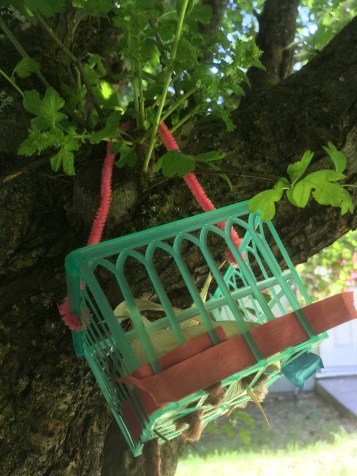
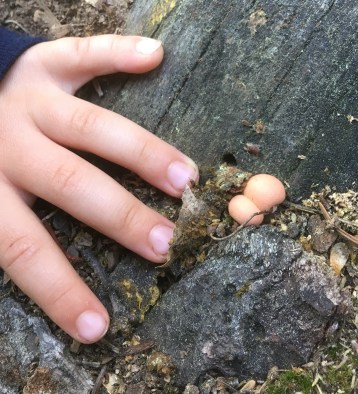
High in an oak tree Ivy has hung a little basket of nest-making supplies for the birds. A flesh-colored button of a fungus was decorating the old stump, evidently the immature stage of what will become a dry and brown puffball type of growth; after I took my picture the children showed me how the little brown balls above would release their powder if broken with sticks.

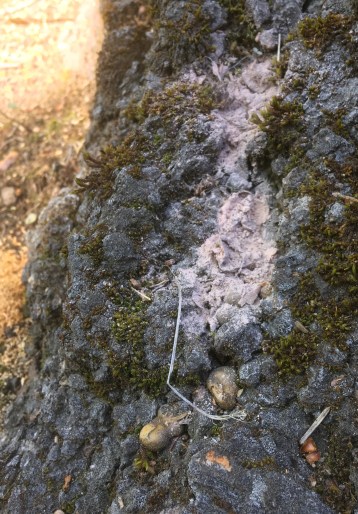
On the other side of the stump, a splash of brightness — is this also a fungus?

Around the homestead of Pippin’s family, the forest is always sharing its life and beauty. I suppose there will never be an end of things for me to explore when I spend time there. But for now, my own garden realm is waiting for me so I will send in my report and say good-bye for now!