Tag Archives: pruning

Ladybugs warned me.

A picture from my garden in springtime:
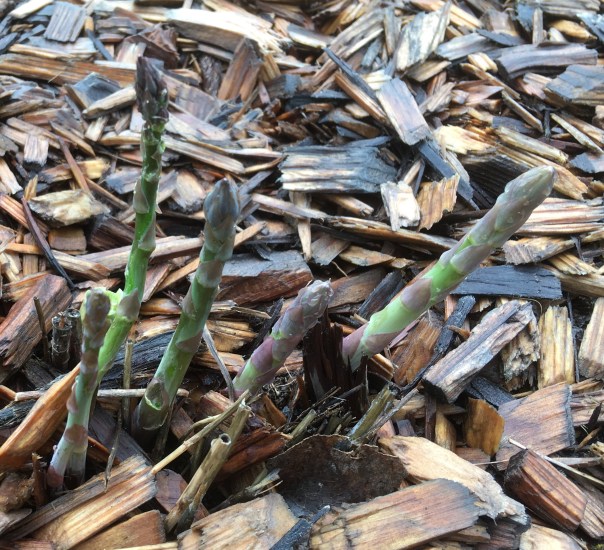
It seems I never wrote last summer about how I had to prune my asparagus early. I didn’t have time, because of how that project consumed me. The same phenomenon is forcing me to do it again this year: an infestation of aphids in the thick jungle of fronds. Last week I saw a few ladybugs on the plants, and thought, Oh, no, I bet it’s happening again. I looked more closely, but the invasion wasn’t obviously imminent.

Then today, as I was trimming the irises, I noticed that some of their leaves had the sticky “honeydew” sign of aphids. That’s exactly what I was doing last year when, as today, I looked up at the asparagus fronds bouncing off my head — Why oh why hadn’t I worn a hat? — and saw the shiny mess everywhere. I had taken a lot of pictures last year (including two I’m posting now), but never got around to sharing anything of that experience; there were immensely more pleasant things to tell about.

Searching online, I did not discover any tricks to prevent this happening every year, though I did learn that much of California is so mild that aphids are a problem with many crops; there are aphids specific to many plants, a fact I didn’t know before. Maybe I have the European Asparagus Aphids.

A single adult ladybug can eat up to 50 aphids per day, and the ones that arrived in my garden this month have feasted well, but they can’t keep up. One is supposed to wait to prune asparagus after cold weather makes the fronds turn brown, so that they have as long as possible to carry on photosynthesis. But if aphids are destroying them anyway, not much is lost by doing it early.
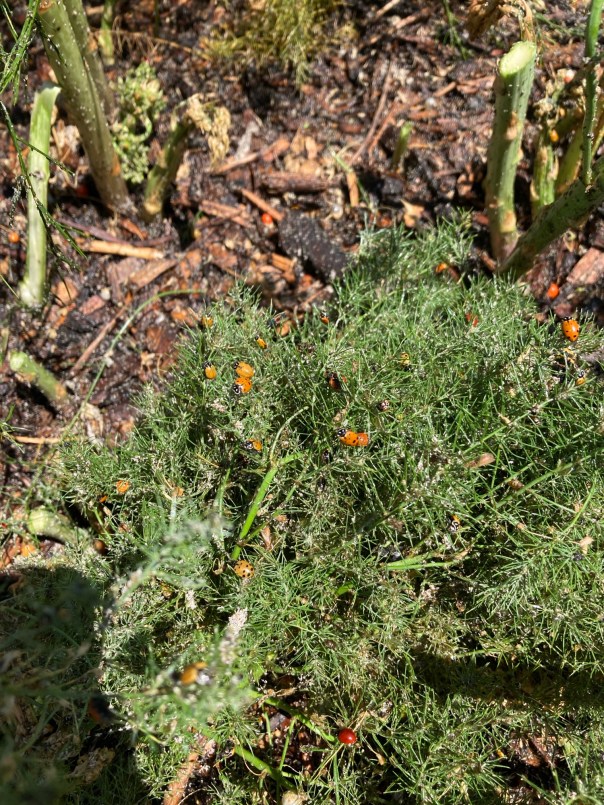
Ladybugs in ’24 after I took away much of their food.

Jacques the Gardener in San Diego shows in his video how he had the same problem I do, in his much smaller plot, and his reasoning about having to cut down the plants months before the usual time helped me to feel better about doing the same. Last year there were so many mild-weather months remaining after I removed the decimated fronds, a whole new crop of them sprouted, which I knew would start over the process of turning the fall sunshine into food for the crowns. Eventually they had to be cut off also. My spring crop following all that was pretty good this year, but it’s possible that a continued aphid plague will weaken the plants.

August 2024, after one of two beds had been cut back.

Today, I only cut off a few of the stalks, to clear the way for me to finish cleaning up the irises. In the process aphids and aphid carcasses drifted down on my hair and clothes. In the next couple of months I’m dividing and replanting the irises and changing things around in that area, so I think after cutting all the asparagus to the ground I’ll take the mulch off the whole space as well and start with fresh everything. I hope that might reduce next year’s aphid population a little.

In the meantime, I will close with a more positive visual reminder of why I do all this work:
 

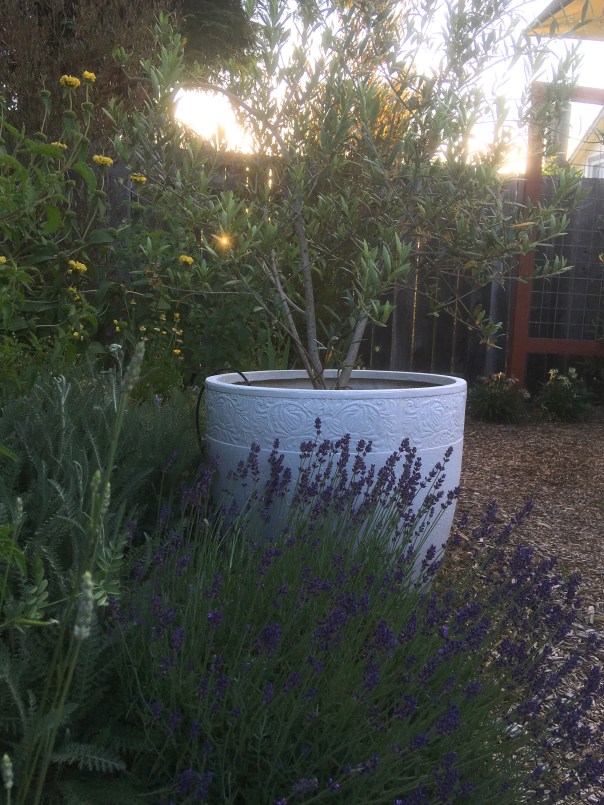
The olive gets refreshed.

September 2016

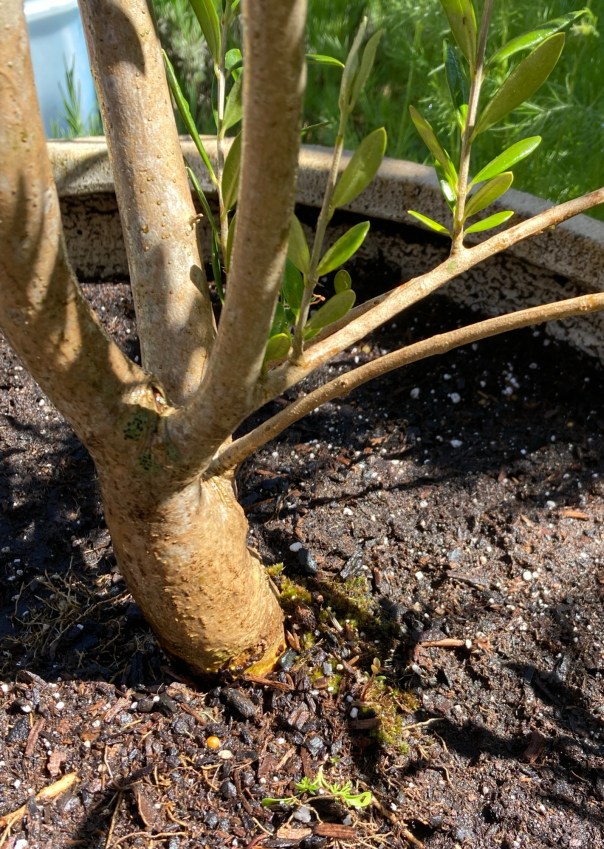
Back in 2016 I removed my two olive trees from their pots, trimmed their roots, and installed them in larger, matching white (and lightweight) fiberglass pots. I seem to have never written about the process here or posted photos; I wish I had, because I couldn’t remember the specifics, and had to consult YouTube when yesterday I decided to tackle the root-trimming job again.

Olive Junior, June 2020

The landscape designer who advised me back then not to plant an olive tree in the ground, because it would grow out of scale and become overbearing in my little garden, suggested I keep the ones I already had and just put them in larger containers; she added that I would need to trim the roots every couple of years to keep them healthy in the confined space.

That was eight years ago this month, and one of the trees by its yellowing leaves has been signalling me that my procrastinating was costing it its health. The task had become more daunting with every year added to my age. Those pots may be easy to move around when they are empty, but with all that moist dirt and biomass in them, I could barely tip one over on to a tarp.

When I did, I found a couple dozen salamanders of all sizes under there. They weren’t happy to feel the sun on their cool and moist bodies, and they writhed and slithered away into the mulch.

Getting the root ball out of the pot was the hardest part of the whole job. My back didn’t suffer any lasting effects, but my arm muscles are complaining. We were stuck in the situation pictured above no matter how I yanked and rolled things around; I really could have used a helper (with long arms) at this point just to pull on the pot while I pulled on the tree. But inch by slow inch — and it was finally out.

After I loosened the snarled roots, and shook off the old soil, it dawned on me that I didn’t have enough new soil to replace it, so I covered the root ball against the sun and took a half hour to go to the store for a few bags of potting soil.

Olive Senior, May 2020

After trimming the roots I put the pot back in place and leveled it using two flat stones from the mountains, then put the tree back in, with the new dirt, and a little fruit tree food. I trimmed the branches a bit, too. I think this tree, whom I’ll call “Olive Junior,” will be happier now.

What about the other one? It seems pretty healthy, so I’m putting off dealing with it for now. The two trees have different history. Olive Senior was given to me as a birthday present by my son “Pathfinder” and his family more than ten years ago. I kept it in a roomy pot but didn’t water it very much; its form was lacking but it didn’t occur to me to try to improve on it.

A few years later I saw little olive saplings at the grocery store half-off, that is, $7.50. They were very healthy and more shapely than my olive tree, and I brought one home. I began to shape Olive Senior with my pruners. When it came time to put them in matching pots, O.S.’s roots weren’t crowded in the pot and there wasn’t much to trim off. Olive Junior’s roots were extensive and needed a lot of trimming, even though it was much younger. So… I’m guessing each is still following its pattern, and I can wait a bit, and tackle Olive Senior with a little more forethought, and with a helper.

It’s a great blessing to own not just one, but two olive trees, even if I do have to give them the bonsai treatment. They like the Mediterranean climate. I will close my olive report with this Bible verse that I took many years ago as a poem-prayer expressing my heart’s vision:

But as for me,
I am like a fruitful olive tree
in the house of the Lord;
I have hoped in the mercy of God
for ever, and unto the ages of ages.

Psalm 51:8

Like a face one has loved.

PRUNING TREES

Trees growing–right in front of my window;
The trees are high and the leaves thick.
Sad alas! the distant mountain view
Obscured by this, dimly shows through.
One morning I took knife and axe;
With my own hand I lopped the branches off.
Ten thousand leaves fall about my head;
A thousand hills come before my eyes.
Suddenly, as when clouds or mists break
And straight through, the blue sky appears;
Again, like the face of a friend one has loved
Seen at last after an age of parting.
First there came a gentle wind blowing;
One by one the birds flew back to the tree.
To ease my mind I gazed to the South East;
As my eyes wandered, my thoughts went far away.
Of men there is none that has not some preference;
Of things there is none but mixes good with ill.
It was not that I did not love the tender branches;
But better still -– to see the green hills!

-Po Chü-i

China, 9th century
Translated by Arthur Waley

Central Valley of California


We prune and purge.

I had a wonderful day, though it was very odd at the beginning. Instead of my usual slow and contemplative morning pace, I had to go downstairs early to phone my auto insurance company as soon as their business hours began, in hopes of asking a simple question of A Real Person, as we say. I had begun to wonder, over the previous several days, if there were any of those on duty. It worked, and I made progress; but I’ll have to do the same thing on Monday.

The contemplative part of the day got postponed and shortened a bit, but it was rich and thought-provoking, as usual. I can’t go into detail about all of that, because most of the day was given to housework, of the purging/organizing sort that I’m making a priority this year. To top it off, the gardener came late in the afternoon, and pruned more trees and bushes. When he is here I usually also work in the garden or tidy up the garage.

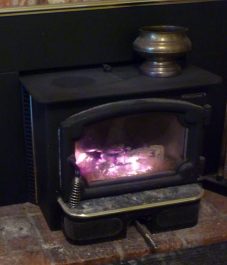
It was lovely to be in the garden and not get wet. Eleven days of the last two weeks were rainy; I was reminded today that January in my area is the month with the most rainfall, and that was a blessing in several ways. When it rains, we are rarely forbidden to burn wood, so my house has been cozy from all the fires I’ve been able to keep going, and the wood stove often keeps putting out heat until the afternoon of the next day. That means that when I wake up I am not so cold I threaten to go into dormancy, and I can put my mind to ideas and projects other than going back to bed or making multiple mugs of hot cocoa.

First Alejandro leveled the fountain. I don’t know why it gets wonky so easily, causing all the water to fall off one side of the upper tier. I am not very skillful at evening it out by myself.

The lemon tree, strawberry tree, and at least one pomegranate bush got trimmed and shaped, and much more order was restored to the garage and garden. Recently I mentioned about how the lemon tree was gangly and out of control, and my helper did have confidence about what to do now, and what we’ll do a little later. It looks much better after we removed several branches. I am always surprised at how good my lemon tree smells. I brought in a few of the trimmings and put them in a vase so that every time I come into the room I will get a whiff of that delicious scent.