This poem about Queen Esther of the Old Testament I find fascinating, in the way it portrays the enervating terror Rilke imagines the saint experiencing, as she forces an audience with the king without an invitation. It recalls the truth we all have heard, that courage doesn’t mean you aren’t afraid, but that you do what you must in spite of fear.
Maybe she didn’t know what she would say, exactly, but she knew that she had to do something, to intervene on behalf of her people, the Jews. (You can read the whole story in the book of Esther in the Bible.) The translator guesses that in the poem, what Esther conceives at the touch of her king’s scepter “is, presumably, the plan to save the Jews of Persia from Haman’s plot.”
For seven days her maids had combed the ash
of her grief, as well as the whole cache
of woeful recollections, from her hair,
and had borne it and bathed it in sunshine,

sustained it and nurtured it with fine
spices day after day; but then and there
the time had come when, uninvited,
with no more respite than the dead,
she finally entered the palace door,
draped upon her women, to see Him —
that one at whose bidding and whim
one dies if one ever dare come near.
He shone so that she felt his brilliance
in the rubies she wore, which seemed aflame;
like a jar she was filled up with his presence,
and quickly she was full to the brim,
before she had reached the third chamber’s end
she overflowed with the great king’s might,
and it seemed that the walls of malachite
flooded her in green. She did not intend
this long walk with her every gemstone
growing heavier as the king shone,
growing cold with fear. She kept walking.
And as she at last approached that one
sitting high on the tourmaline throne,
looming above her like an actual thing,
she was caught by her near-at-hand women,
who bore their fainting mistress to a chair.
He touched her with the tip of his scepter;
and without thought she conceived it within.
-Rainer Maria Rilke, from Rilke: New Poems
Translated by Joseph Cadora
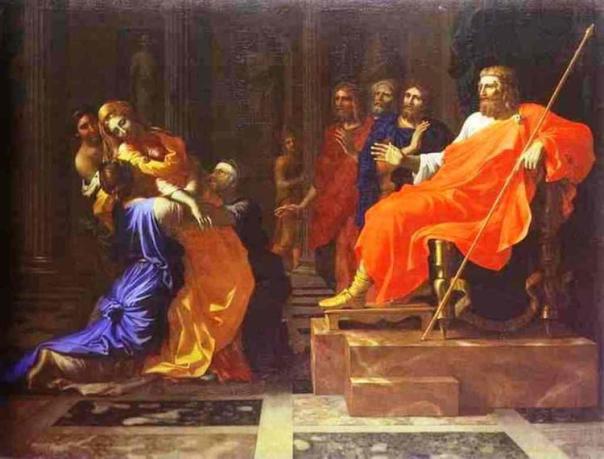
In this telling, the jewels play a big part, in the way they weigh her down; they express something about her relationship to the king, who would have been the giver of them. He was the reason for the events that led to her unique standing as one who had been elevated from being a simple Hebrew girl to the status of royalty. In that role in which she now finds herself, she feels the heaviness of her responsibility. I wonder if Rilke was inspired by this painting by Nicolas Poussin:
Joseph Cadora translated all the poems that are included in Rilke: New Poems, the collection in which I found this one. He includes a short commentary on each poem in the anthology, which he says are “mostly a result of reading the poet’s letters, several biographies, and three other works of Rilke’s …” He also writes that “translating New Poems has been a labor of love, and thus, no labor at all.”

 Gladsome Lights