Tag Archives: roses

Walking with aromatics.

The first scent I noticed on my walk this morning was from the mown weeds, drying up and exuding the remembrance of new-mown hay, which I rarely encounter in my life these days.

There were conifers whose oils were being drawn by the warm sun into the air I breathed… and I forgot for a moment that I wasn’t camping in the redwoods with my family, walking on a duff-y path with gigantic trees towering on either side.
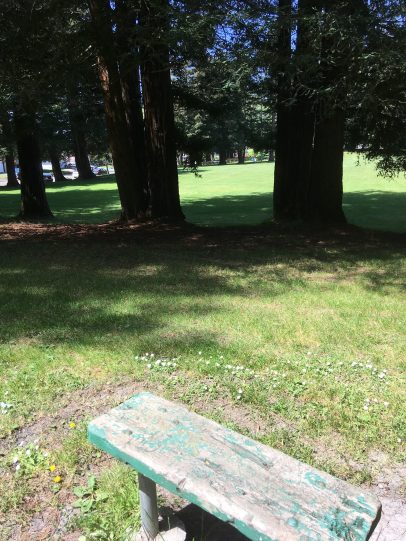
Just on the other side of the creek from the “hay,” was the soccer field with its green and rich scent I used to get once or twice a week, as I stood on the sidelines watching my children run kicking down that lush lawn.

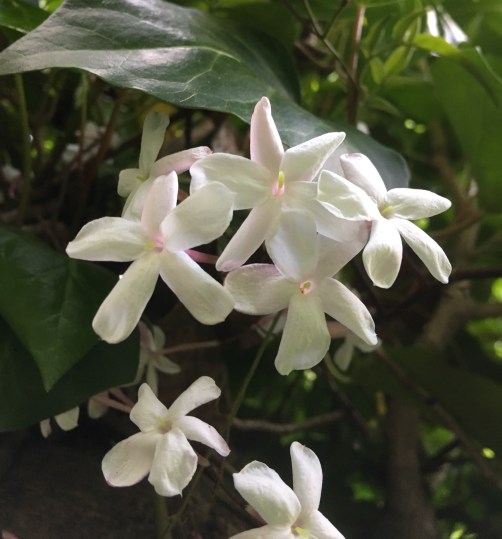
And there were flowers hanging over from the back yards, honeysuckle and potato vine, and other flowering vines, all heady-sweet and making me wonder why I should ever think dessert was anything to satisfy.
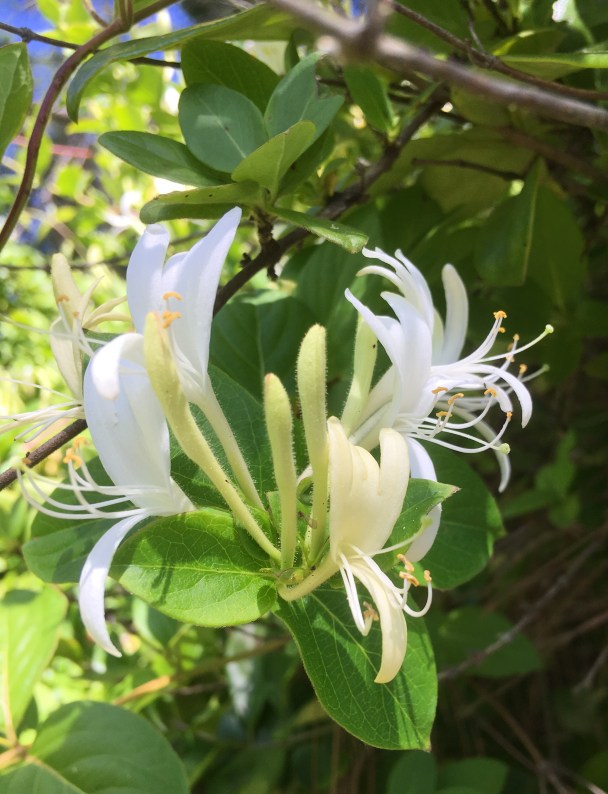
I’m leaving this honeysuckle photo large because there seems to be a tiny long-winged fly hanging on to one yellow part right in the middle. Do you see it, too?

The most familiar aromatic of my walk must be the oaks, because they are ubiquitous in all the places in California that I have ever lived. I think these are live oaks, with their thorny leaves that cling to any concrete patio, etc. that you are trying to sweep them from.

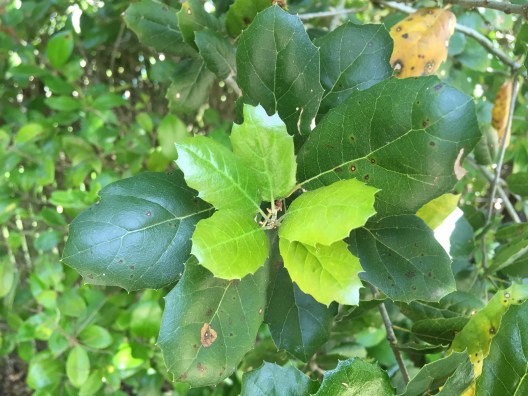
I think those two pictures above, taken of two different trees, are both live oaks, but one has much more concave leaves than the other.

The last classic aromatic plant I passed before I left the path was roses, the little climbing pink and white ones that spill over the fence and pull me off the path to sniff them or take their pictures again and again. This morning I resolved to come back later with my shears — it’s only three blocks — to cut a few for the house.

“Let the field be joyful, and all that is therein: then shall all the trees of the wood rejoice…”
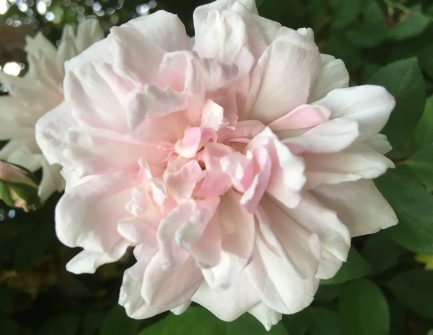
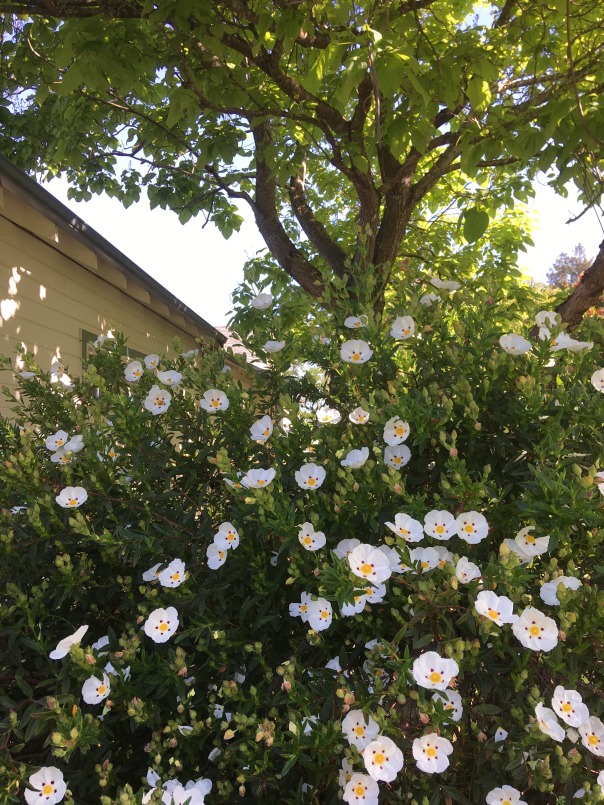
Roses, a towel, and Isidora.

When you have washed the dishes and are letting the dirty water drain out of the sink, remember Saint Isidora, who is commemorated on May 10. Today I thought of her when I had occasion to wear a kitchen towel on my head; I have posted her story below.

isi cistus church 5-17
cistus at church

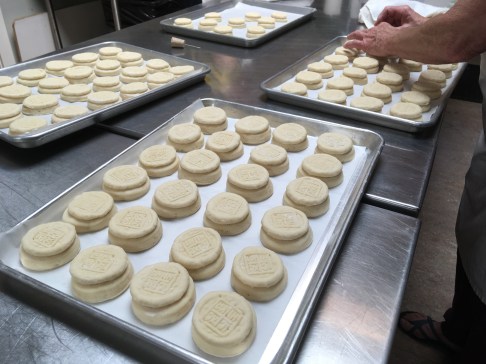
I had scheduled an oil change for my car this morning, and planned to drop it off at the mechanic early enough that I would have time to walk the mile to church, and join two other women to bake Orthodox communion bread called prosphora.

Because I was plotting about how long the walk would take me, what time to leave home, etc., I forgot to bring along the bandana I always wear to keep my hair out of the dough. When I arrived on the property I took some flower pictures and then hunted around for a substitute. I couldn’t find a spare scarf in the church or in the lost-and-found, but there was the stack of frayed but clean terrycloth kitchen towels in the corner of the kitchen, and a safety pin in a drawer… Ah, I thought: Isidora was known to wear a rag on her head, so I will do this in her honor.

Icon over the church hall porch

The following is from the website of the Orthodox Church in America:

Saint Isidora, Fool-for-Christ, struggled in the Tabenna monastery in Egypt during the sixth century. Taking upon herself the feat of folly, she acted like one insane, and did not eat food with the other sisters of the monastery. Many of them regarded her with contempt, but Isidora bore all this with great patience and meekness, blessing God for everything.

She worked in the kitchen and fulfilled the dirtiest, most difficult tasks at thisidora-of-egypt-frescoe monastery, cleaning the monastery of every impurity. Isidora covered her head with a plain rag, and instead of cooked food she drank the dirty wash water from the pots and dishes. She never became angry, never insulted anyone with a word, never grumbled against God or the sisters, and was given to silence.

Once, a desert monk, Saint Pitirim, had a vision. An angel of God appeared to him and said, “Go to the Tabenna monastery. There you will see a sister wearing a rag on her head. She serves them all with love, and endures their contempt without complaint. Her heart and her thoughts rest always with God. You, on the other hand, sit in solitude, but your thoughts flit about all over the world.”

The Elder set out for the Tabenna monastery, but he did not see the one indicated to him in the vision among the sisters. Then they led Isidora to him, considering her a demoniac. Isidora fell down at the knees of the Elder, asking his blessing. Saint Pitirim bowed down to the ground to her and said, “Bless me first, venerable Mother!”

To the astonished questions of the sisters the Elder replied, “Before God, Isidora is higher than all of us!” Then the sisters began to repent, confessing their mistreatment of Isidora, and they asked her forgiveness. The saint, however, distressed over her fame, secretly hid herself away from the monastery, and her ultimate fate remained unknown. It is believed that she died around the year 365.

I have seen this icon for years in the church, but only recently did I get a good enough photo to think about putting up here, and then I read about Isidora just a few weeks ago, close enough to her feast day that I waited to share it now. But who knew that I would so conveniently find another connection to the saint? My fellow bakers smiled at my enthusiasm and immediately asked, “What’s for dinner tonight?”

We have a gardening work day.

To my surprise, I was able to take part in the work day at church. For twoIMG_2235 days previous I’d been getting enough soul-calming Down Time that I could feel relaxed about leaving all the work at home undone, and head over to the church garden to get my hands in the dirt there. Some of you will remember how I used to do that several times a week before my late husband retired.
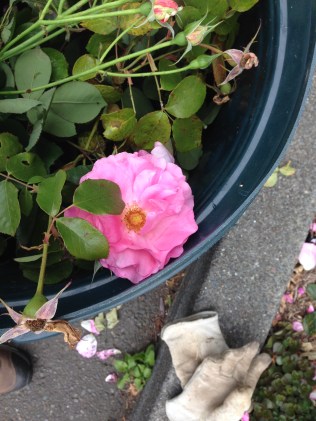
The last time I did anything like this was over two years ago, when Mr. Glad and I together helped prune roses for a few hours. The beautiful rose bushes are still there, but the late rains encouraged a lot of rust on the leaves, so one of my jobs today was to remove all those leaves affected.

IMG_2220Two of the roses that I have tended so many times in the past have to be removed — their old canes are non-productive and the new canes are too small, or only suckers. That’s sad…but it’s happened to my lovely Pristine rose at home, too, and I’m taking it out.
This lovely pink climber I was only cutting back so it will be easier for the men to remove later today. Our priest’s wife supervises the garden currently and does much of the work; she will buy a new climber and we’ll try to get it to climb up the pillar better than we managed with this one.IMG_2236 catalpa

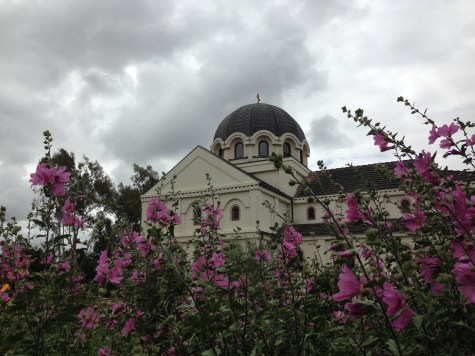
Rain is threatening again today, and the sky was cloudy, which put the flowers in such a good light that I had to take their pictures when I stood up to straighten my back. The rose mallow is in its prime.

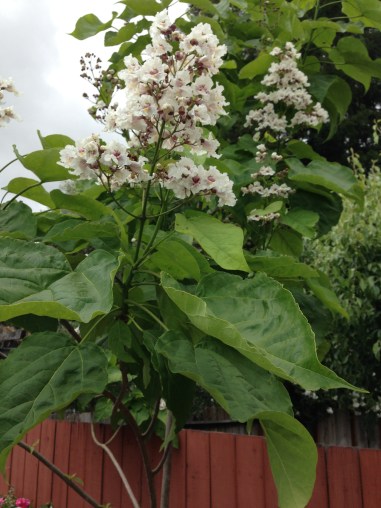
[For those who wonder what tree that is looming above the library, I’m adding a photo below of its leaves and flowers up close. It’s a catalpa.]

catalpa close ss

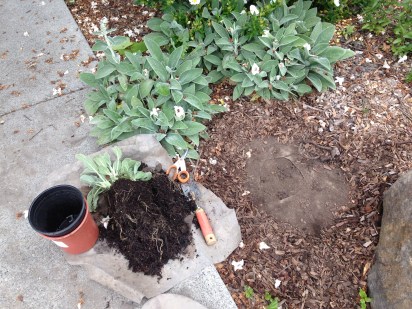
After Kit got all set up to transplant a lamb’s ear plant, she had to leave, so I dug the hole and tucked it in. I’ve never given so much care to planting lamb’s ears  before — on my own property I am always pulling them out, they are such enthusiastic growers. But this soil was pretty hard….

IMG_2224

Three hours went by pretty fast. I had to quit pulling weeds while I was still having fun, in order to preserve my back. But I’m encouraged to hope that if the next work days come when I’m not traveling, I’ll be able to spend some fruitful time in these beloved gardens again.

IMG_2246

Death was strangled…

…and other images of atonement are the subject of Fr. Stephen Freeman’s post Knocking Down the Gates of Hell, in which he shares the findings of a research paper he once wrote on Martin Luther’s hymns. Luther’s own atonement theology highly favored the imagery that also dominates that of the early church fathers, in which Christ smashes the gates of Hell and frees all those in chains.

Fr. Stephen shares several verses from various exuberant Orthodox Paschal hymns we are singing this month, such as these I excerpted from his post:

Hell, who had filled all men with fear,
Trembled at the sight of Thee,
And in haste he yielded up his prisoners,
O Immortal Sun of Glory.

Thou hast destroyed the palaces of hell by Thy Burial, O Christ.
Thou hast trampled death down by Thy death, O Lord,
And redeemed earth’s children from corruption.

Though Thou art buried in a grave, O Christ,
Though Thou goest down to hell, O Savior,
Thou hast stripped hell naked, emptying its graves.

Death seized Thee, O Jesus,
And was strangled in Thy trap.
Hell’s gates were smashed, the fallen were set free,
And carried from beneath the earth on high.

Thou didst will, O Savior,
To go beneath the earth.
Thou didst free death’s fallen captives from their chains,
Leading them from earth to heaven.

In the earth’s dark bosom
The Grain of Wheat is laid.
By its death, it shall bring forth abundant fruit:
Adam’s sons, freed from the chains of death.

Wishing to save Adam,
Thou didst come down to earth.
Not finding him on earth, O Master,
Thou didst descend to Hades seeking him.

The Paschal icon shows the resurrected Christ pulling Adam and others out of Hades.

db271-resurrectionstvladorthchurch

It’s Bright Monday as I write. This morning’s Divine Liturgy was splendid and full of love and light. We are all giddy with joy and fatigue, and can’t stop greeting one another with kisses and proclamations of “Christ is risen!” In the Paschal Canon where we sing, “Let us embrace each other joyously!” I always hope I will be standing next to someone I can hug at that moment. Today two women I didn’t know were the closest, and I made so bold as to hug them both at once, which they didn’t seem to mind. gl - EB

I realized just in time for the midnight service of Pascha Saturday/Sunday, something I have had to call to mind again and again over the last months, that wherever my late husband is, he lives in the present. The part of me that grieves for his presence the way it used to be, as my earthly lover and companion, can never be satisfied; it is a longing for the past, and God is giving me instead Himself and all His gifts in this present moment. My dear Mr. Glad does not live “back there” in the past, either!

It’s because the various parts of me are not all united that my heart’s faith and love must keep instructing my mind — and other tangled and erratic parts? — that to be here right now with God is the way to stay close to my husband. In the reality of the Resurrection and our Blessed Hope, in the gathering of time and times that is kairos, he and I are more together than we have ever been, and in Love.

gl rose pascha 16


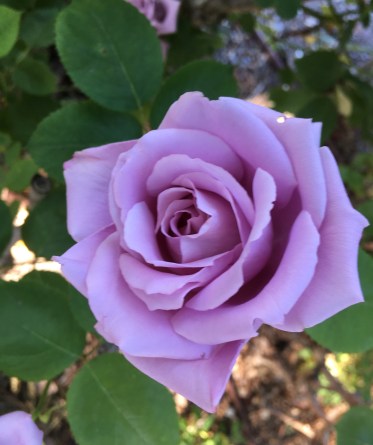
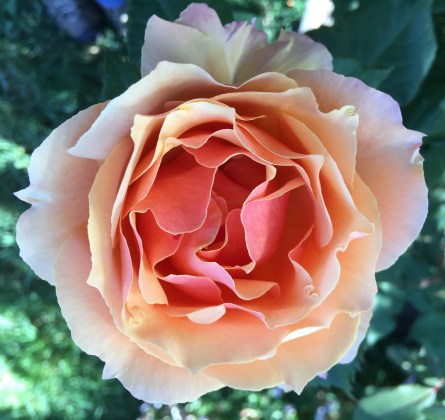
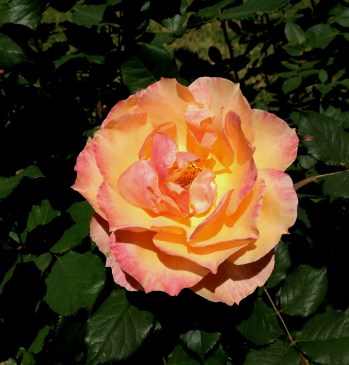
One sweet thing about Pascha coming so late this year is that roses are blooming all over. We have dozens of rosebushes at church that are loaded with flowers (not to mention the white roses that filled bouquets decorating inside the church.) This morning I took a picture of one favorite, to decorate this blog post. Happy Spring! Christ is risen! If you have read this far, I send you my Easter love!