Tag Archives: Russia

The joys of Holy Week.

Palm Sunday is the beginning of Holy Week, and here on the eve of it I’m sharing again, slightly updated, my experience of about ten years ago when I was in the middle of reading The Brothers Karamazov, and I came to the the part “From the Life of the Elder Zosima,” which takes place during this week leading up to Christ’s death and resurrection: 

The Elder Zosima first relates about his older brother, who only at the age of seventeen and sick unto death, turned from anger and scoffing toward a path that might lead to repentance, and seemingly only to please his mother. But that is not an entirely bad reason.

… on Tuesday morning my brother started keeping the fast and going to church. “I’m doing it only for your sake, mother, to give you joy and peace,” he said to her….But he did not go to church for long, he took to his bed, so that he had to confess and receive communion at home. The days grew bright, clear, fragrant — Easter was late that year. All night, I remember, he used to cough, slept badly, but in the morning he would always get dressed and try to sit in an armchair. So I remember him: he sits, quiet and meek, he smiles, he is sick but his countenance is glad, joyful. He was utterly changed in spirit — such a wondrous change had suddenly begun in him!

The young man asked forgiveness of everyone and talked about his great sin, but at the same time was so happy and full of thankfulness and exhortations, that people thought he was going mad.

Thus he awoke every day with more and more tenderness, rejoicing and all atremble with love. The doctor would come — the old German Eisenschmidt used to come to us: “Well, what do you think, doctor, shall I live one more day in the world?” he would joke with him. “Not just one day, you will live many days,” the doctor would answer, “you will live months and years, too.” “But what are years, what are months!” he would exclaim. “Why count the days, when even one day is enough for a man to know all happiness. My dears, why do we quarrel, boast before each other, remember each other’s offenses? Let us go into the garden, let us walk and play and love and praise and kiss each other, and bless our life.”

This older brother died a few weeks after Easter, when the teller of the story, the elder Zosima, was only eight years old. Now now near death himself, he talks more about his childhood, and how it was also during Holy Week that he began to see more when he went to church.

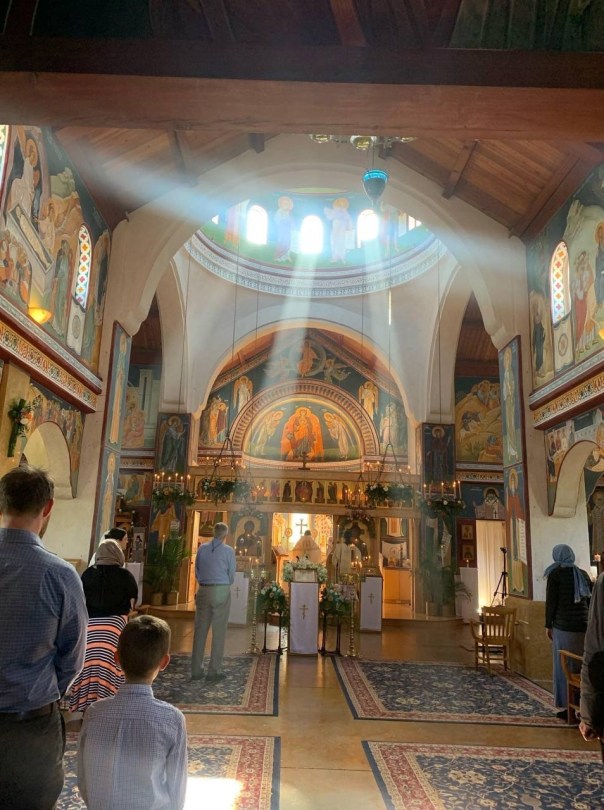
But I remember how, even before I learned to read, a certain spiritual perception visited me for the first time, when I was just eight years old. Mother took me to church by myself (I do not remember where my brother was then), during Holy Week, to the Monday liturgy. It was a clear day, and, remembering it now, I seem to see again the incense rising from the censer and quietly ascending upwards, and from above, through a narrow window in the cupola, God’s rays pouring down upon us in the church, and the incense rising up to them in waves, as if dissolving into them. I looked with deep tenderness, and for the first time in my life I consciously received the first seed of the word of God in my soul. A young man walked out into the middle of the church with a big book, so big that it seemed to me he even had difficulty in carrying it, and he placed it on the analogion [lectern], opened it, and began to read, and suddenly, then, for the first time I understood something, for the first time in my life I understood what was read in God’s church.

The reading was from the book of Job. I myself have attended these same services over the years, and they grow more precious every time I hear the readings and hymns. The gifts of the Church are too rich to ever plumb their depths, but there is no need to fret about our limitations, when, as the sick brother says, even one day is enough for a man to know all happiness.” How many times have I also watched the beams of light shining down when I stood in church, and even felt their heat on my face, like the warmth of God’s love?

Christ the Bridegroom

The Elder Zosima is a fictional character, but he is believed to be based on a real-life monk in old Russia. In the novel the Elder proceeds from this point in his very moving fashion to tell his life’s story: “– and over all is God’s truth, moving, reconciling, all-forgiving!”

The “accidental” timing of my reading seemed to be a gift from God that morning, helping me in an unusual way to become even more receptive to His being with us at the evening service by means of hymns such as, “Let my prayer arise in Thy sight as incense….,” and the Psalms of Ascent — and the Holy Mysteries.

When our bishop was with us the previous week, he gave a good word about the last days of Lent — well, technically Lent has come to an end, but we are still in the anticipation and preparation that is Holy Week. He said that Lent is not about finding every bit of dirt in our souls, but about the bridal chamber, about discovering the great love that our Lord Jesus has for us. It is truly a “bright sadness” that colors these days as we accompany Him to the Cross.

Perhaps Zosima’s brother went to a Bridegroom Matins service on Tuesday; we have three of them during Holy Week. The Lord Himself has been filling my lamp with the oil of His Holy Spirit.
Divine Flower, Divine Wisdom.

Sophia, by Thomas Merton

AND IT WAS HERE — IT WAS AUTUMN

And it was here — it was autumn —
When I told Her: “Divine Flower,
I feel Your touch! But why have you hidden Yourself
From my sight since I was a boy?”

At the very moment these thoughts moved through my mind —
Instantly, golden azure filled the room,
And she shone before me once again —
But just Her face — Her face.

At that instant lasting bliss was born in me!
Once more my soul went blind to mundane matters.
If I gave a sober hearing to Her, I know not what I heard;
Her words were incomprehensible, talk fit for a fool.

-Vladimir Solovyov (or Soloviev) (1853 – 1900) Russia
      Translated by Ivan M. Granger

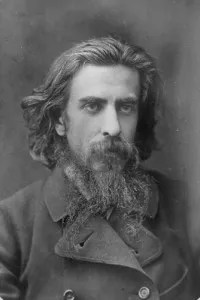
Vladimir Solovyov

Vladimir Solovyov loved Sophia, that is, Divine Wisdom. He philosophized about her throughout his life; I think this is probably a poem to that Sophia.

Solovyov  was an influential person in the late 19th century and into the 20th, and is thought to be a source for some of his friend Fyodor Dostoevsky’s characters, Ivan and/or Alyosha, in The Brothers Karamozov; he gave a eulogy at Dostoevsky’s funeral. His ideas definitely were stimulating to Tolstoy, and to many other thinkers, and he continues to be controversial in the 21st century. This article: “Holy Wisdom,” explains why his ideas about Sophia have generally not been accepted by the Orthodox Church.

Wikipedia quotes David Bentley Hart, another controversial philosopher, from his forward to Solovyov’s Justification of the Good,

“In truth, the divine Sophia is first and foremost a biblical figure, and ‘Sophiology’ was born of an honest attempt to interpret intelligibly the role ascribed to her in the Wisdom literature of the Old Testament, in such a way as to complement the Logos Christology of the Fourth Gospel, while still not neglecting the ‘autonomy’ of creation within its very dependency upon the Logos.”

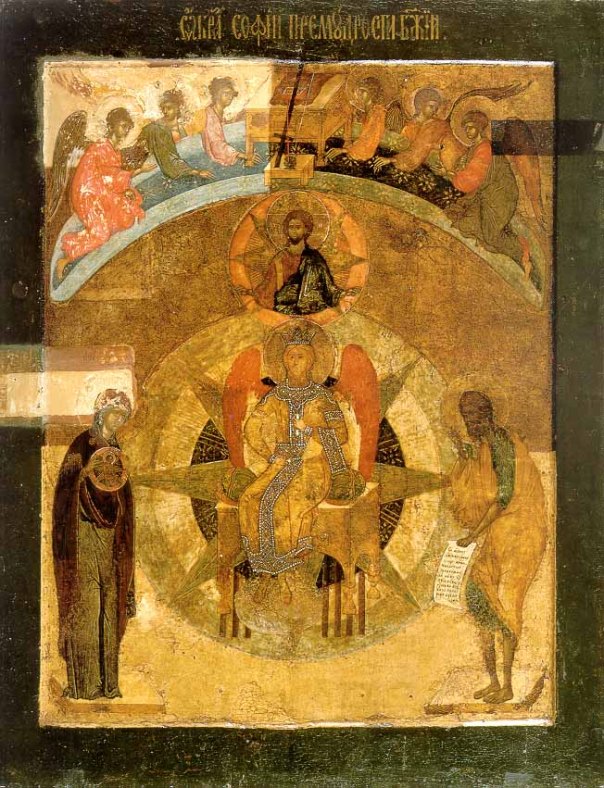
The Orthodox icon of Holy Wisdom often shows a “fiery angel” seated on a throne, with the Theotokos and St. Cosmas on either side, as in the example below. There is so much to ponder about Wisdom in the Bible. Even one of these verses I chose might provide for plenty of profitable contemplation:

Do not forsake wisdom, and she will keep you;
love her, and she will guard you.
Wisdom is the principal thing; therefore get wisdom:
and with all thy getting get understanding.
Proverbs 4:6-7

But the wisdom that is from above is first pure, then peaceable, gentle,
and easy to be intreated, full of mercy and good fruits,
without partiality, and without hypocrisy.
James 3:17

But if any of you lacks wisdom, let him ask of God,
who gives to all generously and without reproach,
and it will be given to him.

James 1:5

Icon “Holy Wisdom,” 15th Century, Moscow

LOVE WISDOM, and GET WISDOM.

People are weeping – St. Tikhon of Zadonsk

On this day we remember St. Tikhon of Zadonsk, a man born into a poor Russian family in 1724. He excelled in school, and after attending seminary became a teacher, and then a monk. After being elevated to the bishopric, at one time he had over 800 churches under his care; the story of his life is well told: here.

It was a huge job, and he accomplished a great deal, but his health began to suffer to the point that he wasn’t able to carry out his duties. He was transferred to a monastery in Zadonsk, and in solitude and relative rest continued to write. Bodily afflictions didn’t cease, but changed, and he became plagued with insomnia and depression, as this article “Victor over Melancholy” explains:

“It was a time of desperate and total battle with his thoughts, of overcoming the spirit of melancholy, despair, and despondency, and of a reassessment of his life circumstances; in the end, his soul acquired the priceless experience of overcoming, and with that the boldness to comfort the despairing….”

Being in seclusion was in some ways harder than overseeing hundreds of parishes, and the saint considered a petition to go back to his former overly-busy life. But eventually he gave up trying to change his situation, and gave himself to ministering to the many needs of the people in the community:

“In the small house where he lived, he organized a type of hospital for those who contracted any kind of illness on the way to work or on pilgrimage. He also offered spiritual alms, tearfully praying for the needs and illnesses of those closely and not so closely known by him.”

His writings were widely read by this time; in one of his compilations of “spiritual treasures” he exhorts us:

“We see in the world that people are weeping… They are born with weeping, live with weeping, and die with weeping. People weep because they live in the world—a place of weeping, the vale of tears… And you weep, Christian!… Weep, while time yet remains, while tears are yet beneficial. Weep, and you will not weep eternally. Weep, and be comforted.”   Source

The first Orthodox monastery established in the United States is dedicated to St. Tikhon of Zadonsk: St. Tikhon’s Monastery in Pennsylvania was founded in 1905 concurrently with an orphans’ home, and the current campus is shared with St. Tikhon’s Seminary and Bookstore as well.

Annual Memorial Day Pilgrimage to St. Tikhon’s Monastery, May 2024

Before falling asleep in death, at the age of 59, St. Tikhon was delivered of his melancholy. But in the years previous, during which his writings were proving beneficial to so many, it’s clear from them that his spiritual struggles were already bearing fruit. His example is inspiring, and his words confirm it:

“A manifest sign of love for God is a heartfelt gladness in God, for we rejoice in what we love. Likewise love of God cannot exist without joy, and whenever a man feels the sweetness of the love of God within his heart, he rejoices in God. For so sweet a virtue as love cannot be felt without joy. As honey sweetens our throat when we taste of it, so the love of God makes our heart glad when we taste and see that the Lord is good (LXX-Ps. 33:9 [KJV-Ps. 34:8]). –“On Love for God”

Saint Tikhon was glorified on Sunday August 13, 1861.

Books became the only reality.

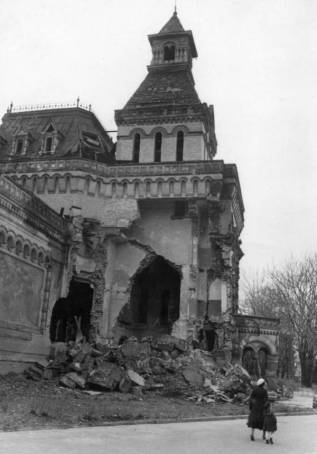
Scene from Leningrad after seige.

Joseph Brodsky was born in St. Petersburg, what was then Leningrad, in 1940. He writes in the first, title essay of his book, about his generation in postwar Soviet Russia, how they were “somewhat spared” the full experience of what their country had become: a “drab hell, with a shabby materialist dogma and pathetic consumerist gropings.”

“We emerged from under the postwar rubble when the state was too busy patching its own skin and couldn’t look after us very well. We entered schools, and whatever elevated rubbish we were taught there, the suffering and poverty were visible all around. … The empty windows gaped at us like skulls’ orbits, and as little as we were, we sensed tragedy. … The amount of goods was very limited…. we didn’t develop a taste for possessions. Things that we could possess later were badly made and looked ugly. Somehow, we preferred ideas of things to things themselves….”

I can’t help comparing the cultural environment in which Brodsky came of age to that of the generation currently in their teens and twenties. When those young people in Leningrad were trying to survive the privations at every level of their being, they didn’t have the option of comforting themselves with marijuana or escaping to the metaverse. Their daily life didn’t include such diversions as shopping at the mall for the current fashions in jeans or phones. What they did have was books:

“If we made ethical choices, they were based not so much on immediate reality as on moral standards derived from fiction. We were avid readers and we fell into a dependence on what we read. Books, perhaps because of their formal element of finality, held us in their absolute power. Dickens was more real than Stalin or Beria. More than anything else, novels would affect our modes of behavior and conversations, and 90 percent of our conversations were about novels. It tended to become a vicious circle, but we didn’t want to break it.

“In its ethics, this generation was among the most bookish in the history of Russia, and thank God for that. A relationship could have been broken for good over a preference for Hemingway over Faulkner; the hierarchy in that pantheon was our real Central Committee. It started as an ordinary accumulation of knowledge but soon became our most important occupation, to which everything could be sacrificed. Books became the first and only reality, whereas reality itself was regarded as either nonsense or nuisance. Compared to others, we were ostensibly flunking or faking our lives. But come to think of it, existence which ignores the standards professed in literature is inferior and unworthy of effort. So we thought, and I think we were right.”

-Joseph Brodsky, Less Than One

This passage gives me a clue as to a question I’ve had about Brodsky: How, born a Jew and growing up under atheist Communism, did he come to be a “Christian poet”? Not only does he say (quoted in a previous post about him) that he tries to be a Christian, but Wikipedia tells us:

Daniel Murphy, in his seminal text Christianity and Modern European Literature, includes Brodsky among the most influential Christian poets of the 20th century, along with T. S. Eliot, Osip Mandelstam, Anna Akhmatova (Brodsky’s mentor for a time), and W. H. Auden (who sponsored Brodsky’s cause in the United States). Irene Steckler was the first to categorically state that Brodsky was “unquestionably a Christian poet”.

What the writer tells us about this education he and his friends got for themselves shows the power of the vicarious experience that can be had from reading good stories. The best books helped them to endure  the “nonsense or nuisance” of totalitarian society, and at the same time gave them a broad, universal understanding of Reality. What a blessed bookishness; as Brodsky says, Thank God for that.