 As soon as I got inspired by the 5×5 reading plan that I mentioned in my last post, I collected most of the books from around my two-storey house that were in stacks and not on shelves, and spread them on the dining table. I started to arrange the appropriate ones according to topics, and the two categories of “Women” and “Church History/Saints” were quite overloaded.
As I perused this scene, I recalled that in the last few years, many books I’ve read have been by audio — and few of those on the table were of the sort that are easy for me to attend to, by the “ear gate.” I wondered, “When will I sit and read all these books, most of which are too big to read in bed at night?” Quickly my mood also went into the Overloaded/Overwhelmed category and I climbed the stairs to bed.
Soon I decided the 5×5 plan is not for me. Clearly it wasn’t designed for me, but for young homeschooling mothers who need to read more books and look less at screens, who need to develop the habit of lifelong learning. I picked out several — not 25 — that I want to try extra hard to read in print this year.
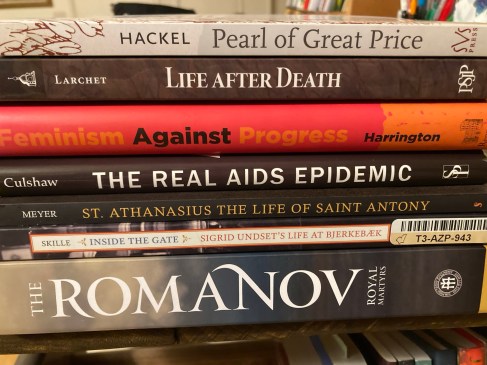
Hmm… I almost forgot these I want to read after that first bunch. Altogether I see that they add up to about half of 25:
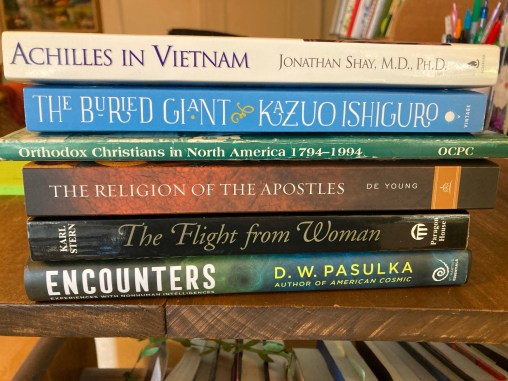
My two long-time friends Cori and Di came to visit for a couple of days last week, and because I planned for us to eat at the smaller table near the kitchen, I left my book mess as it was. They each brought dozens of titles for show-and-tell, give-or-lend. The warmth of the wood stove drew us to the nearby love seats, where we talked about all the volumes they brought out of their bags, a broad variety of genres and titles that would make the Scholé Sisters proud.
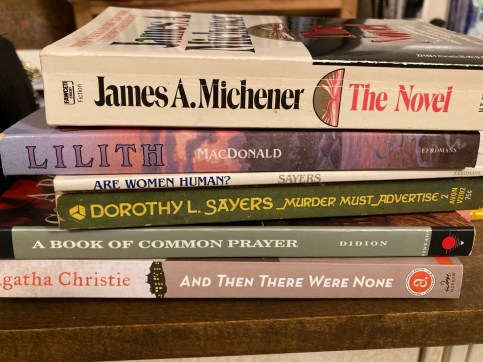
Many of Di’s offerings had Cori in mind, because she and her husband had lost their extensive library when their house burned down, in one of the many northern California fires of recent years. The only books I kept from this trading session were small paperbacks that I can easily read lying in bed, while my mind is turning off just before conking out for the night.
Our gathering was a festival, and a marathon
of talking and thinking, laughing and even weeping.
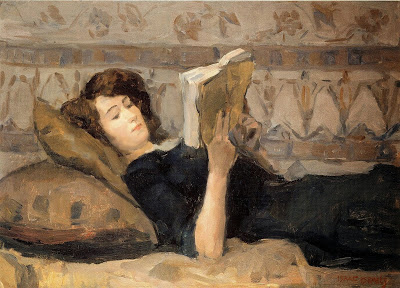
Now, it’s time for the reading to begin.

 Gladsome Lights