At this season of Thanksgiving as a holiday, it seems good to consider thanksgiving as a way of life, even a way to Life. First, D. Martyn Lloyd-Jones brings up a good point about the Garden of Eden:
“. . . The terrible fallacy of the last hundred years has been to think that all man’s troubles are due to his environment, and that to change the man you have nothing to do but change his environment. That is a tragic fallacy. It overlooks the fact that it was in Paradise that man fell. . . .”
—D. Martyn Lloyd-Jones, Studies in the Sermon on the Mount (1971)
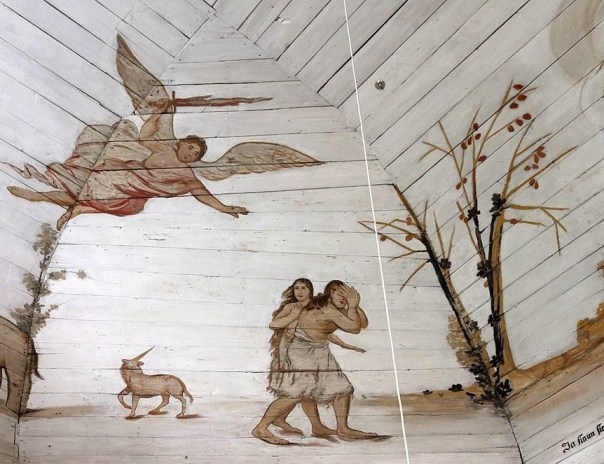
Fr. Alexander Schmemann also mentions that garden:
“In the story of the Garden this took place in the cool of the day: that is, at night. And Adam, when he left the Garden where life was to have been eucharistic — an offering of the world in thanksgiving to God — Adam led the whole world, as it were, into darkness. In one of the beautiful pieces of Byzantine hymnology Adam is pictured sitting outside, facing Paradise, weeping. It is the figure of man himself.”
But that sad picture is not the end. The Son of God became incarnate, and Jesus Christ is the New Adam. He has fulfilled all that the first Adam failed to do, and now in the Divine Liturgy we can:
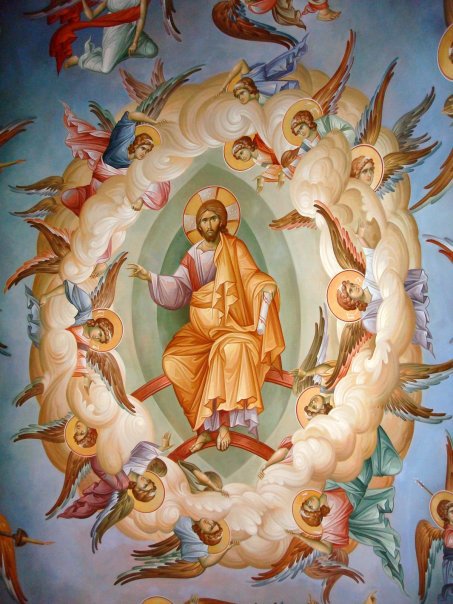
“…ascend to heaven in Christ to see and to understand the creation in its real being as glorification of God, as that response to divine love in which alone creation becomes what God wants it to be: thanksgiving, eucharist, adoration. It is here — in the heavenly dimension of the Church, with ‘thousands of Archangels and myriads of Angels, with the Cherubim and Seraphim … who soar aloft, borne on their pinions …’ — that we can finally ‘express ourself,’ and this expression is: Holy, Holy, Holy, Lord of Sabaoth. Heaven and earth are full of Thy glory. Hosanna in the highest. Blessed is He that cometh in the Name of the Lord. This is the ultimate purpose of all that exists, the end, the goal and the fulfillment, because this is the beginning, the principle of Creation.”
“In thanksgiving we recognize and confess above all the divine source and the divine calling of our life. The prayer of thanksgiving affirms that God brought us from nonexistence into being, which means that he created us as partakers of Being, i.e., not just something that comes from him, but something permeated by his presence, light, wisdom, love – by what Orthodox theology, following St. Gregory Palamas,  calls the divine energies and which makes the world called to and capable of transfiguration into a ‘new heaven and a new earth,’ and the ruler of creation, man, called to and capable of theosis, ‘partaking of the divine nature.’”
-Fr. Alexander Schmemann
These three quotes from Fr. Alexander are from the book, For the Life of the World, an incredibly rich and deep explanation of Orthodox Christian theology. Our women’s book group and sisterhood at church are reading it right now during our Nativity fast, and I discovered that it can be found on YouTube being read in its entirety. You can listen for free here on the channel The Orthodox Voice: For the Life of the World.
If you want to read for free instead, a pdf file is here: For the Life of the World
“In everything give thanks, for this is the will of God.”
I Thessalonians 5:18
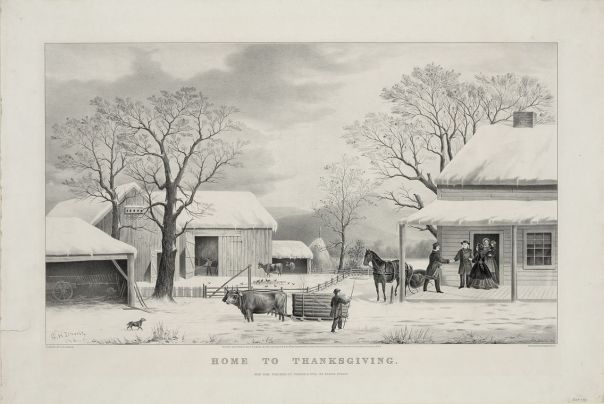
Getting back to thanksgiving as a holiday, this year I’ll be giving thanks and praise with the angels in the morning in Liturgy, and in the afternoon feasting in the traditional American way. Whether your celebration is small and quiet, or large and festive, I hope you remember much to be thankful for ❤
HAPPY THANKSGIVING!


 Gladsome Lights