Tag Archives: tomatoes

Koulourakia and Colors

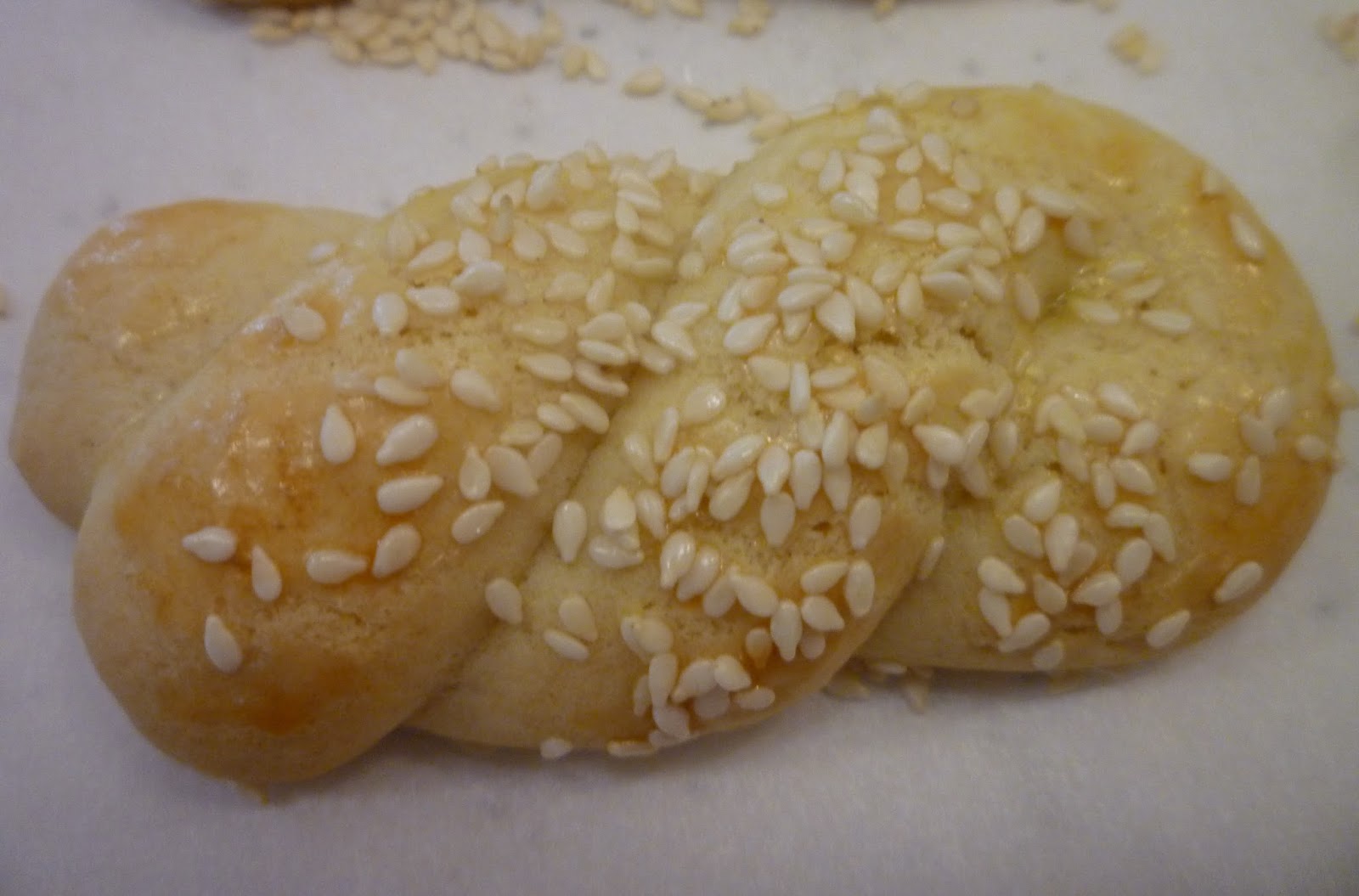
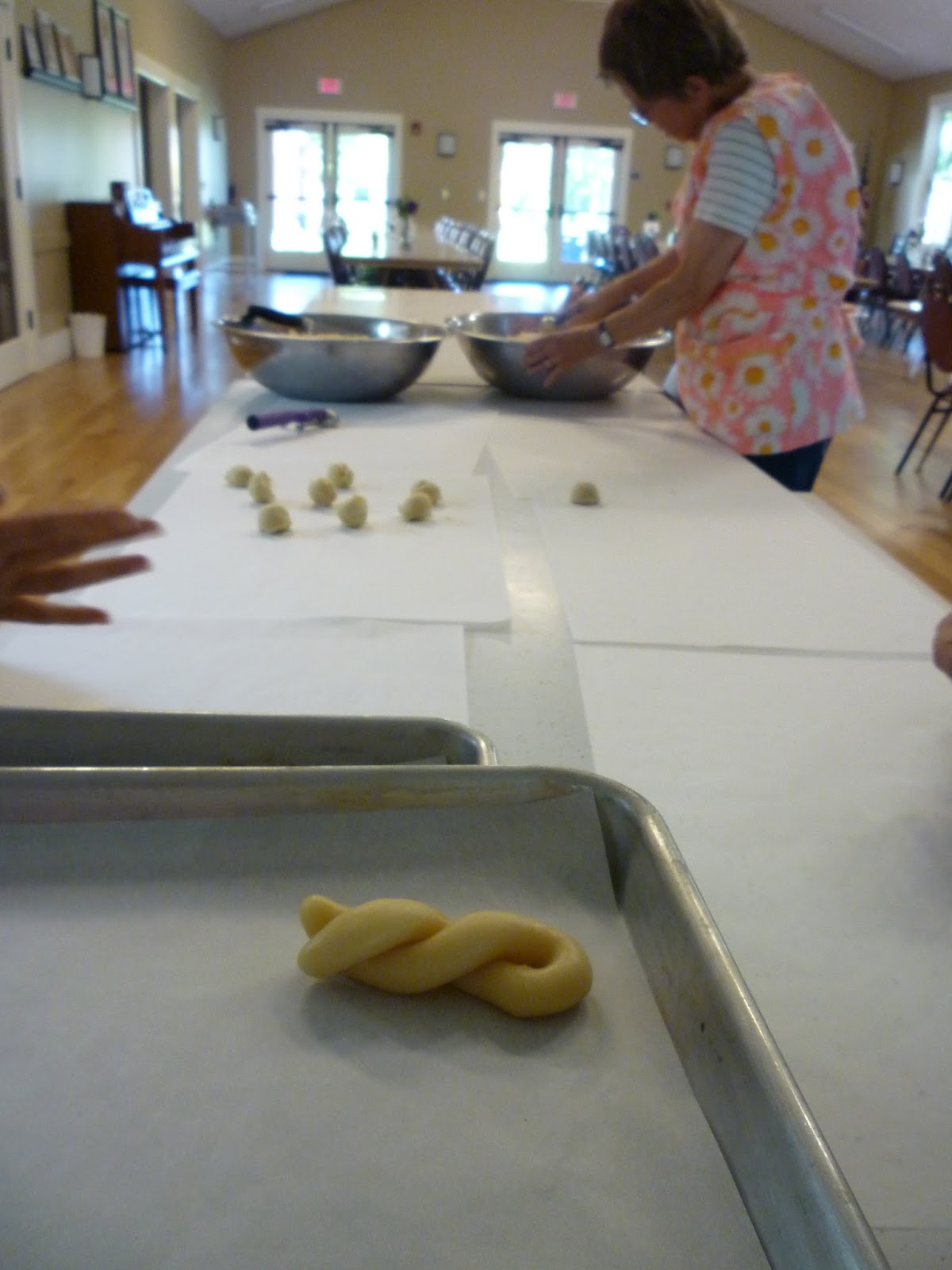
first twist

At church again, this time for baking cookies for that upcoming festival. We made koulourakia, which most of us bakers can’t pronounce, so we call them “the twisty Greek cookies.”

The dough, made with seven pounds of butter, had been prepared last night and stored in the fridge. We scooped it out with melon-ballers and rolled the balls into ropes.

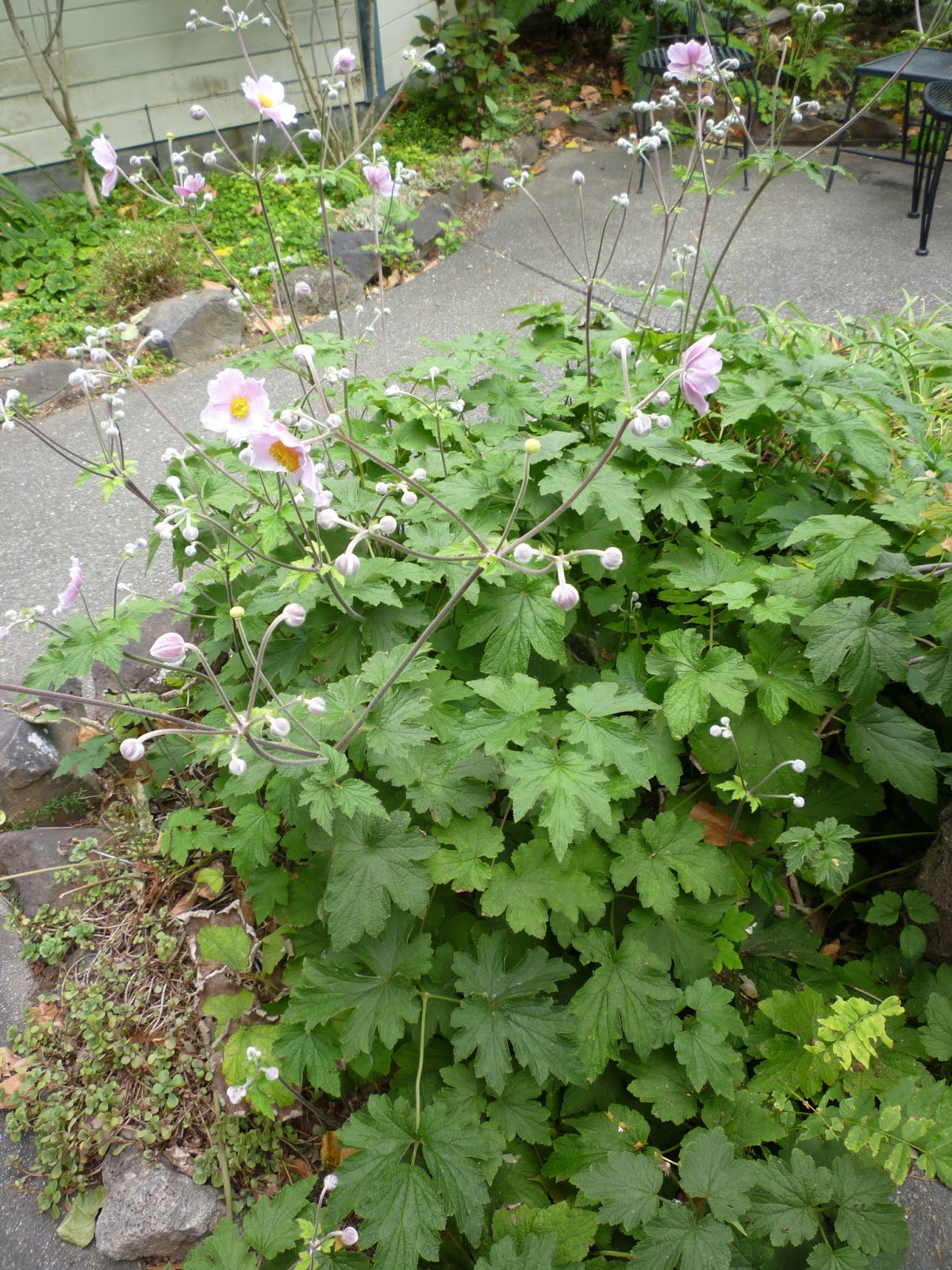
Japanese anemone

And outside I caught this graceful and lovely flower in bud and bloom. I haven’t looked it up yet to find out what it is….though I might have known in the past. Do you recognize it? (update: Jo tells me in the comments it is a Japanese anemone.)

GJ twisting

After being twisted, the cookies get an egg wash and then a sprinkling of sesame seeds. They are basically a butter cookie, and though some recipes include orange juice and/or zest, our current version is “plain.” But I came home with my hands smelling anything but plain.

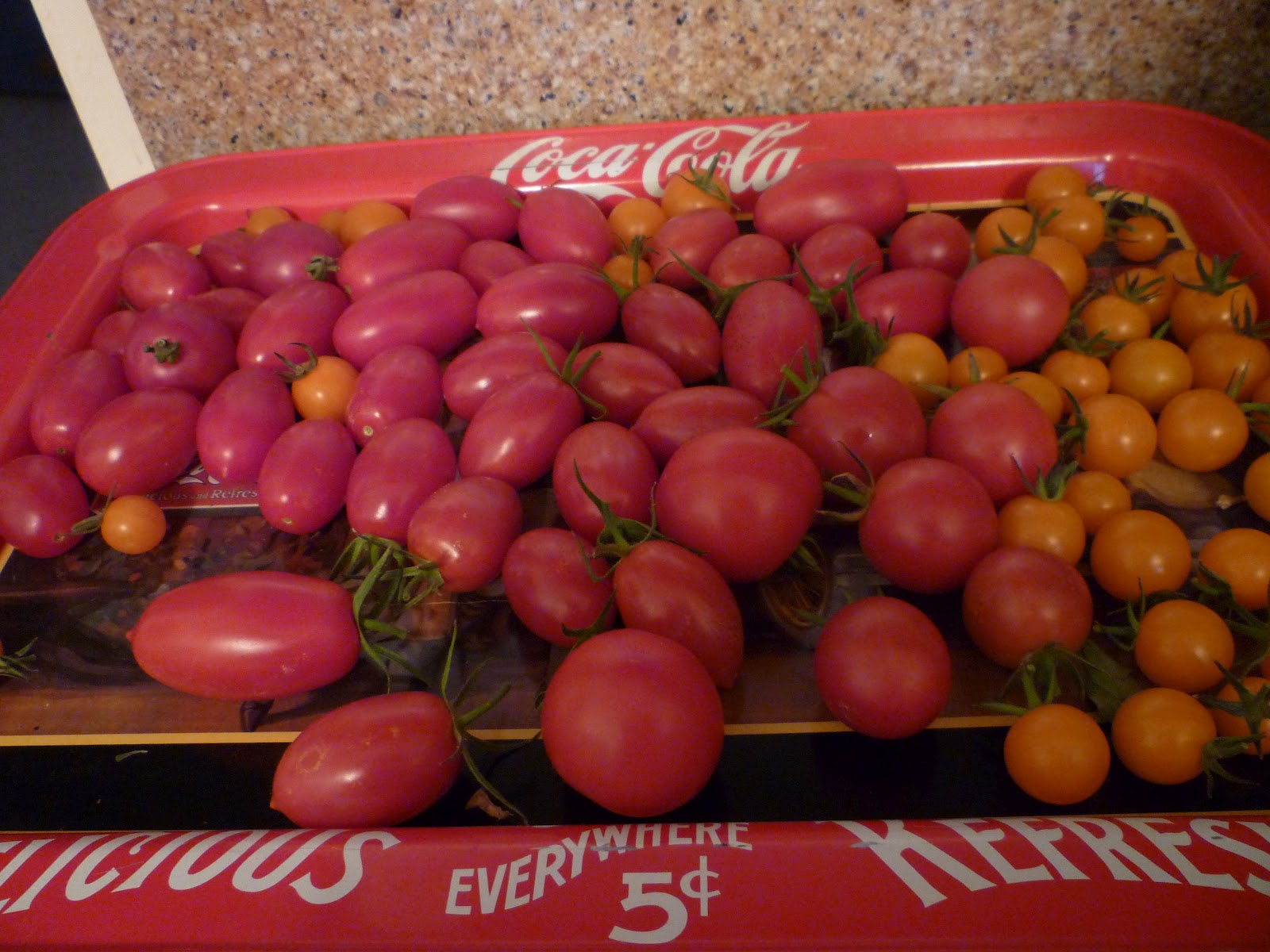
In our back yard now we have three cherry-sort of tomatoes: Juliet (red); Sun Gold and Sunsugar (orange); and Michael Pollan (pointy green striped). So I can put them all in a salad to colorize it! Not to mention, this year I have three colors of nasturtiums, red, orange and yellow — so I put all those petals in my salad as well. That’s a visual feast as well as a feast for the palate, as last night’s guest said.

In case you can’t see all three tomatoes, here is a close-up:

Today the thermometer reached 75° – woohoo –
so we hope we are in a warming trend.

Esthetics and Agriculture


We made at least two wrong turns getting to the mountains last month, and they helped put me in touch with my farming roots. In the middle of August the fields are lush with the bounty that gives California’s Central Valley the name of The Greatest Garden in the World. Tomatoes, corn, cotton, walnuts, tree fruits, grapes… Wikipedia says that every non-tropical crop is grown here.
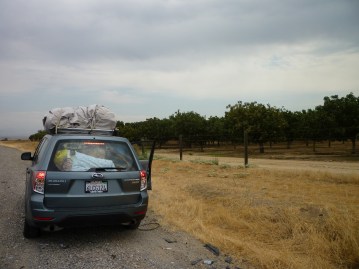
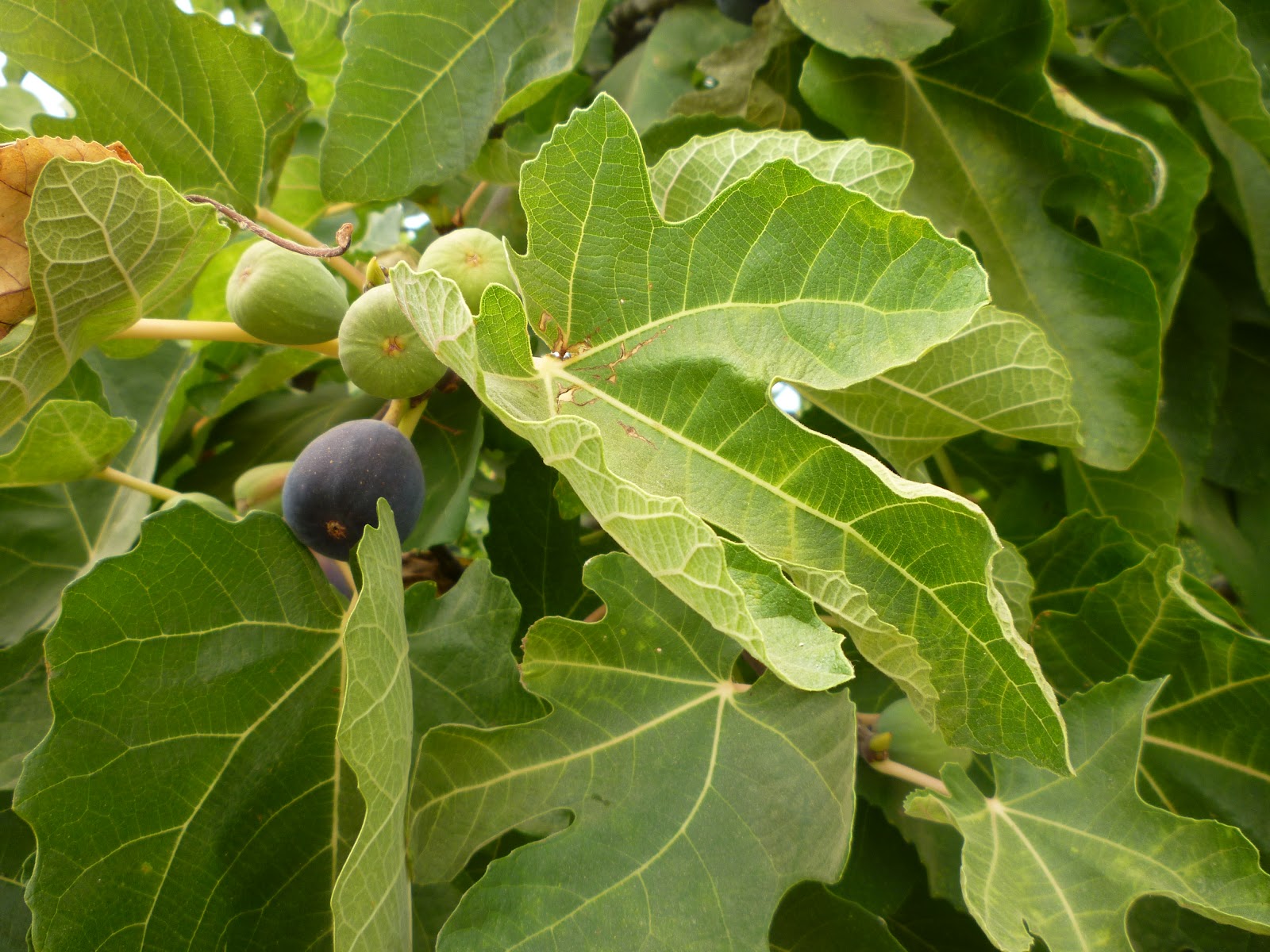
On our second meander, in the northeasterly instead of southeasterly direction, we were surprised to see fig orchards on one side and pomegranates on the other. What could be more exotic or impossible? William Saroyan describes the impossibility in his 1930’s story “The Pomegranate Trees” that Mr. Glad and I have laughed over a few times:


“My uncle Melik was just the worst farmer that ever lived. He was too imaginative and poetic for his own good. What he wanted was beauty. He wanted to plant it and see it grow. I myself planted over one hundred pomegranate trees for my uncle one year back there in the good old days of poetry and youth in the world. I drove a John Deere tractor too, and so did my uncle. It was all pure esthetics, not agriculture. My uncle just liked the idea of planting trees and watching them grow.

“Only they wouldn’t grow. It was on account of the soil. The soil was desert soil. It was dry. My uncle waved at the six hundred and eighty acres of desert he had bought and he said in the most poetic Armenian anybody ever heard, Here in this awful desolation a garden shall flower, fountains of cold water shall bubble out of the earth, and all things of beauty shall come into being.”

Melik plans to have apricots, peaches, figs and olives too, but he never gets beyond planting the pomegranates, which eventually fail, because instead of a fountain there is only a trickle of water flowing from the many wells he digs.
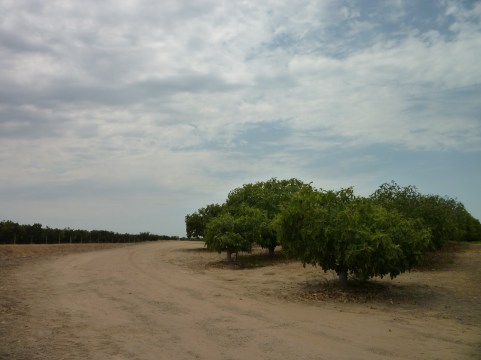
Fig orchard in Madera Co.

But since the 1930’s, state-funded irrigation projects have increased the available farmland to such a degree that in the present day about one-sixth of the irrigated land in the nation is in our Central Valley. The pomegranate trees we saw with their ripening red fruits were not far from where the fictional Uncle Melik farmed.

I do think there is nothing more lovely than a fig tree with its extravagant leaves on curvy branches, and fruits more refreshing than a cup of cold water. Though I grew up in the Valley this was my first sighting of a groveful. I didn’t notice what kind of irrigation system is used in the orchard, but no doubt there was one.
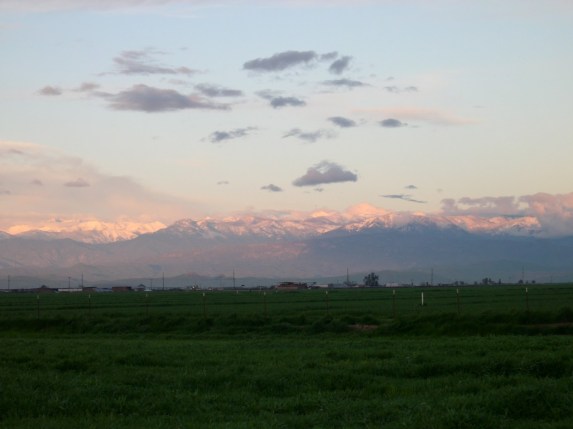
View of Sierras from Tulare County (Pippin pic)

By means of our state water projects we take all that melted mountain snow pack and hold it behind dams so that we can let it out bit-by-bit all through the summer. In this long agricultural center of the state, on less than one percent of the total farmland in the United States, we produce 8% of the nation’s agricultural output by value. (Wikipedia)
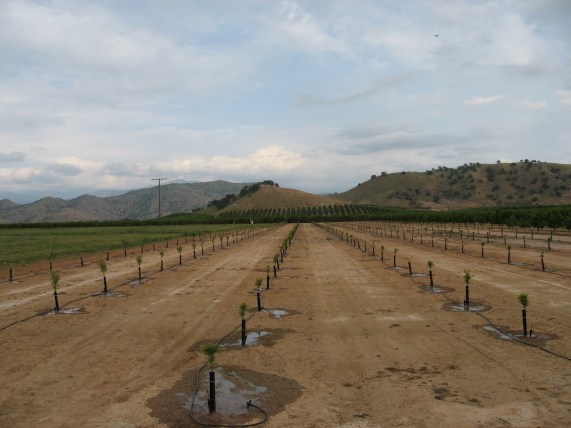
Tulare Co. in Spring – still green in places

I’ve been googling to find out how many dams are in California, but that list is too long for me to take the time to count. Maybe I’ll just stick to the ones in the Sierra Nevadas that end up feeding canals and rivers that water orange groves and almond orchards and alfalfa fields. It turns out that list above is sortable, and I can see that in Fresno County alone there are eleven dammed lakes.

When you drive across the state, from a dammed mountain lake to San Francisco Bay Area in one day, the repetition of scenes along the highway impresses on you the importance of water. There are dead almond orchards on Highway 5, on the “West Side” of the Valley, that testify to water wars still going on, and to our inability to grow very much without irrigation.

Westside tomato field in April

It was 101° as we headed home through that fertile swath. All the crops whose irrigation was current were happy. The corn was probably growing inches every day, and the almonds swelling in their shells. We were happy to look out from our car through the windows that were closed to keep in the cooled air.

A little north of the dead trees, on a slope above the freeway, a Hispanic family were systematically planting new almond trees. It dawned on me that Why, yes, it is a week day, a work day, isn’t it? Not all the farm work can be done in the cooler mornings or evenings.

I recalled my sweaty and tanned father getting off his tractor, coming into the house mid-afternoon with a watermelon and slicing it into rounds at the kitchen counter. He’d put one big slice on a plate and eat it with a fork before going back out to take care of his orange trees.

Water melon. Melons are some of those things of beauty that Uncle Melik likely envisioned as he was trying to find their necessary water. And the people who tend the earth’s gardens, who are willing to build the dams and plant the trees and irrigate them all summer long are beautiful to me, too.
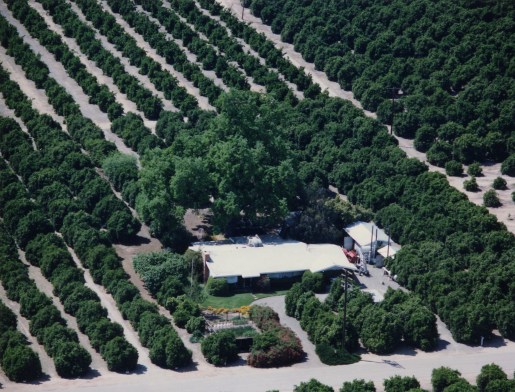
The house where my father ate watermelon.
Gardening requires lots of water – 
most of it in the form of perspiration. 

~Lou Erickson
Tomato Festival

Persimmon and Early Girl

With all the new varieties Mr. Glad and I are growing this summer, we can have our own Backyard Tomato Tasting Festival.

It’s the best tomato year in at least a decade, partly because we planted more vines, and maybe for some other reasons we are mulling over.

Trays and platters and bowls of tomatoes are crowding the kitchen counters and tables. Time to make soup or just freeze some after I peel and dice them — and take their pictures, of course.

Juliet, SunSugar, Northern Lights

There are some puzzling and disappointing results, like Czech Bush, which was billed by our nursery as being an “orange slicer,” but bears red fruits the size of a large cherry.

Ailsa Craig is in theory interesting, as Tatiana writes on her TOMATObase site, “…a variety of tomato that has been an experimental staple of tomato molecular biology and biotechnology. Originally Ailsa Craig, named for a small rocky island off the coast of England, was grown for greenhouse production of tomatoes in Great Britain. Apparently this crop is particularly important for English breakfasts.”

None of the English or Scottish breakfasts I knew featured tomatoes that small. One seed site predicted 1.5-oz. fruits, another “medium” size, and another 70-90 gm. for Ailsa Craig. I must have read the “medium” word last spring, but now that heirloom tomatoes are so popular, in the future I will do more research, as on Tatiana’s site, and have fewer surprises. And I know now that I want my slicers to be a minimum of 8 oz.

Northern Lights is a pinkish tomato that we expected to be “smallish,” but it was a local news columnist’s “favorite red tomato! Very productive….” The flavor is truly fantastic, but again, they are too small to slice, and too large to pop into the mouth like a cherry tomato — and anyway, we have plenty of cherry tomatoes.

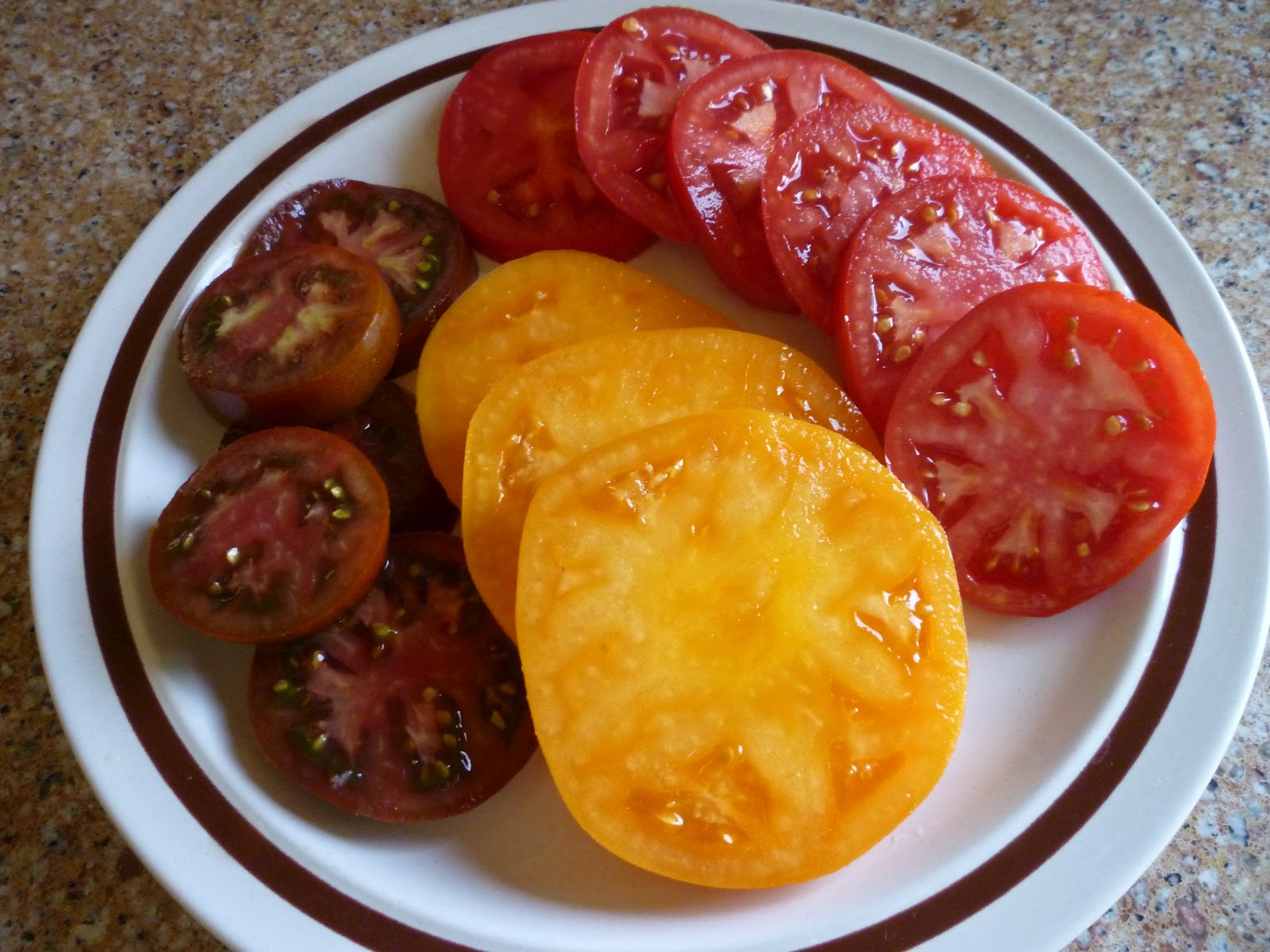
The Brazilian Beauty fruits aren’t large, but the plant is loaded with fruit. I like the unusual flavor, often called “smoky,” and I would like to plant them again, but I’m not sure my husband would go for it. I like having a “black” tomato, and these are nicely shaped and look good arranged on a plate with other varieties.

Brazilian Beauty, Persimmon, and Early Girl

Isn’t that Persimmon gorgeous? It tastes divine, too. I think we will always plant Persimmon tomatoes if we can get them. (In the old days it was Jubilees we adored for orange tomatoes.)

Our one Early Girl plant continues to amaze us – the many fruits are running 8 oz. or more, and are perfect smooth globes with great flavor. The local nursery’s special hybrid is a similarly big, productive and luscious specimen.

Yesterday we made grilled cheese and BLT sandwiches with orange, red and black tomatoes in them. I slice Juliets and Sunsugars in half and throw them into salads, and grab a few as I’m walking past throughout the day.

September is often our biggest tomato month. Even as the nights are getting chillier, and apples are coming on, we are surrounded by these lavish gifts of Summer.

Love and Hate in the Garden


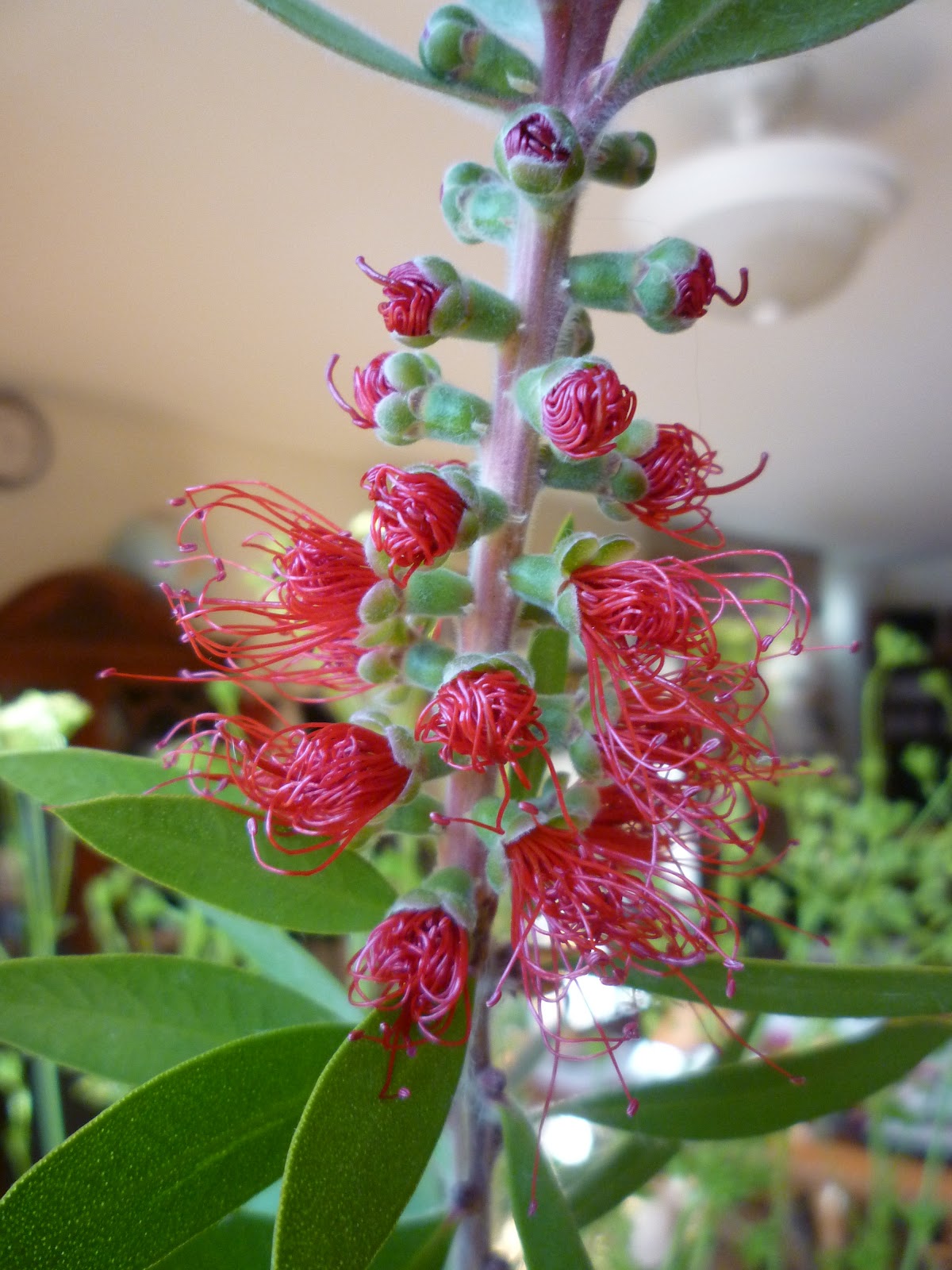
We thought we had cut the bottlebrush shrub down for good, but it was soon evident that he took it as a pruning for more vigor. That was a long time ago. Ever since this Callistemon showed us who is boss we have liked him even less, and try not to look at him except for about twice a year when we hack away at his skyrocketing branches to let more sun shine on our nearby vegetables.

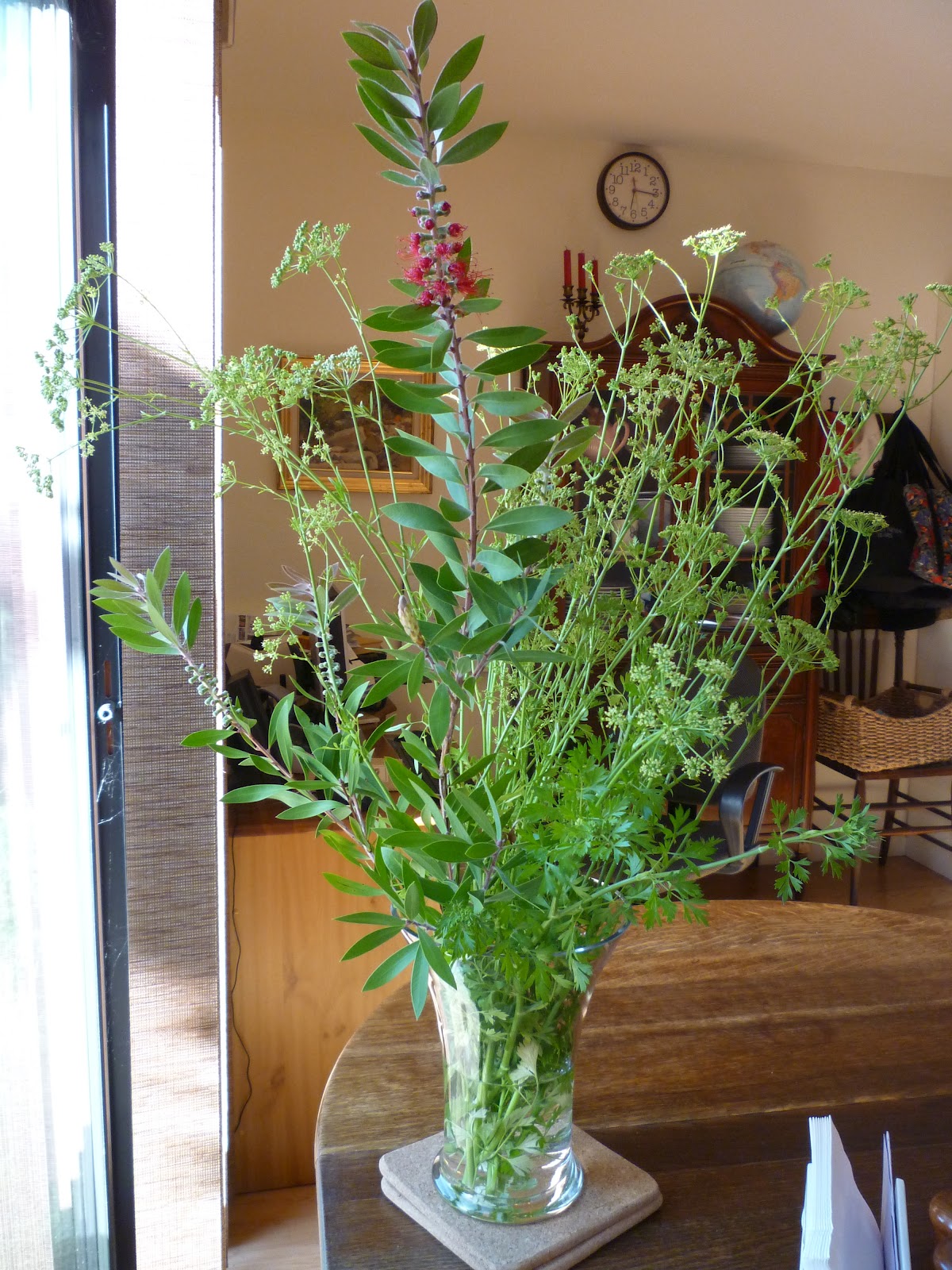
We were doing that yesterday when I noticed the lone first flower of the season, barely opening, and it didn’t seem so brash and domineering when in a tender phase. I let him into the house.

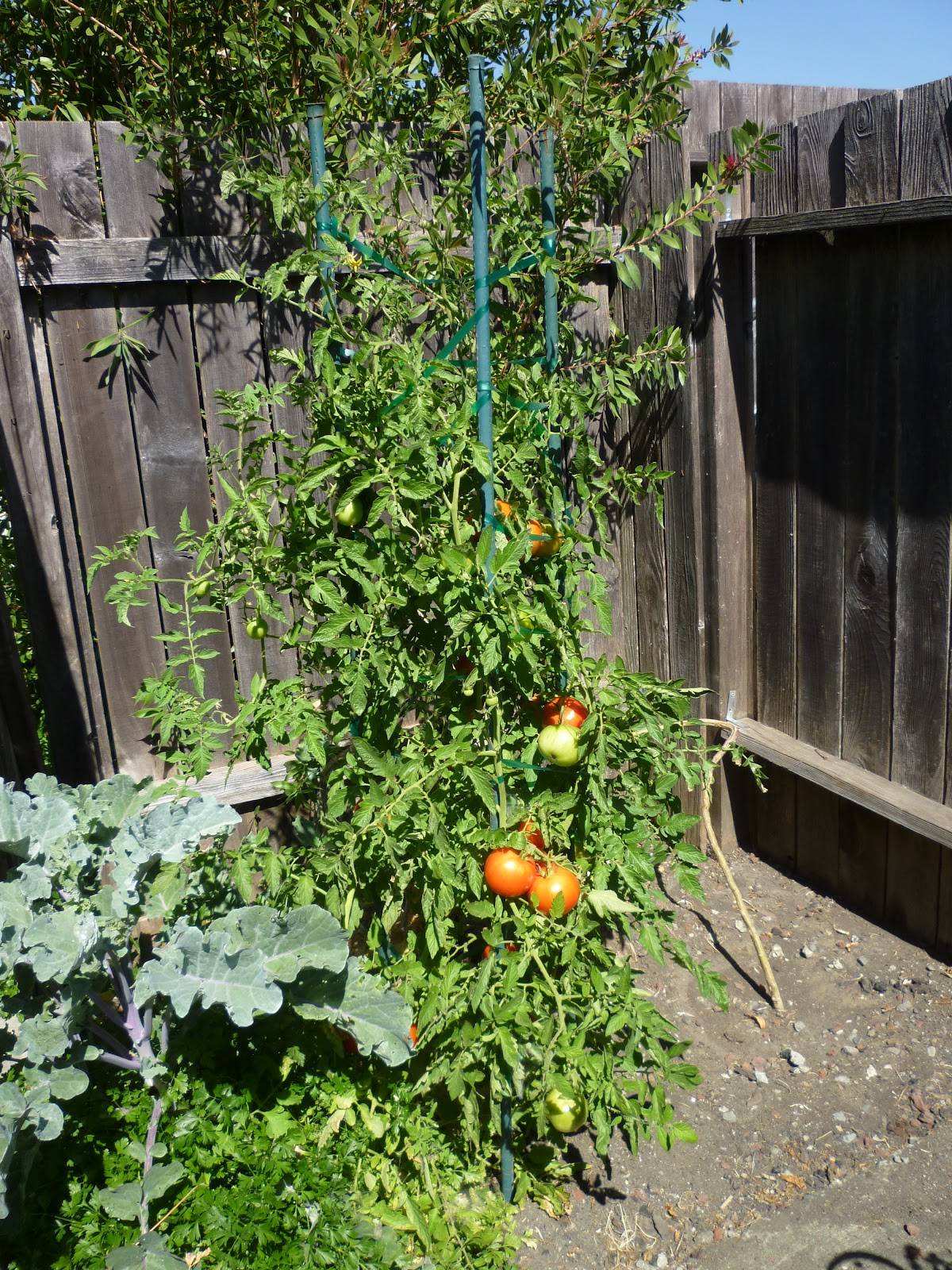
On the left is a photo of the amazing Early Girl tomato vine. My husband wanted to plant anything but Early Girls this year, because after 30 years of being The Best and most famous of our tomatoes, superior in every way, they were disappointing for five years in a row.

I begged to plant just one Early Girl, and she has turned out to be the largest of our ten tomato bushes, with the biggest and most perfect fruits, and the consistently wonderful flavor we expect. She did not want to be cast off, so she tried really hard this time – that seems the obvious message. I will never again even think of forsaking her.

In the tomato photo you can also see the tree collard emerging from the ground like a dowel on the right side of the staked vine, and leafing out on the left side.

It’s great, in theory, to have a perennial leafy green vegetable always ready for the picking, but our garden is simply not big enough to accommodate such a meandering type. I don’t think I had ever harvested one leaf, and he was suffering an aphid infestation again, so I removed Mr. Tree Collard. Above right you can see him before he went into the yard waste bin.

This is the Summer of Parsley. I like to let parsley go to seed and sow itself where it will, and in the spring there were lots of little seedlings which I stuck in here and there. They’ve now formed thick hedgerows in some places, I’ve got plenty to cook with, and new seed heads are starting to hang across the sidewalk.

That’s not convenient, so I put those pretty sprigs into a vase with the budding bottlebrush. The parsley had been growing right under the shrub, so they weren’t complete strangers. To all appearances they are getting along, and each has something to contribute to a relationship that is proving to be a boon to the household.