Tag Archives: trees

Maui Diary 4 – Bright Trees and Critters

Hibiscus looks nice against volcanic rock.

For most of my life, the image that came to my mind when someone mentioned Hawaii was of beaches, and volcanoes spewing lava into the ocean. Ten years ago or so a friend visited the islands and told me about the beautiful flowers, and at that point I began to be interested.

Reading The Folding Cliffs, about the history of Kauai in a setting that highlighted the lush landscape, took my imagination further along, to the point where I was willing and interested to visit.

bougainvillea bush

If our stay on Maui had a focus, I would say it was the ocean, based on the amount of time spent, but with the flowers blooming everywhere I turned my head, I came away with my visual sense more than satisfied in that department — it was more than I could take in.

Right out our back door there were spider lilies and red ginger, and multi-colored bougainvillea trained into shrubs. Along the roads hedges of hibiscus or bougainvillea or even more extravagant flowers let us know we were in the tropics.

African Tulip Tree

The writer of the plant guide we took to Maui was clearly biased against species that were not native, or that at least had been brought from other Polynesian islands long ago, but I admit to liking many of those plants very much. The African Tulip Tree makes lovely splashes of orange against the green landscape, and it at least doesn’t seem to have spread into the weed category yet.

Bougainvillea along roadway

We’d heard reports of wild chickens being found all over Maui, and we were happy to see a lot of them on beaches, along streets, most anywhere. And other beasts who had no doubt escaped from households and barnyards generations ago.

On the drive to Hana we ate our lunch at a wayside park where a green lawn ran up the hill to a tall and thick forest — or perhaps on that rainy stretch it would be called a jungle. I spotted chickens with shiny feathers up there, and walked up to try getting a picture. It was not to be: the closest bird disappeared behind some vines, I followed as quietly as I could and peeked under the trees, to see a couple of cats lounging there with the chickens. It was just a glimpse, and then the whole inter-species family was gone from sight.

Where I saw cats and chickens

This cat sat patiently under our table while we were picnicking, and waited for us to drop a bite of sandwich. And at Honolua Bay a bright rooster in the middle of the jungle path was engrossed in pecking the meat out of a broken coconut. Many times we saw road signs warning of the approach of a pig or nene crossing. Nenes are the type of goose that is the state bird of Hawaii.

Feral chickens in Iao Valley
Common Myna

We were on the island for several days before we discovered that the perky bird we saw everywhere is the Common Myna, native to Asia but living all over the world. On a list of the 100 Most Invasive Species, there are only three birds, and the Myna is one of them. Found this picture on the Internet.

My favorite animal sighting was in the Upcountry where there are farms and ranches with jacaranda trees catching your eye with their purple flowers. We drove past a large pasture with a herd of dark cattle grazing on the green, and as many white birds as steers walking around chummily in their midst. I assume that they are what has been sensibly named the Cattle Egret.

picking mangoes

It seems that a lot of trees bearing flowers or fruits are so tall that it takes some trouble to harvest the crop. I asked the rosette-pinning woman (whom I tell about further down) if pickers use ladders to get the flowers from those tall plumeria trees, and she replied that they “mostly climb” to fetch them. Walking around Lahaina, we saw a man picking mangoes with a long pole contraption, and it’s certain one would need a ladder or good tree-climbing skills to get papayas.

tiny plumeria tree at center


Plumeria! I’m in love with plumeria. I knew of leis, of course, and I’d heard that flower mentioned, but I had to go to Hawaii to see what a plumeria blossom looks like or get intoxicated by its scent. It was a surprise to find that these sweet flowers grow on trees.

I wish I had taken a dozen more pictures of plumeria trees. Many of the taller ones look at first glance as though they are some kind of dead thing, but then you notice the flowers at the tip of every smooth and bare branch.

We went to a luau where a girl in Hawaiian dress taught female guests how to stick plumeria flowers on to a toothpick to make a rosette, which she then fastened into our hair with a bobby pin.

When we had first arrived at the luau, I was given a tuberose, which I had been carrying around for a while, so I stuck that on to my toothpick as well, and while our taste buds enjoyed the traditional foods, my nose feasted on the rose and plumeria delicacies. I already have forgotten most of the food I ate, but the memory of my fragrant rosette lives on.

Big Sur


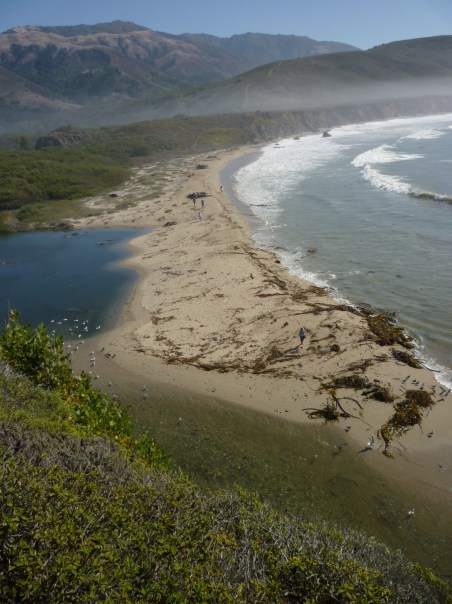
Mouth of Big Sur R. – Andrew Molera Park

Many years ago at the spot in this first photo, Mr. Glad and I watched a group of waterbirds playing. We were having a weekend at Big Sur to celebrate a wedding anniversary.

Here the Big Sur River flows into the Pacific Ocean on California’s central coast. On that day in March way back then, the birds would float down the riffles of the river, then fly back up to the jumping-in place and wait in line behind their fellows until their turn came; jump in, float down, fly back up, over and over. We watched them a long time, and they were still at it when we left.

This week we had made the trip to see family and friends. It was a very short visit, but we managed to take in aspects of both Andrew Molera State Park and Soberanes Canyon.

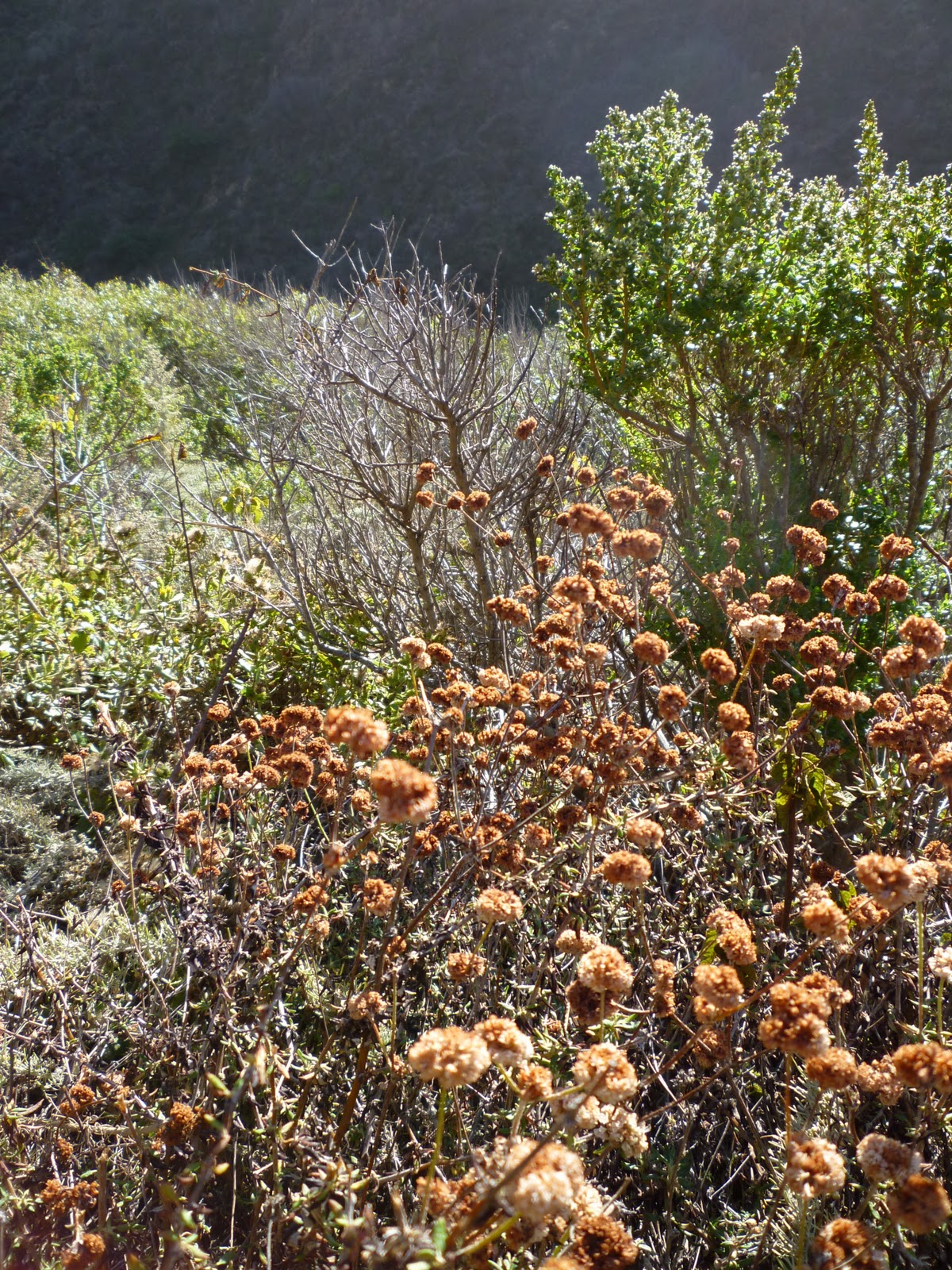
The Big Sur area features such a profusion of plant forms, not to mention the animal life that I mostly ignore, that it is easy to understand why so many people want to live there where the ocean and trees and flowers make a dramatic but not agitating backdrop for solitude.

Everywhere we went for three days, the air was thick with the aromas of a casserole of natural ingredients, seaweed and sagebrush, redwoods and damp soil, a thousand essential oils in microscopic droplets bombarding my senses and reminding me that I should get out into the woods and the fields more often just to inhale this kind of nourishment.

If I did live near Big Sur, I’d want to go regularly to Soberanes Canyon, where the plant forms overlap in an unlikely and seemingly chaotic way.
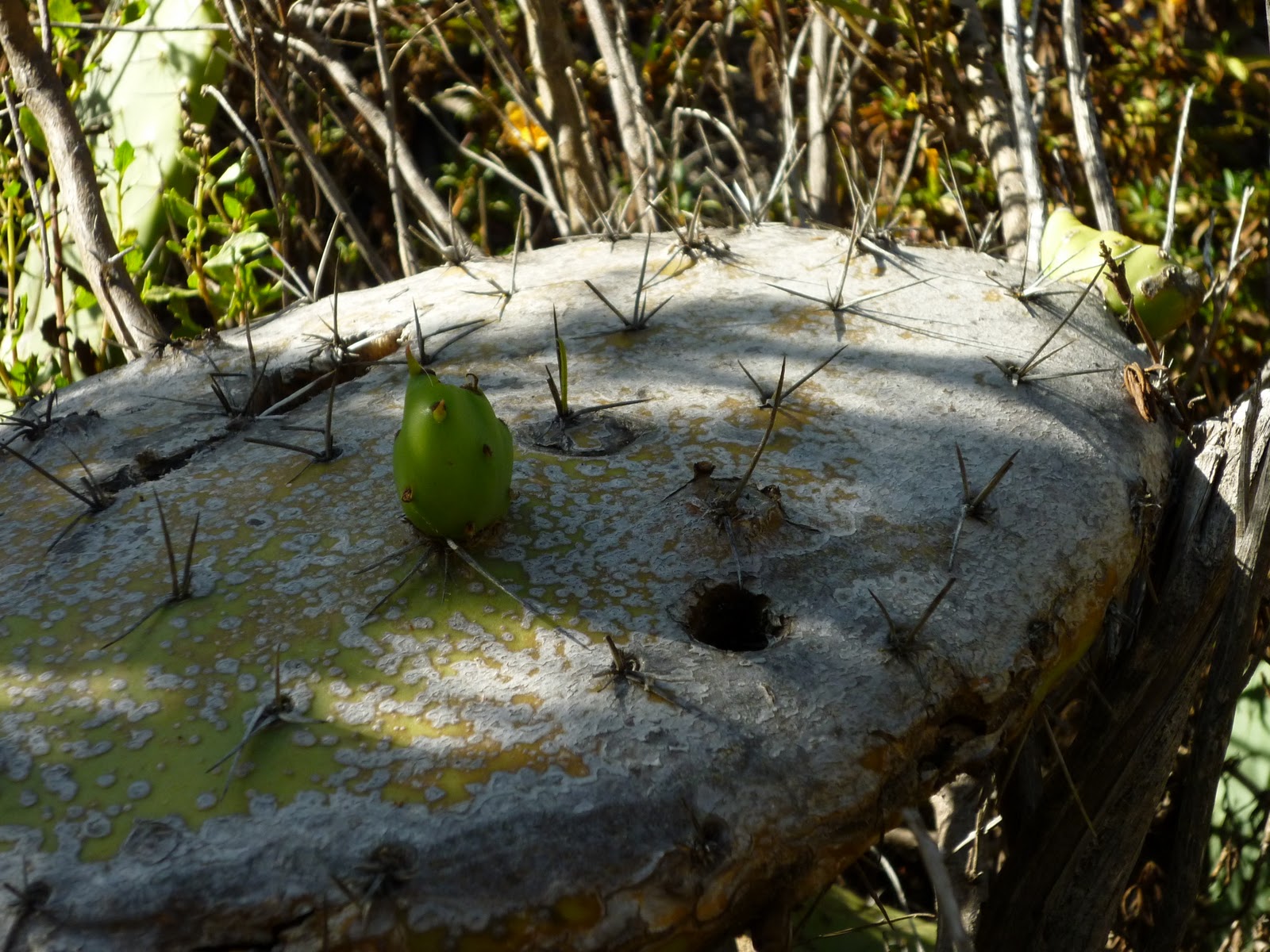
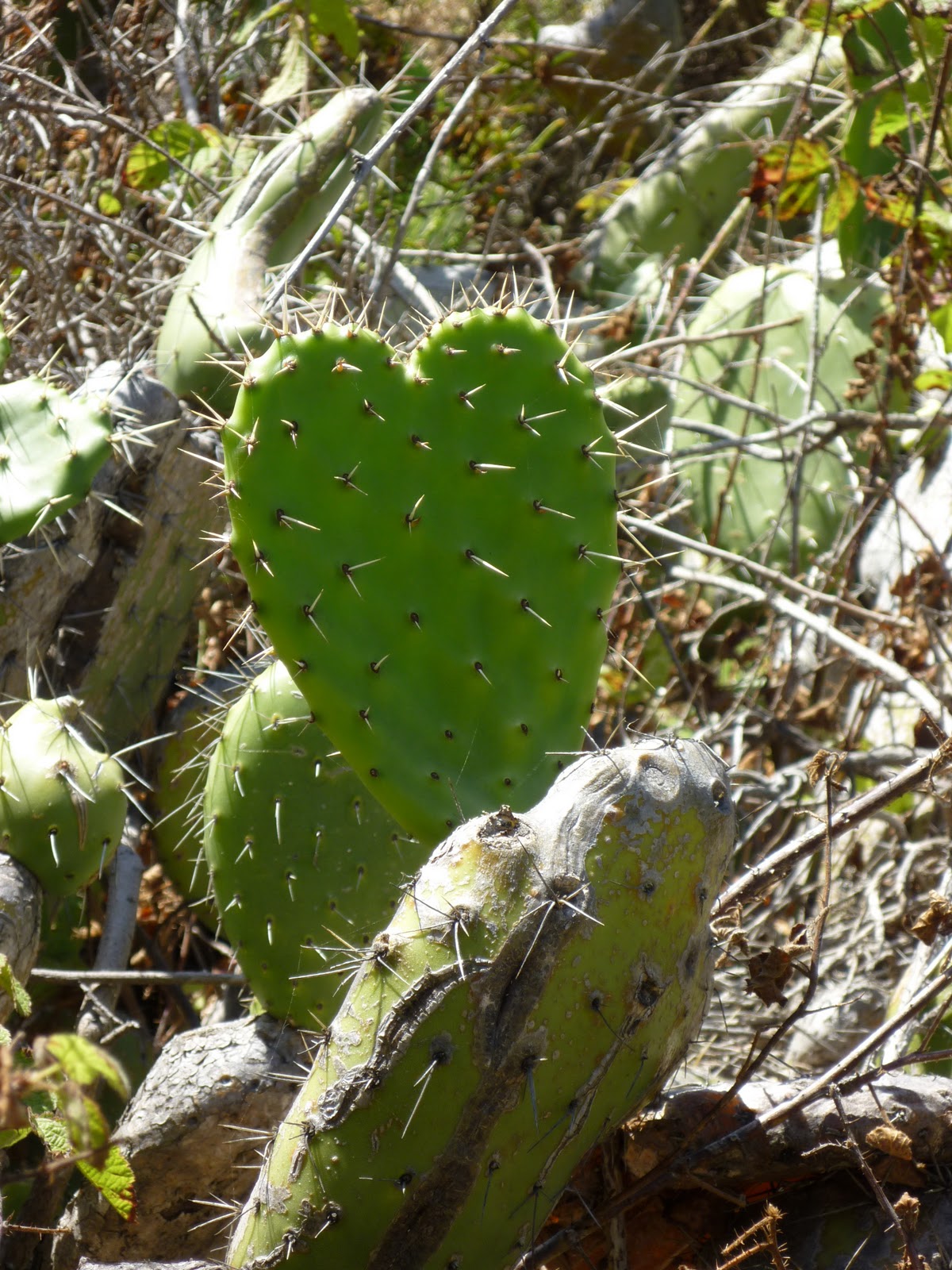
Old cactus with baby on Soberanes Canyon Trail

I’ve never before seen redwood sorrel and poison oak growing together, or ferns next to cactus. Those are the most surprising things that jumped out at me, but if I went every month or so along the same canyon trail, other wildflowers or shrubs might eventually get my attention with the changing seasons and blooms. Whether I saw a scene or a tiny part of it in mist or sunshine would also make a difference.
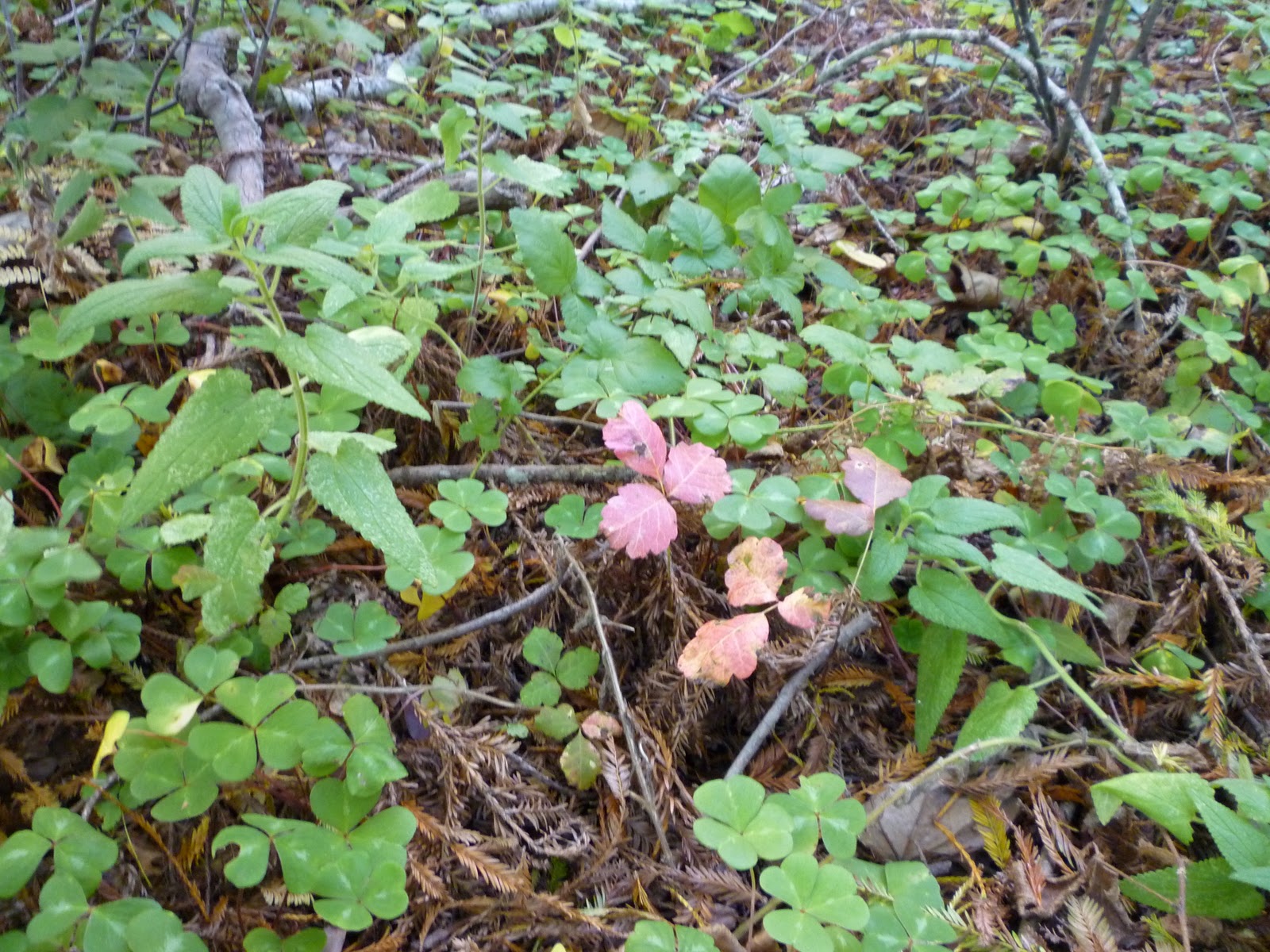
Redwood sorrel with poison oak and nettles

This is a coastal steppe zone, my guide and son told me. The cactus were old and weather-beaten, some of their trunks resembling thick board platforms, but still producing new and fresh green sprouts.
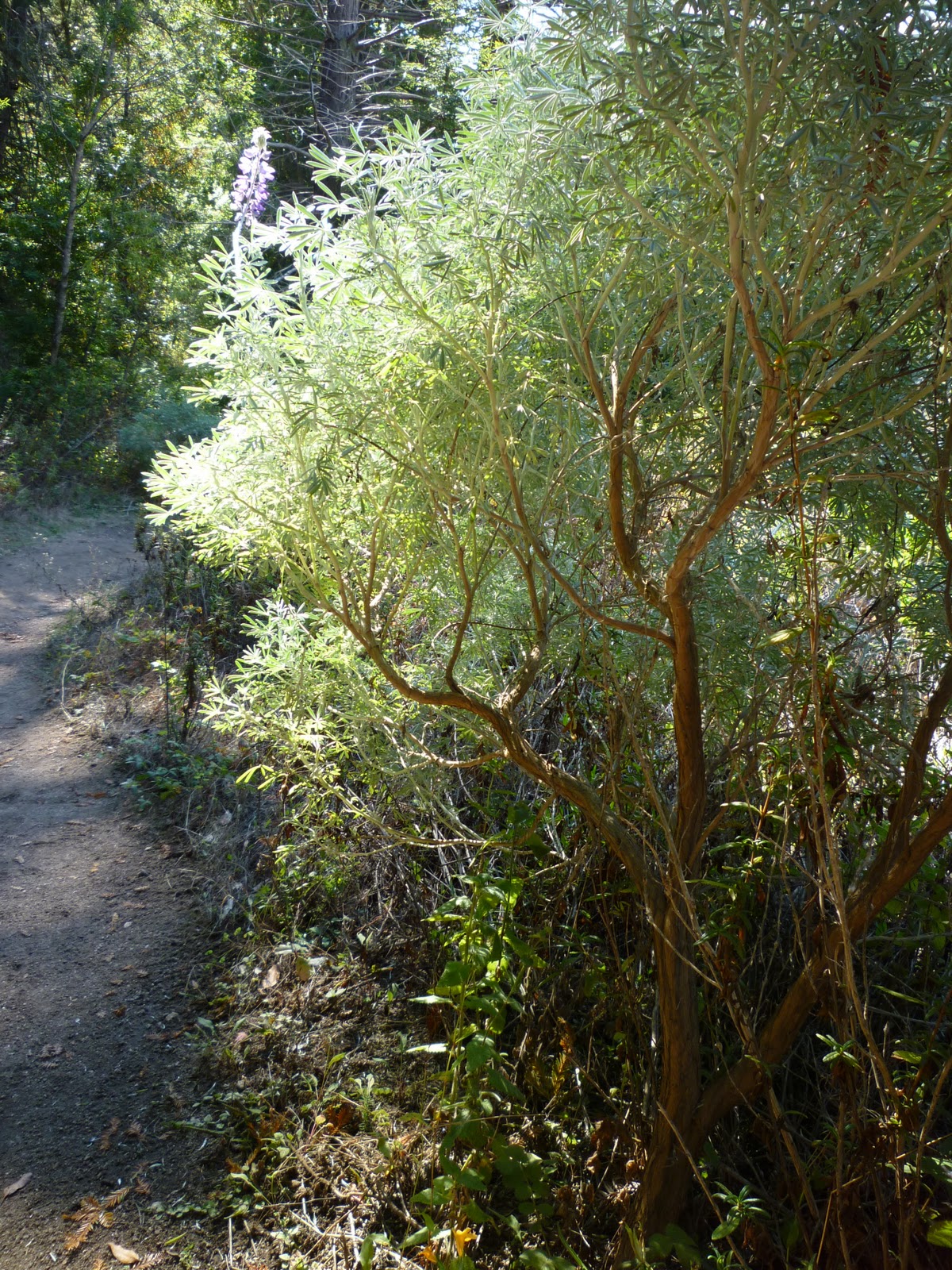
one of the smaller lupines

Venerable lupine “trees” five feet across stood alongside the trail, with trunks four inches in diameter, still blooming mid-October.

Only a couple of minutes up from Highway 1, the trail takes you through dry hills with spreads of cactus all around. We got hot and sweaty pretty quickly, as it was mid-afternoon on what was probably the hottest fall day, but we didn’t grumble, being quite glad that the usual fog wasn’t dampening our spirits.
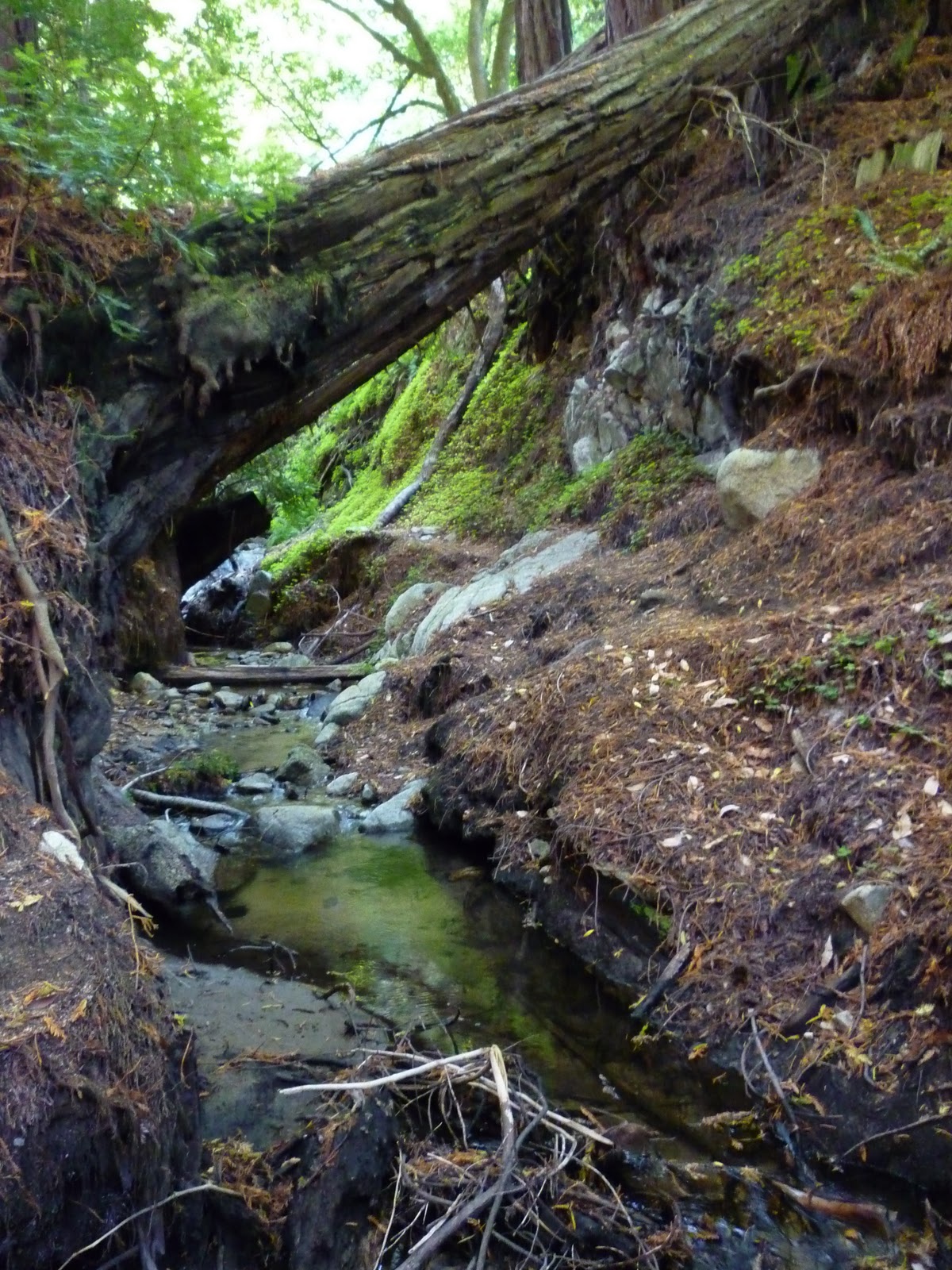
Soberanes Creek

Before we knew it, we were descending to the creek, stands of tall, thick redwoods and carpets of sorrel, and after twenty paces the temperature had dropped ten degrees.
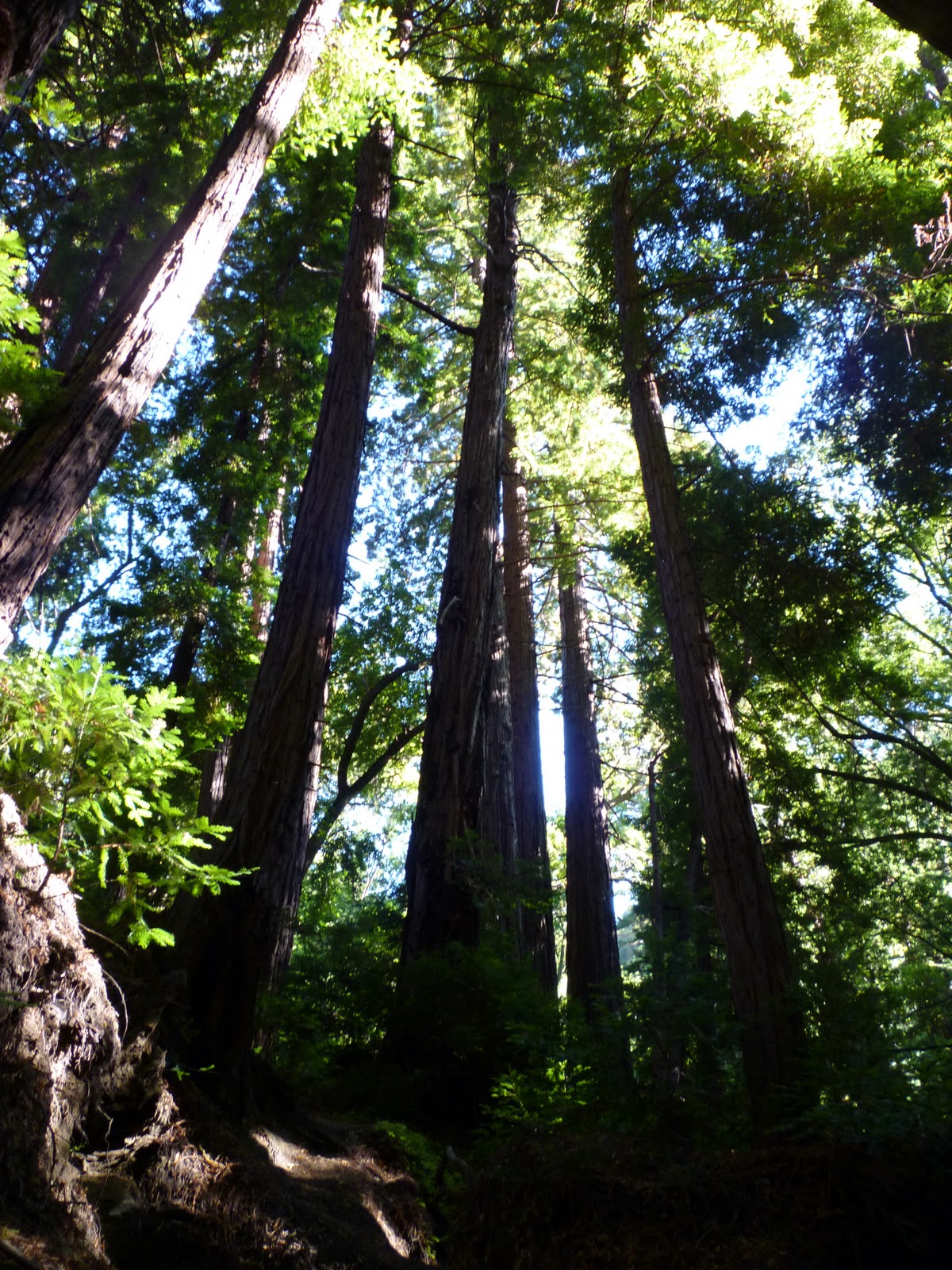
At the base of one of those huge specimens of Sequoia sempervirens, Mr. G pointed out to us the sponginess of the ground. It was not dirt, but many inches – or feet? – of redwood needles, making a duff that we all took turns bouncing on before we went on down the grade and back to our car.
I just love the way the Father creates these playgrounds for the delight of His children.


Of Earth and Altar and Lake

Mr. and Mrs. Bread joined us at My Lake for a few days. We canoed and hiked and ate a lot and sat by the fire. On the Lord’s Day we sunned ourselves on the deck while singing hymns to The God of Earth and Altar, praising Him for his Wondrous Love that flows Like a River Glorious.

In the top photo you can see on the left margin the brown needles of a dead tree that was the subject of some discussion between Mrs. B. and me.

There’s a lot of philosophy and theology in a dead tree, did you know? But I spent so much time doing the nature study while barely tackling the philosophizing, that my time-bucket is empty. Maybe next summer I’ll look at it again and write, and figure out what I think.

manzanita

Another dead tree (above), growing out of a hunk of granite that we christened Gumdrop Dome, was more strikingly beautiful. According to G.K. Chesterton, “Anything beautiful always means more than it says.” As I was saying….?

A baby manzanita bush was hugging a rock in a most endearing manner. It’s amazing how often I find a new and lovable manzanita bush in my view.

One night Mrs. B. was working out on paper what she thought about the meaning of things, as the dinner she crafted for us stewed in the oven, and we all enjoyed the fire her mister had built up to a controlled inferno. The thermometer got up past 60 in the daytime but at night dropped to freezing.
Wax Currant – Ribes cereum

Last year Mrs. Bread and I were roughing it alone up there, without our menfolk. I took more pictures then, though now I am finding that so few images in my Lake collection satisfactorily describe the lake itself. Next trip I’ll have to climb to the top of Gumdrop, as I haven’t done in years, and get the wide view with my camera. In the meantime, here’s a picture we took from there Once.

For me the most blessed part of our stay at the cabin was when Mr. Glad and I paddled our blue canoe for a long time, early in the morning when the surface of the water was smooth. The sky was deep blue, and most of the time the only sound was of our paddles dipping. Peace.

California Mountains – Directions and Points

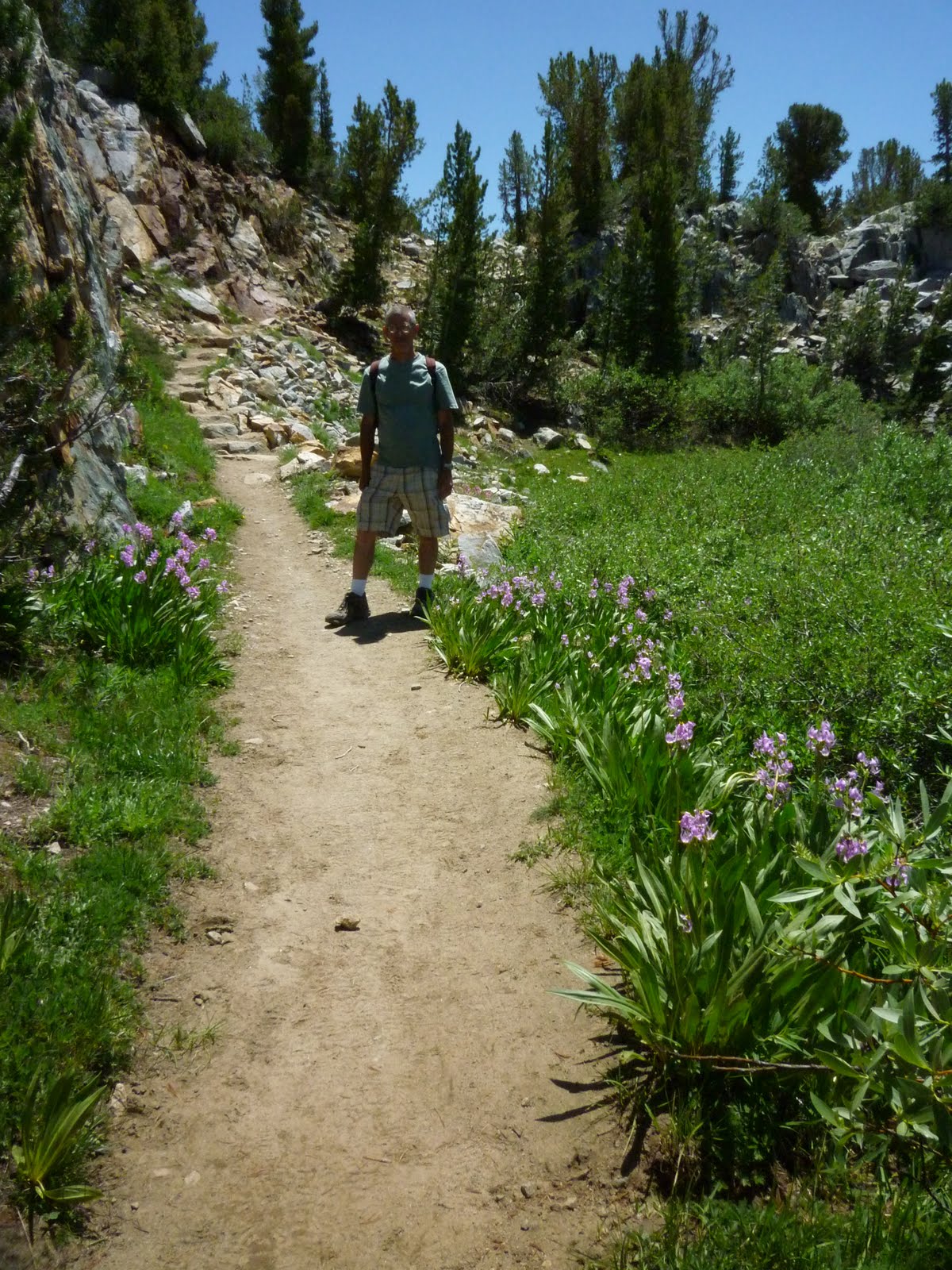
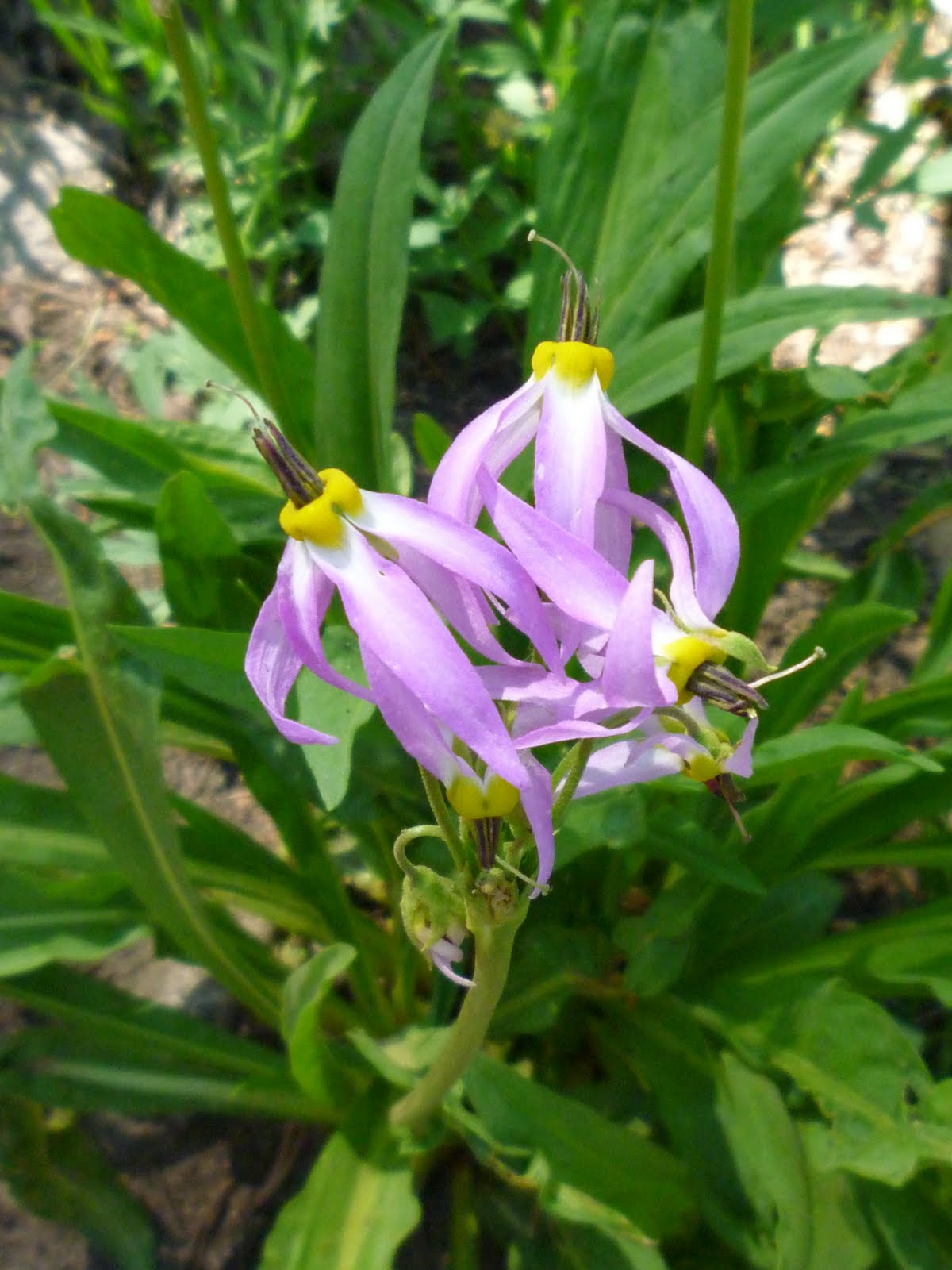
Mr G. with shooting stars

The point of going to the eastern slopes of the Sierra Nevada was to take a hike out of South Lake, above the town of Bishop. When my husband first proposed this trip, I liked the idea of driving to a trailhead that is already high up there; I knew that our day hike would likely not be too strenuous.

After spending the day driving down from Tahoe, mostly on Hwy. 395, we stayed at a nice motel that made luxuriating possible. Making the most of our relaxed schedule, we didn’t get to the trailhead until what was to us an embarrassingly late hour, and I’m not going to publicize it here. When we left Bishop, though, it was already 80°.

shooting star

A mere 22 miles up the road, the temperature had dropped to 60° — because we had gone in the upward direction 5,760 feet. We got nice and warm, hiking for six hours close to the sun, but the thermometer never rose above 75°. When we stopped to cool off or take a drink, we could quickly do that in the shade of a boulder — but the mosquitoes liked the shade, too.

I couldn’t begin to photograph all the flowers and many of my pictures came out too bright owing to that midday sun. Anyway, Mr. Glad and I had made a deal that I would leave some space on the memory card for his shots of larger landscapes and peaks, so for ten whole minutes at a time I would try hard to pretend that I didn’t have a camera with me.

I did think many of my readers would appreciate the one mountain picture I took myself, of this brown peak (at right). Now ladies, does it remind you of anything? How about…a heap of cocoa powder, maybe? It’s called Chocolate Peak.

It was odd that I didn’t feel a need for the boost a dark chocolate bar might give me, hiking along a trail that continued to ascend in the direction of Bishop Pass for our first few hours, up where the air is thin.

I did need to stop pretty frequently to catch my breath, but all in all I was exhilarated, and my mind was composing about 20 different blog posts in an effort to process all the beauty and excitement of the dramatic topography.

When we got back to the car I quickly wrote a few notes to work from when back home in front of the computer. Sadly, when that time came a few days later, I found that without the context that stimulated such a fervent response in me, I couldn’t even recall all the main points that were to flow from the title of this installment.

Since he was a young boy my husband has liked to hike up to mountain tops or mountain passes where he could get a view, and know that he had reached a specific goal. I, of course, would be happy to sit by a field of flowers and work on taking close-ups while getting whiffs of pine needles on the breeze.

That’s partly because I long ago found that orienteering is not my thing, as was well demonstrated on this hike. During the outward bound portion I felt, without thinking much about it, that we were hiking in an easterly direction, but looking at the map later, I learned that our path led pretty much due south.

And every few minutes the mountains change position relative to one another, as it seems when you are getting closer to one and seeing the other side of its neighbor, so I never learn to recognize them. This is one reason to hike particular trails until they become familiar.

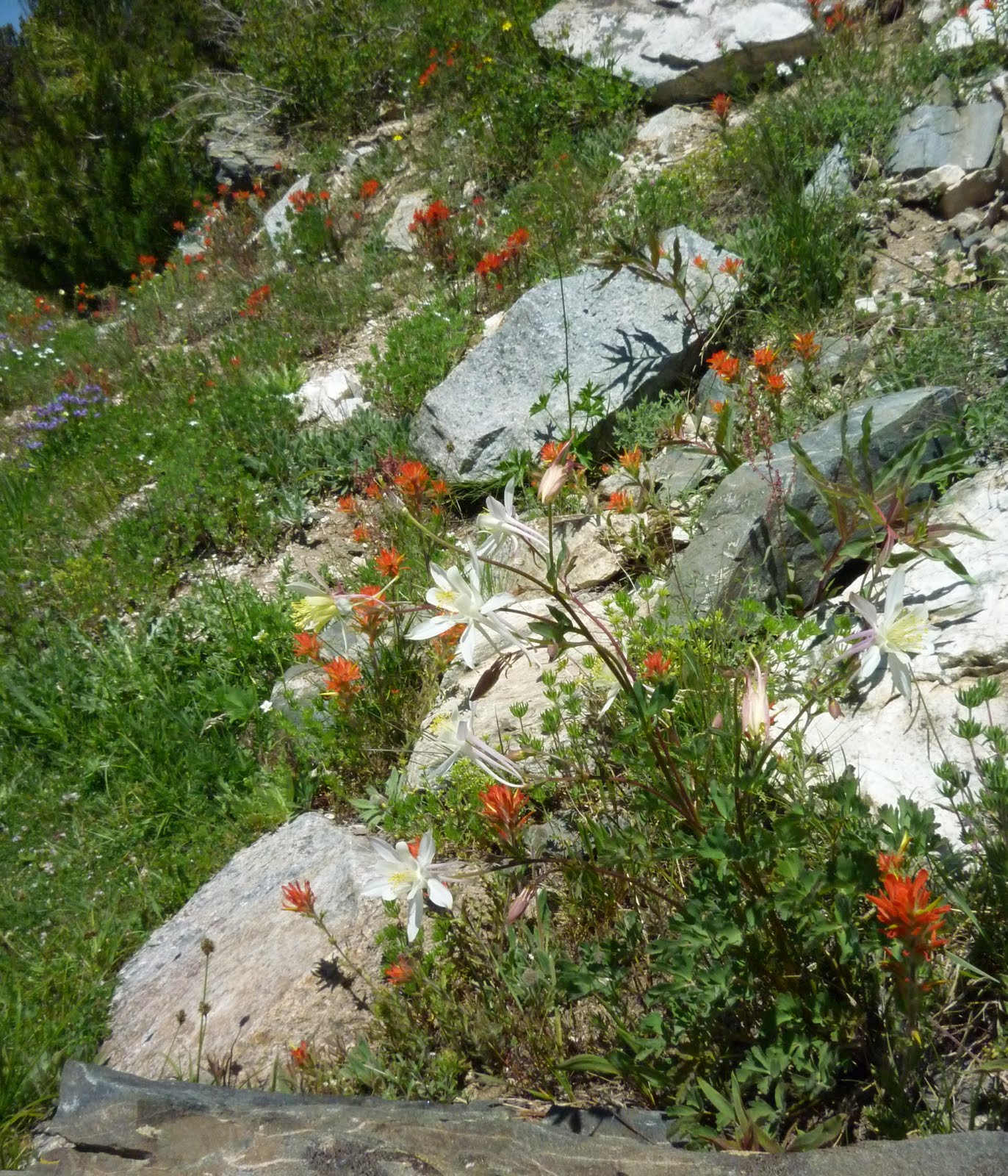
paintbrush and columbine with granite

That is probably not going to happen, considering how our hikes are less frequent these days. As for reaching a panoramic viewpoint or summit of anything, on this hike we didn’t try to accomplish that goal. At an unremarkable spot along the trail, Mr. G. merely said, “I think we should turn around now and go back.”

Of course, he knew that the next day he’d get fantastic views of many of the particular mountains he’s come to love during his life. And that is a hint as to the upcoming posts on California Mountains.

(Previous posts in the series: Getting Over,
Tahoe, Rivers and a Song )