I write in order to comprehend not to express myself I don’t grasp anything I’m not ashamed to admit it sharing this not knowing with a maple leaf So I turn with questions to words wiser than myself to things that will endure long after us I wait to gain wisdom from chance I expect sense from silence Perhaps something will suddenly happen and pulse with hidden truth like the spirit of the flame in the oil lamp under which we bowed our heads when we were very young and grandmas crossed the bread with a knife and we believed in everything So now I yearn for nothing so much as for that faith
-Anna Kamieńska
Translated from Polish by Grażyna Drabik and David Carson
Why do people think it intelligent to say, “I can see no difference”? It is nowadays quite a mark of culture to say that one can see no difference between a man and a woman, or a man and an angel, or a man and an animal. If a man cannot see the difference between a horse and a cow across a large field, we do not call him cultured: we call him short-sighted. Now there are really interesting differences between angels and women; nay, even between men and beasts, and all such things. They are differences which most people know instinctively, as most people know a cow is not a horse without looking for its mane; or most people know a horse is not a cow without looking for horns. Whether the difference ought to count in this or that important question is a completely different matter; but it ought not really to be so difficult simply to see the difference…
This is a strange epoch; and while, in some ways, we have quite dangerously encouraged the appetites, we have quite ruthlessly crushed the instincts.
— G.K. Chesterton in The Illustrated London News, December 1912
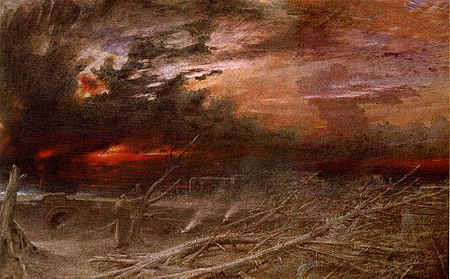
The trees and bushes in my garden get bigger year by year, requiring more attention from me; and several other aspects of my present life prevent me from having the leisure I once had, to write reviews of the books I read. For example, A Canticle for Leibowitz, which I only finished this month. It is the first post-apocalyptic novel I’ve ever read, published in 1959.
It made a big impression on me, which I probably wouldn’t be able to analyze or articulate to my satisfaction, so I didn’t even begin to try, but immediately moved on to a different book. (It’s my experience that reading books doesn’t require the same quality of leisure as writing reviews.) But O happy day! Jeff Bilbro mentioned the book, with a quote, in the newsletter of The Front Porch Republic, so I will just pass that on, with thanks to him. I also commend the other articles on that site, or their print journal, as worthy of your consideration. Here’s Jeff:
“I recently read Canticle for Leibowitz by Walter M. Miller Jr., and I found it a moving narrative exploring the proper cultural and religious conditions for rightly valuing knowledge. The novel follows a monastic order that forms in the wake of a nuclear holocaust, and they carefully preserve remnants of the former industrial civilization through generations of warfare until human civilization is ready to rediscover natural science and its applications. Can such knowledge ever be used wisely, or does increased technical know-how inevitably lead cultures to abandon religious and moral wisdom? Miller offers no easy answers. In this passage, an abbot of this monastic order reflects on the significance of the rising interest in their archives:
‘Now a Dark Age seemed to be passing. For twelve centuries, a small flame of knowledge had been kept smoldering in the monasteries; only now were their minds ready to be kindled. Long ago, during the last age of reason, certain proud thinkers had claimed that valid knowledge was indestructible—that ideas were deathless and truth immortal. But that was true only in the subtlest sense, the abbot thought, and not superficially true at all. There was objective meaning in the world, to be sure: the nonmoral logos or design of the Creator; but such meanings were God’s and not Man’s, until they found an imperfect incarnation, a dark reflection, within the mind and speech and culture of a given human society, which might ascribe values to the meanings so that they become valid in a human sense within the culture. For Man was a culture-bearer as well as a soul-bearer, but his cultures were not immortal and they could die with a race or an age, and then human reflections of meaning and human portrayals of truth receded, and truth and meaning resided, unseen, only in the objective logos of Nature and the ineffable Logos of God. Truth could be crucified; but soon, perhaps, a resurrection.’
“Thanks for spending some time with us on the Porch,




 Gladsome Lights