“I ask this much” was the title of a post I wrote ten years ago, not long after my husband died. My thoughts then were inspired by the poem below, which I recently revisited. Yesterday I began to notice afresh the near constancy of my murmuring and complaining; today I was encouraged by the testimony of my former self, who wrote back then,
And every day, I feel a great Love surrounding me, like the pleasant air that holds me and gives me oxygen even while I am having those pity parties. Or like the sun whose heat is keeping me alive and giving me energy.
Let us be up and doing! And let’s start by asking the great Maker of the sun and of us, for His light, and strength, and joy. Our asking will be the beginning of the receiving.
PRAYER at SUNRISE
O mighty, powerful, dark-dispelling sun, Now thou art risen, and thy day begun. How shrink the shrouding mists before thy face, As up thou spring’st to thy diurnal race! How darkness chases darkness to the west, As shades of light on light rise radiant from thy crest! For thee, great source of strength, emblem of might, In hours of darkest gloom there is no night. Thou shinest on though clouds hide thee from sight, And through each break thou sendest down thy light.
O greater Maker of this Thy great sun, Give me the strength this one day’s race to run, Fill me with light, fill me with sun-like strength, Fill me with joy to rob the day its length. Light from within, light that will outward shine, Strength to make strong some weaker heart than mine, Joy to make glad each soul that feels its touch; Great Father of the sun, I ask this much.
“Why We No Longer But Still Could Have Beautiful Things” is something Anthony Esolen discusses in an article titled “The Ugly and the Good,” which was first published in Touchstone in 2020. This month he republished it in his Substack newsletter.
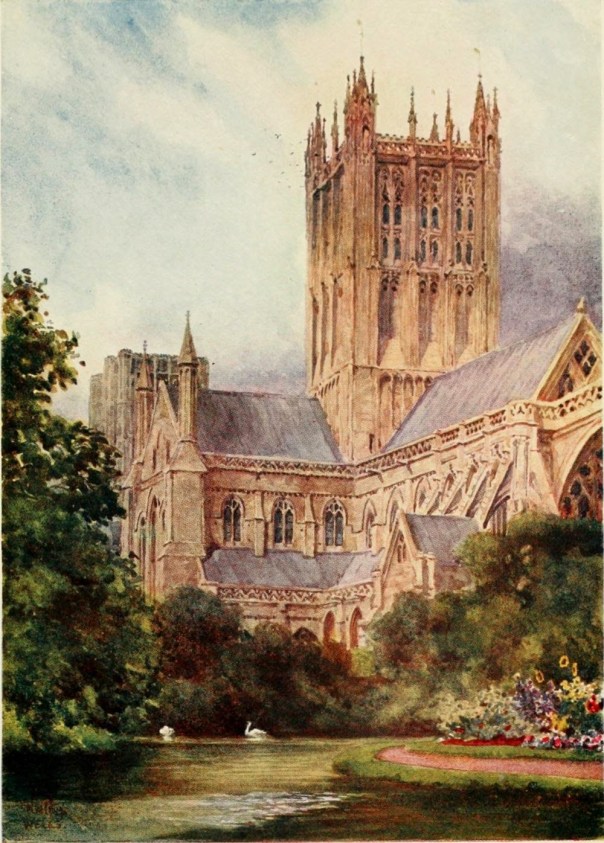
Wells Cathedral, England
Esolen begins by talking about beautiful cathedrals built in the Middle Ages:
“I’ve come to see the medieval cathedrals of Europe as the most glorious works of folk art the world has ever known…. They rose up as a lofty expression of the piety of ordinary people, the work of hundreds of men’s hands, digging the deep cavity for the foundation, hewing and setting delicate half-ton stones without mortar, mixing colors for paint or the glazing of windows, searching the forests for the tallest oaks to fell and to carve into beams to span a roof; far more kinds of work than I know and can name.
“They did it because they loved doing it. They were free.”
He contrasts freedom with license, using the example of Ebenezer Scrooge for the latter:
“To be free is not, O modern man, to be rid of all claims upon your love, your duty, your person, and your substance. If that were true, then Charles Dickens crafted a truly blithe and free spirit in the unregenerate Ebenezer Scrooge, crouching alone in his dismal flat and eating gruel gone sour. If you are talking about freedom and you are not talking about love and devotion, then you are not talking about freedom at all; you are talking about moral license, or a permission guaranteed by statutory law, that you may in some regard do exactly as you like, which may include gazing endlessly at evil pictures on your computer screen, and thus transforming yourself, cell by cell and pulse by pulse, into a thing, an automaton.”
Van Gogh, The Good Samaritan
His college students ask him for a definition of freedom, because, unfortunately, many of them are puzzled by his statements about what it is not. This is his answer:
“Freedom is the unimpeded capacity to attain to the perfection proper to the kind of creature you are. But since man is made in the image of the God who is a three-personed communion of love, his perfection, the enlargement of his soul, can only come by means of a gift, by the gift of grace from God, which enables him to make of himself a gift to others. There is no truly human freedom without grace, and the love that is its proper response.”
As to modern man’s failure to develop a love, or even a desire for beautiful things, Esolen proposes three reasons. If you’re interested enough that you’ve read this far, you can read them in the article: “The Ugly and the Good”
He also exhorts us to work on the restoration of the culture we have lost:
“We must take back the heart, the chest, the seat of proper passions, which is to take back from Satan those commanding heights of the imagination, which is to reject the errors I have mentioned and to repair the harm they have done. We must not value the useful over the beautiful. We must not reduce beauty to a commodity. We must not forget that our experience of beauty should lead us back to the source of beauty, who is God.”
Esolen suggests that we spend more time cultivating an appreciation for art of every sort; and that we start with the beautiful things that are most accessible:
“Song and poetry are the most immediately available of all the arts, requiring only a human mind and a human voice. If you want a Rembrandt, you have to go see it, or carry a copy with you under your arm while you avert your eyes from the glare of the policeman. Grand pianos, with Van Cliburn sitting at them, are not to be found on every street corner. You cannot from your porch in New Hampshire gaze upon the great arms that Bernini conceived for St. Peter’s piazza, extending in the shape of a key to embrace the thousands who would come to worship there.
“But anyone can possess a song or a poem. If you have a voice, you can sing, and if you have a mind, you can remember what you sing. If you have a voice, you can utter a poem, and remember what you have uttered. In a way, you can best possess a song only by singing it, and a poem only by giving it the performance of your mind and heart and voice and body. Song and poetry should be the most democratic of the arts, more truly by the people, of the people, and for the people than anything else in our experience.”
That brings me to — Poetry Month! I have a little experience of what he’s talking about here, knowing by heart several poems from A Child’s Garden of Verses, which give me joy when I have occasion to recite them, usually to a grandchild, these days. How many songs do I know? Oh my, countless! After reading Esolen, I am extra grateful for all the songs and singing I have loved throughout my life. I am singing these days more than ever.
This short and beloved poem below, which I think I’ve shared here more than once — maybe I should compose a tune for it. Because of its simplicity and rhythm it embedded itself in my mind very easily, long ago, and years later it was right at hand to speak aloud, one night when my late husband and I were peering over a bridge into the dark, where with the help of a street light we could see ripples in the stream down below.
The tide in the river, The tide in the river, The tide in the river runs deep. I saw a shiver Pass over the river As the tide turned in its sleep.
–Eleanor Farejon
May we nurture ever more beauty, music and poetry in our lives,
and offer the joy with thankfulness up to God.
I have always loved this hymn since singing it in the Presbyterian church of my childhood. I included it in a booklet of Thanksgiving hymns I put together some years ago, for our family to sing when we gathered for the feast. Here is John Rutter conducting a choir singing it: We Plough the Fields and Scatter. The lyrics have undergone some adaptation over the decades, which you can read about on Wikipedia where the hymn has its own entry.
Matthias Claudius published this poem in Germany, where it was set to music attributed to Johann A. P. Schulz, in 1800. I also like this bold instrumental version: We Plough the Fields and Scatter.
WE PLOUGH THE FIELDS AND SCATTER
We plough the fields and scatter the good seed on the land, but it is fed and watered by God’s almighty hand; he sends the snow in winter, the warmth to swell the grain, the breezes and the sunshine, and soft refreshing rain.
He only is the Maker of all things near and far; he paints the wayside flower, he lights the evening star; the wind and waves obey him, by him the birds are fed; much more to us, his children, he gives our daily bread.
We thank thee, then, O Father, for all things bright and good, the seed-time and the harvest, our life, our health, our food. Accept the gifts we offer for all your love imparts, with what we know you long for: our humble, thankful hearts.
All good gifts around us are sent from heaven above; then thank the Lord, O thank the Lord for all his love.





 Gladsome Lights