Tag Archives: words

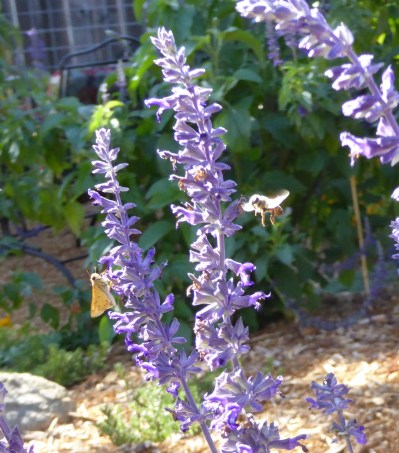
Insect friends on the soft breeze.

gl9 P1050458

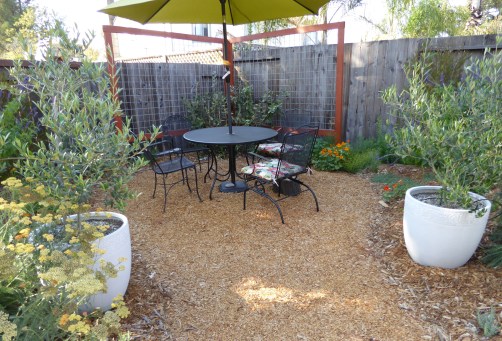
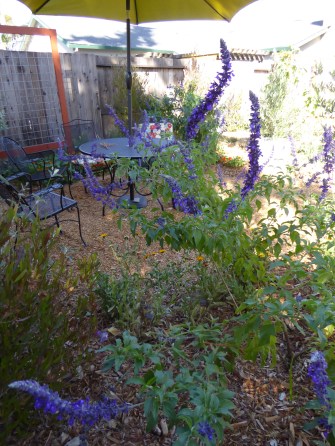
I am sitting in the garden, in the corner where the unbelievable salvias and the olive trees have grown up to make a sort of alcove. The three salvias are each six to nine feet in diameter and four feet high; they amazed me by taking a big leap in July and August of their first year. The umbrella is shielding me from the sun, and I am enjoying the insects that make the air alive with their darting and swooping from one flower to another above and all around me.
gl9 P1050197crp

The only reason I thought to move out here with my bowl of plums is that my house is so cold. I brought the laptop so I could continue reading Fr. Stephen’s article while I ate, but the fruit drew all of my attention to my mouth, and to the juicy plumminess too intense to consume mindlessly while reading. Now I remember why I planted two Elephant Heart Plum trees last fall — which, by the way, didn’t produce any fruit from their pretty green and white blossoms this season. Pearl brought me some of her plums yesterday; a year ago the mature trees at her new house had been the inspiration for my decision to grow some of my own.

gl9 P1050466
portulaca
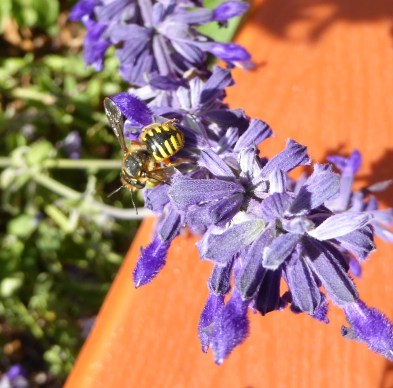
gl9 P1050452 wasp on salvia 9-4-16
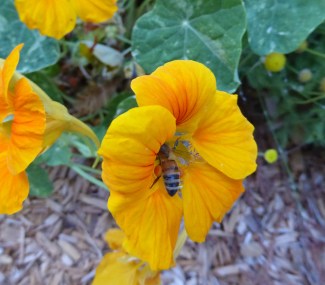
Hoverflies are pollinators, too.


If I could just sit out here in the soft air, I would most certainly eat less; shivering in the house makes me distracted and uneasy without knowing why, and I unconsciously start stoking the furnace of my body with whatever fuel I can find in the cupboards.
gl9 P1050426


And being in the garden makes me want to share the experience in words, so I looked to see if I have a good summer poem from a previous year. I’m sure it must be here somewhere, if I only had the patience. While looking I found a verse that is new to me, from Walter de la Mare, about one of the winged creatures flitting about.

After pasting it in (and thereby shaping this article into another Pollinator post) I thought perhaps I shouldn’t be so hasty, and I began to look online for a different poem, maybe about a dragonfly or a butterfly ? which, after all are more to my liking. I also hunted around for a clue to the meaning of “specks of sale” in the poem. Does anyone know? I wonder if sale is a word for salt? [Duh. It was a typo, as commenter shoreacres pointed out below. But from now on I think I will always think of it as a synonym 🙂 ]
gl9 P1050444


But before any more pages had time to load – I must be too far from the house for the wifi – a common housefly dropped in on me, on my arm, on my keyboard, my shoulder, and he would not be shooed away for anything. I think he sensed what was going on, and wanted me to tell his story, and not another’s. Maybe as soon as I hit “Publish” he will go back to playing.


THE FLY

How large unto the tiny fly
Must little things appear!-
A rosebud like a feather bed,
Its prickle like a spear;

A dewdrop like a looking-glass,
A hair like golden wire;
The smallest grain of mustard-seed
As fierce as coals of fire;

A loaf of bread, a lofty hill;
A wasp, a cruel leopard;
And specks of salt as bright to see
As lambkins to a shepherd.

-Walter de la Mare
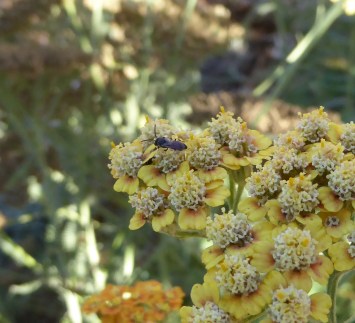
gl9 P1050431 fly on yarrow crp
some kind of fly on the yarrow

Looking at stars, snow, and a challenge.

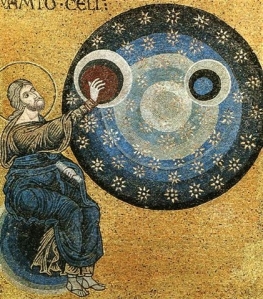
I’ve been out aa crown for our heads - stars RtoPnd about in spite of the weather and my cold – that is, via my computer. Here are some things I’ve found. The last one may be the most interesting, so don’t miss it.

**I learned something about stars and their colors when they are out of focus.

**On the topic of the skies and the weather, I have only this week noticed a way of talking about weather systems as “pieces of energy.” It’s probably not new; do TV weather forecasters use this phrase? This from a recent email:

RAIN WILL SWITCH OVER TO SHOWERS BY LATE IN THE MORNING OR EARLY IN THE AFTERNOON ON FRIDAY. A SECOND PIECE OF ENERGY WILL QUICKLY MOVE TO OUR REGION WITH ANOTHER ROUND OF RAIN FORECAST FOR FRIDAY EVENING INTO SATURDAY.

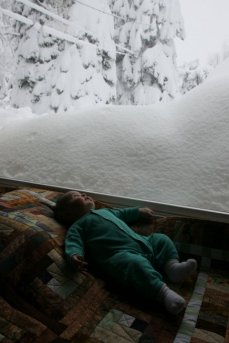
**Bonnie posted a short and sweet exhortation in the form of a poem by Wendell Berry.ee9f1-cbywindowwsnow

**Last year I was very interested when Podso listed some things she has learned about life, that is, how to have good days. I wonder what my list would look like, if I could ever get past my usual endless analysis to come up with one?

**DeAnn has a good collection of thought-provoking quotes on her blog, which is where I read one taken from a book I read last summer. I don’t even remember reading this paragraph then, and that makes me think I should go back and read the whole thing over again.

“It is by loving, and not by being loved, that one can come nearest the soul of another; yea, that, where two love, it is the loving of each other, that originates and perfects and assures their blessedness. I knew that love gives to him that loveth, power over any soul he loved, even if that soul know him not, bringing him inwardly close to that spirit; a power that cannot be but for good; for in proportion as selfishness intrudes, the love ceases, and the power which springs therefrom dies. Yet all love will, one day, meet with its return.”

~ George MacDonald, Phantastes

**Owen White has a faith-literary-art challenge going on at his blog The Ochlophobist. Entries must be titled in this form: Why I am a ________________.” And in that blank spot you are to place your faith designation, to the degree of precision you prefer.”

Some of the resulting titles in the entries that have been posted so far: “Why I am a slightly miserable but motivated methodist,” “Why I Am Still an (Orthodox) Christian Who Mans His Post” and “Why I am a non-believer who still goes to church.” The content of the entries includes many poems, music on YouTube, works of visual art, and prose.

After you read the rules and see what other people have done (entries have been posted for several days now) to meet the challenge, maybe you also would like to engage with this exercise. I had to push myself to not be too perfectionistic about it, and managed to put together my own entry. I hope you will, too!

blessing of waters through ice

We’re looking and making words.

This poem reminds me of the effect Annie Dillard’s An American Childhood had on me the first time I read it. Her noticing of so many details in the history and geography and biographies of her life made me realize that I’d had just as fascinating a childhood. From then on I began to look around with a new eye.

Looking Around, Believing

How strange that we can begin at any time.
With two feet we get down the street.
With a hand we undo the rose.
With an eye we lift up the peach tree
And hold it up to the wind — white blossoms
At our feet. Like today. I started
In the yard with my daughter,
With my wife poking at a potted geranium,
And now I am walking down the street,
Amazed that the sun is only so high,
Just over the roof, and a child
Is singing through a rolled newspaper
And a terrier is leaping like a flea
And at the bakery I pass, a palm,
Like a suctioning starfish, is pressed
To the window. We’re keeping busy —
This way, that way, we’re making shadows
Where sunlight was, making words
Where there was only noise in the trees.

by Gary Soto

Gleanings – What is Man?

Anthony Esolen reflects on the significance of Catholics dropping the word “man” from the Ash Wednesday service:

A little consideration shows that there is no substitute in English for man. None of the alternatives do the necessary work. Human being is singular and somewhat personal, but it is not a universal term; we do not conceive of the fall of human being. Humanity is abstract and impersonal, and names a quality rather than a being. People is plural, and not necessarily universal; I am not people, and the sin of people might mean the sin of John and Mary and Agnes and Bill, but not the sin of all people considered as one. Mankind is a universal, but not personal. The priest could never say, “Remember, mankind, that thou art dust,” because he would then seem to be speaking not to the penitent, but to a vast generality. Men and women is not universal—it excludes children!—and introduces an irrelevant distinction of sex. Person is singular but not universal, and is in any case not limited to man; angels, too, have personal being, as do the Persons of the Holy Trinity.

…why should we not have a word that corresponds to our mysterious sense that each one of us carries the burden of all, and that the good of all is oriented towards the good of each?

-Anthony Esolen

Read the whole article in the Jan/Feb 2012 issue of Touchstone