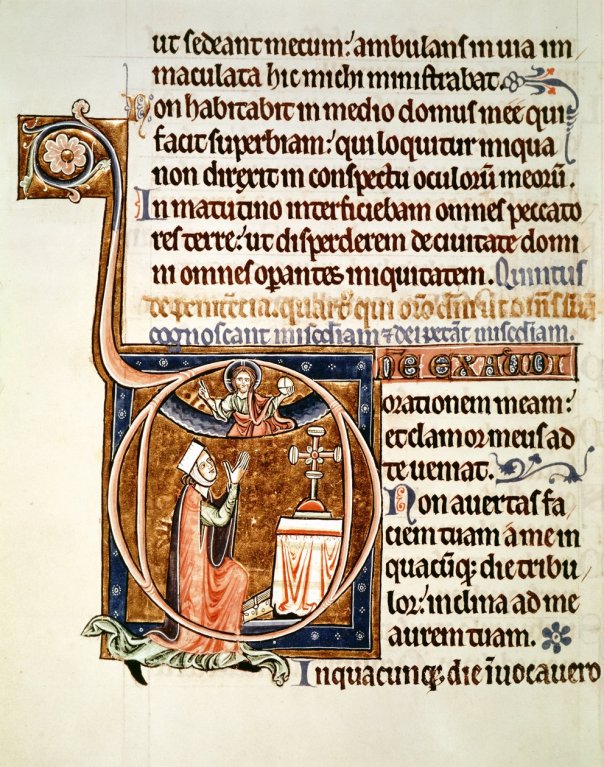
From the Psalter of St. Louis and Blanche of Castile, 13th c.
“…how did the monks train? By singing the psalms. Here is the key to the power, such as it is, of medieval communal prayer: it was focused on the psalms. And why on the psalms? Because, as every medieval Christian knew, they are focused on Christ the Lord, the Word who is with God and who is God, through whom everything was made (John 1), who set his tabernacle in the sun and came forth as a bridegroom from his wedding chamber (Ps. 18:6), the king of glory mighty in battle (Ps. 23:8) who entered into his temple (Heb.) to rescue his people from their sins (Ps. 21).
“Religion, properly speaking, is about worship, and it is the object of worship that defines the community. If the community worships itself (as a city, nation, or empire) then its religion is about belonging to the group (see, pagan Rome, and its opposition to Christians). But a community worshiping Christ is defined by Him—and its individual members have strength to stand up against other communities who define themselves by something other than Christ.”
“Worship is the submission of all of our nature to God. It is the quickening of conscience by His holiness, nourishment of mind by His truth, purifying of imagination by His beauty, opening of the heart to His love, and submission of will to His purpose. All this gathered up in adoration is the greatest of all expressions of which we are capable.”
“The ultimate expression of this Christian attitude toward the power of money is what we will call profanation. To profane money, like all other powers, is to take away its sacred character…. Giving to God is the act of profanation par excellence…. We need to regain an appreciation of gifts that are not utilitarian.
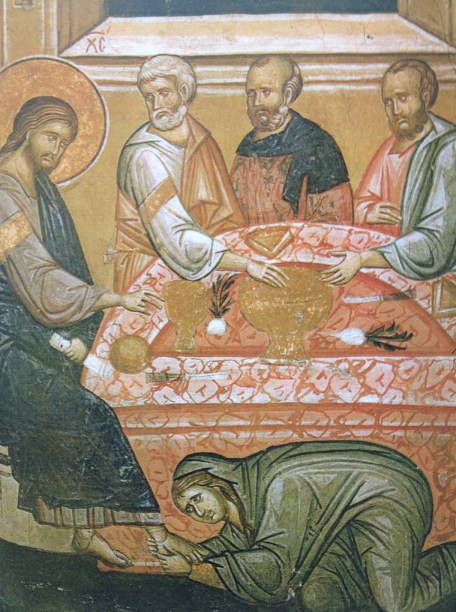
“We should meditate on the story in the Gospel of John where Mary wastes precious ointment on Jesus. The one who protests against this free gift is Judas. He would have preferred it to be used for good works, for the poor. He wanted such an enormous sum of money to be spent usefully. Giving to God introduces the useless into the world of efficiency, and this is an essential witness to faith in today’s world.”
― Jacques Ellul, Money and Power
Six days before the Passover, Jesus therefore came to Bethany, where Lazarus was, whom Jesus had raised from the dead. So they gave a dinner for him there. Martha served, and Lazarus was one of those reclining with him at table. Mary therefore took a pound of expensive ointment made from pure nard, and anointed the feet of Jesus and wiped his feet with her hair. The house was filled with the fragrance of the perfume.
But Judas Iscariot, one of his disciples (he who was about to betray him), said, “Why was this ointment not sold for three hundred denarii and given to the poor?” He said this, not because he cared about the poor, but because he was a thief, and having charge of the moneybag he used to help himself to what was put into it. Jesus said, “Leave her alone, so that she may keep it for the day of my burial. For the poor you always have with you, but you do not always have me.”
At the Feast of the Presentation of Christ in the Temple, we bless candles in church. I liked this letter from Abbot Tryphon in which he reminds us that the Light of Christ is what our lamps and candles represent, and what makes the saints shine:
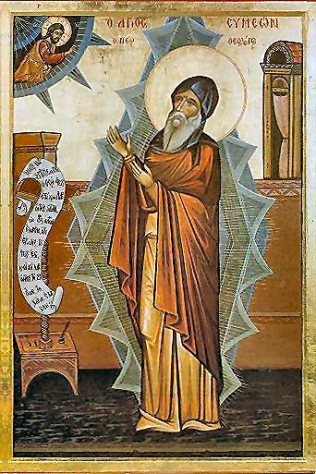
“Vigil lights are placed before the icons of the saints, according to Saint Symeon the New Theologian, as a way of showing that without the Light, Who is Christ, the saints are nothing. It is only as the light of Christ shines on them that they become alive and resplendent.
St. Symeon the New Theologian
“The saints show us what a glorious destiny we have in God, and through the example of their lives, point the way to our becoming ‘partakers of divine nature.’ The saints, as the cloud of witnesses in heaven, are present in the divine services, worshiping the Holy Trinity with us. They, as our friends, intercede before the Throne of God on our behalf, having won the good fight, and we are encouraged by the memory and example of their lives, as we struggle on our own path to God.
“It has been said that there are two kinds of people in the world: sinners who think they are saints, and saints who know they are sinners. A saint is a Christian who lets God’s light shine through, and whose life has been transformed by the power of the Holy Spirit.
“We venerate the saints as we seek their intercession with God, but we adore and worship only God in Trinity, the Father, the Son, and the Holy Spirit. We venerate the images (icons) as well as the relics of the saints and martyrs. Yet according to the decisions and Canons of the Seventh Ecumenical Council, this veneration relates not to the icons as such, but to their prototypes, or to the persons whom they represent.
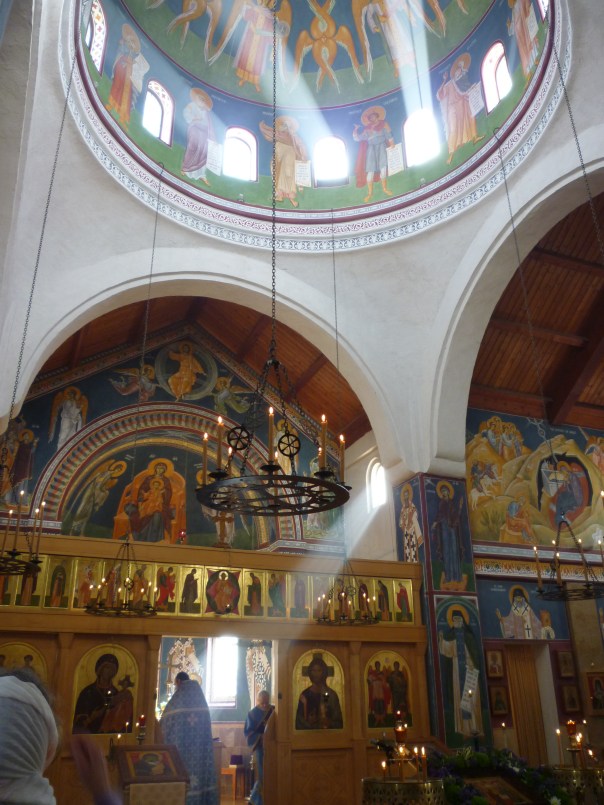
“The interior walls of our temples are adorned with the icons and frescoes of the saints as a reminder that we are surrounded by the cloud of witnesses, the saints, and that the Church Militant (here on earth) is not separated from the Church Triumphant (in heaven). In Christ, death does not divide us, for the saints are not dead, but alive in Christ Jesus.
“Glory to Jesus Christ, Who is glorified in His saints.


 Gladsome Lights