Every day a poem comes into my e-mail inbox from The Poetry Foundation. Even this solitary Poem-a-Day is often too much for me to handle, and I either let my supply build up for days and/or I delete some poems after a brief scan. But on the occasional day I take the bait and end up reading several poems and stories about the poets.
A couple of months ago there was a poem by X.J. Kennedy that got my attention, because although I knew his name from a poetry textbook I own, as he was co-editor with Dana Gioia of that book, I hadn’t seen any of his own poetry before. I was predisposed to like him because of his collaboration with Dana Gioia whom I greatly admire (As you will see if you check out tags with his name here on my blog).
Kennedy was born in 1929 and wrote science fiction in his youth. His poem-writing seems to have come a little later, along with journalism work during the war, and teaching English. Here is a short poem from 1985:
You Touch Me
You touch me.
One by one
In each cell of my body
A hearth comes on.
When I read that he had been writing a lot of poetry for children in recent years, I borrowed several books by him from the library to investigate. A book of nonsense poems wasn’t my style, but The Beasts of Bethlehem is quite wonderful, with short poems from the perspective not just of the usual farm animals, but some critters less famous for being near the Christ Child, such as a beetle, a bat, a worm, and this:
HAWK
Before Christ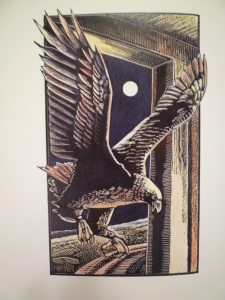 , yesterday,
From clouds I dived, gave chase,
And fed. But in this place
Of peace I shall not prey
On living things. Those six
Young hares ripped from their burrow
Were lovely, though. Tomorrow,
Old plump hen, watch your chicks.
As you can see, the animals not only think to themselves about the Event, but are in conversation with each other. Many also convey Kennedy’s sense of humor that is not without reverence. I have already bought three copies of this book so that I’ll be ready for next Christmas.
The Owlstone Crown is a novel Kennedy wrote for middle-schoolers, I think. It features children who accidentally fall into an alternate world where they help to rescue their relatives from slave labor. I was first off charmed by the presence of a talking ladybug, but it turned out to be a man ladybug who was a wisecracking tough character, and I didn’t like him much even though he was the type who has a good heart. I did see the book through to the end, but can’t imagine anyone to whom I couldn’t recommend some much better story.
My favorite discovery from X.J. Kennedy (if you Google him you can find out how and why he got those initials) I have kept for last. It is his Child’s Introduction to Poetry titled Knock at a Star. I wish I could have read the whole thing with my children, but it was published a little late for most of them, in 1999. So I bought a few copies for grandchildren who are at the right age right now, or will eventually be.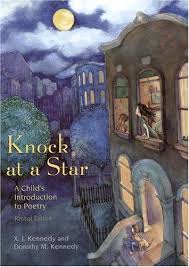
The first section of the book is “What Do Poems Do?” and the answers are Make You Smile, Tell Stories, Send Messages, Share Feelings, Help You Understand People, and Start You Wondering. Each of those chapters includes ten or more poems, many by well-known poets and not specifically for children, which I appreciated. Too often I’ve seen collections that were so dumbed-down as to be insulting, and not a good kind of literary food for inculcating good taste.
Even the humorous poems include “Termite” by Ogden Nash. This one from the Understanding People section is by Valerie Worth
My Mother
My mother
Wasn’t like
Some others.
She didn’t
Make cakes or
Candied apples.
She sat down
Beside her
Sewing basket
And stayed
Up late
Reading poetry.
In Section 2 the question “What’s Inside a Poem?” is answered. Here a poem by Wallace Stevens illustrates that Images may be inside. And Word Music is shown through this poem by Emanuel diPasquale, “Rain”:
Like a drummer’s brush,
the rain hushes the surfaces of tin porches.
Beats That Repeat are found in one of my favorite “Opposites” poems by Richard Wilbur, and in others by Robert Frost and Gertrude Stein. The descriptions of poetic technique are brief and helpful, so we can move on quickly to the poems themselves.
There are limericks, of course, and songs (“Blowin’ in the Wind” by Bob Dylan) and haiku. And a last section on writing your own poems. I just think this book has everything for the child of eight or ten and older, and if I’d read something like this when I was young I’d be even more like that mother in the poem. I wonder just how late she stayed up?

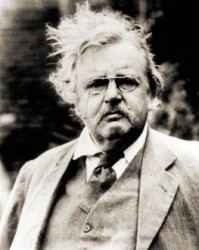
 Today is the birthday of our dear friend G.K. Chesterton. He was born in 1874, which makes it 140 years since God gave him to the world. I’ve begun reading Chesterton’s autobiography two times, and it seems the least interesting of all his writings I’ve tried, because it doesn’t come naturally to the author to talk about himself. Much of what I read in the first chapters was about other people, perhaps well-known in his day but not to me.
 ho eat and drink with right good will…”
 what flag it follows and what high town it assaults. The most dangerous thing in the world is to be alive; one is always in danger of one’s life. But anyone who shrinks from that is a traitor to the great scheme and experiment of being.”
 Gladsome Lights