Monthly Archives: July 2015

Anthropology of water and radio.

One Friday I set off for the mountains to our family’s cabin in the southern Sierra Nevada. P1000688 sf close w roadThe homesickness that always comes on in advance seems to be even worse these days. I did not want to leave what feels like my soul’s safe place,  and it took me all the next morning to drag myself away. The sun was high in the sky before I got on the road, but from then on I was the Happy Wanderer. And I didn’t get lost, at least not very soon.
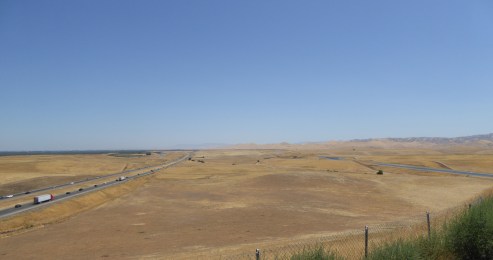
It’s dry out there, folks! Even so, crops are growing, and canals are full of water. This view of Highway 5, the interstate that runs right down the middle of the state, shows the most barren looking stretch. I took the picture looking south, and you can see the California Aqueduct running along in the same general direction and to the west of the highway here.
P1000662 5 & aqueduct

I was listening to the radio and thinking about the anthropology of radio stations. Close to home I had tuned into my favorite jazz or classical stations, but after a while there were more Christian, Spanish, and talk radio options. I landed on a gospel station as a rich woman’s voice began to sing meaningfully, “Bless the Lord, O my soul, oh-oh-oh my soul….” and I wept with joy. I think it was joy. I weep so much lately, I probably don’t know all the reasons.

Soon I turned east toward the mountains and drove through miles and miles of farmland as I crossed the Central Valley. Huge plantings of tomatoes and cotton and alfalfa, and what I think were safflower plants maturing all coppery gold. Around here farmers are rightly worried about the future, and they put up billboards asking, “IS GROWING FOOD A WASTE OF WATER?” and “DAMS or TRAINS – BUILD WATER STORAGE NOW.” Over a farm machinery dealership yard, surrounded by fields of corn, the largest American flag I’ve ever seen billowed in the wind.

I kept stopping to take pictures, assuring myself that I had time, because the summer sun wouldn’t set too early. I didn’t really want to arrive by myself in the dark at the cabin. My sister would not join me until the next day.P1000703
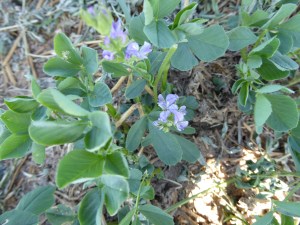
After years of knowing alfalfa only by its summery sweetness in the air, I parked near a freshly mown field and bent down to see its lavender flowers and clovery leaves.

The temperature outside had reached 102° by this time, so when I stopped for gas it seemed the right thing to do, to buy myself a Snapple Kiwi Strawberry drink, hearkening a long ways back to a time when that was the “special” drink that many in our family favored. That disappeared fast.

P1000709

P1000712

And then I came upon the pistachio trees, which I didn’t recognize until I walked through the pale plowed dirt and got close to them, too. I noticed that the orchards were not flooded as nut trees sometimes are, but were irrigated by means of very localized misters.

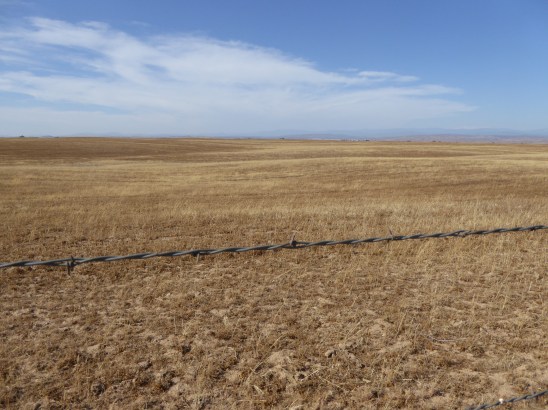
A sign read: “50% of THE FRUITS, VEGETABLES and NUTS of THE NATION ARE GROWN in CALIFORNIA.” But often, directly across the highway from the orchards, would be land like this:
P1000713

P1000720

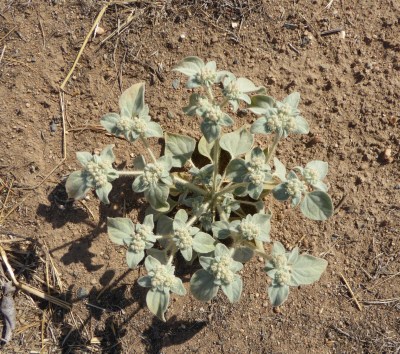
…..and these gray-green weeds and tumbleweeds were common wild plants, showing what the natural state of affairs is in these parts.
P1000687


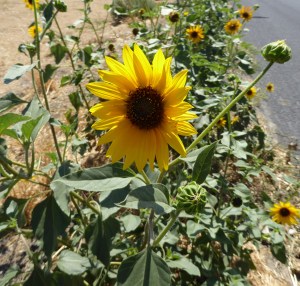
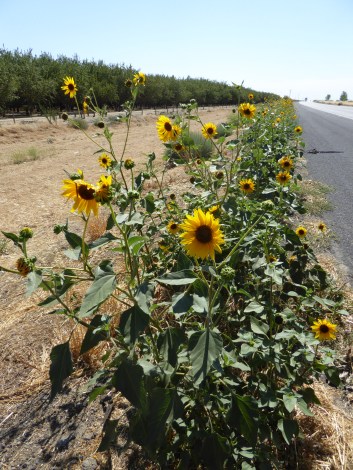
But I think the most common roadside plants are probably not considered weeds at all, because they are wild sunflowers that brighten up long stretches of highway and wave at the traffic whizzing past.

The singer on the country station was asking, “Mama, should I run for President? Mama, should I trust the government?”

When I lost that station I came upon more Christian radio with the blessing, “God be with you till we meet again….,” and you can imagine who was on my mind right then.

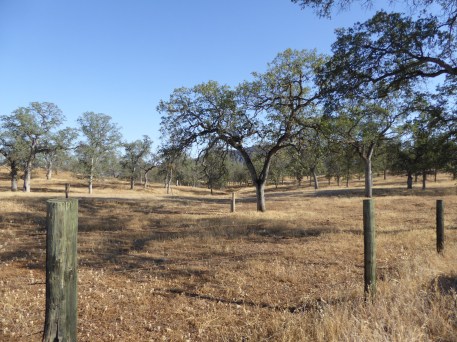
I was just starting to climb into the foothills, where there were oak trees, but no crops. The temperature had dropped to 99°, and I kept the AC on. This area slightly above the hottest parts of the valley like Fresno or Bakersfield is where a lot of people have liked to retreat at 2,000 feet or so above the valley floor. Over the years I many times heard my father wonder at the foolishness (and he used stronger descriptors) of building houses where there is no groundwater in all but the wettest years. I saw houses on hilltops and wondered myself if the occupants were still living there, or if they have to bring all their water in by truck nowadays.

Maybe cattle are grazed here in greener seasons, but all I saw were a few beehives. As the road climbed up toward my destination, pines began to appear. And in this transition zone of the foothills I will break my story in two. The next installment will be: Mountains!P1000739
How faithfully your life is delivered.

The poem below expresses different aspects of my life of late. I’ve been reading David Bentley Hart’s book The Experience of God, and there is so much in there about how our life is a mysterious gift. We did not bring about our own existence, and we can’t keep ourselves alive, either. Why should we be here? Why is anything here? I’ve been meditating on that amazing everyday occurrence of waking up in the morning, even as I am coming out of my dreams into consciousness. Some days it takes longer than others for me to remember, “I am here, God was with me through the night and Dear Father, You are here with me in my bed this morning, and will be in me all day long.” Sometimes I lie there just being happy in His presence — especially when He wakes me up extra early.

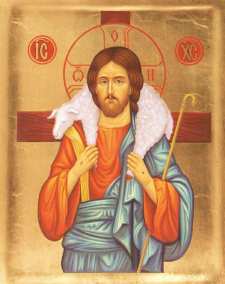
Father Stephen Freeman spoke of the same reality in a podcast I listened to, saying, “If God did not immediately and relentlessly will good for us, then no one would even continue in existence. Being and existence are inherently good things. The very fact that we exist is itself a witness of God’s good will for us.”christ seeker of the lost-sheep-butryki-prison-chapel-moscow

I realize most people can’t be so slow and lazy about the start of their day. I am really really grateful, though, that most days I can take the time for this remembrance, because there is also this other attitude in me, of fear and unwillingness. I don’t like meetings with strangers about financial matters, or having to decide what work should be done on my car. It’s not a constant thing, but a feeling of vulnerability does distract me.

Once when we were on a camping trip in the mountains, four-year-old Soldier was looking out the window of the car at the curvy highway and the steep drop-off just to his left. He turned to Baby Kate and said brightly, “God is keeping us on the road, Kate!” He must have thought his father needed help driving. I need to remind myself in these morning meditations that this day I am not trusting strangers who might not be worthy of my confidence, but I am trusting the One Who gives me existence to give me whatever else I need.

TRUST

It’s like so many other things in life
to which you must say no or yes.
So you take your car to the new mechanic.
Sometimes the best thing to do is trust.

The package left with the disreputable-looking
clerk, the check gulped by the night deposit,
the envelope passed by dozens of strangers—
all show up at their intended destinations.

The theft that could have happened doesn’t.
Wind finally gets where it was going
through the snowy trees, and the river, even
when frozen, arrives at the right place.

And sometimes you sense how faithfully your life
is delivered, even though you can’t read the address.

–Thomas R. Smith

A Thousand Years

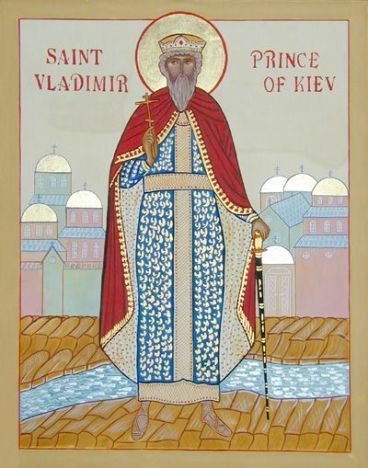
Today is the 1,000-year commestvladimir-big halifaxmoration of the repose of St. Vladimir, Enlightener of Russia. He was the emperor whose decision to convert to Orthodox Byzantine Christianity transformed Russia and turned its history in a new direction, in about 988. I was lucky enough to attend Liturgy today, in a parish with Russian roots, and to hear a homily on St. Vladimir from a priest who had graduated from St. Vladimir’s Seminary. The Orthodox Church in America has posted online a long and rich story of the saint if you would like to read more of his exploits than I can tell here.
The most famous story among the faithful is an account found in the Primary Chronicle of Russia, written about this time, of how Vladimir, when he was still a confirmed pagan, sent emissaries to check out the churches and faiths of his neighboring lands.

They were completely unimpressed with the Muslim Bulgars, partly because of the ban on alcoholic beverages; of the German churches they reported, “We beheld no glory there.”

But in Constantinople at Hagia Sophia: “…they led us to the place where they worship their God, and we knew not whether we were in heaven or earth, for on earth there is no such vision nor beauty, and we do not know how to describe it; we only know that God dwells among men. We cannot forget that beauty.”

This has been the experience of so many of us converts to Orthodoxy, that we can well believe the story, which is not held to be as certain as the facts about the politics of the time and how Prince Vladimir made an arranged marriage with the daughter of the Byzantine Emperor, and was baptized before the marriage. However it came about, his conversion was providential and has had tremendous ramifications for the last 1000+ years.

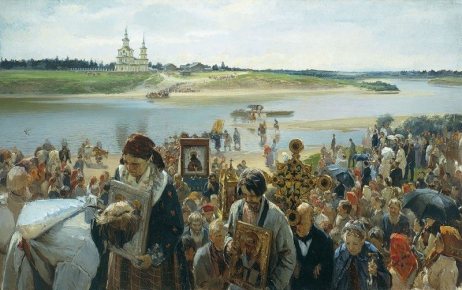
He ordered the baptism of all his subjects, who dutifully went down to the River Dneipr en masse the next morning. Here I want to quote from the OCA article about how this event resulted in the continuing celebration of another meaningful church feast day:

cross-procession-illarion-pryanishnikov

It is difficult to overestimate the deep spiritual transformation of the Russian people effected by the prayers of St Vladimir, in every aspect of its life and world-view. In the pure Kievan waters, as in a “bath of regeneration,” there was realized a sacramental transfiguration of the Russian spiritual element, the spiritual birth of the nation, called by God to unforeseen deeds of Christian service to mankind.

“Then did the darkness of the idols begin to lift from us, and the dawn of Orthodoxy appear, and the Sun of the Gospel illumined our land.” In memory of this sacred event, the regeneration of Rus by water and the Spirit, the Russian Church established the custom of an annual church procession “to the water” on August 1. Later, the Feast of the Procession of the Honorable Wood of the Life-Creating Cross of the Lord, which Russia celebrated with the Greek Church, was combined with the Feast of the All-Merciful Savior and the Most Holy Theotokos (established by St Andrew Bogoliubsky in the year 1164). In this combination of feasts there is found a precise expression of the Russian theological consciousness, for which both Baptism and the Cross are inseparable.

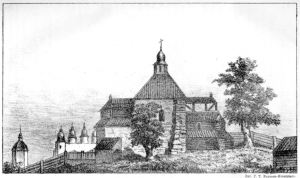
Prince Vladimir soon started to destroy pagan idols, some of which he had commissioned himself, and began serious reforms that would create a new church of the Tithes 17th cent Deśatynna_cerkvaChristian culture. He built monasteries and many and magnificent churches; hospitals, schools and orphanages. The capital city during this era was Kiev, and these first years of Christianity in Russia were a time of growth and prosperity and art. The hundreds of churches in Kiev were renowned for their beauty, for example, the fascinating Church of the Tithes, which has been destroyed many times and whose rebuildingvladimir card from vladimir 1000 yrs is under discussion again at this time.
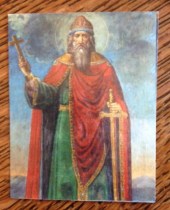
My own first experiences of Orthodox worship were not outwardly as splendorous as Hagia Sophia, but like those emissaries I felt the splendor of Heaven coming down on me. (Just this week I added to my page newly renamed “Orthodoxy and Me,” to tell much more of my story as a story and not just scattered parts.) In my parish we have a man who was born a Jew and took the name of Vladimir at his baptism somewhat late in life. This morning he joyfully passed out these little icon cards as gifts, and we were all glad that he was there so we could say, “Happy Name’s Day!”

Time to tan the knees.

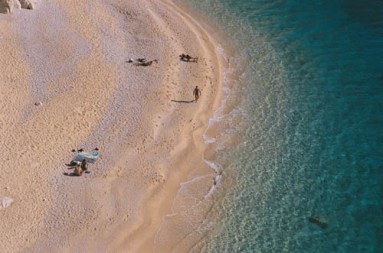
Certain philosophical questions are probably hard to focus on when you are lying on the beach trying to get a suntan. I remember a Peace Corps ad on TV that showed a couple slathered with oil and doing nothing under the sun, seemingly oblivious to their radio propped in the sand and telling the news about people suffering in a third-world country.

If you are sitting up and looking out at the ocean, you might appear to be meditating, or praying, so maybe no one would try to make you feel guilty. It’s been three years since I was on a beach warm enough to expose much skin, and I wouldn’t feel bad at all about soaking up some summer in that manner.

Well, none of this applies directly to the poem I am sharing today. I just love this lighthearted look at how we humans are.

THE SOUL AND THE BODY ON THE BEACH

The soul on the beach
studies a textbook of philosophy.
The soul asks the body:
Who bound us together?
The body says:
Time to tan the knees.

The soul asks the body:
Is it true
that we do not really exist?

The body says:
I’m tanning my knees.

The soul asks the body,
Where will the dying begin,
in you or in me?
The body laughed,
It tanned its knees.

~ Anna Swir (1909-1984), Polish poet,

translated by Czeslaw Milosz and Leonard Nathan

01467