Monthly Archives: June 2019

I sip nectar with the tiniest.

I sat in my garden reading Penelope Lively, who when writing about garden fashions that come and go, kept using the word “rill.” I picked up my phone to look up that word and see what the British might mean by it, and quick as a wink a tiny fly, almost too tiny to see without reading glasses, lit on the screen, with its wings open for about one second, a flash of shimmering rainbows.

Then it fell off, on to my book. Was that the fly, merely a black gnat? I got him to crawl on to my finger and back on to the screen, where he was kind enough to display his bright wings again for a moment, and then took flight.

On my walk yesterday I saw just one insect in a sea of catsear blooms. And I worked hard to get a picture of a flower with him on it. Not like most years of my photography, when I tried to avoid bugs on blooms, and would be disappointed if my flower were spoiled by a spider or something I hadn’t noticed when I clicked. But most of those critters had come out blurry anyway. No, getting a sharp image of an insect is not easy with a little phone camera. But I have time, don’t I? And a lot of digital storage, too, in case I don’t get around to deleting all those blurry pictures.

I started looking for flowers with insects, and of course, there were bees! It was so warm by this time, they were flying fast and furious, and couldn’t decide which of many privet or blackberry blooms to drink from, like kids in a candy store. The best shot I got was of one flying away with her loot. And I found a near relation to catsear beetle closer to home, descending a wide staircase of rose petals.

Obviously, I also am a kid in my own candy store, and can’t choose just one or two pieces of ambrosia to gaze upon or aim my camera at or share with you. If the temperature were constantly mild when I sit out in that paradise, I think I would fill to bursting with the joy of the place. But usually I get too hot or too chilly or find a task to do, so I don’t get dangerously stretched.

In my front garden many insects are buzzing back and forth and not lighting on any flower. I think they are just hanging around, or more precisely, swooping around — coming back to check every few minutes, so they can be the first to drink at the ocean of teucrium flowers that are going to start opening any minute now. I’m not sure that walkway will be wide enough for human feet to walk without colliding with honeybee wings.

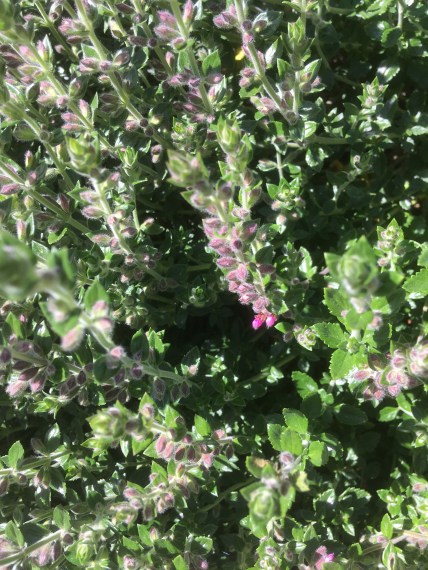
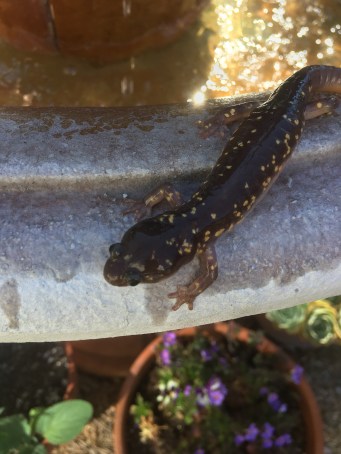
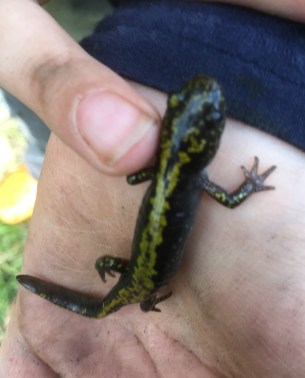
Many of the cistus, Jerusalem sage and helianthemum already need shearing! Alejandro my sometimes gardener was here yesterday and we moved one of the big pots that hold olive trees, and found two salamanders underneath! How they ended up in this droughty place I don’t understand, but I didn’t think about that at the time.
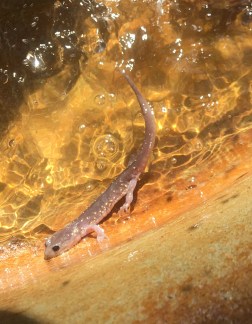
I grabbed the two of them, who looked like Mama and Baby, and put them to swim in the fountain for a minute while I ran into the house for my camera. Then I released them near a faucet with good luck wishes. Maybe I should have carried them to the creek? (Which reminds me, a rill in a British garden is a water feature.)
 

Back to the insect kingdom and their food… The word nectar carries a heady meaning. Drink of the gods – delicious. But the origin of the word is also pretty tasty if you like words: The first step back is to the Greek nektar (we’re talking about Greek gods, after all), “which is perhaps an ancient Indo-European poetic compound of nek- ‘death’ + -tar ‘overcoming,’ ‘cross over, pass through, overcome.'” No one used this word for the sweet liquid in flowers until about 1600.

Those links to the thought of overcoming of death could lead to an intellectual/writing exercise about how it’s all connected, but I’m not willing for that kind of workout today. I just want to join my fellow creatures in imbibing the sweets.


 

The almond, the light and the glory.

christ forgiving resurrection 2Until a recent vocabulary expansion, I knew little Italian beyond pizza and zucchini. Now I know mandorla, which means almond. In the language of iconography, it means a background shape, often an almond shape but not always, which conveys meaning having nothing to do with the nut.

In this article “Within a Mandorla” I read that “Revealed in the context of a mandorla is that which we know by the revelation of Scripture but which might not have been witnessed by the human eye – or – if witnessed – somehow transcended the normal bounds of vision.

“Mark says that [Christ] was “carried up into heaven and seated at the right hand of God.” This last formula is a creedal confession – but not an eyewitness description. That Christ was taken up and that He is seated at the right hand of the Father is the faith and dogma of the Church. But the Church knows this in a mystical manner and not in the manner of a newspaper reporter.”

And from a different source:

“Sometimes a star – but the usual elliptical shape gives it the name mandorla, which is Italian for the nut. The almond tree is the first plant to flower in Greece, sometimes as early as mid-January, and as such is a symbol of new life and fertility. Ancient Greek myths also link almonds, and the almond-shape, with new life; yet preceding all these in time, and succeeding them in importance, is the story of Aaron’s rod, which blossomed forth not only flowers, but almonds (Numbers 17:8)”

The mandorla can represent light that was actually seen by those present at an event, but it often also symbolizes the majesty and glory that is beyond our earthly vision or ability to put into words.

From Wikipedia: “These mandorla will often be painted in several concentric patterns of color which grow darker as they come close to the center. This is in keeping with the church’s use of apophatic theology, as described by Dionysius the Areopagite and others. As holiness increases, there is no way to depict its brightness except by darkness.”

The story of what the disciples of Jesus saw with their own eyes is told in the first chapter of the Book of Acts:

“So when they had come together, they asked him, ‘Lord, is this the time when you will restore the kingdom to Israel?’ He replied, ‘It is not for you to know the times or periods that the Father has set by his own authority.  But you will receive power when the Holy Spirit has come upon you; and you will be my witnesses in Jerusalem, in all Judea and Samaria, and to the ends of the earth.’ When he had said this, as they were watching, he was lifted up, and a cloud took him out of their sight.  While he was going and they were gazing up toward heaven, suddenly two men in white robes stood by them.  They said, ‘Men of Galilee, why do you stand looking up toward heaven? This Jesus, who has been taken up from you into heaven, will come in the same way as you saw him go into heaven.’”

  This year we Orthodox celebrate the Ascension of Christ on June 6.

The Lord has ascended into heaven
that He might send the Comforter to the world.
The heavens prepared His throne, and the clouds His mount.
Angels marvel to see a Man high above them.
The Father receives Him Whom He holds, co-eternal, in His bosom.
The Holy Spirit commands all His Angels:
“Lift up your gates, ye princes!
All ye nations, clap your hands:
for Christ has gone up to where He was before!”

The forest adorns itself and me.

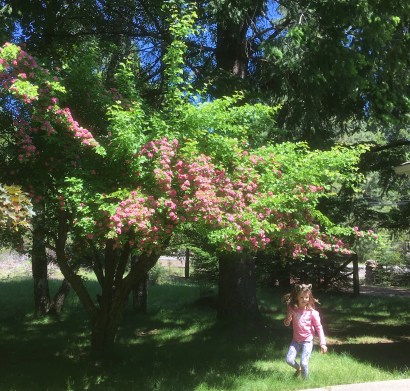
black locust

In the middle of Saturday’s graduation party, Pippin and I wandered through a gate into the vegetable garden and soon found ourselves sitting in two chairs that seemed to have been set there just for us introverts, who were perhaps unconsciously following the advice given to introverts as to strategies for party-going.

After the weekend was over and we were both in our separate towns and homes again, in “recovery mode,” it was amusing how we found ourselves still together, after a fashion.

I was sifting through my pictures and notes on my phone and looking through my Weeds of the West, the book Pippin had mentioned when I asked her about a weed growing in her own vegetable garden. I was only a few pages away from finding it when on my computer a message popped up from her with a photograph of that very page.

Great Hound’s Tongue

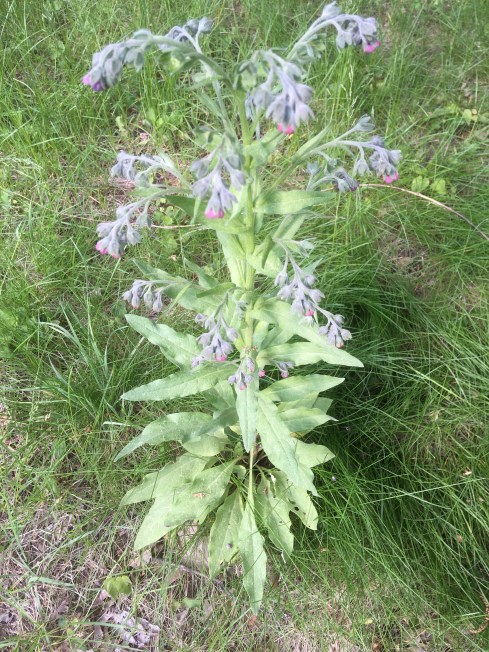
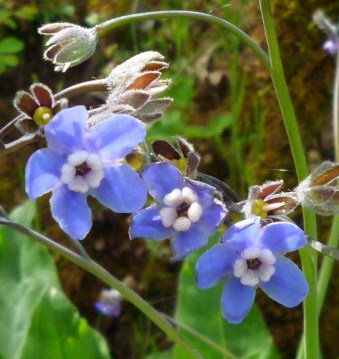
It is Common Hound’s Tongue, Cynoglossum officinale, or “gypsyflower,” which she said she always pulls out before it makes its terrible stickery burrs — and this very minute, when I looked for photos of them online, I realized that these are the burrs which one September I noticed looked like Mrs. Tiggy Winkle! It’s also the same genus as beautiful wildflowers like the Great Hound’s Tongue I saw in Oregon eight years ago.

There is also another photo of hound’s tongue in my files that I think might be Pippin’s work, because it comes from her neck of the woods and I don’t remember taking it:

If that weed in Pippin’s garden looks strangely familiar to those of you who have been reading my last several blog posts…. That’s because hound’s tongue is in the Boraginaceae Family! Yep, it’s closely related to borage. Well, well.

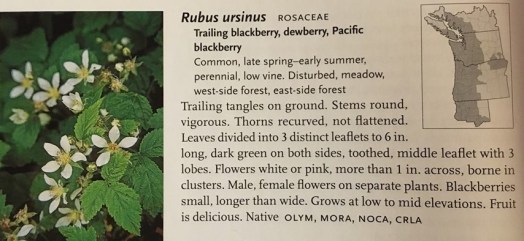
The first full day I spent at Pippin’s, we took a picnic to the lake before working in the garden. There we also found some plants to look into further. There was a white flowering bush my daughter told me was a ceanothus called Mountain Whitethorn, though its flowers can be blue or pink.  We saw a recumbent berry that Pippin identified yesterday as a Dewberry, a name that echoes in my mind from the distant past.

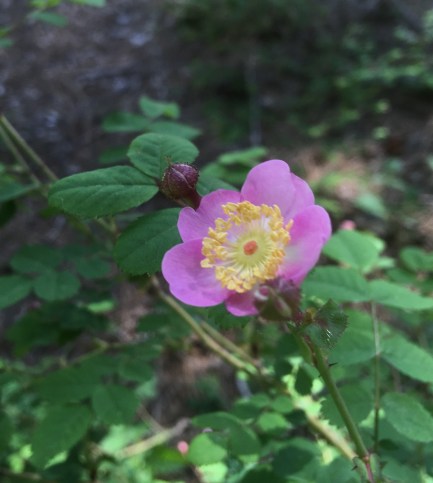
And we all stopped to look at a lovely wild rose,
until Scout in his bare feet ran into some red ants, and from then on we didn’t linger.

wild ginger
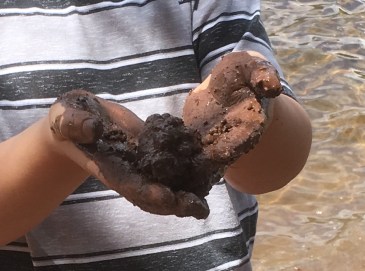
merely mud

Back when we’d arrived for our picnic, before we had even got fully out of the parking lot above the lake path, we were hit by the scent of black locust trees in bloom — so delicious. And because a couple of my readers have told me that the flower petals are edible, we all tried them. They were a little dry and bland compared to pineapple guava petals, in case anyone is interested. 🙂
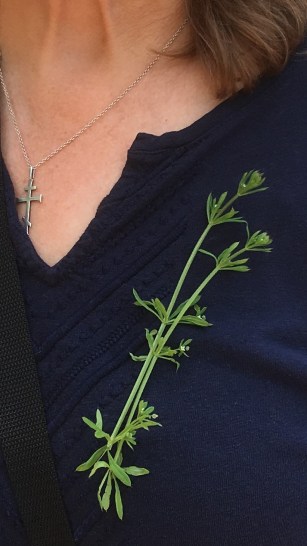
Right under the boughs of those trees Scout spied what he called “Botany Brooch,” and which I knew as the annoying sticky weed or catchweed, Galium aparine. But if you need a very temporary natural-looking piece of adornment, it lives up to its other nickname of “velcro plant,” and requires no difficult clasp to attach it, even after it  has wilted, which happens fast.

From this time forward, I will be less grumpy about this plant with a dozen nicknames, and who knows, you might even see me wearing a bit of it at my garden (work) parties.

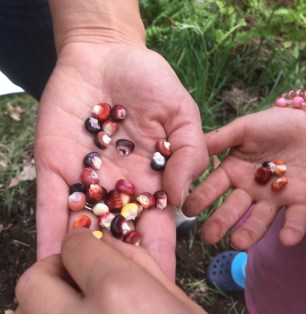
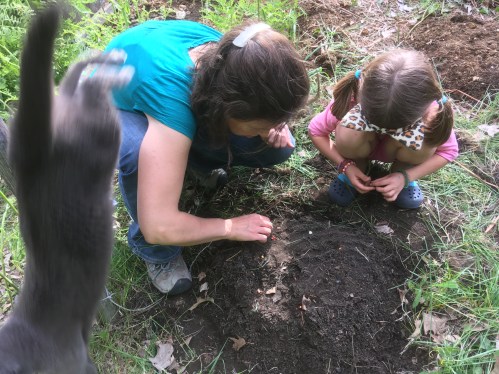
When we returned to the garden that afternoon it was to plant Indian corn that Mr. and Mrs. Bread had given from their bounty. Pippin has never tried to raise corn before but she knows people who do, up there where the growing season is not long. It needed to be planted inside the garden fence so the deer won’t eat it; we decided to dig some “hills” here and there where there weren’t too many rocks to extract.

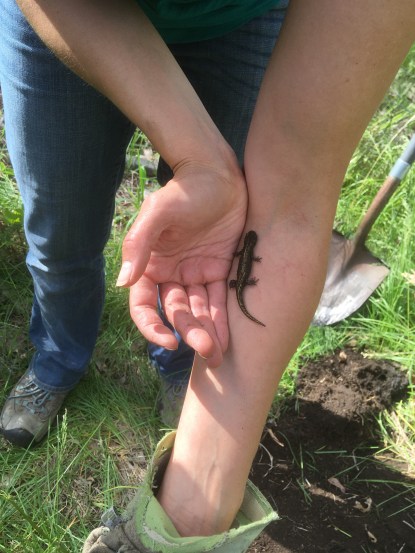
In the course of the afternoon the Professor brought us bags of compost and contributed to the dinner that was simultaneously in process. The children played all over the place, and helped to push the seeds into the earth, and discovered worms to feed to a toad that Pippin had found hiding behind a box. A salamander was unearthed and rinsed off and admired, and eventually let go in a wet area of the yard. I tried to take pictures of the striped bumblebees that are so pretty, compared to the fat black ones that I get down here.

blueberry flowers

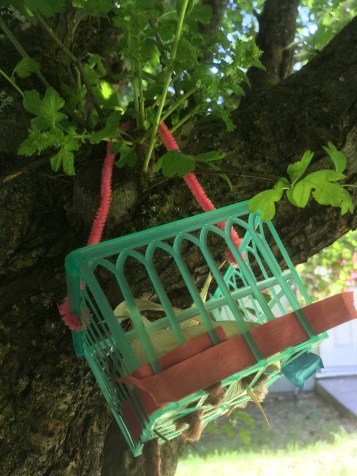
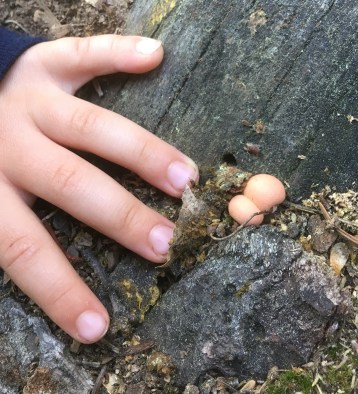
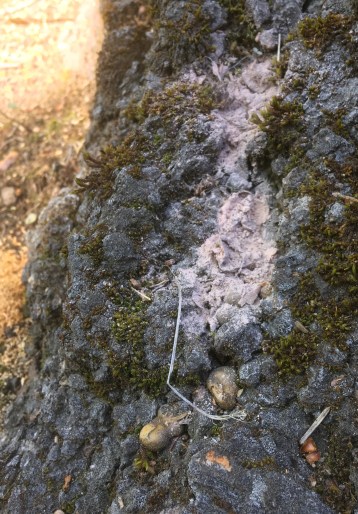
High in an oak tree Ivy has hung a little basket of nest-making supplies for the birds. A flesh-colored button of a fungus was decorating the old stump, evidently the immature stage of what will become a dry and brown puffball type of growth; after I took my picture the children showed me how the little brown balls above would release their powder if broken with sticks.

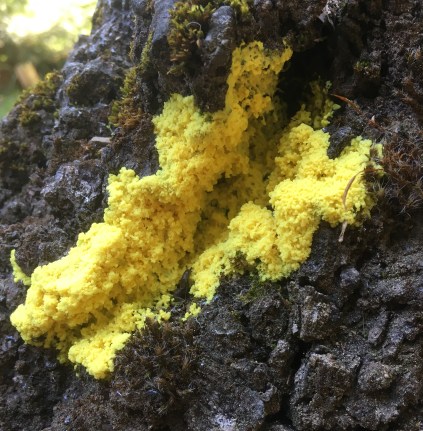
On the other side of the stump, a splash of brightness — is this also a fungus?

Around the homestead of Pippin’s family, the forest is always sharing its life and beauty. I suppose there will never be an end of things for me to explore when I spend time there. But for now, my own garden realm is waiting for me so I will send in my report and say good-bye for now!


Nature’s art and nature’s artists.

Just before the weekend linked May to June, I drove north to see two of my children’s families and to be with Annie on the day of her graduation from high school. Her brother is graduating from college this month, too, so the afternoon barbecue was in his honor as well.
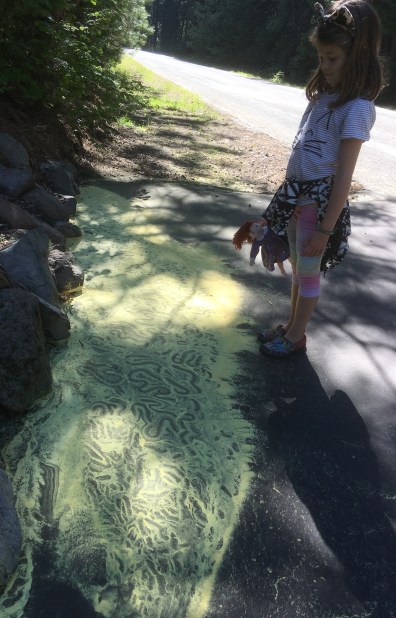
In the northern parts of the state winter was having its last fling all the way until Sunday; only a week before, Pippin had to put off her planting on account of snow, and I drove through a thunderstorm on my way up. When one downpour ended, the wind would blow the pine pollen around wildly, so that while Ivy and I lay on the grass birdwatching into the oak tree, a fine yellow blizzard suddenly whirled above and around us.

I stayed at Pippin’s. The morning of the graduation party, before I piled in the van with their family to drive up into Oregon, Ivy and I took a walk down the road and back. We saw strawberry flowers and the carcasses of wild animals, and some strange natural art.

It appeared that the same pine pollen that was plastered all over my car and lay as yellow dust on Pippin’s iris flowers had fallen on a driveway and then been washed by the rain into an intriguing design. We’ve been trying to imagine who or what prepared the asphalt “canvas” beforehand in such a way that the natural events could form these patterns.

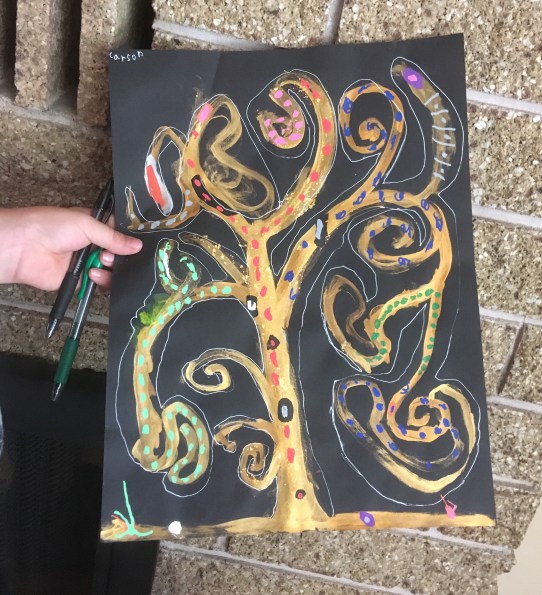
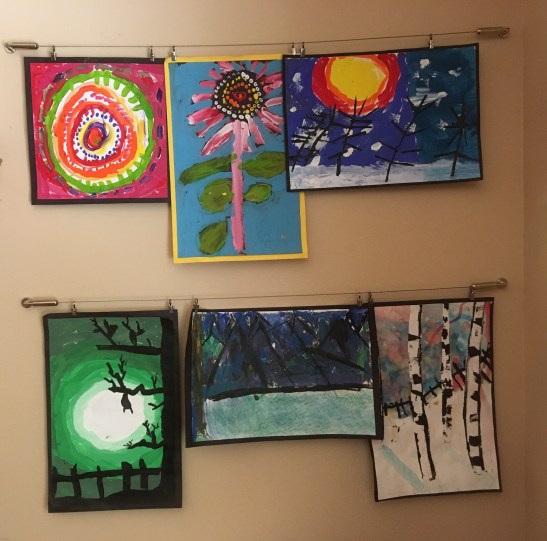
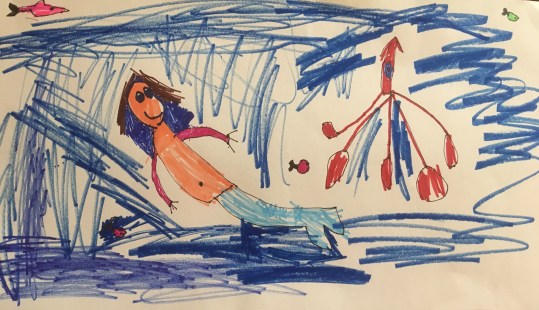
Just a bit later, after Ivy had washed her hair for the party, she and Scout showed me their collection of artwork from the past school year. It was hard to choose which of several dozen pieces to take away on my camera, but here is a little gallery:

mermaid and squid
wolf

Bouquet of flowers including book-, pencil- and butterfly-flowers,
in a detailed and highly narrative and symbolic vase.

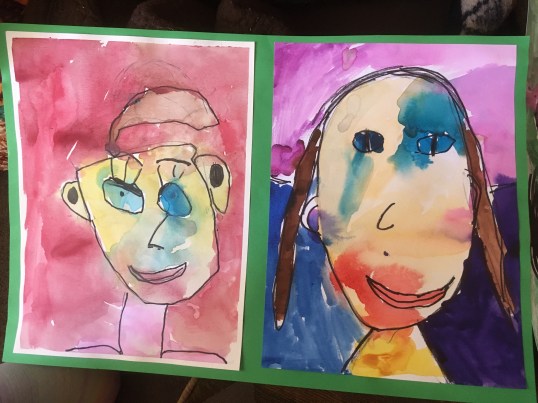
Self portraits by Ivy; note the pony tail at left.
Klimt style by Scout

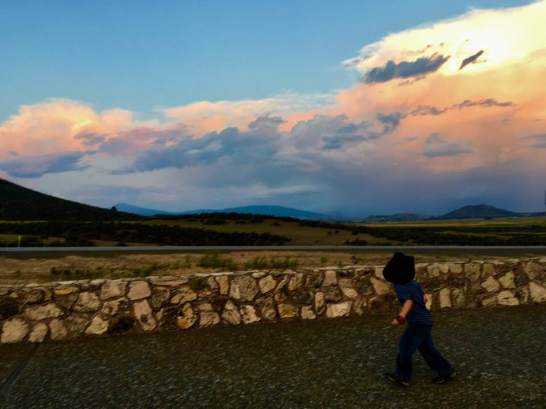
And then, Pippin’s picture of the last storm Saturday evening, and Jamie:


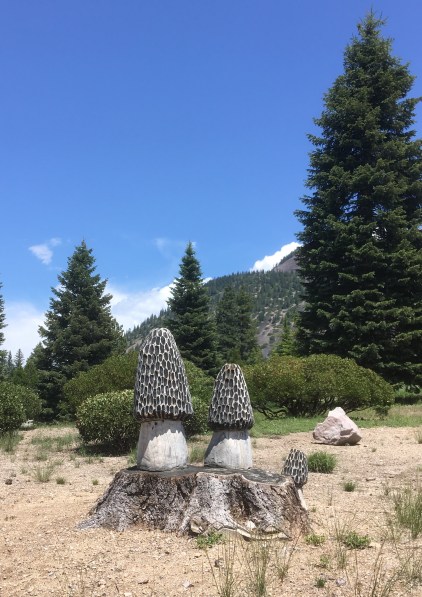
I’ll be showing you more of nature’s art in another post, but here’s a bit more human artwork — clever and beautiful use of natural wood — which I saw just as I was leaving town to come home. I put my car in reverse and backed up a hundred feet to the side of the road so I could take this picture for Pom Pom especially, but I know there are lots of other art and mushroom lovers out there.