Monthly Archives: December 2019

Not codes, but cookies!

This morning I started gathering and measuring ingredients for a few of the cookie recipes I like to make at Christmas. I was afraid to start mixing them and actually cooking, afraid I would make a mistake, with so many distractions of carpenters and tile-setters coming and going, asking questions.

The truck that brought the new sheet rock had a boom so long and mighty that it reached all the way from the street up to the second-story window, which was the easiest route in. The delivery was two hours late, so it arrived about the same time as the contractor and the inspector.

While the inspector was here I was on pins and needles from the suspense; she was returning to inspect the “corrections” she had noted on Monday. I opened the door to the wet back garden and looked out there without seeing, and prayed. It is scary what power these inspectors have, and in California the building code provides a endlessly shifting and growing body of regulations to draw from so that it is easy to find lots of things that need correcting, which translates to extra hours and money fixing things that aren’t broken. But enough about that — I started out wanting to talk about cookies!

And sugar. I know that sugar is BAD, but I find it hard to come down too hard on the stuff, partly because I have a historical family interest in C&H (California and Hawaiian) Sugar Company, for which my great uncle was a chemist.

Have you heard that cane sugar is better for you (or, more precisely, not as bad for you!) and makes better-tasting baked goods than beet sugar? I don’t know if either or both of those are true or myths. But I do always buy C&H cane, when I am buying white sugar.

When I poured a fresh bag into my sugar jar today I noted how pretty it is. I wonder if I ever showed you the jar that I have kept sugar in for decades; it came from my husband’s family’s cabin where I think they were using it for sugar when I first saw it.

Do you remember this picture from when I was in India,
of women buying coarse sugar from bulk bins?

This year I’m experimenting with making a few of my traditional cookies gluten-free, for the sake of a family member who I’d like to be able to eat them. But when it comes to sweetening, I don’t worry whether it’s fructose or sucrose or honey or beets — I just try to keep the sweetness to a minimum so we can taste the butter and other interesting flavors.

I eventually got the dough made for the Ginger Spice cookies, but I haven’t got one cookie into the oven yet. The kinds that I’ve started measuring out ingredients for are:

Chunky Ginger Spice
Double Pecan Thumbprints
Apricot Macaroons

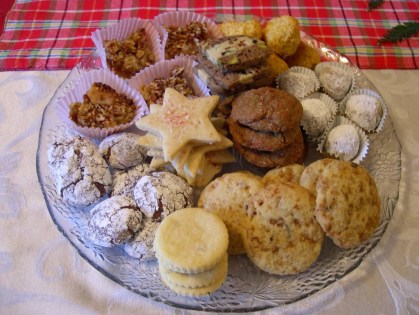
I was going to link you to the recipes…. Oops — I’ve never transcribed the recipes here! But the link on the Thumbprints above will take you to the recipe eventually. The photo of a cookie platter at top is from a few years ago. I hope tomorrow I can make a little more progress. It soothes my nerves to bake Christmas cookies.
The inspector signed off on all the corrections. She was surprised that “we” were able to get them done so fast. 🙂 I wish I’d had a plate of cookies to give her as she went out the door.

Sun temples don’t celebrate in winter.

Why is Christmas on December 25? Did Christians make use of a pagan festival date when they decided to celebrate Christ’s birth? Very unlikely, as you will understand if you read William J. Tighe’s  “Calculating Christmas.”

“In the Julian calendar, created in 45 B.C. under Julius Caesar, the winter solstice fell on December 25th, and it therefore seemed obvious [to some] that the day must have had a pagan significance before it had a Christian one. But in fact, the date had no religious significance in the Roman pagan festal calendar before Aurelian’s time, nor did the cult of the sun play a prominent role in Rome before him.

“There were two temples of the sun in Rome, one of which (maintained by the clan into which Aurelian was born or adopted) celebrated its dedication festival on August 9th, the other of which celebrated its dedication festival on August 28th. But both of these cults fell into neglect in the second century, when eastern cults of the sun, such as Mithraism, began to win a following in Rome. And in any case, none of these cults, old or new, had festivals associated with solstices or equinoxes.”

Tighe explains that “…the pagan festival of the ‘Birth of the Unconquered Sun’ instituted by the Roman Emperor Aurelian on 25 December 274, was almost certainly an attempt to create a pagan alternative to a date that was already of some significance to Roman Christians. Thus the ‘pagan origins of Christmas’ is a myth without historical substance.”

If they didn’t choose December 25 for that reason, why did they? For reasons we never would have thought of in modern times. Read the whole brief article to find out.

Jacinto and the Bishop

When they are traveling around the American Southwest visiting the many and remote parishes in their huge diocese, the French priests in Willa Cather’s Death Comes for the Archbishop often have an Indian companion along. At night they camp on the desert sand. This passage is excerpted from the tale of one such journey:

Kneeling on either side of the embers they repeated their prayer together and then rolled up in their blankets. The Bishop went to sleep thinking with satisfaction that he was beginning to have some sort of human companionship with his Indian boy. One called the Indians “boys,” perhaps because there was something youthful and elastic in their bodies. Certainly about their behavior there was nothing boyish in the American sense, or even in the European sense.

Jacinto was never, by any chance, naïf; he was never taken by surprise. One felt that his training, whatever it had been, had prepared him to meet any situation which might confront him. He was as much at home in the Bishop’s study as in his own pueblo — and he was never too much at home anywhere. Father Latour felt he had gone a good way toward gaining his guide’s friendship, though he did not know how.

The truth was, Jacinto liked the Bishop’s way of meeting people; thought he had the right tone with Padre Jesus, and that he had good manners with the Indians. In his experience, white people, when they addressed Indians, always put on a false face. There were many kinds of false faces; Father Vaillant’s, for example, was kindly but too vehement. The Bishop put on none at all. He stood straight and turned to the Governor of Laguna, and his face underwent no change. Jacinto thought this remarkable.

-Willa Cather

Maybe the Bishop and Jacinto share some qualities of character, and that’s why they appreciate one another. One aspect of Bishop Latour’s character that I see is his humility. In fact, perhaps there is a double meaning in the book’s title: not just the usual meaning of the ending of his earthly life, which we read about in the last pages, but also the little deaths that come to him day by day, not adding up but subtracting bit by bit from the possibility of earthly glory that might have been his, if he had given his fine mind and life to a different life back in France. Instead of fame and accomplishment, he sees defeat on many levels. But he accepts that.

Fr. Stephen Freeman recently wrote in “The Despised God” about the humility of God. He says, “The ‘glory’ of God is not the glory of wondrous success, shining fame and an incomparable reputation. Instead, we are told that we behold the glory of God ‘in the face of Jesus Christ.’… The crucifixion of Christ for Paul is more than an event that accomplishes salvation – it is an event that reveals Him in His fullness.”

“For many, such meekness in Christ is treated as something of a disguise, or a temporary work for the purpose of salvation. They all too quickly turn away from this understanding to assert that ‘He will come again in glory to judge the living and the dead!’ But there is nothing to indicate that the definition of glory is somehow being altered for the sake of the Second Coming. As for the imagery of the Revelation of St. John, it should be read through the Cross rather than used as a corrective for the Cross.

“… the friends of God are foolish, weak, base and despised. That is the narrow way. Interestingly, it is a way that is the most open for all to walk. We need not be wise, strong, and well-thought-of. It turns the world upside-down and our lives along with it.

“Right now the world is desperate for a few fools.”

-Fr. Stephen Freeman

The electrician learns of his special day.

Today the cousins and brothers who are the electricians on my project brought a fourth young man who was introduced as Nico. After they had all been working upstairs and I had been cleaning downstairs all morning, I began to wonder if any of them knew that today was St. Nicholas Day.

Then it occurred to me that “Nico” is probably short for “Nicholas,” so I ran up and waited nearby while he finished installing a fixture in the new hallway, and asked him if he was named for St. Nicholas. He said Nicholas was indeed his “real name,” and I said, “Today is your day! It’s St. Nicholas Day.” He had no idea, poor boy. But now he knows; I told him St. Nicholas is probably praying for him today.

Until that little conversation I hadn’t thought of putting anything pertinent on my blog, but it made me want to take advantage of the calendar to honor St. Nicholas again. I am giving you (for the third time!) a quote from Fr. Thomas Hopko below, in my post re-published from last year. Those of you who have had enough of that might like to go instead to this blog post from on how the memory of St. Nicholas can help us resist the spirit of the age and the “talk about our having ‘the best Christmas ever!’ It is as if Christmas is a rush that brings us perfect happiness.” It is here: “Saint Nicholas and the Meaning of Christmas.”

St. Nicholas is one of the “favoritest” saints in the Orthodox Church. I have read about him many times and don’t usually remember much. I didn’t grow up hearing about him as the real historical not-Santa-Claus person that he is, or knowing that there was such a thing as St. Nicholas Day, and since I became Orthodox I haven’t succeeded in implanting him in my heart in any satisfying way.

But we both live by and in the love of Christ, so he must be in my heart in spite of my neglect. I will pass on to you (again) what blessed me some years ago, from The Winter Pascha:

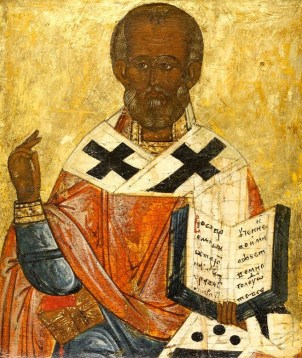
“The extraordinary thing about the image of St. Nicholas in the Church is that he is not known for anything extraordinary. He was not a theologian and never wrote a word, yet he is famous in the memory of believers as a zealot for orthodoxy, allegedly accosting the heretic Arius at the first ecumenical council in Nicaea for denying the divinity of God’s son.

“He was not an ascetic and did no outstanding feats of fasting and vigils, yet he is praised for his possession of the “fruit of the Holy Spirit…love, joy, peace, patience, kindness, goodness, faithfulness, gentleness, self-control” (Gal. 5:22-23). He was not a mystic in our present meaning of the term but he lived daily with the Lord and was godly in all his words and deeds. He was not a prophet in the technical sense, yet he proclaimed the Word of God, exposed the sins of the wicked, defended the rights of the oppressed and afflicted, and battled against every form of injustice with supernatural compassion and mercy.

“In a word, he was a good pastor, father, and bishop to his flock, known especially for his love and care for the poor. Most simply put, he was a divinely good person.”

-Fr. Thomas Hopko