Monthly Archives: March 2021

My non-philosophy that is reality.

Karl Jaspers

Why would a Christian like me want to read a whole book about existentialism? At least a few of my readers are confused about that. I may in the future share more of my gleanings from this book as it helps me understand this modern age that we live in, but now let me just clarify that it is the enlightening presentation by William Barret that I find beautiful, not the anxiety and “spiritual homelessness” of the Europeans whom he includes in the lonely camp of existentialists.

In contrast to their interesting but ultimately unsatisfying way of thinking, Father Stephen Freeman writes about our existence in a non-existentialist way. If I hold to a philosophy, it is this non-philosophy, which is reality, my life in God:

“The modern movement of secular thought has been to move existence into an independent and self-defining realm, relegating God and religion to a specialized interest of those who find themselves religiously minded. This is the death of religion – or rather a religion of death. For as soon as our existence is moved away from God and grounded in something else, God Himself has been abandoned. It is not possible for God to be a lesser concern. Either He is the very ground of our existence or He is no God.”

“As Met. John Zizioulas has famously stated, ‘Being is communion.’ In such a context we are able to move towards authentic existence – a mode of being that is not self-centered nor self-defined, but that is centered in the Other and defined by communion. Sin is removed from its confines of legalism and mere ethics and placed at the very center and character of existence itself. Sin is a movement towards non-being. In contrast, to know God is to love and its greatest test is the love of enemies. As St. Silouan taught: ‘We only know God to the extent that we love our enemies.’”

“Christ is, as He said: the Way, the Truth and the Life. His death and resurrection are the movement of God’s love to rescue humanity from a self-imposed exile from true and authentic existence which is found only in communion with God… It presses the question upon us all: ‘What is the truth of my existence?'”

 

To gather all the elements.

“Positivist man is a curious creature who dwells in the tiny island of light composed of what he finds scientifically ‘meaningful,’ while the whole surrounding area in which ordinary men live from day to day and have their dealings with other men is consigned to the outer darkness of the ‘meaningless.’ Positivism has simply accepted the fractured being of modern man and erected a philosophy to intensify it.

“Existentialism, whether successfully or not, has attempted instead to gather all the elements of human reality into a total picture of man. Positivist man and Existentialist man are no doubt offspring of the same parent epoch, but, somewhat as Cain and Abel were, the brothers are divided unalterably by temperament and the initial choice they make of their own being.”

-William Barrett, Irrational Man

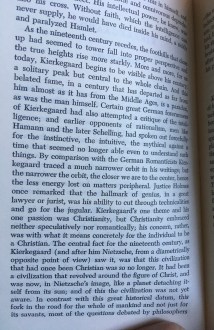
These paragraphs are from a book I’ve had on my shelf for a couple of years, since it was highly recommended to me by one of my most philosophical Christian friends. The subtitle is A Study in Existential Philosophy. I bought a paperback copy, but probably was unconsciously put off by the size of the print and the absence of white space on the pages.
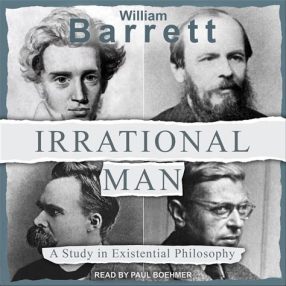
Recently I discovered that the book is on Audible, so I began yesterday on my drive  to the beach to listen to it, though I wasn’t very hopeful about being able to attend to the subject matter that way, having an “ear gate” that is extra narrow or full of obstacles or something… It’s particularly hard for me to read non-fiction when I can’t underline or take notes.

It’s a testimony to the clarity and beauty of Barrett’s writing that I was swept up into the story, as he tells it so engagingly, of the context and development of Modern Existentialism. As, in his words above, the need is for true philosophy “to gather all the elements of human reality into a total picture,” so also Barrett shows us a holistic picture by describing the interplay of cultural and historical roots of existentialism and of its effects.

Since high school I’ve had an inkling, or an awareness, that I needed to understand existentialism, but I feel that I’ve made little progress toward that goal. This book and I came into the world in the same decade, but I’ve been waiting for it my whole life!

Intersecting losses make a harbinger.

Five speeches that Aleksandr Solzhenitsyn gave  in the U.S. and in Britain in 1975 and 1976 make the book, Warning to the West. Today I sat on a log at the beach and got on with reading this collection that I’d started before Christmas; a while later I sat in my car overlooking the ocean and finished it.

It’s a nice little book, if you’d like a taste of Solzhenitsyn but don’t feel up to tackling one of his novels or The Gulag Archipelago. He said he prefers to write, but his speeches are powerful, and complement his writings. Taken altogether, these talks present a lot of history “from the inside,” and the perspective of someone whose analysis is based on thorough knowledge. His unique vantage point combines with true wisdom.

In different striking and blunt words to different groups, such as U.S. legislators and BBC listeners, he gives his prophetic message. While he uses details of events that were then recent history to make his points to his audience at the time, the heart of his concerns is ever pertinent and enduring.

“There is a German proverb which runs Mut verloren — alles verloren. ‘When courage is lost, all is lost.’ There is another Latin one, according to which loss of reason is the true harbinger of destruction. But what happens to a society in which both these losses — the loss of courage and the loss of reason — intersect? This is the picture which I found the West presents today.”

-Aleksandr Sozhenitsyn, 1976

Greens, munchers, and seeds.

As I woke on Sunday morning I saw through the slats of my window blinds the full moon going down, against a background that was being colorized from gray to pale blue. Well, it probably wasn’t quite full — because Kate had sent me a picture she took from Panama City, of the full moon on Friday evening. Pretty close, though.

When I went to church I admired the flowering plums, and after my ZOOM church school class that afternoon, I planted SEEDS! A day after the full moon, a few hours before March dawned….

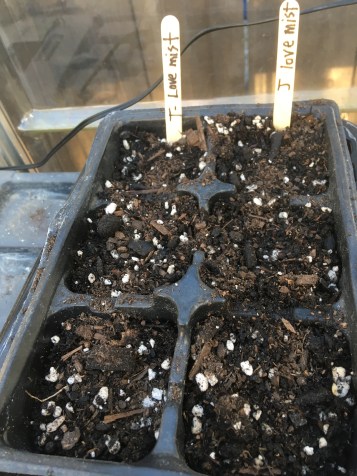
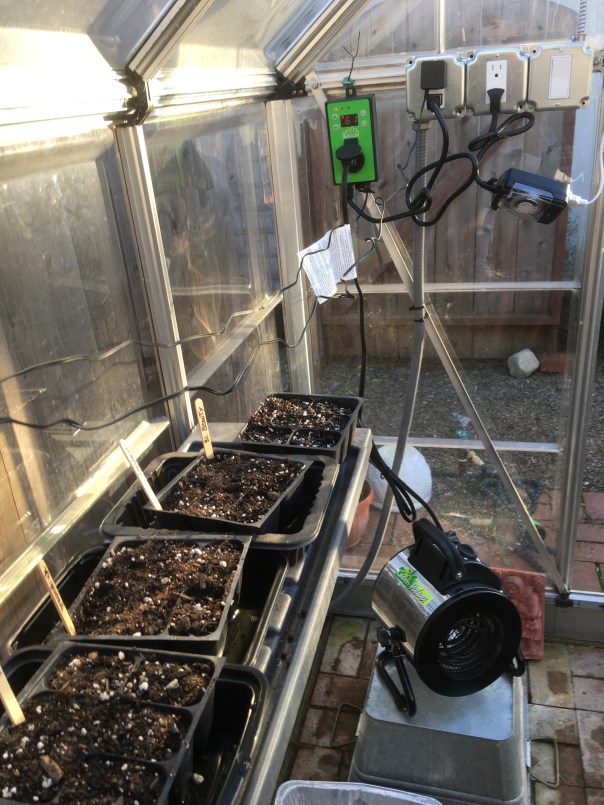
I was so glad to have a surprisingly balmy afternoon to work in, out in the garden. The day before, I had set up lots of little 6-pack  trays with potting soil, so that the soil could wick up water and be thoroughly moist. And because I ran out of time to plant anyway.

Two friends, Tim and John, had at different times given me seeds of Love-in-a-Mist from their gardens, one nearby and one in Oregon. So I planted them together, equal amounts, but in such a way that I could tell them apart. When they start sprouting I’ll update my blog report on what I’ve got going in there.

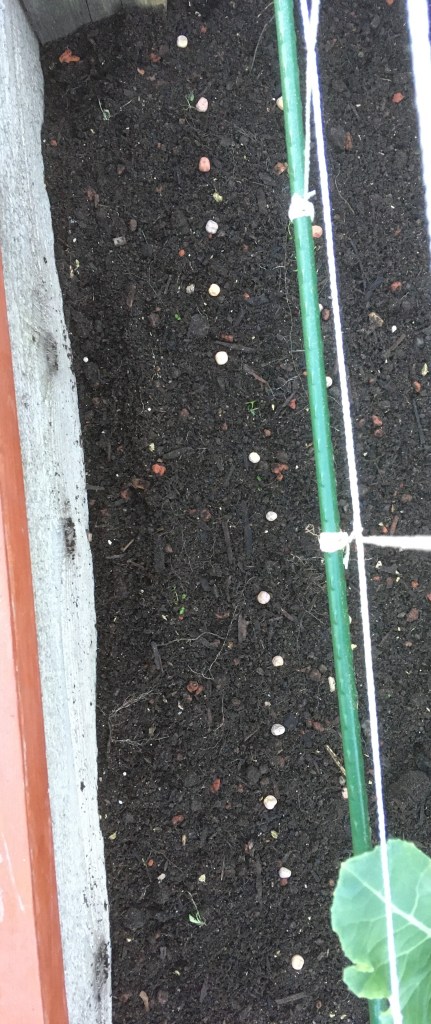
In the planter boxes I poked another (double) row and a half of snow peas into the soil, near where chamomile is coming up through the volunteer sweet peas:

I did some trimming and weeding in the rest of the garden, and discovered these caterpillars munching at my Yellow Bush Lupine. They are Genista Broom Moths, and I threw a few dozen of them into the green bin along with the trimmings. I’ve never noticed them as moths, but they look like they would be easy to miss. Maybe they will be a regular thing now that I have my lupine, which is the type of perennial and evergreen food they are known to like.

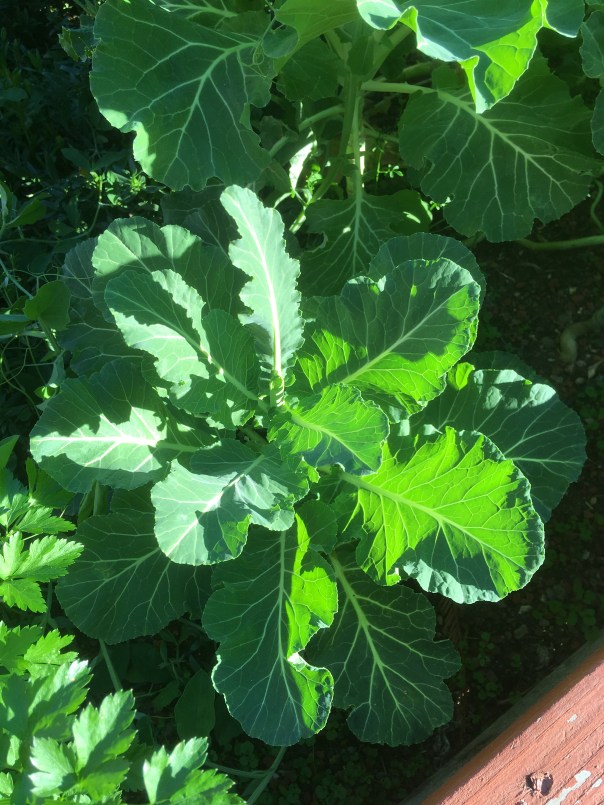
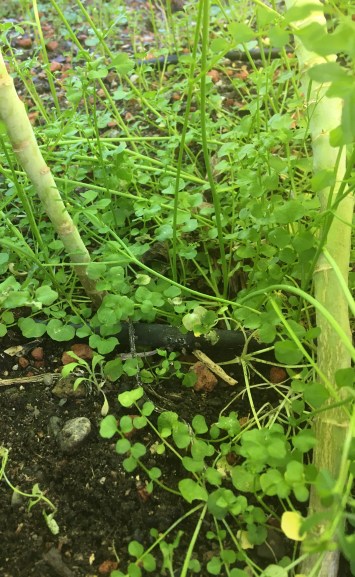
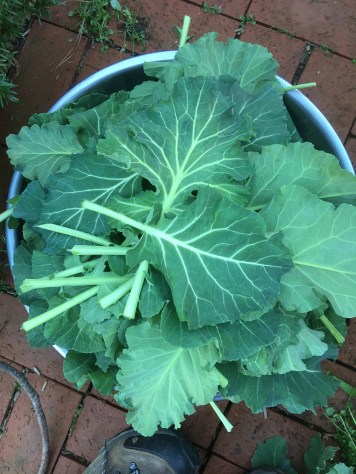
I feel about my collard patch the way some people feel about their chickens, or dahlias. They are so beautiful and healthy this year, I feel very proud and thankful, and want to take their picture again and again. Especially now that they are starting to flower, and I know I will need to pull them out and put summer squash in their place in another month or so. There were jungles of Hairy Bittercress in the grove of collards. I pulled weeds and pretty much scalped the plants to cook up a truly huge mess of greens.

Hairy Bittercress

Here is my absolute favorite way to cook collards. It’s a great recipe for church fast days and I make a big batch and put containers in the freezer.

COCONUT BRAISED VEGAN COLLARD GREENS

1 bunch collard greens
1 can of full-fat coconut milk
1 Tblsp. soy sauce
1/2 Tblsp. rice vinegar
1 bay leaf
1 pinch red pepper flakes (opt.)
1/2 tsp. sugar

Wash the greens and chop into bite-sized pieces. Put everything in a pot and simmer until tender. Add a little water if necessary and adjust seasonings to taste and to the quantity of greens.

I have made these several times with different amounts of collards every time. This last time I had at least eight quarts of chopped raw collards but still only used 1 can of coconut milk.

If you have a springtime garden, I hope it contains the minimum
of unwanted munchers and plenty of tender greens. To your health!