Orthodox Christian, widowed in 2015; mother, grandmother. Love to read, garden, cook, write letters and a hundred other home-making activities.
View all posts by GretchenJoanna →
He sometimes felt that he had missed his life By being far too busy looking for it. Searching the distance, he often turned to find That he had passed some milestone unaware, And someone else was walking next to him, First friends, then lovers, now children and a wife. They were good company—generous, kind, But equally bewildered to be there.
He noticed then that no one chose the way— All seemed to drift by some collective will. The path grew easier with each passing day, Since it was worn and mostly sloped downhill. The road ahead seemed hazy in the gloom. Where was it he had meant to go, and with whom?
If I had procrastinated just a little longer this evening, I’d have missed a great blessing. As it was, I had just enough minutes to take a walk and make it back before dark. I wished I had given myself time to drive somewhere different, but I did take a slightly different route. What I saw made me thankful in the end about all the timing.
As I set out I was recalling how I wanted to share pictures of the lemon curd I made last week. The color is so gorgeous, not just Lemon Yellow but Lemon and Egg Yellow. I’m not a fan of yellow for decorating my house or my self, but when I had just got my driver’s license as a teenager, I thought I’d like to have a yellow pick-up.
That idea must have been a response to discussion about such things among my friends; I can’t imagine that I was dreaming or scheming on my own initiative, as I don’t seem to have a (good or bad) ambitious bone in my body. I know I never tried in any way to get a vehicle. This evening, musing on my lack of yellow clothing, I emerged from the redwood grove at a street to see a yellow pick-up. I have to say, the one I “wanted” was older and rounder, but just about that color.
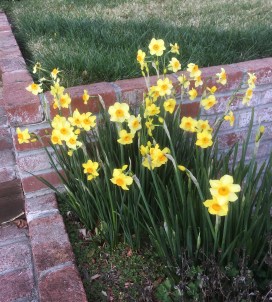
That was fun. I walked and walked and found blue and purple things to take pictures of. Lovely rosemary, and a too-blue house, that was trying to be a flag. Yellow, too, narcissus of a form that always pleases me when I see it at this time of year.
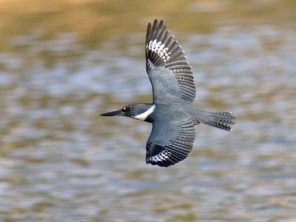
I ended up on the bridge over the creek close to my house, and there a man with a camera spoke to me; he wanted to talk with someone about the kingfishers he has been trying to photograph for six years. I have been walking along this creek for 25 years and I didn’t know we had kingfishers. He said there was an otter in the creek lower down a couple of years ago, too.
I mentioned the bald eagles I’d seen; he had not had that experience. And he said I certainly would have heard the kingfishers, they make such a racket as they fly just above the water, very fast. Would I have forgotten that? Of course it’s possible. I’m still surprised, though not incredulous, at what I have forgotten. The man was kind enough to introduce himself to me and shake hands, and he and I walked in the same direction down the path, talking about good places to see birds, and good hikes to take.
Photo from the Internet
And then, a great commotion, there they were, tearing down the creek channel behind the trees, not stopping to have their picture taken. So noisy! You probably all know their sound already but if not, you can listen here. About three minutes later, back they came just as loud and fast, but this time I glimpsed a flash of blue.
I was so happy to see that Mary Oliver wrote a poem about the kingfisher, because that wild creature may remain a phantom blue noise for me for a while to come, but — there was a sighting!
THE KINGFISHER
The kingfisher rises out of the black wave
like a blue flower, in his beak
he carries a silver leaf. I think this is
the prettiest world — so long as you don’t mind
a little dying, how could there be a day in your whole life
that doesn’t have its splash of happiness?
There are more fish than there are leaves
on a thousand trees, and anyway the kingfisher
wasn’t born to think about it, or anything else.
When the wave snaps shut over his blue head, the water
remains water–hunger is the only story
he has ever heard in his life that he could believe.
I don’t say he’s right. Neither
do I say he’s wrong. Religiously he swallows the silver leaf
with its broken red river, and with a rough and easy cry
I couldn’t rouse out of my thoughtful body
if my life depended on it, he swings back
over the bright sea to do the same thing, to do it
(as I long to do something, anything) perfectly.
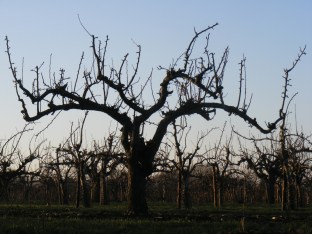
When winter was half over
God sent three angels to the apple tree
Who said to her
“Be glad, you little rack
Of empty sticks,
Because you have been chosen.
In May you will become
A wave of living sweetness
A nation of white petals
A dynasty of apples.”
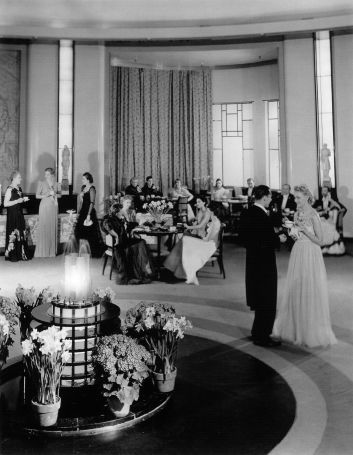
“There was an actress who wore a white dress with a circle cut in it just above her navel so that her skin could be seen, which looked very pink. Against the white, it was as if she had dropped a slice of ham on her lap; but it showed good feeling and willingness to think out new ways of pleasing.”
The actress appears at a party in New York, in the last pages of Cousin Rosamund by Rebecca West. At the end of the third novel in the Aubrey Trilogy, Rose is talking about her visit with her sister Mary to the United States during the Great Depression; West herself did visit many times, not as a musician but as a journalist and author. What she does in these books I think of as the best kind of historical fiction, the autobiographical kind; when I do my time travel I like to go about with a friend who knows the places and people well, who is observant, analytical, and attentive to every detail.
“Since the crash in America Mary and I were not offered nearly such good tours… but we could not keep away, and we felt a longing… to be with our friends again. They were so friendly and they were so violently engaged in life; being with them was like getting on a toboggan behind somebody one liked, putting one’s arms round them, and dashing off downhill over the spurting snow.”
“On the boat the American passengers told us stories of ruin, but with an upward, hopeful inflection that made them hard to consider: it was as if we were trying to look into the eyes of someone who wore brightly polished spectacles.”
“…these people spoke always of general ruin, which had not touched them yet but must, of this paralysis, spread further. They spoke too of prescriptions to end it, and showed themselves naked and newborn in their innocence, as unaware that blood ran in their bodies as they were of bandages and tourniquets.
“’They are like us when Papa went away,’ said Mary, as we drove home. ‘Do you remember how we talked about going into factories, we did not know which, and making enough to keep the house going?’
“’They are like us in other ways,’ I said. ‘They speak of the stock market as something that has an independent existence and sometimes gave them lots of money. It was their father, they are like us, they are gambled children.’”


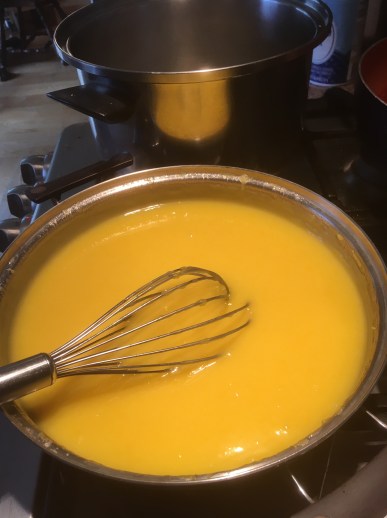
 As I set out I was recalling how I wanted to share pictures of the
 That was fun. I walked and walked and found blue and purple things to take pictures of. Lovely rosemary, and a too-blue house, that was trying to be a flag. Yellow, too, narcissus of a form that always pleases me when I see it at this time of year.