When Les Murray died, some obituaries made reference to him “vanishing into the future.” This poem contains the source of that phrase, and makes me think of kairos, or “eternal time,” and the Kingdom of God, which is always a stretch of the mind, because our relationship to this time that we swim in is so mysterious.
I appreciate Murray’s exploration of the subject, which humbles me with the reminder of all that we don’t know, and the foolishness of getting caught up in our “projections.” I am comforted by the last lines bringing us back to Christ, and us together with Him, in the “future,” which, if we could see with the eyes of faith, is also Now. He not only “told us that evil would come,” but He said, “Lo, I am with you always, even to the end of the world.”
Fr. Stephen Freeman writes about time, history, and the Kingdom in “What’s With the Kingdom of God?” and in “Mystery as Reality,” asking, “…if the Kingdom of God is already complete and we are already able to participate in it and we await the day of its full manifestation, then what is the place of history and the events associated with our salvation that have occurred in space and time?”
I’ll leave the broader questions for now and hope that after all that rambling you can still enjoy this more focused poem for itself. The reference to yarrow stalks in the poem is in regard to their use in reading the I Ching.
THE FUTURE
There is nothing about it. Much science fiction is set there
but it is not about it. Prophecy is not about it.
It sways no yarrow stalks. And crystal is a mirror.
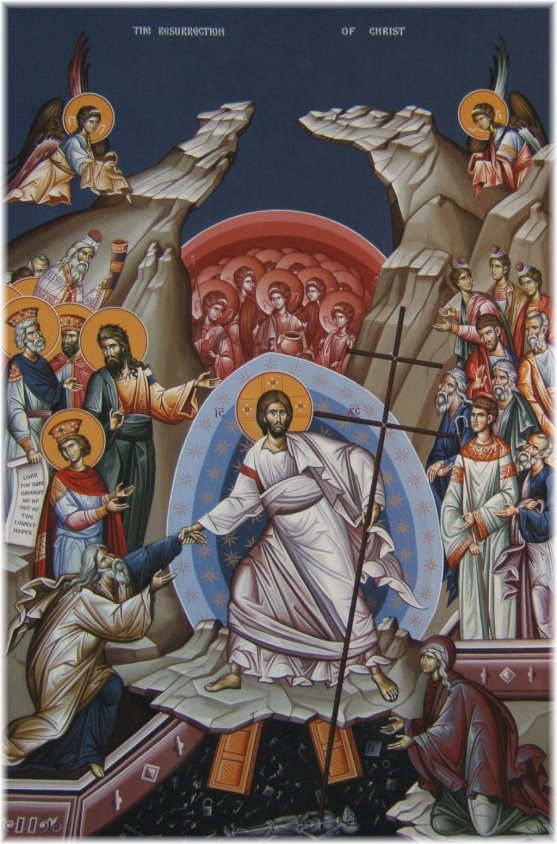
Even the man we nailed on a tree for a lookout
said little about it; he told us evil would come.
We see, by convention, a small living distance into it
but even that’s a projection. And all our projections
fail to curve where it curves.
It is the black hole
out of which no radiation escapes to us.
The commonplace and magnificent roads of our lives
go on some way through cityscape and landscape
or steeply sloping, or scree, into that sheer fall
where everything will be that we have ever sent there,
compacted, spinning – except perhaps us, to see it.
It is said we see the start.
But, from here, there’s a blindness.
The side-heaped chasm that will swallow all our present
blinds us to the normal sun that may be imagined
in their ordinary day. A day to which all our portraits,
ideals, revolutions, denim and dishabille
are quaintly heartrending. To see those people is impossible,
to greet them, mawkish. Nonetheless, I begin:
‘When I was alive –’
and I am turned around
to find myself looking at a cheerful picnic party,
the women decently legless, in muslin and gloves,
the men in beards and weskits, with the long
cheroots and duck trousers of the better sort,
relaxing on a stone verandah. Ceylon, or Sydney.
And as I look, I know they are utterly gone,
each one on his day, with pillow, small bottles, mist,
with all the futures they dreamed or dealt in, going
down to that engulfment everything approaches;
with the man on the tree, they have vanished into the Future.
-Les Murray

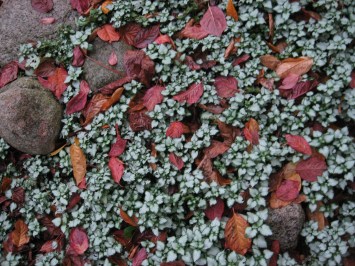
 What sets this autumn apart from any other is my distaste for leaves turning color. Out of the corner of my eye I’ve seen it happening, and my heart protests, “Oh, please don’t!” I look the other way. Time has been swallowed up in remodeling, or waiting for remodeling, and the steady progress of months and seasons was not in my face so colorfully until now, telling me that without a doubt the end of the calendar year is drawing near as well.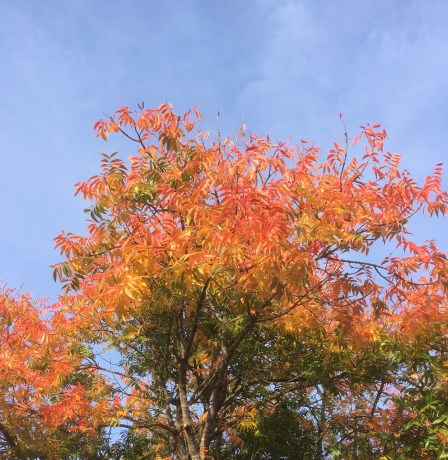
 peat the horrors of the fires of the last two years. Too bad we can’t put all that behind us — but “it” is trying to be part of our future as well, a reality of which the power company keeps reminding us, and shutting off the power as a precaution.


 on with my blessings has a hard time imagining a home in which children do not hear reading and are not read to, even prenatally. The cadences of ordered meaning should be with
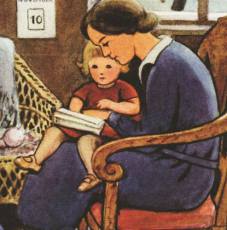 them, in them, and growing from their beginnings to a supernal End. The intuition of number, with which all are born, is, by education, not taught so much as recognized, named, and applied. Combine the intuition of number and the cadence of ordered meaning and one has music. A mother singing a melody to her unborn child is fitting him for greater glories, first perhaps of Mozart and Bach, and finally of heaven, whence all this comes and to which it returns.”
