All posts by GretchenJoanna

Unknown's avatar

About GretchenJoanna

Orthodox Christian, widowed in 2015; mother, grandmother. Love to read, garden, cook, write letters and a hundred other home-making activities.

St. Michael the Chief Commander


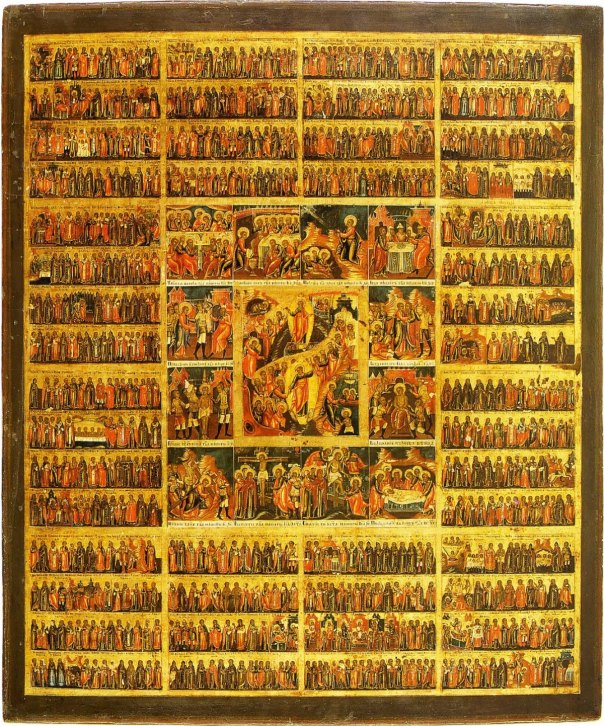
Today we commemorate St. Michael and all the Bodiless Powers. This feast day was established at the beginning of the fourth century, even before the First Ecumenical Council. This page on the Orthodox Church in America website explains the nine ranks of angels and much about St. Michael, the Chief Commander of angels.


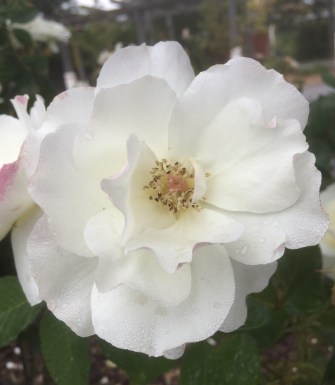
When I arrived at church I saw a rose gracing the damp and grey day,
so I memorialized it, too.

Father Stephen reminded us of a prayer that came from his son at about four years old:

Dear St. Michael,
Guard my room.

Don’t let anything
eat me or kill me.

Kill it with your sword.
Amen.

He shared other stories on his blog about children especially, who have seen their guardian angels. Our rector in his homily noted that many of us have our physical senses finely tuned so that we can know, when we taste wine, where the grapes were grown; and when we hear music we often know if it’s off-key, or even who composed it. But our spiritual senses are usually so dull that we not only can’t see our angels, but we mostly ignore them. In any case, they are there, guiding and protecting us! Let’s try to pay more attention.

How to love a strawberry tree.

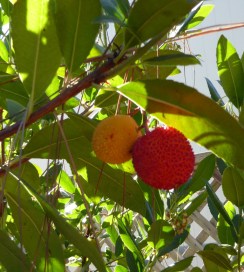
This summer my strawberry tree got my attention as never before, for a couple of reasons. First, there was lots of fruit. This is probably because of the wet spring we had, and because the tree is bigger than ever, and has been pruned twice in the last few years.

When I was popping the “berries” into my mouth I noticed that some of them were damaged, or that they were inhabited by other hungry creatures. That began my months-long more intensive engagement with my tree.

Let me tell you why I love this tree so much:

1) My husband and I planted our Arbutus unedo together, perhaps 15 years ago, so it’s got history with me.

2) It grows and grows without demanding any attention; it’s drought-tolerant, shade-tolerant and frost-resistant.

3) Even without its fruit it’s a handsome tree, but its blossoms and fruit add to that beauty over a long period.

4) The fruit is yummy and bears over a long period in late summer and fall, and the birds don’t seem to eat it.

Below, those are pine needles from the tree above, hanging like tinsel all over my tree.
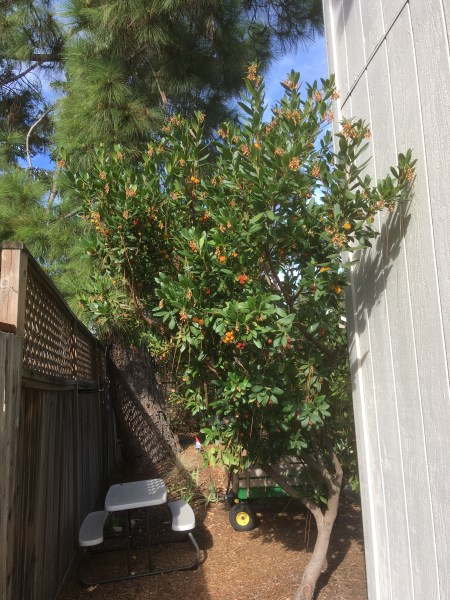
The Strawberry Tree is native to the Mediterranean region, and also western Europe and southern Ireland. Here in California it’s grown a lot as an ornamental and usually the people who are familiar with it as a good landscape tree are surprised that I like to actually eat the fruit. Even the volunteers at the nearest Master Gardener help desk were surprised. I regretted that when I took in a few inedible fruits for their scrutiny I hadn’t brought a bunch of prime examples for snacks as well.

The Master Gardeners thought that the dark mottling of some fruit, which fruit also never ripens but remains hard as it dries up, was likely caused by a watering issue. That seems strange to me, because we had such a wet winter, and late rains, you’d think the tree would still have its roots down deep in the moist earth. But I had given it a long drink even so, before I asked.
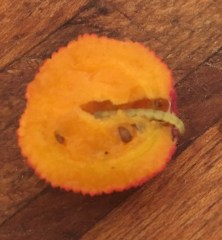
They studied and studied my pictures of the worms that were not around anymore for me to bring in as live specimens, but they could not identify them, though a couple of the staff consulted at length their University of California entomology databases. That didn’t surprise me, because if you look online, no one ever mentions one problem with the fruit – all the pests and diseases mentioned affect the leaves or the bark.

We are hoping that these worms will not come back in greater numbers next summer, but if they do, I’ll bring in a live worm for our research. They are icky. I can tell you, they get very excited when you slice their food-house in half, and their writhing about makes them more unlikable.

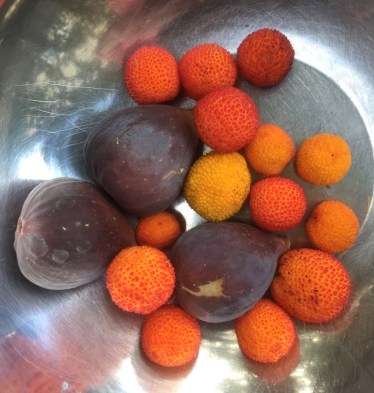
Let’s switch back to a photo of robust and radiant, healthy fruits. Yum. I think they are best when they are just turning orange, because they are plenty sweet, but still slightly firm. Their flavor then is also brighter than when they turn red and are starting to get soft.

I saw a picture of a crumble cake made with the fruit, in one of the many countries that appreciates them as a food crop, so when I baked a fig and almond cake recently, I added some cut-up fruits. Either they disappeared, or turned blue as did the figs, because there was nothing remotely red or yellow in that cake when we ate it, except the dried apricots.  😦

We haven’t had a frost yet, and I have a feeling I’ll have “berries” to enjoy until we do.

The poetry of a wise man might crack your shell.

Many people seem to think that politics will save us, that if we could just get the right people, or “our people” in office, they would begin to set things right, however we envision that. Anthony Esolen in the article Listening Up, in the Nov-Dec 2019 issue of Touchstone magazine, discusses some reasons for this idea, and its often corresponding impulse to judge our human forefathers for their sins, judgment not “by eternal verities, but by the cheap modern substitute, the ‘political.'”

He believes we lack historical imagination, and he sets out to consider the different ways one might make better use of stories and history in general, giving examples first from antiquity:

“So to attempt to transpose Xenophon or Cyrus to the current day, and to grill him with ‘political’ questions, is not to think politically at all, but to replace reality with a caricature. You will learn nothing from Xenophon that way. You may instead be out to teach him a lesson, him, that is, being the cartoon Xenophon you have made. At no time do you allow yourself to be still and to learn, so that the poetry of a wise man might penetrate your shell, crack it open, and show you the stars.

“Once you enter the world of history, you encounter the maddening complexity of human affairs, not to mention that labyrinth called the human heart. With hindsight we can say, with some confidence, that the young Octavius was far better suited for governing the Roman world than was the elder and more experienced Antony. We cannot be so sure of ourselves, though, when it comes to the noble-minded Brutus, and the ambitious and capable Julius Caesar, whom he assassinated.”

Esolen goes on to mention American leaders of note, and of complex history and character, such as William Tecumseh Sherman, and Stonewall Jackson, “a genuinely kindly owner of slaves.” And then he comes to his “three broad categories of modern man, each of them characterized by the stories they listen to and tell”: The Man of Faith, The Man of Wistful Unbelief, and the Man of Superstition.

I found his categories to be very helpful in understanding differences between people in the first two groups especially, and their stories that nourish our hearts. Oh, if only the third group would quiet down and listen to some true stories! But they don’t like the stories of the other two groups, and have their own ever-changing and doubtful heroes.

“History is too dark and tangled a forest for them, sacred Scripture too high a mountain to climb. Therefore they fall into worship of the biggest or most prominent things near them: sex, themselves, the State.”

“They are not brave enough to enter the dark caverns of the human heart…. they cannot forgive what men and women really are. They have no sense of sin, which afflicts everyone, including themselves, but they grasp at being among the elect, by having the most up-to-date pseudo-political opinions.”

You can read the whole article here: “Listening Up.”

People who make history know nothing about history.
You can see that in the sort of history they make.
-G.K. Chesterton


The chimes of neverwhere.

THE CHIMES OF NEVERWHERE

How many times did the Church prevent war?
Who knows? Those wars did not occur.

The neither state of Neverwhere
is hard to place as near or far
since all things that didn’t take place are there
and things that have lost the place they took:

Herr Hitler’s buildings, King James’ cigar,
the happiness of Armenia,
the Abelard children, the Manchus’ return
are there with the Pictish Grammar Book.

The girl who returned your dazzled look
and the mornings you might have woke to her
are your waterbed in Neverwhere.
There shine the dukes of Australia

and all the great poems that never were
quite written, and every balked invention.
There too are the Third AIF and its war
in which I and boys my age were killed

more pointlessly with each passing year,
but there too half the works of sainthood are,
the enslavements, tortures, rapes, despair
deflected by them from the actual

to rain on the human-sacrifice drum
which millions never have to hear
beating for them in Neverwhere.

-Les Murray

I discovered an earlier version of the poem online which speaks overtly of the Devil and of Christ’s love, but this is the one the poet chose to include in Selected Poems.