All posts by GretchenJoanna

Unknown's avatar

About GretchenJoanna

Orthodox Christian, widowed in 2015; mother, grandmother. Love to read, garden, cook, write letters and a hundred other home-making activities.

Poetic cooking while in fetters.

coconut curry with garbanzos

Since my husband’s death three years ago I’ve had three long-term housemates. Two of them have moved on, so that Susan and I are the only ones here, just two of us using the cupboards and large freezer space. This situation dovetails with my own less-burdened mind, which  now is able to grasp:

Yes! The obvious thing is to clean out the larder, use up the food, and start planning and cooking interesting meals with all the bits of this and that squirreled away. Facing up to what is unusable is part of the process; the soup that got lost in the back of the freezer for too long is one of the hidden costs associated with huge life changes, and is not a cause for guilt.
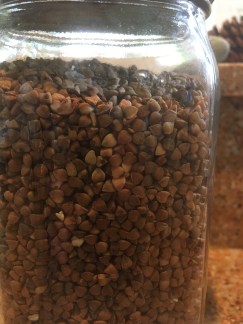
kasha (buckwheat)

Chesterton’s wisdom on creativity always helps me: Thrift is the really romantic thing; economy is more romantic than extravagance…  economy, properly understood, is the more poetic. Thrift is poetic because it is creative; waste is unpoetic because it is waste. It is prosaic to throw money away, because it is prosaic to throw anything away; it is negative; it is a confession of indifference, that is, it is a confession of failure.

The most prosaic thing about the house is the dustbin, and the one great objection to the new fastidious and aesthetic homestead is simply that in such a moral menage the dustbin must be bigger than the house. If a man could undertake to make use of all things in his dustbin he would be a broader genius than Shakespeare.

Another development since I returned from India is that I can’t go back to the weird eating habits I had fallen into as soon as I no longer had anyone to cook for routinely. Eating normally and very tastily for eight weeks cured me forever, I think, of my go-to frozen chopped spinach that I had been eating as the main part of every meal. Yesterday I used the last of it with a little container of likewise defrosted meaty red sauce and a (fresh) egg, to make a perfect breakfast:

These limitations I have placed on myself made me remember other things Chesterton said about art and painting and limits, and that led me on an interesting path through fields of quotes on the topic. Talk about limits and people will argue that they only exist in your mind, and must be “dropped,” if you are “to go beyond them into the impossible.” Even Winston Churchill is reported to have said, “The vistas of possibility are only limited by the shortness of life.” But he wasn’t trying to get dinner on the table in an hour.

Modern man seems especially prone to this delusion, but there are many sage exceptions, like Robert Browning: “So free we seem, so fettered fast we are!”

In matters of food and cooking, even if you had unlimited money you have limited time, and limits on whom you might find to prepare the ingredients, the choice of which is always limited to some degree, and on and on. I know you all know these things; this is my philosophical rambling you’re reading.

“Untitled” by Richard Diebenkorn

I am not advocating for an unhealthy fear of trying something new, but actually the opposite. As George Braque said, “It is the limitation of means that determines style, gives rise to new forms and makes creativity possible.”

And though Richard Diebenkorn was talking about painting, this word from him is empowering when considered at the beginning of any creative work: “My freedom will be so much the greater and more meaningful, the more narrowly I limit my field of action and the more I surround myself with obstacles.”

Yesterday I found several very ripe bananas in the freezer, and I did not want to waste them, even if their monetary value at purchase was minimal. You can imagine what they looked like after being there for a while; I’m sure I couldn’t have found a neighbor who wanted them. Anyway, part of my “style” is to stay home. I avoid going shopping, and knocking on doors for any reason. If only I had got my hoped-for worm bins set up, I would have given them to the worms!

But various baking supplies were sitting in the refrigerator begging to be used, so I put everything together into an unusual banana bread. It started from a “paleo” recipe with almond flour, but when I substituted egg replacer for the eggs I created a Grain-Free Vegan Chocolate Chip Banana Bread.
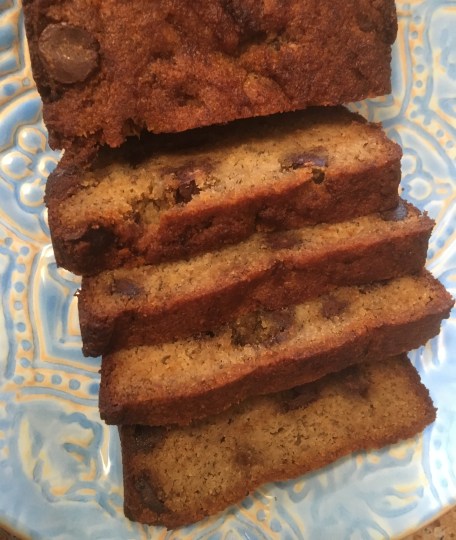
It is a work of super enjoyably edible art!

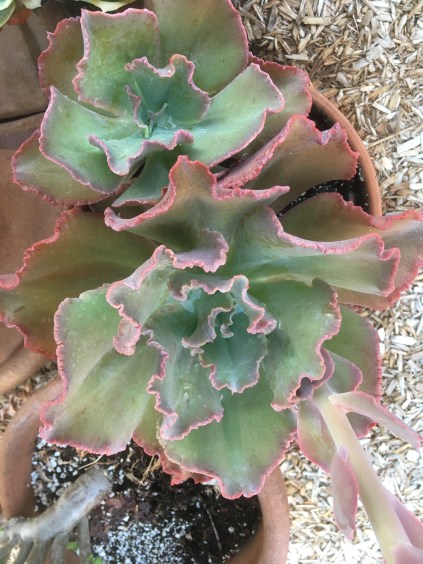
time happiness

9IMG_8984

I don’t know what “time happiness” means exactly, but I have an inkling about the longed-for place that St. Nikolai talks about:

Moments of happiness are given to you only in order to leave you longing
for time happiness in the bosom of the ever happy Lord;
and ages of unhappiness are given to you
to waken you out of the drowsy dream of illusions.

O Lord, Lord, my only happiness, will You provide shelter for Your injured pilgrim?

– St Nikolai Velimirovich

And I don’t know anything about “ages of unhappiness.” My sad times can’t by any stretch be called ages, though it’s true, when one is in the midst of intense sorrow, time warps.

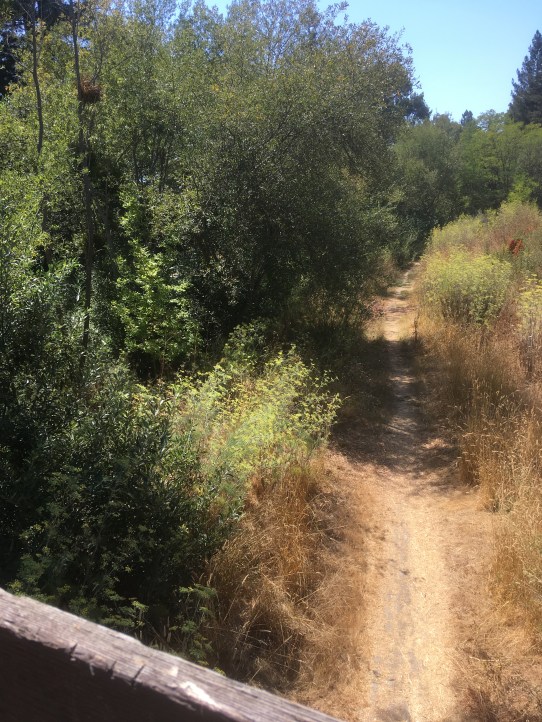
Today has been sweet and kind of dreamy. I stopped on the bridge over the creek and thought about how beloved this little patch of suburbia has grown, especially in the last three years. This is the season when the creek bed is so packed with plants, you can’t see the little water that is down there. It was quiet and warm. The warm part of the day is short now.

I was passing by the yard with roses, lilies and other plants that are wilted and ugly from drought, insects, and disease. No one cares enough about them to pick off a dead leaf. And then what caught my eye and made me stop? A weed growing next to the fire hydrant.

“Weeds grasp their own essence and express its truth.”
– Santoka Taneda

It occurs to me just now that I may have posted a picture of this weed once before, recently… if so, it is deserving enough for a repeat showing.  It has been neglected just as much as the cultivated plants, which for a weed means it was not killed or pulled out. That has let its essential health and hardiness shine forth and produce tiny and flowers all over, decorating the wasteland beautifully.

Real needs are not far from us.

Van Gogh – The Good Samaritan


I think each village was meant to feel pity for its own sick and poor whom it can help and I doubt if it is the duty of any private person to fix his mind on ills which he cannot help. This may even become an escape from the works of charity we really can do to those we know. God may call any one of us to respond to some far away problem or support those who have been so called. But we are finite and he will not call us everywhere or to support every worthy cause. And real needs are not far from us.

-C.S. Lewis

A palace in the cosmos.

These narrowleaf milkweed flowers were the inspiration for the first draft of this blog post, which I thought to title “Wonders of the Universe.” Their intricacy and delicacy wowed me!

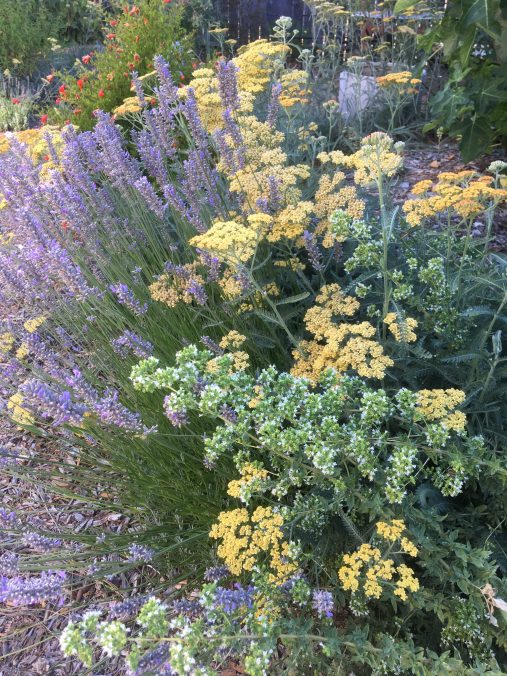
I had been thinking for some time about the gentle bombardment of the senses I experience in my garden, including how on warm days the space hums with the sound of busy insects. Just to sit out there is to listen to Life, and is a privilege. It’s also a sweet gift that God gave me, that I could have a tiny part in creating this environment, doing a little bit of planting and watering and seeing God give disproportionately generous increase.

I knew I wanted a Pollinator Garden, because I like the idea of helping the bees. But it was theoretical, and I didn’t begin to imagine what the physical reality would feel like when these fellow creatures buzzed their flight patterns in a rich tapestry of sight and sound throughout the garden. It fills my senses which in turn communicate with my soul.

“God is the Creator of the world. The world as cosmos, i.e. a created order with its own integrity, is a positive reality. It is the good work of the good God (Gen. 1), made by God for the blessed existence of humanity. The Cappadocian Fathers teach that God first creates the world and beautifies it like a palace, and then leads humanity into it. The genesis of the cosmos, being in becoming, is a mystery (mysterion) for the human mind, a genesis produced by the Word of God. As such, the world is a revelation of God (Rom. 1:19-20). Thus, when its intelligent inhabitants see it as cosmos, they come to learn about the Divine wisdom and the Divine energies. The cosmos is a coherent whole, a created synthesis, because all its elements are united and interrelated in time and space.” (From this site)

Now I often think of the book, My Family and Other Animals, which Gerald Durrell wrote about the Greek island of Corfu where he lived for a time as a boy. The one concrete image I’ve retained from my reading many years ago is of Durrell on a baking dirt road stooping to examine and collect whatever fascinating insects and other animals he could find. This quote I found I think is representative:

“…the incessant shimmering cries of the cicadas. If the curious, blurring heat haze produced a sound, it would be exactly the strange, chiming cries of these insects.”

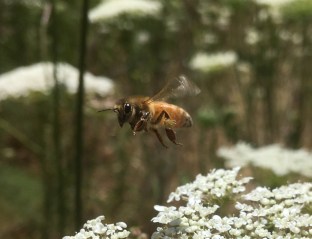
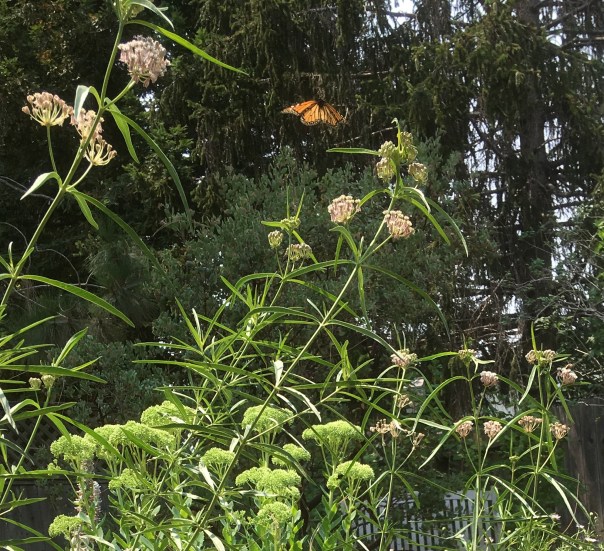
I do not have cicadas at present. I have quieter bees and flies, and nearly silent butterflies, and cries and songs from the bird kingdom as well, adorning my garden. A day or two after I took the picture at the top, I saw a Monarch butterfly near the narrowleaf milkweed. I watched out the window for a few minutes and then… yes! She had landed on the plant. So out I went with my camera, and crouched nearby.

She fluttered away, and circled the garden to come back and light again, but only for a few seconds, mostly hidden by leaves, and then off she flew, nearly grazing my head as she made the same circuit, repeating this behavior many times! My knees got a little tired, so I lay on the ground waiting with my camera at the ready. But that didn’t give me enough flexibility, and I moved to the plum tree nearby and leaned my back against it.

Was she laying eggs each time she landed on those narrow leaves? I gave up trying to get close enough, or to catch her at rest, and began to take shots as she was flying. And this is the best one I have to show, proof to myself that she was there. 🙂

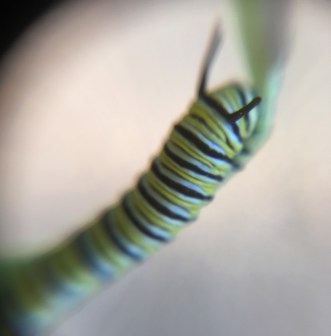
A couple of weeks later, back from the mountains, I found the minutest caterpillar on one of those narrowleaf milkweeds. Quickly I went indoors to attach my new clip-on macro lens to my phone, such as son-in-law Tom showed me how to use months ago but which I hadn’t taken out of its box. I hope my one-and-lonesome caterpillar does not get eaten by a bird, and survives to grow large enough to use my camera alone on, because this is the best I could do:

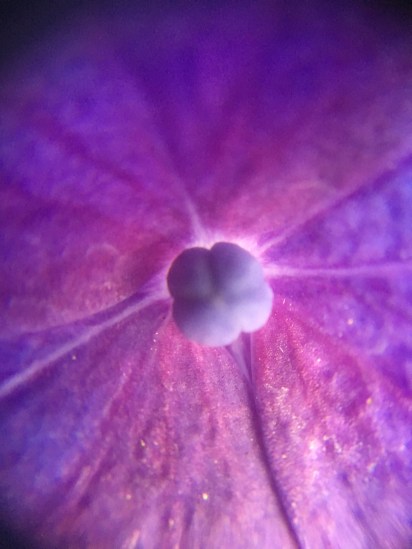
It seems this little lens is best for completely still shots, not flowers or creatures on long stems waving in the breeze. Here is a sharper image I captured using it:

Can you guess what it is?
Clue: It is a closeup of a flower I showed you in a recent post…
You’re right! It’s the center of a hydrangea bloom!

It’s another decoration of this palace into which we have been led by God….

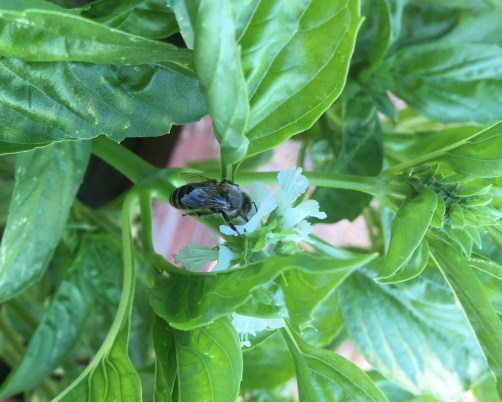
But bees have preferences, and I’ve never seen them interested in hydrangeas.
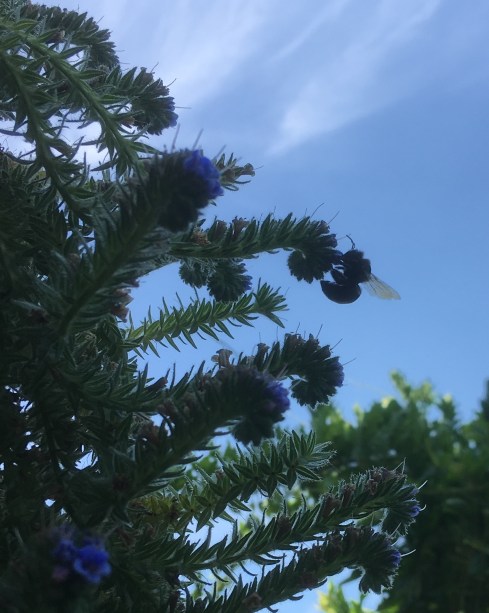
What they love is the echium! Remember when it looked like this?

Its flowers just kept opening on the ends of what I don’t think would be called a stem… so that those parts got longer and longer, with always new flowers that the bees never tired of.

Until the Autumn Joy opened. Now the echium is deserted.

It has been two days since I wrote all of the above, and I’m sorry to say that my infant caterpillar has disappeared. If I’m around next August maybe I will bring some Monarch eggs into the house to safeguard the latter stages of this project of assisting the butterfly population. This year I will have to be content with having seen progress beyond the planting of the milkweed, my only direct contribution. I saw the milkweed thrive in its second season, I saw the Monarch laying eggs, I saw a caterpillar… and then, I fed a bird!